

Journalist

Lester Munson
-
 SK hynix plans U.S. AI solutions unit to expand role in AI data centers SK hynix said Tuesday it is pushing ahead with plans to set up an AI solutions company in the United States, tentatively named “AI Company,” or AI Co. The company said it aims to move beyond being a memory chip maker and become a key partner in the AI data center ecosystem, building on its competitiveness in AI memory technologies such as high-bandwidth memory, or HBM. It said it will pursue strategic investments and partnerships with companies that have AI capabilities, strengthen its memory competitiveness and grow AI Co. into a business that can provide solutions across the AI data center sector. Global big tech companies have been competing aggressively to secure leadership in AI through investment and business restructuring, SK hynix said. With memory performance increasingly seen as a key factor in easing AI data bottlenecks, broader cooperation is needed to optimize AI systems, it added. SK hynix said it is considering using AI Co. to invest in AI innovators in the U.S. and expand collaboration, while linking capabilities gained there to synergies across SK Group. It also said the effort could help strengthen the competitiveness of South Korea’s AI and semiconductor industries, citing the value of a global network and experience in technology cooperation as global competition intensifies. AI Co. will be created by reorganizing Solidigm, which has positioned itself as a key player in AI data centers through high-capacity enterprise SSDs, the company said. Solidigm’s corporate name is SK hynix NAND Product Solutions Corp. Solidigm will establish a subsidiary and transfer its business, and its corporate and company names will be changed later, SK hynix said. The new subsidiary will use Solidigm Inc., AI Co.’s current company name, as its corporate name to maintain business continuity. SK hynix said it plans to contribute US$10 billion depending on AI Co.’s capital calls. “Establishing AI Co. is a step to secure various opportunities in the AI data center ecosystem ahead of the next AI era,” SK hynix said. “We will work closely with key AI partners in the United States and create value customers need ahead of time.”* This article has been translated by AI. 2026-01-28 18:12:00
 -
 South Korean equities log rare double win as decoupling fears grow SEOUL, January 28 (AJP) - South Korean equities are logging a rare double win, with both the main KOSPI and the tech-heavy KOSDAQ hitting historic highs, but the synchronized rally is increasingly stirring anxiety that markets are pulling away from economic reality. The benchmark KOSPI climbed to 5,170.81 on Wednesday, setting a fresh record, while the KOSDAQ advanced to 1,133.52. Both indices are up about 20 percent so far this year, extending last year’s outsized gains of 76 percent for the KOSPI and 36 percent for the KOSDAQ. The surge has lifted South Korea’s total equity market capitalization above that of Germany, underscoring the scale — and speed — of the rally. Leadership has been concentrated. Alongside heavyweight chipmakers Samsung Electronics and SK hynix, Hyundai Motor has joined the record-setting run, with its share price up more than 63 percent year to date. Optimism around semiconductor exports, autos and emerging technologies such as robotics has reinforced investor appetite. Yet beneath the headline strength, warning signs are accumulating. Markets diverge from the real economy For one, equity markets appear increasingly decoupled from underlying economic conditions. South Korea’s economy contracted 0.3 percent in the fourth quarter and 1 percent for the full year, according to the Bank of Korea — the weakest performance among major Asian economies. Even compared with Japan, which entered a low-growth era earlier, South Korea’s annual growth rate remained similar or lower, falling well short of the earlier consensus forecast of 1.8 percent. Leverage is adding to concerns. Margin debt reached approximately 29.35 trillion won ($20.6 billion) as of Jan. 26, according to the Korea Financial Investment Association, approaching the 30 trillion won mark — an all-time high for funds borrowed to purchase stocks. The pace of the increase has been particularly striking. Compared with about a year earlier, margin borrowing has surged by 12.51 trillion won, or 74.3 percent, amplifying fears that rising asset prices are being fueled by debt rather than earnings fundamentals. Household balance sheets remain stretched as well. Non-bank household debt increased by 37.6 trillion won over the course of 2025. Although it edged down by 1.5 trillion won in December, the ratio still stood at 89 percent of GDP at year-end — among the highest levels in major economies. Labor-market indicators offer little reassurance. Youth employment, a key barometer of long-term growth potential, remains mired in stagnation. The employment rate for those aged 15 to 29 stood at 44.3 percent in December, down 0.4 percentage points from a year earlier and marking the 20th consecutive month of decline, according to data released by the National Data Agency on Jan. 14. As the gap between asset prices and the real economy widens, volatility has risen sharply. The KOSPI Volatility Index (VKOSPI) closed Wednesday at 38.68, up 11.12 percent from the previous day and more than double its level a year earlier. Liquidity, not recovery This is not the first time South Korean equities have diverged from economic fundamentals. Similar patterns emerged in the aftermath of the global financial crisis, during the COVID-19 stimulus cycle and in the early stages of the dot-com boom — periods when abundant liquidity converged with compelling technology narratives. The current rally appears driven less by a broad-based recovery than by excess liquidity and concentrated inflows into specific sectors such as AI and semiconductors. According to a Bank of Korea report released Jan. 14, the M2 money supply grew 4.8 percent year on year as of November 2025. When beneficiary certificates — including ETFs, equity funds and bond funds — are included, effective liquidity growth reached 8 percent. Investor positioning reflects this trend. Investor deposits climbed to a record 97.54 trillion won as of Monday, highlighting the scale of capital circulating around the stock market. “The rally that began last year and continued into early this year reflects domestic liquidity conditions and expectations surrounding monetary accommodation by major economies such as Japan and the United States, rather than improvements in the real economy,” said Lee Kyung-min, a strategist at Daishin Securities. Lee added, however, that with forward earnings per share expected to trend upward, liquidity could eventually translate into corporate investment and growth. Others remain more cautious. J.P. Morgan, in its “2026 Market Outlook,” warned that downside risks remain elevated amid weak business sentiment and a cooling labor market, posing potential headwinds for global equities, including South Korea. Adding to concerns, the U.S. Consumer Confidence Index fell sharply to 84.5 in January, nearly 10 points lower than the previous month and well below market expectations. “We are not unaware that key real-economy indicators — including youth employment and construction activity — remain weak despite rising stock prices,” said a securities industry official, speaking on condition of anonymity. “But given the belief that a buoyant stock market can support corporate investment in R&D and facilities — and potentially lift the real economy — it is difficult to openly raise the prospect of a correction.” 2026-01-28 18:11:27
 -
 PPP leader Jang Dong Hyuk says expulsion case against Han Dong Hoon will follow procedure Jang Dong Hyuk, leader of South Korea’s People Power Party, said Tuesday that disciplinary proceedings seeking to expel Han Dong Hoon, the party’s former leader, would move forward “according to procedure,” signaling expulsion remains possible. Speaking to reporters after an on-site meeting on price trends at the Korea Agro-Fisheries & Food Trade Corp. (aT) center in Seoul’s Seocho district, Jang avoided a direct answer on Han’s case, saying, “What matters now is people’s lives and livelihoods.” Asked about Seoul Mayor Oh Se Hoon’s call for the two sides to meet “even today,” Jang said, “Enough time has been given under the procedure, and we will proceed according to procedure.” On the New Reform Party’s decision to put off cooperation on a special counsel probe, Jang said the opposition’s proposed special counsel “must be carried through,” adding that “carrying through the special counsel itself is the justification.” Explaining his early return to party duties, Jang cited South Korea-U.S. tariff talks, high prices and two special counsel issues, saying he could now move again and “couldn’t delay,” and that he believed returning “as soon as possible” was the right course. Regarding Rep. Kwon Seong Dong, who faces allegations of receiving money linked to the Unification Church and was sentenced Tuesday in a first trial to two years in prison, Jang said authorities had pursued all possible investigations into the opposition over Unification Church-related matters, but did not investigate when names of ruling-party figures were mentioned during the process. “That’s why we are demanding a special counsel,” he said. Jang added that he expects the courts to make fair decisions the public can accept and said he would watch the case through the final ruling.* This article has been translated by AI. 2026-01-28 18:09:23
 -
 Assets in ETFs Tracking FnGuide Indexes Top 40 Trillion Won Financial data firm FnGuide said Tuesday that total net assets in exchange-traded funds based on indexes it developed have surpassed 40 trillion won. The total topped 30 trillion won about three months ago. Over that period, net assets in the KODEX AI Semiconductor ETF rose about 310%, to 2.1 trillion won from roughly 500 billion won. TIGER Semiconductor TOP10 climbed about 190%, to about 4.1 trillion won from 1.4 trillion won. FnGuide said the gains reflect concentrated demand for related investments as shares of Samsung Electronics and SK hynix repeatedly hit record highs. FnGuide said it runs its index business on its in-house platform, FNAIDX, which automates the full process of index development and validation. The system uses data to cover everything from generating theme ideas to selecting components, running simulations and verifying performance. A FnGuide official said that in a favorable market environment, nine of the top 10 domestic equity theme indexes by net assets are based on FnGuide indexes. The official said the company plans to expand index development beyond equities to overseas markets, bonds and crypto assets, while upgrading its index design and validation framework to respond to longer-term market shifts.* This article has been translated by AI. 2026-01-28 18:09:16
 -
 Samsung Welstory 2025 Operating Profit Slips 2.5% to 153 Billion Won on Higher Costs Samsung Welstory posted higher revenue last year, but operating profit edged down as cost pressures increased. According to a filing on the electronic disclosure system on Tuesday, the company’s operating profit totaled 153 billion won, down 2.5% from a year earlier. Its operating margin slipped to 4.7% from 5.0%, a decline of 0.3 percentage points. The company cited higher labor costs and rising food ingredient prices as weighing on profitability. Revenue rose 4.7% to 3.264 trillion won over the same period, driven by more catering contracts that lifted meal volumes and by expansion of its food-ingredient business. In the fourth quarter, revenue and profit moved in opposite directions. Revenue fell 2% from a year earlier to 799 billion won as fewer business days reduced demand for catering and food ingredients. Operating profit, however, rose 9.4% to 35 billion won on cost efficiencies and a focus on profitability.* This article has been translated by AI. 2026-01-28 18:09:00
 -
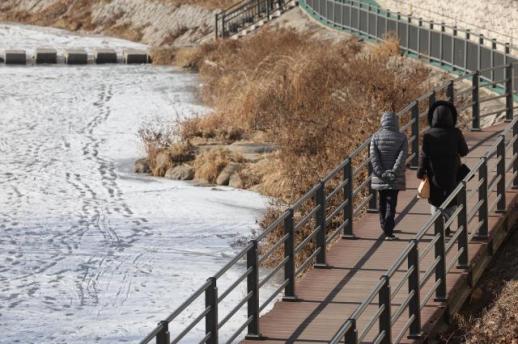 Cold Wave to Grip Central South Korea; Snow or Rain Expected on Jeju Cold weather will persist Thursday, with the harshest conditions centered on South Korea’s central regions. Morning lows are forecast at minus 15 to 3 degrees Celsius (5 to 37 degrees Fahrenheit), with daytime highs of minus 3 to 7 C (27 to 45 F). That is colder than seasonal averages of minus 12 to 0 C (10 to 32 F) in the morning and 1 to 8 C (34 to 46 F) in the afternoon. Cold wave warnings remain in effect for Gyeonggi Province, inland and mountainous Gangwon Province, inland Chungcheong, and inland and northeastern mountainous areas of North Gyeongsang Province. In those areas, morning temperatures are expected to hover around minus 10 C (14 F), with daytime temperatures staying below freezing. Winds will be somewhat stronger, making it feel even colder. Snow or rain is expected on Jeju Island from the afternoon into the night. Forecast snowfall is 1 to 5 centimeters (0.4 to 2 inches) in Jeju’s mountains and less than 1 centimeter (0.4 inch) in mid-mountain areas. Along the west coast of North and South Jeolla provinces, some areas may see flurries from early morning through the morning. Where snow is on the ground or newly falling, roads may be slippery, with icy patches and black ice widespread. Drivers are urged to use extra caution. Dry weather advisories are in place for Seoul; parts of inland Gyeonggi; central and southern inland Gangwon; Gangwon’s east coast and mountains; the eastern coast of South Jeolla; and the Gyeongsang region. With strong winds, officials urged heightened vigilance against fires. Fine dust levels are expected to be “good” nationwide due to clean northwesterly airflow and favorable atmospheric dispersion. Seas are forecast at 1.0 to 3.5 meters (3.3 to 11.5 feet) in the East Sea, 0.5 to 2.0 meters (1.6 to 6.6 feet) in the Yellow Sea, and 0.5 to 1.5 meters (1.6 to 4.9 feet) in the South Sea. In offshore waters about 200 kilometers (124 miles) from the coast, waves are expected at 1.0 to 3.5 meters (3.3 to 11.5 feet) in the East and Yellow seas and 1.0 to 2.5 meters (3.3 to 8.2 feet) in the South Sea.* This article has been translated by AI. 2026-01-28 18:06:24
 -
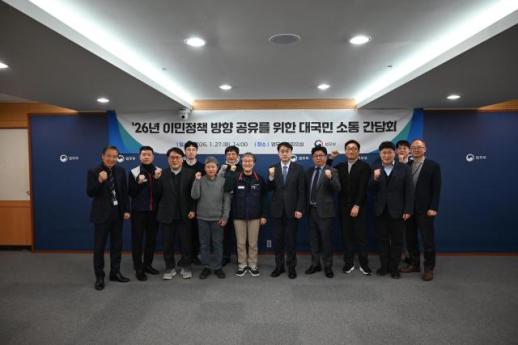 South Korea Justice Ministry Holds Public Meeting on 2026 Immigration Policy South Korea’s Justice Ministry said it held a public communication meeting on Jan. 27 to share key directions for its 2026 immigration policy, including managing illegal stays and protecting the rights of foreign nationals. The ministry said the meeting was organized amid calls to better reflect what most citizens want from immigration policy while ensuring the enforcement process does not neglect the human rights of foreign nationals. It shared its 2026 policy direction with civic groups including the Korean Confederation of Trade Unions, academics and immigration policy experts, and heard feedback from the field. The ministry said its efforts to reduce illegal stays cut the number of undocumented residents to 350,000 from 430,000 in 2023. It said it is using multiple approaches beyond on-site crackdowns, including support for voluntary departures and partial legalization. It also said enforcement needs strengthening, citing a recent death of a Vietnamese woman. The ministry said it will deploy additional safety personnel during inspections at workplaces considered high-risk for accidents and will bolster its response to crimes by foreign nationals that threaten public safety, including drug offenses and voice phishing scams. Participants said enforcement methods need to change, and the ministry outlined additional steps aimed at protecting foreign nationals’ rights. To strengthen protections, the ministry said it will more specifically define review agenda items handled by its Foreign Nationals Human Rights Protection and Rights Promotion Council and tighten guidance procedures through its Comprehensive Immigration Information Center. Academic participants also conveyed views from education and industry on expanding employment opportunities and settlement measures for foreign nationals staying on student (D-2, D-4) or job-seeker (D-10) visas. The ministry said it will incorporate the opinions raised at the meeting and prepare detailed implementation procedures in February, including follow-up steps such as revising related operating guidelines. Cha Yong Ho, head of the ministry’s Immigration and Foreign Policy Headquarters, who chaired the meeting, said, “Because the issue of illegal stays is directly tied to public safety, we will respond strictly, but we will make procedural transparency and safety our top priorities so that no human-rights blind spots arise during enforcement.” He added, “We will continue to communicate with civil society and pursue a balanced immigration policy that the public can support.” * This article has been translated by AI. 2026-01-28 18:06:00
 -
 NAND Flash Supply Tightens as Chipmakers Prioritize HBM, Raising Costs for Businesses and Consumers As the semiconductor industry shifts investment toward high-bandwidth memory, or HBM, and other high-performance DRAM, a deepening shortage of NAND flash is expected to squeeze both corporate buyers and consumers. Industry officials said Samsung Electronics and SK hynix have recently concentrated equipment and staff on expanding HBM and converting to advanced DRAM processes, while keeping new NAND investment and line expansions to a minimum. As a result, global NAND supply growth is expected to remain in the low single digits this year, creating a gap that is not keeping pace with demand. Prices are already rising. TrendForce said enterprise NAND used in server SSDs rose an average 15% to 20% in the first quarter, with an additional 5% to 10% increase expected in the second quarter. NAND used in mainstream consumer SSDs rose about 10% on average in the first quarter, and some high-capacity products have seen increases of more than 15%. The increases are directly raising procurement costs for corporate customers. NAND-based storage and system-chip customers including Kioxia, Western Digital and MediaTek are struggling to secure contracted volumes, and some are increasing spot purchases, according to industry officials. Global cloud providers that buy large volumes of data center SSDs are responding by renegotiating annual pricing contracts or adjusting shipment schedules. In the server market, the shortage is affecting system configurations. Some enterprise SSD lead times have reportedly stretched from six to eight weeks to 10 to 12 weeks or more. Some small and midsize data center operators are also shifting specifications from high-capacity SSDs to mid- and lower-capacity products that are easier to obtain. The impact is also showing up in consumer markets. Major PC and laptop makers in South Korea and overseas have raised launch prices for new models by about 3% to 7% to reflect higher SSD costs. Smartphone makers are widening price gaps among storage options, passing costs on to buyers, with the biggest increases concentrated in models with 512GB or more. Changes are also emerging in retail channels. Major online shopping sites have sharply reduced discounts on 1TB and 2TB SSDs, and some brands have faced longer restocking waits for popular models due to uneven supply. Many in the industry expect NAND supply to normalize only after the second half of this year. Analysts also see signs of a longer-term shift. As memory makers steer investment toward higher-margin HBM and premium DRAM, NAND could become structurally less flexible on supply over the medium to long term, raising the possibility that price strength could persist beyond a short-term spike. An industry official said, "As long as investment remains centered on HBM, NAND expansion will be limited, and price pressure is likely to persist, especially for enterprise SSDs and high-capacity consumer products."* This article has been translated by AI. 2026-01-28 18:04:00
 -
 South Korea to Require English Disclosures for All KOSPI-Listed Companies Starting Next March Starting in May, the number of listed companies required to file disclosures in English will jump to 265 from 111. Disclosure items will expand and some deadlines will be shortened. To raise the KOSPI market’s international standing, South Korea will also move up the start of mandatory English disclosures for all KOSPI-listed companies to next March, more than a year earlier than planned. The Financial Services Commission said it approved revisions to the “Regulations on Issuance and Disclosure of Securities” and the Korea Exchange’s disclosure rules for the KOSPI, KOSDAQ and KONEX markets at a regular meeting on Tuesday. Under the revisions, companies subject to mandatory English disclosures will increase from 111 in the current first phase to 265 in the second phase. The first phase, introduced in 2024, applied to listed companies with assets of at least 10 trillion won and foreign ownership of at least 5%, or assets of at least 2 trillion won and foreign ownership of at least 30%. From May, the second phase will cover all KOSPI-listed companies with assets of at least 2 trillion won. The list of items that must be disclosed in English will also grow. In addition to shareholder meeting results, companies must file in English all 55 categories of major management matters related to business and investment activities, as well as fair disclosures and inquiry disclosures. For KOSPI-listed companies with assets of at least 10 trillion won, the deadline will be shortened from “within three business days after filing the Korean-language disclosure” to, in principle, same-day disclosure. The third phase, which makes English disclosures mandatory for all KOSPI-listed companies, will begin next March instead of May 2028. That would expand the coverage to 848 companies. The commission said the move reflects “the KOSPI market’s status as South Korea’s flagship market and strong interest from global investors.” Starting in March, companies will also be required to disclose shareholder vote tallies. Until now, they disclosed only whether each agenda item passed. Under the revisions, companies must disclose, on the day of the meeting, the voting results for each item, including the percentages for votes in favor, against and abstentions. In regular filings such as annual reports, they must provide not only percentages but also the number of shares. Executive compensation disclosures will also become more detailed starting in May, after criticism that current disclosures do not clearly show the link between company performance and pay and make it hard to understand how compensation is calculated. Companies will add total shareholder return and operating profit for the past three years to executive pay disclosures. They must also provide specific reasons and calculation standards for each component of compensation. Because stock-based compensation for executives has been disclosed separately from pay, it has been difficult to gauge total compensation. Going forward, companies must disclose restricted stock and other stock-based awards together with total executive compensation and detailed, individual compensation information. They must also include the cash-equivalent value of unrealized stock-based compensation.* This article has been translated by AI. 2026-01-28 18:03:34
 -
 Korean GM Workers Rally Against Mass Layoffs at Sejong Logistics Contractor "Direct and subcontract workers have united. Bring out the real boss now." Direct employees and subcontract workers at Korean GM rallied together over mass layoffs involving subcontract workers at the company’s Sejong logistics center. On Jan. 28, about 300 members of the Korean Confederation of Trade Unions and the Korean GM branch of the Korean Metal Workers’ Union held a joint rally outside the west gate of Korean GM’s Bupyeong plant, demanding that the company immediately reverse what they called unfair dismissals of Sejong logistics subcontract workers. Despite temperatures of minus 3 degrees Celsius, protesters chanted, "Bring out the real boss now." About 50 laid-off workers from Woojin Logistics, a Sejong logistics center contractor, wore closure notices on their backs to protest the dismissals. The union said Korean GM "preemptively fired subcontract workers with bargaining power" ahead of the March implementation of revisions to Articles 2 and 3 of the Trade Union Act, known as the Yellow Envelope Act. Woojin Logistics workers formed a union in June last year, citing low pay and forced overtime, the union said. Korean GM later terminated its contract with Woojin Logistics, and 120 workers were laid off effective Jan. 1 this year. Park Ok Ju, head of the KCTU’s North Chungcheong regional headquarters, said Korean GM promised to resolve the issue through talks while saying it would ensure employment succession, but then carried out layoffs. She also criticized what she described as shifting blame to striking workers after consumer complaints emerged over parts supply disruptions. The Sejong logistics union expressed regret that months of protests have disrupted parts supplies. About 1.5 million Chevrolet vehicles are registered in South Korea, raising concerns that a prolonged dispute could increase inconvenience for drivers. Sun Ji Hyun, co-chair of a joint committee supporting the GM parts logistics union, said workers understood the impact on consumers and felt sorry, but argued that ignoring what she called injustice because of inconvenience would make it impossible to correct wrongdoing by GM’s capital. Direct employees said they would also support efforts to resolve the dispute. The union claimed the Sejong layoffs, along with Korean GM’s plan to close nine company-run service centers in South Korea, signals restructuring. It said it has filed for an injunction with the Incheon District Court to block the closures. Ahn Gyu Baek, head of the Korean GM union branch, said a special labor-management meeting was held the previous day to seek withdrawal of the service-center closure plan. He warned that if both the service-center issue and the Sejong parts logistics dispute are not resolved, labor-management relations this year will head toward a breakdown. The union said it delivered a request for negotiations to Korean GM headquarters, urging the parent company to take responsibility for resolving the dispute. It also said it plans to hold a performance on Jan. 29 at the Chevrolet Daejeon Center with vehicle owners to oppose the service-center closures. Kim Gi Yeon, secretary-general of the KCTU’s North Chungcheong regional headquarters, said Korean GM is taking steps in advance to undermine the intent of the Yellow Envelope Act revisions. He said the moves appear to reflect the possibility of downsizing or withdrawal from South Korea ahead of the completion of a 2028 agreement between global GM and the Korea Development Bank.* This article has been translated by AI. 2026-01-28 18:03:00