

Journalist

Lester Munson
-
 UPDATE: Korea's April factory output and spending retreat on Gulf energy shocks *updated with additional information and market response SEOUL, May 29 (AJP) — The energy shocks from a months-long disruption of the Strait of Hormuz arising from Middle East conflicts have landed on South Korean shores, battering industrial activity, corporate investment, and consumer spending in April, official data showed Friday. Factory output fell 0.7 percent month-on-month, marking the first contraction since January, as the crucial refining sector was hit hard by the suspension of crude shipments from the Gulf, according to the Ministry of Data and Statistics. By sector, petroleum refining production collapsed by 19.4 percent, registering its sharpest drop in approximately 38 years since May 1988, when output plummeted following a massive nationwide industrial and petrochemical restructuring during the wake of Asian financial crisis. The historic contraction underscored the severe transmission of the Hormuz shock into domestic refiners. The factory floor displayed widespread friction as automaker output plunged 10.0 percent on components bottlenecks, though a 3.1 percent uptick in semiconductors capped steeper industrial losses. Mirroring the manufacturing slowdown, the manufacturing average capacity utilization rate dropped 1.2 percentage points from March to stand at 73.7 percent. Concurrently, manufacturers faced inventory overhangs, with the index rising 1.7 percent month-on-month, lifting the ratio of inventory to shipments by 5.1 percentage points to 98.2 percent. Amid the manufacturing retreat, industry-wide output stood at 117.8 in April, shedding 0.6 percent from the previous month to mark its first decline in three months. While public administration expansion offered a minor cushion, synchronized declines across services and construction dragged down the broader economy. Service sector output decreased 1.0 percent from the previous month, as spikes in domestic borrowing costs forced a 7.7 percent drop in financial and insurance services, alongside a 1.5 percent drop in wholesale and retail trade. The real-economy squeeze was equally visible in consumer markets, where retail sales tumbled 3.6 percent month-on-month—the sharpest pull-back since the beginning of the year. High price stickiness weighed down demand, leading to an 11.1 percent collapse in consumer durables like telecommunications equipment and computers, while non-durables including vehicle fuels shed 1.1 percent as motorists rationed expensive gasoline and diesel. Corporate investment lines turned equally defensive, with equipment investment retreating 3.6 percent from March, driven by an 11.5 percent drop in transport equipment such as aircraft imports. Domestic machinery orders received, a key forward-looking indicator for capital outlays, shrank 7.6 percent year-on-year. Concurrently, construction completed at constant prices dropped 1.4 percent month-on-month, registering a 5.5 percent contraction compared to the same period last year. Despite the broad-based retreat across current output and consumption, business cycle indicators continued to signal divergence due to historical lags. The cyclical component of the coincident index crawled up 0.2 points from March to 100.2, supported by previous export volumes. Meanwhile, the cyclical component of the leading index, a gauge for future economic health, advanced 0.6 points to 104.1, driven primarily by gains in the stock market and export-import price ratios before the full weight of the supply-chain shock consolidated. Despite the widespread retreat in April's macroeconomy, the benchmark KOSPI opened up 2.43 percent from the previous session at 8,384.31, catalyzed by breaking news that a peace agreement between the United States and Iran is imminent. Tech heavyweights Samsung Electronics and SK hynix continue to rewrite their historical highs, surging past 310,000 won ($207.3) and 2.3 million won, respectively. The morning rally was heavily fueled by the combination of South Korea’s robust 1.7 percent gross domestic product (GDP) growth in the first quarter—propelled by soaring semiconductor prices and resilient global demand—and Thursday's reports that a final peace accord between Washington and Tehran now awaits only the formal signature of U.S. President Donald Trump. 2026-05-29 12:44:14
 -
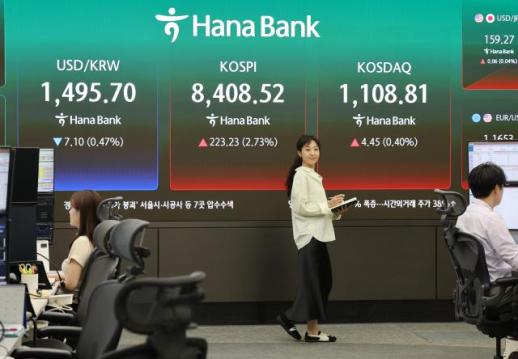 KOSPI Touches 8,424 Before Pulling Back, Fluctuates Around 8,300 The KOSPI index touched 8,424 during trading but later reduced its gains, fluctuating around the 8,300 mark. According to the Korea Exchange, as of 11:58 a.m. on May 29, the KOSPI was up 185.32 points (2.26%) at 8,370.61. The index opened at 8,384.31, rising by 199.02 points (2.43%) from the previous session, reaching a high of 8,424.53 before pulling back to the 8,300 level. In terms of trading activity, individuals and foreign investors sold a net 667.5 billion won and 1.4883 trillion won, respectively, while institutions bought a net 2.111 trillion won, helping to support the index. The top stocks in the securities market showed mixed performance. Samsung Electronics rose by 3.51%, SK Hynix by 0.48%, Samsung Electro-Mechanics by 15.09%, Hyundai Motor by 4.73%, LG Energy Solution by 5.03%, Samsung Life by 3.92%, and Samsung C&T by 5.63%. Conversely, SK Square fell by 1.13% and HD Hyundai Heavy Industries by 1.28%. Meanwhile, the KOSDAQ index was down 30.22 points (-2.74%) at 1,074.14 at the same time. The index opened at 1,112.15, up 7.79 points (0.71%) from the previous session, but reversed course due to selling pressure from foreign and institutional investors. In the KOSDAQ market, individuals bought a net 192.8 billion won, while foreign and institutional investors sold a net 96.2 billion won and 110.3 billion won, respectively, contributing to the index's decline. The top stocks in the KOSDAQ exhibited varied trends. EcoPro BM fell by 0.69%, Alteogen by 0.68%, EcoPro by 2.21%, Kolon TissueGene by 7.05%, Samchundang Pharm by 0.15%, Rino Technology by 2.42%, and Peptron by 4.84%. In contrast, Rainbow Robotics rose by 1.14%, Juseong Engineering by 0.48%, and HLB by 0.20%.* This article has been translated by AI. 2026-05-29 12:16:00
 -
 Public Institutions Tighten Hiring Standards for Non-Regular Workers Public institutions are making it more difficult to hire non-regular workers. The government is expanding the pre-screening process for hiring non-regular workers to include subsidiaries and affiliated organizations, as well as assessing the necessity of fixed-term hiring and the allocation of budgets for improving working conditions. This move aims to curb the abuse of non-regular employment in the public sector and reinforce the principles of regular hiring. On May 29, the Ministry of Employment and Labor announced that it, along with related ministries, will implement revised guidelines for improving the treatment of non-regular workers in the public sector and the operation of the pre-screening system for hiring non-regular workers. These revisions follow measures announced in April during a Cabinet meeting aimed at improving unfair employment practices for non-regular workers and enhancing compensation for labor value and job insecurity. The government has also established detailed criteria for the fair wage and appropriate pay system set to take effect in 2027. Fair wages will be provided to fixed-term workers with less than one year of service based on their duration of employment, and wages for fixed-term workers earning below 118% of the minimum wage will be raised to that level. In cases where hiring non-regular workers is unavoidable, a minimum one-year employment contract will be guaranteed, and fair wages and weekly holiday pay will be provided proportionally to part-time workers. The most significant change is the expansion of the pre-screening system for hiring. Introduced in 2018, this system has primarily operated within central government, local governments, and public institutions, but it will now also apply to local government-affiliated organizations and subsidiaries of public institutions. The Ministry of Labor explained that the system has been revised to function as a practical measure to prevent the abuse of non-regular workers, addressing concerns that it was being operated merely as a formality in some institutions. Going forward, the pre-screening process will assess not only the necessity of hiring non-regular workers but also the unavoidable nature of contracts lasting less than one year, the need for part-time work, and the allocation of budgets for improving working conditions. This is seen as a step to reduce the short-term contracts and part-time hiring that have been customary in the public sector and to strengthen the principle of converting such positions into regular employment for ongoing and continuous work. The government will also enhance the management of non-regular workers. Each institution will be required to annually manage the status and wage levels of non-regular workers, and if the number of non-regular workers increases by more than 10% compared to the previous year, the reasons for the increase must be documented separately. Supervisory agencies will conduct inspections of subordinate organizations at least once a year. In particular, the government plans to investigate the operation of the pre-screening system annually and assess the appropriateness of the review results and the composition of review committees. There are also plans to evaluate the implementation and effectiveness of the pre-screening system for use in institutional assessments. Kim Young-hoon, Minister of Employment and Labor, stated, "We have established a system to create a workplace where the labor value of non-regular workers is respected, starting with the public sector as a model employer. We will actively guide and inspect to ensure that this is felt on the ground in collaboration with related ministries."* This article has been translated by AI. 2026-05-29 12:02:00
 -
 South Korea Launches AI-Based Cyber Threat Response System The South Korean government is establishing a nationwide cybersecurity framework to address the increasing cyber threats associated with the rise of generative artificial intelligence (AI). With the potential for high-performance AI to automate vulnerability discovery and attacks, the government aims to create an AI-based security system in collaboration with the private sector. On May 29, the Ministry of Science and ICT (MSIT) announced the 'Private Sector Cybersecurity Promotion Plan to Counter AI-Based Cyber Threats' during the 9th Science and Technology Ministers' Meeting. Concerns have grown regarding security organizations as vulnerability discovery becomes routine with high-performance AI. In response, the MSIT plans to establish a governance and cooperation framework to publicly address AI vulnerabilities. The government will facilitate rapid sharing and dissemination of information regarding AI vulnerabilities and threats, led by the National Security Office at the Blue House. An emergency response system will be established to enable joint responses to incidents, with a central situation room within the MSIT and separate situation rooms in relevant ministries for the private sector. The government plans to set up a Vulnerability Management Center within the Korea Internet & Security Agency (KISA) to centralize vulnerability and patch management. This center will collect and analyze vulnerability and patch information from both domestic and international sources through the National Vulnerability Database (KNVD) and share it promptly with Chief Information Security Officers (CISOs), private cooperation channels (C-TAS, ISAC), and relevant ministries. Additionally, the MSIT intends to pilot the use of high-performance AI models, acquired through international cooperation, for vulnerability analysis and patch generation and validation. On May 26, the MSIT held a meeting with OpenAI to discuss responses to AI security threats and measures to ensure AI safety and trust. The government has decided to participate in OpenAI's Government and Agency Trust-Based Access Program (GTAC). Based on this, the government will gradually implement an AI-based automation system for collecting open-source vulnerabilities, automatic analysis and classification, and patch generation and validation. In the corporate support sector, the government is considering analyzing source code that does not include personal data, with the consent of the companies, to identify vulnerabilities and provide AI-based remediation measures. For major companies, the government will promote enhanced security preparedness through asset management, vulnerability assessments, and patch responses. Approximately 1,200 companies and institutions, including those in critical information infrastructure, ISMS-mandated companies, and large enterprises in finance, healthcare, energy, as well as major hospitals and private universities, will undergo sector-specific compliance checks. Support for small and medium-sized enterprises (SMEs) will also be strengthened. The government plans to distribute a web-based tool that allows SMEs to assess their IT assets and security levels, along with providing security investment guidelines and remediation measures. To address open-source vulnerabilities that could be exploited by AI, the government will promote support for Software Bill of Materials (SBOM) generation and analysis technologies. Additionally, it will offer attack surface assessments, expert consultations, and support for vulnerability assessment infrastructure based on high-performance AI models. The government will also enhance its AI-based cyber threat response system. It plans to continuously monitor approximately 350 million global domains and establish a system to detect and block malicious activities and suspicious domains from the initial stages. In the event of an incident related to AI services, the 'Incident Investigation Advisory Committee' will be activated immediately to conduct swift investigations and prevent the spread of damage. The government is also pursuing expanded international cooperation. Starting with OpenAI's GTAC, it aims to enhance participation in AI security projects from global tech giants and foster information-sharing collaborations. Efforts will also be made to establish AI-based threat response and information-sharing systems with cybersecurity agencies in allied countries. Furthermore, the government will prepare and distribute guidelines for responding to vulnerabilities from discovery to patching for manufacturers, companies, institutions, and the general public, while promoting activities to increase security investments. Plans are also underway to hold relay meetings with CEOs from key industries. Starting in 2027, the government aims to transition the domestic cybersecurity framework to be based on independent AI technology and to actively pursue projects to secure AI security sovereignty. Deputy Prime Minister and Minister of Science and ICT Lee Baek-hoon emphasized, "As the pace of AI development in the field of cybersecurity is rapid, it is essential for our country to establish a security system and global cooperation suitable for the AI era. Through this plan, we will establish an emergency response system to address the large-scale public disclosure of AI vulnerabilities and accelerate the establishment of AI security sovereignty based on our technology and models."* This article has been translated by AI. 2026-05-29 12:02:00
 -
 April Mortgage Rates Drop 0.03% for First Decline in Seven Months Mortgage rates for housing loans fell last month for the first time in seven months. The share of fixed-rate loans dropped below half, reaching its lowest level in four years and nine months. According to the Bank of Korea's "Weighted Average Interest Rate" statistics released on May 29, the weighted average mortgage rate for new loans at deposit banks was 4.31% in April, a decrease of 0.03 percentage points from the previous month. This marks the first decline since October of last year. While fixed-rate mortgage rates increased due to the rise in the government-backed housing loan rates, the overall drop in mortgage rates was influenced by a higher proportion of lower-rate variable loans. The overall household loan rate also fell from 4.51% in March to 4.43% in April, a decrease of 0.08 percentage points. This decline was driven by a 0.11 percentage point drop in mortgage and guarantee loan rates, along with a reduction in the share of higher-rate general credit loans. Among mortgages, the share of fixed-rate loans decreased by 13.0 percentage points to 47.8% in just one month. This marks the lowest level since July 2021 (43.9%) and follows six consecutive months of decline since November 2025 (90.2%). The fixed-rate mortgage rate was 4.34%, higher than the variable rate of 4.28%, which likely contributed to this trend. The share of fixed-rate loans among all household loans also fell from 35.5% to 27.8%, the lowest level since July 2022 (21.4%). Lee Hye-young, head of the Bank of Korea's Financial Statistics Team, explained, "The reduction in the fixed-rate share is due to the fact that the fixed-rate level is significantly higher than variable rates, particularly as the government-backed housing loan rates have increased. Borrowers are opting for lower rates." The government-backed housing loan rates were frozen between 3.65% and 3.95% from February to December last year, but have seen three increases this year: 0.25 percentage points in January, 0.15 percentage points in February, and 0.30 percentage points in April, influenced by the ongoing rise in mortgage-backed securities (MBS) issuance rates. In April, corporate loan rates remained unchanged at 4.14%. While rates for large enterprises decreased by 0.02 percentage points, the rates for small and medium-sized enterprises increased by 0.01 percentage points due to some banks engaging in high-interest financing. Overall bank loan rates, which include both household and corporate loans, remained stable at 4.20%, as the decline in household loans was offset by stable corporate loan rates. The monthly savings deposit rate (based on new transactions) rose from 2.82% to 2.92%. The rates for pure savings deposits, such as time deposits (2.87%), and market-based financial products like financial bonds and certificates of deposit (CDs) increased by 0.08 and 0.09 percentage points, respectively. The interest rate spread between loans and deposits, calculated based on new transactions, decreased by 0.10 percentage points to 1.28%, marking three consecutive months of decline. However, the balance-based interest rate spread increased by 0.01 percentage points to 2.28%. As benchmark rates have risen this month, it is expected that loan rates will also increase. However, the Bank of Korea noted that loan rates vary by product, making it difficult to predict exact changes. Lee stated, "This month, both short-term and long-term rates have risen, with long-term rates increasing significantly. Different products are influenced by varying benchmark rates, and the proportion of products offered by banks also affects this, so predictions are challenging."* This article has been translated by AI. 2026-05-29 12:02:00
 -
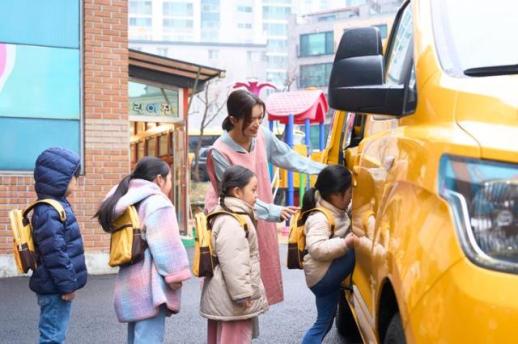 Workplace Childcare Facility Compliance Rate Reaches 94.9% As of 2025, the compliance rate for the mandatory establishment of workplace childcare facilities for businesses with 500 or more employees or 300 or more female employees has reached 94.9%, an increase from the previous year. The government has also released a list of 10 businesses that failed to meet this requirement.On May 29, the Ministry of Employment and Labor and the Ministry of Education announced the results of a survey on compliance with the workplace childcare facility mandate. Out of 1,674 eligible businesses, 1,588 have complied by either establishing workplace childcare facilities or utilizing entrusted childcare services.The requirement applies to businesses with 300 or more female employees or 500 or more total employees. Employers can fulfill this obligation by either setting up their own childcare facilities or contracting with external childcare providers to support employee childcare needs.This year's compliance rate of 94.9% reflects a 1.0 percentage point increase from last year. Among the 1,674 eligible businesses, 1,103 have directly established and operated workplace childcare facilities, while 485 have complied through entrusted childcare services, where employers contract with external providers to subsidize childcare costs for employees.The disclosed list includes hospitals, manufacturers, and retail companies. Notably, Das, a company based in Gyeongju, has been named for the 11th time, having the highest number of children eligible for childcare at 191 among the listed businesses.The B.H. 2nd Plant in Seo-gu, Incheon, has been publicly listed twice, along with SSG.com and MTS Corporation in Icheon, Gyeonggi Province, which cited 'insufficient childcare demand' as the reason for non-compliance.Medical institutions such as Daejeon Korean Hospital, ID Hospital, Jinju Korea Hospital, and Hanaro Leaders Clinic of the Seoul Institute of Science and Technology are also included in the disclosure.The Ministry of Employment and Labor and the Ministry of Education conduct annual checks on compliance with the workplace childcare facility mandate. To enhance the effectiveness of the system, they operate a public disclosure system for businesses that fail to comply.The published list includes the names of the businesses, the owners, the number of employees, the cumulative number of disclosures, and reasons for non-compliance. The government aims to encourage voluntary compliance among businesses through this disclosure.Kwon Chang-jun, Deputy Minister of Labor, stated, "Workplace childcare facilities are a crucial foundation for balancing work and family life, supporting both parents' careers and sustainable corporate growth. We will strengthen on-site support through briefings and consulting to promote the expansion of workplace childcare in more businesses."* This article has been translated by AI. 2026-05-29 12:02:00
 -
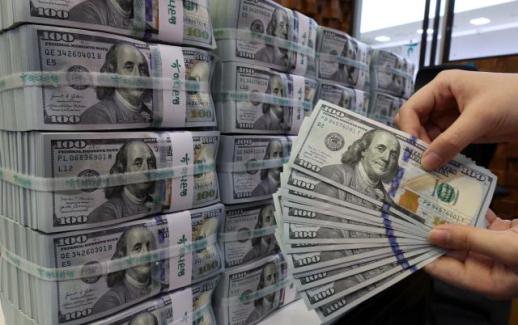 April Foreign Currency Deposits Increase by $8.5 Billion as Investors Expand Deposits Last month, foreign currency deposits held by domestic residents increased by over $8.5 billion, rebounding after a record decline the previous month. According to the Bank of Korea's report on 'Trends in Resident Foreign Currency Deposits' released on May 29, the balance of foreign currency deposits held by residents at foreign exchange banks was recorded at $110.68 billion as of the end of April. Resident foreign currency deposits refer to deposits made by Korean nationals, domestic companies, foreign nationals residing in Korea for more than six months, and foreign companies operating in Korea. Both corporate and individual deposits saw increases. The balances for corporate and individual deposits were reported at $94.88 billion and $15.8 billion, respectively, with corporate deposits rising by $8.08 billion and individual deposits increasing by $430 million. By currency type, the balance of dollar deposits rose by $7.68 billion from the end of March to reach $93.32 billion. Yen deposits increased by $400 million to $8.22 billion, while euro deposits rose by $260 million to $6.57 billion. The Bank of Korea attributed the increase to a rise in investor deposits at securities firms, inflows of funds for overseas investments by pension funds, and large corporations receiving current account payments. It noted that yen deposits increased due to higher investor deposits at securities firms, while euro deposits saw a slight rise due to some companies issuing bonds. Domestic investors turned to net selling of U.S. stocks last month, selling $468.93 million worth of shares. This is interpreted as the proceeds from dollar sales not being exchanged but instead deposited. The average monthly exchange rate based on weekly closing prices remained high, increasing from 1,448.38 won in February to 1,492.50 won in March and 1,485.03 won in April.* This article has been translated by AI. 2026-05-29 12:02:00
 -
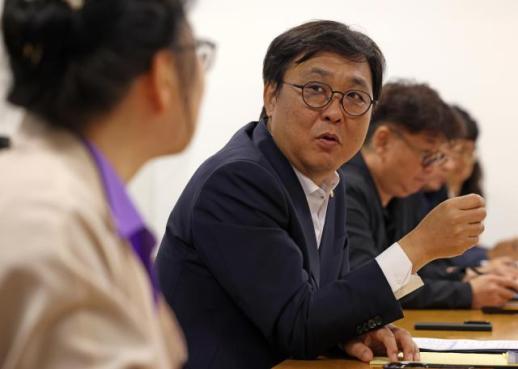 South Korea's Culture Minister Vows to Crack Down on Illegal Webtoon Site 'Newtoki' "'Newtoki' has struck again. However, we will not be caught off guard. We will pursue and block it in any form," said Choi Hwi-young, South Korea's Minister of Culture, Sports and Tourism, on May 28. He pledged to relentlessly track down the country's largest illegal webtoon and web novel distribution site, 'Newtoki', and warned that legal action would be taken against content delivery network (CDN) providers that support such illegal operations. During the 3rd meeting of the Cultural Arts Policy Advisory Committee's Webtoon Subcommittee held at the National Museum of Modern and Contemporary Art in Jongno, Seoul, Minister Choi assured the webtoon industry that the government would "catch 'Newtoki' to the end." The government has implemented an emergency blocking system for copyright infringement sites since May 11, but 'Newtoki' has been evading authorities by frequently changing its domain, leading to a cat-and-mouse chase. Industry representatives at the meeting unanimously agreed that 'Newtoki' must be eradicated as it plays a central role in illegal distribution. Kim Byeong-soo, president of the Regional Comic Webtoon Association, stated, "Other illegal sites take webtoons from 'Newtoki' and use them. If 'Newtoki' is caught, small illegal distributors will be unable to upload content." The operator of 'Newtoki' is reportedly a South Korean who naturalized in Japan in 2022. While the industry is calling for the operator's extradition to South Korea, there has been no visible progress to date. Minister Choi emphasized, "We will move faster than the rabbit," referring to 'Newtoki'. He stated, "The government, which has the power of public authority, must not turn a blind eye to criminal acts." The Ministry of Culture has secured emergency blocking authority for illegal content distribution sites through amendments to copyright law. As a result of the government's swift action, the amendments were passed in four months, and the system has been in effect since May 11. Minister Choi particularly stressed the need for a strong response against CDN providers. CDNs operate by replicating content from overseas servers to domestic servers, which allows illegal sites to circumvent access blocks imposed by internet service providers (ISPs). He noted, "I heard that the copyright holder of the Japanese manga 'One Piece' won a lawsuit against a CDN provider," emphasizing that all businesses must make every effort to protect copyright, or they risk exposure to lawsuits. Four major Japanese publishers, including Shueisha, which publishes 'One Piece', successfully sued the U.S. CDN provider Cloudflare for approximately 500 million yen (about $4.7 million) in damages for providing services to pirate manga sites. Concerns were also raised about illegal webtoon sites luring teenagers to illegal gambling sites. Comic artist Won Soo-yeon pointed out, "Teenagers enter illegal sites to read free comics and end up on a path that ruins their lives. Serious issues arise, such as gambling and gaming with their parents' credit cards." Minister Choi stated, "Illegal webtoon sites are generating revenue through illegal gambling advertisements," and warned that if related businesses, including CDN providers, do not take necessary actions and allow these sites to operate, they will face pressure to take responsibility.* This article has been translated by AI. 2026-05-29 11:58:00
 -
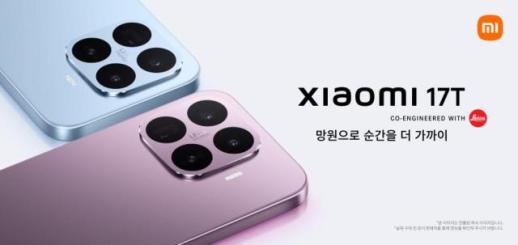 Xiaomi Launches 17T Smartphone with Leica Camera Features Xiaomi has introduced its new smartphone, the 17T, featuring a Leica camera and artificial intelligence (AI) photography capabilities, priced around 700,000 won (approximately $530). This launch is expected to intensify competition in the mid-range AI smartphone market, which has been dominated by premium devices in South Korea. On May 29, Xiaomi Korea officially launched the flagship smartphone Xiaomi 17T and began pre-orders. Official sales will start on June 5 through Xiaomi Korea's official online and offline stores, as well as major retail channels like Coupang and Naver Brand Store. The key feature of the new device is its camera system, developed in collaboration with Leica. The Xiaomi 17T is the first in the T series to include a Leica 5x telephoto camera, supporting up to 10x optical zoom and 120x AI ultra zoom, based on a 50-megapixel telephoto camera with optical image stabilization. It is designed to capture clear images even in environments where subjects are far away, such as concert halls or sports stadiums. The device also includes features like 'Leica Live Moment' to record moments before and after a shot, and 'Leica Live Portrait' for enhanced portrait photography. "The Xiaomi 17T inherits the Leica optical tuning and OIS technology from the Xiaomi 17 Ultra while providing a flagship smartphone experience at a price point of around 700,000 won," said Summer Fung, CEO of Xiaomi Korea. "It will offer a new option for domestic users who value both content consumption and photography experiences." The performance and battery life have also been optimized to push the limits of mid-range smartphones. The Xiaomi 17T is equipped with the MediaTek Dimensity 8500 Ultra chipset, a 6,500mAh silicon-carbon battery, and supports 67W fast charging, catering to long-duration photography and content consumption needs. The display features a 6.59-inch 1.5K AMOLED panel with a maximum refresh rate of 120Hz and brightness of up to 3,500 nits. It also includes Xiaomi Vision Care technology, which has received TÜV Rheinland's quadruple eye protection certification, making it the first of its kind. The pricing for the 12GB RAM and 256GB storage model is set at 799,800 won, while the 12GB RAM and 512GB model is priced at 879,800 won. Customers who pre-order will receive Redmi Headphones Neo and a 67W GaN dual-port charger, along with three months of YouTube Premium, four months of Spotify Premium, and three months of Google AI Pro benefits. In addition to the smartphone, Xiaomi also unveiled three new AIoT products: the Redmi Headphones Neo with up to 42dB adaptive active noise cancellation, the entry-level Xiaomi Smart Camera C201, and the Xiaomi Rainbow Battery. Industry analysts believe that Xiaomi is targeting the domestic mid-range smartphone demand by emphasizing camera, battery, and AI features. While the South Korean market is dominated by Samsung and Apple, there is a growing demand for high-performance smartphones at reasonable prices due to high inflation and extended replacement cycles. If the Xiaomi 17T achieves strong sales, it could further intensify competition in the mid-range smartphone market.* This article has been translated by AI. 2026-05-29 11:38:00
 -
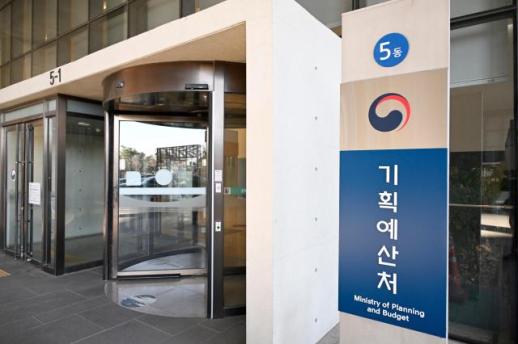 Government Revenue from Public Charges Decreased by 3.3% Last Year Last year, a decrease in tobacco export volume led to a reduction in the National Health Promotion Charge, while a rate cut also lowered the burden from the Power Industry Fund. As a result, the total public charges collected by the government fell by 3.3% compared to the previous year. On May 29, Vice Minister Lim Gi-geun chaired the third meeting of the Public Charge Management Committee, where the "2025 Comprehensive Report on Public Charge Management" was finalized. This report will be submitted to the National Assembly by the end of this month. Public charges are imposed in addition to taxes based on the principle of beneficiary and cause for the execution of specific public interest projects. Notable examples include the National Health Promotion Charge levied on tobacco consumers, the development charge that recovers a portion of profits from land development projects, and the traffic impact charge imposed on owners of large facilities in urban traffic management areas. Currently, 82 public charges are managed by 19 ministries, including the Ministry of Climate, Energy and Environment (21 charges), the Ministry of Land, Infrastructure and Transport (15 charges), and the Financial Services Commission (8 charges). The Comprehensive Report on Public Charge Management provides overall information related to public charges and serves as a financial statement for the national budget. The total amount collected from public charges last year was 23.4 trillion won, a decrease of 800 billion won (3.3%) from the previous year’s 24.2 trillion won. This marks the first decline in five years since 2020. By ministry, the Ministry of Climate collected the most at 6.47 trillion won, followed by the Financial Services Commission at 5.77 trillion won and the Ministry of Health and Welfare at 2.88 trillion won. The significant drop in the National Health Promotion Charge, which decreased by 279.5 billion won due to reduced tobacco export volume, contributed greatly to this decline. Additionally, the rate for the Agricultural Land Preservation Charge was adjusted from 30% to 20%, and the rate for the Power Industry Fund was reduced from 3.7% to 2.7%, resulting in decreases of 112.4 billion won and 311.2 billion won, respectively. In total, 44 public charges saw a reduction in collection, amounting to 1.4 trillion won. Conversely, efforts to secure funding for financial support for low-income households led to an increase of 136.8 billion won in contributions to the Korea Financial Services Agency, while contributions to regional credit guarantee foundations and the Central Credit Guarantee Foundation rose by 95.5 billion won. Additionally, the collection from 37 public charges, including the School Site Charge (340 billion won), increased by 600 billion won. The majority of the collected funds, totaling 19.8 trillion won (84.4%), were allocated to central government funds and special accounts. In terms of expenditure, 7.1 trillion won (30.1%) was directed towards financial support for small businesses and low-income households, the largest share. The industrial and energy sectors received 5.1 trillion won (21.8%), while the health and medical sectors, including National Health Promotion, accounted for 2.9 trillion won (12.3%), primarily utilized for public interest projects. Vice Minister Lim Gi-geun stated, "The public charge system, as a pillar of national finance, will be carefully managed to contribute to mitigating social externalities and applied transparently and equitably to the public and businesses. We will ensure that the funds are efficiently returned to essential public interest projects, such as supporting low-income finance and building industrial foundations."* This article has been translated by AI. 2026-05-29 11:38:00