*updated with additional information and market response
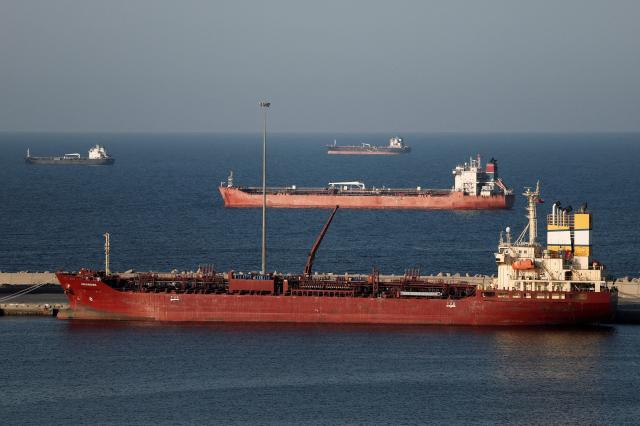
SEOUL, May 29 (AJP) — The energy shocks from a months-long disruption of the Strait of Hormuz arising from Middle East conflicts have landed on South Korean shores, battering industrial activity, corporate investment, and consumer spending in April, official data showed Friday.
Factory output fell 0.7 percent month-on-month, marking the first contraction since January, as the crucial refining sector was hit hard by the suspension of crude shipments from the Gulf, according to the Ministry of Data and Statistics.
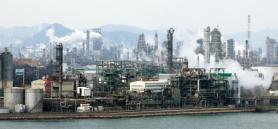
By sector, petroleum refining production collapsed by 19.4 percent, registering its sharpest drop in approximately 38 years since May 1988, when output plummeted following a massive nationwide industrial and petrochemical restructuring during the wake of Asian financial crisis. The historic contraction underscored the severe transmission of the Hormuz shock into domestic refiners.
The factory floor displayed widespread friction as automaker output plunged 10.0 percent on components bottlenecks, though a 3.1 percent uptick in semiconductors capped steeper industrial losses. Mirroring the manufacturing slowdown, the manufacturing average capacity utilization rate dropped 1.2 percentage points from March to stand at 73.7 percent.
Concurrently, manufacturers faced inventory overhangs, with the index rising 1.7 percent month-on-month, lifting the ratio of inventory to shipments by 5.1 percentage points to 98.2 percent.
Amid the manufacturing retreat, industry-wide output stood at 117.8 in April, shedding 0.6 percent from the previous month to mark its first decline in three months. While public administration expansion offered a minor cushion, synchronized declines across services and construction dragged down the broader economy.
Service sector output decreased 1.0 percent from the previous month, as spikes in domestic borrowing costs forced a 7.7 percent drop in financial and insurance services, alongside a 1.5 percent drop in wholesale and retail trade.
The real-economy squeeze was equally visible in consumer markets, where retail sales tumbled 3.6 percent month-on-month—the sharpest pull-back since the beginning of the year. High price stickiness weighed down demand, leading to an 11.1 percent collapse in consumer durables like telecommunications equipment and computers, while non-durables including vehicle fuels shed 1.1 percent as motorists rationed expensive gasoline and diesel.
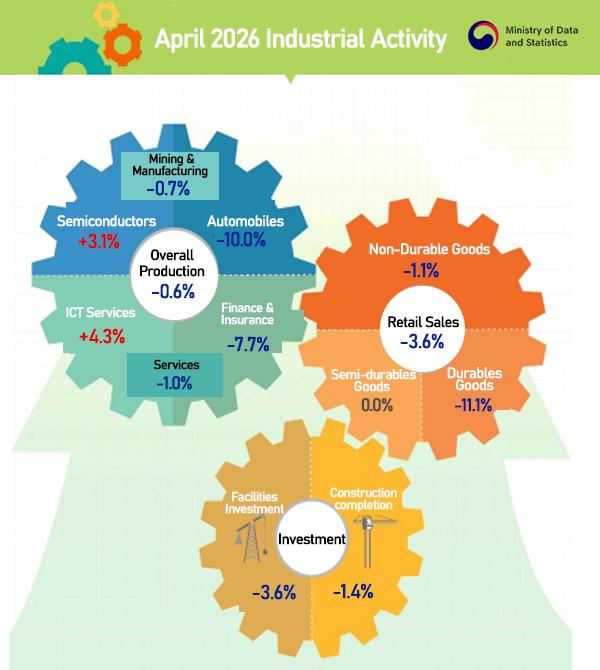
Corporate investment lines turned equally defensive, with equipment investment retreating 3.6 percent from March, driven by an 11.5 percent drop in transport equipment such as aircraft imports. Domestic machinery orders received, a key forward-looking indicator for capital outlays, shrank 7.6 percent year-on-year.
Concurrently, construction completed at constant prices dropped 1.4 percent month-on-month, registering a 5.5 percent contraction compared to the same period last year. Despite the broad-based retreat across current output and consumption, business cycle indicators continued to signal divergence due to historical lags.
The cyclical component of the coincident index crawled up 0.2 points from March to 100.2, supported by previous export volumes. Meanwhile, the cyclical component of the leading index, a gauge for future economic health, advanced 0.6 points to 104.1, driven primarily by gains in the stock market and export-import price ratios before the full weight of the supply-chain shock consolidated.
Despite the widespread retreat in April's macroeconomy, the benchmark KOSPI opened up 2.43 percent from the previous session at 8,384.31, catalyzed by breaking news that a peace agreement between the United States and Iran is imminent. Tech heavyweights Samsung Electronics and SK hynix continue to rewrite their historical highs, surging past 310,000 won ($207.3) and 2.3 million won, respectively.
The morning rally was heavily fueled by the combination of South Korea’s robust 1.7 percent gross domestic product (GDP) growth in the first quarter—propelled by soaring semiconductor prices and resilient global demand—and Thursday's reports that a final peace accord between Washington and Tehran now awaits only the formal signature of U.S. President Donald Trump.

Copyright ⓒ Aju Press All rights reserved.