

Journalist

Lester Munson
-
 Kakao Pay Says 10-Year Transfers Totaled 447 Trillion Won, Saving 1.5 Trillion Won in Fees Kakao Pay said Tuesday that since it launched its money transfer service in April 2016, users have sent a cumulative total of about 447 trillion won over the past 10 years. The company said that is equivalent to people nationwide exchanging 120 billion won a day, or 5 billion won an hour, through Kakao Pay. Over the same period, cumulative transfer transactions topped 4.8 billion, it said. Annual transfers rose from about 2.65 million in 2016 to about 843.1 million last year, a 320-fold jump over a decade. This year, as of last month, average daily transfers exceeded 2.3 million, with about 240 billion won moving each day. That works out to roughly 1,600 transfers per minute, the company said. Kakao Pay said the service has expanded beyond a simple way to send money. In 2016, users sent money to an average of five acquaintances each; by 2025, that figure had grown to an average of nine. The company also said the service helped lower barriers to financial services, estimating users saved about 1.5 trillion won in fees over the past decade. A Kakao Pay official said the past 10 years have focused on reducing the hassle of transfers and improving users’ daily lives, adding the company will continue upgrading the service so users can feel that finance is “closer” and keep sharing “feelings and value.” * This article has been translated by AI. 2026-04-29 09:45:17
 -
 Hanna Chang Aims to Transform Seoul Arts Center into a Cultural Hub The Seoul Arts Center, located at the foot of Woomyeonsan in Seocho-dong, is more than just a performance venue. It serves as a mirror reflecting a nation's cultural level and a symbol embodying the spirit of an era. Like the traditional hat perched atop the opera house's roof, the Arts Center is a place where Korean tradition meets global artistry. However, an institution cannot survive on symbolism alone. Beautiful architecture does not cover maintenance costs, and reputation alone cannot offset deficits. Culture must ultimately move people's hearts, draw their footsteps, and become a platform for the times. In this context, the appointment of world-renowned cellist Hanna Chang as president of the Arts Center is not just a personnel change. It signifies a shift in the direction of Korean cultural administration and raises a crucial question about what the Arts Center should become in the future. One of the most striking statements in her inaugural speech was:“The competitors of the Arts Center are not Japan's Arts Center, America's Lincoln Center, or China's National Centre for the Performing Arts. Our real competitors are Netflix and YouTube.” This statement instantly dismantles the long-standing walls of Korean cultural administration. In the past, the Arts Center was viewed merely as a 'facility.' Good performance spaces, excellent acoustics, and quality exhibition areas were the focus. However, today is the era of platforms, not spaces. People do not necessarily go to performance venues. They watch Netflix on their smartphones and consume world-class performances on YouTube. Time has become fragmented, appreciation has become personalized, and culture has already entered the subscription economy. The chronic deficits of the Arts Center stem from this reality. Audiences are dwindling while costs rise. Innovation under the guise of a public institution has been slow, and past methods have failed to persuade the future. Accumulated deficits amounting to hundreds of billions of won are not just numbers; they are a warning. Cultural institutions must now declare a survival strategy. Hanna Chang has recognized this point. By defining the competition not as foreign performance venues but as digital platforms, she envisions the Arts Center as a 'content company' rather than merely a 'building.' This perspective is modern and accurately penetrates the MZ generation and the age of artificial intelligence. Today's younger generation chooses experience over authority. They prefer participation over formality and intuition over explanation. They consume short videos and memorable moments rather than lengthy explanations, and they remember shareable experiences more than the venue itself. Algorithms learn preferences, and platforms do not wait for audiences; they seek them out.The Arts Center must shift from a strategy of “Come see our great performances” to “We will enter your life.” Hanna Chang is a person with that potential. She is not just a famous performer; she is someone who has survived the harsh standards of world music history. Initially, she learned piano. As a child playing the piano, she became captivated by the deep, human sound of the cello one day. This change was not merely a shift in hobby but a turning point in her destiny. The cello became her life, and she ultimately became a globally recognized master. From a young age, she was called a genius, but the term 'genius' can be cruel. People see only the results, but behind those results lies unimaginable training and solitude. At the age of eleven, she shocked the world music scene by becoming the youngest and first Asian winner of the Rostropovich International Cello Competition. This was the moment when the legendary cellist Mstislav Rostropovich personally acknowledged her talent. The first proof of her genius is this 'victory at eleven.' Classical music is a world of early education, but it is nearly miraculous for a young performer to reach the top in a prestigious cello competition. It was a judgment that she was not just a prodigy but a fully formed musician. The second example is her invitations to the world stage. She has since collaborated with top orchestras, including the New York Philharmonic, London Symphony Orchestra, and Berlin Philharmonic. The world does not consider nationality or age; only skill remains on stage. The third is the evaluations from masters. World-renowned conductors and critics have described her performances as “simultaneously possessing fiery concentration and human depth.” Her recordings and live performances have become timeless art, not mere trends. These three points illustrate that Hanna Chang's success is not a coincidence but a structure, and her genius is just the beginning; ultimately, it was her rigorous self-discipline that completed it.She practiced for more than ten hours a day, moving her bow thousands of times for the sensitivity of her fingertips. Achieving ten minutes of perfection on stage requires tens of thousands of hours offstage. There is a scene in the film “Tár” where a young student says, “I don’t like Bach.” The reason is not music but identity; he judges art based on the composer’s gender and race. This scene symbolizes today’s cultural politics. Art is sometimes consumed based on identity rather than skill. However, Hanna Chang's true greatness lies beyond that. She is not great because she is a woman or an Asian; she is great because she has silenced the world with her overwhelming skill. Identity may be a starting point, but the ultimate judgment of art is always skill. The stage cannot be maintained by political correctness. If a single note is wrong, all rhetoric collapses. Hanna Chang is someone who has passed through that harsh truth. Her musical achievements are not just tales of success; they are records of human will. Collaborating with the world's top orchestras means stepping onto the judgment stage every time. She has always survived. Behind her success is her family.Hanna Chang's family has essentially devoted their entire lives to nurture one genius. Her father could have chosen a stable path but changed the direction of his life for his daughter's talent. Her mother also helped create a musical foundation. In fact, Hanna Chang's musical education began with her family's dedication. From learning piano to choosing the cello, the entire family went all-in for one artist. World-class geniuses are not created in isolation; behind one person's success lies the sacrifice of a family. Applause may echo on stage, but the time that makes that applause possible always begins at home. Hanna Chang understands this better than anyone. That is why she has always remained humble. Even on the grand stage, she refers to herself as “still a learner.” A true master knows how much they lack.She has not just remained a performer; she has sought to nurture younger generations and return classical music to the public. Notably, during the time when President Lee Jae-myung served as mayor of Seongnam, she contributed to popularizing classical music among youth through performances at the Seongnam Arts Center. She is not just a star performer but a cultural educator showing that classical music is not merely the privilege of a select few. Therefore, what the Arts Center needs now is precisely that. It should no longer be a sanctuary for classical music enthusiasts alone. It must become the heart of K-Culture. It should be a living platform encompassing classical music, opera, ballet, film, AI art, game music, digital performances, and global collaborations. The world’s best performance venue is not just a good concert hall; it is a place that the world seeks out first. To compete with the Lincoln Center in the U.S., Suntory Hall in Japan, and the National Centre for the Performing Arts in China, it requires more than mere comparisons of facilities. It needs the stories of Seoul, the emotions unique to Korea, and the strength of K-Culture. Just as Gwanghwamun becomes a stage for BTS and Gyeongbokgung serves as a backdrop for the world, the Arts Center must also become a cultural landmark that the world seeks out. It should not just be a place to watch performances but a destination to experience the future of Korean culture.In the age of artificial intelligence, culture is about 'participation,' not 'appreciation.' Audiences are no longer passive consumers. They connect, share, and recreate directly. The Arts Center must now move beyond operating a performance venue to becoming a center for digital platforms, global streaming, educational content, and cultural technology industries. Viewing Netflix and YouTube as competitors ultimately means the Arts Center aims to enter the daily lives of people worldwide. Laozi said in the Dao De Jing,“大器晩成 (great vessels take time to form).” The Arts Center is the same. It has long been a symbol of the nation, but now it must be reborn as a truly global platform. Deficits are just numbers, but vision can change the era. Hanna Chang's appointment is not merely a personnel change; it poses a question about the next 30 years of Korean culture. The answer to that question is clear: The completion of K-Classical will be achieved by Hanna Chang. Korea has already shaken the world with K-Pop. K-Dramas and K-Movies have captured the emotions of global audiences. The final pinnacle remains K-Classical. It is about Korea becoming the standard in the realm of the oldest, deepest, and highest art. The baton for that completion is now in Hanna Chang's hands. Transforming the Arts Center is not just about turning one institution into the black; it is about rewriting the status of Korean culture. Beyond Netflix, beyond YouTube, the day will come when the world looks to Seoul's Arts Center. On that day, we will finally say, “The completion of K-Classical was achieved by Hanna Chang.” 2026-04-29 09:42:49
 -
 LIV Golf Postpones New Orleans Event From June to Fall Amid Funding Questions 최근 재정 위기설에 휩싸인 LIV 골프가 오는 6월 미국 루이지애나주 뉴올리언스 대회를 가을로 연기한다. LIV 골프는 29일(한국시간) AP 통신에 보낸 보도자료에서 "루이지애나주 정부와 협력해 새로운 일정으로 대회를 옮기는 결정을 내렸다"며 "이는 한여름의 극심한 더위를 피하고 글로벌 스포츠 일정(FIFA 북중미 월드컵)과 충돌하지 않기 위한 것"이라고 밝혔다. LIV 골프는 "가을에 대회를 할 수 있도록 노력하고 있다"며 "가까운 시일 내에 확정된 날짜를 공유하기를 기대한다"고 덧붙였다. 뉴올리언스 대회가 미뤄지면서 LIV 골프는 6월 4일 개막하는 스페인 안달루시아 대회 이후 7월 23일 영국 대회까지 약 2개월간 공백이 생기게 됐다. 이번 결정은 사우디아라비아 국부펀드(PIF)가 LIV 골프에 대한 자금 지원 중단을 검토하고 있다는 현지 보도 직후 나와 관심을 모았다. 최근 4년간 약 50억 달러(약 7조 3680억원)를 투입해 온 PIF가 더는 지원에 나서지 않을 수 있다는 관측이 나오며 LIV 골프는 존폐 위기설에 휩싸였다. LIV 골프는 위기설을 부인했다. 스콧 오닐 LIV 골프 최고경영자(CEO)는 지난 28일 부산 아시아드 컨트리클럽에서 열린 국내 기자회견에서 "우리는 2026년 시즌을 운영할 자금을 이미 충분히 확보한 상태"라며 "주요 파트너들의 후원 규모도 약 5억 달러 수준으로 커졌다. 사업성과 경기력 양면에서 드라마틱한 성장을 이뤘다"고 말했다.* This article has been translated by AI. 2026-04-29 09:42:05
 -
 FSS chief’s expense account disclosed for first time; averaged 2.09 million won a month over 8 months Details of official expenses used by Financial Supervisory Service Gov. Lee Chan-jin since taking office have been disclosed for the first time, with most spending tied to discussions on supervisory issues, staff encouragement and media briefings. According to financial authorities on the 29th, the FSS posted the governor’s expense-account records on its website the previous day. The disclosure covers eight months of spending from August last year, when Lee took office, through March this year. Total spending during the period was 16,677,500 won across 76 transactions, averaging about 2.09 million won a month. Monthly totals were 1,621,100 won in August 2025; 2,167,000 won in September; 1,629,000 won in October; 2,336,600 won in November; 2,068,400 won in December; 2,268,300 won in January 2026; 2,204,100 won in February; and 2,383,000 won in March. Most expenses were incurred at restaurants around Yeongdeungpo-gu in Seoul, where the FSS headquarters is located. By purpose, work-related meetings accounted for a large share, including discussions on key supervisory issues and work plans and sharing difficulties by division. Other items included staff encouragement, meetings with news organizations, consultations with related agencies, and condolence or congratulatory payments. The disclosure follows Lee’s pledge during a National Assembly Legislation and Judiciary Committee audit in October last year. After criticism over how the FSS exercises its authority, he said he would improve transparency in the use of official expenses. Separately, official expenses used under the previous FSS governor from January through May last year totaled 12.10 million won, averaging 2.42 million won a month: 2.37 million won in January, 2.55 million won in February, 1.82 million won in March, 2.45 million won in April and 2.89 million won in May. 2026-04-29 09:40:16
 -
 Korea Creative Content Agency Earns Top Shared-Growth Rating for Fourth Straight Year The Korea Creative Content Agency said Tuesday it received a top rating for the fourth consecutive year in the Ministry of SMEs and Startups’ 2025 evaluation of shared growth by public institutions. Among 133 institutions assessed, the agency maintained the highest grade and posted the top score among other public institutions, it said. The agency credited efforts including building an innovation ecosystem for the content industry using artificial intelligence; creating a cooperation framework between over-the-top streaming platforms and small and midsize broadcast and video production companies; expanding cross-industry collaboration opportunities centered on content intellectual property through a character licensing fair; and strengthening shared-growth programs based on environmental, social and governance management, it said. The agency also operates business centers overseas that serve as local hubs for small and micro content companies. It said it used the global reach of K-content to broaden overseas demand in related industries such as food, consumer goods and tourism, helping open new export channels. “This result reflects our steady efforts to spread a culture of shared growth and cooperation across the content industry,” said Yoo Hyun-seok, acting president of the agency. “We will continue to actively support small and midsize companies so they can grow into core players in the content industry.”* This article has been translated by AI. 2026-04-29 09:38:15
 -
 Samsung Biologics Labor Dispute Nears Strike, Raising Calls for Balanced Solution Samsung Biologics’ labor dispute has moved toward a strike, with disruptions already reported in some processes and the possibility of a broader walkout being discussed. The issue should not be dismissed as a routine company dispute, but it also should not be exaggerated into a “national crisis.” The central task is to uphold the principle of autonomous bargaining at a private company while finding a balanced approach that accounts for potential spillover effects across the industry. First, the basic principle should be clear: A company is a private entity, and labor-management negotiations are fundamentally voluntary. Talks over wages, bonuses and working conditions are a matter of reconciling interests between the parties. Framing the dispute as “public interest” to pressure one side is difficult to justify. Workers’ right to strike is also protected by the Constitution. Still, this dispute has features that set it apart. Contract manufacturing of biopharmaceuticals depends on long-term trust and quality certification. Production disruptions can go beyond short-term revenue losses, affecting contract stability and a company’s reputation. That can ripple to partners, investors and the local economy. In other words, while the dispute is private, the industry’s external impact is large, and public-interest considerations may also need to apply. Even so, that does not justify assigning blame to only one side. It is not persuasive to label union demands “excessive” simply because a strike burdens the company. At the same time, management cannot avoid responsibility if it allowed conflict to escalate in an industry where stable production is critical. In sectors with high systemic risk, managing disputes early and drawing out compromise is a core management function. The view that worker compensation and future investment are a simple trade-off also warrants review. Corporate capital allocation is complex. It cannot be assumed that wage increases automatically lead to cuts in research and development. Conversely, it also cannot be ruled out that excessive short-term compensation could squeeze investment capacity. The key is not simply raising or lowering one item, but designing a balanced allocation of overall resources. Labor and management should seek a practical meeting point on that basis. A solution is not found in “dialogue” alone. For talks to work, institutional support is needed, and that is where the government’s role begins. The government cannot directly intervene in wage levels or management rights. But it can create a framework for mediation and conditions that allow negotiations to continue. Options could include procedures that encourage intensive bargaining for a set period, minimum operating standards for essential processes, and a system to assess public-interest impacts if the dispute drags on. Such measures could reduce industrial shock without undermining bargaining autonomy. Another key issue is transparency. When wage demands, business performance and investment plans are disconnected, rational judgment is difficult. The company should present financial conditions and investment plans more clearly, and the union should explain the basis for its demands in concrete terms. When information is shared, negotiations can be driven by numbers rather than emotion. Ultimately, the core issue is balance: workers’ rights, corporate sustainability and industrial stability must all be weighed. Emphasizing only one side will not produce a solution. A strike should be a last resort, and management should also leave room for compromise to the end. What is needed now is not a test of strength, but restoring trust and finding a realistic compromise. The Samsung Biologics dispute may be part of the growing pains of a maturing Korean industry. If it is not managed, it could become a broader crisis; if resolved well, it could help establish a new balance. Neither side is free of responsibility. * This article has been translated by AI. 2026-04-29 09:37:38
 -
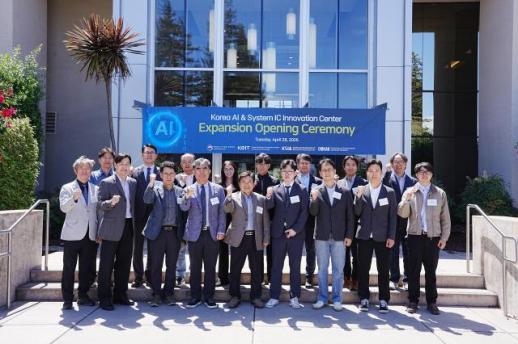 Korea Expands Silicon Valley AI Chip Innovation Center to Support Fabless Firms The Korea Semiconductor Industry Association has doubled the size of its Korea-U.S. AI Semiconductor Innovation Center in Silicon Valley, stepping up support for South Korean fabless chipmakers seeking to expand in the U.S. market. The group said the center will further serve as a local hub, offering on-the-ground testing and verification and helping connect companies with customers as the AI chip market grows and global supply chains are reshaped. The association said it held an opening ceremony for the expanded center on April 28 local time in Silicon Valley. The center is operated with support from South Korea’s Ministry of Trade, Industry and Energy and the Korea Institute for Advancement of Technology. Founded in September 2024, the center has served as a base for South Korean system semiconductor companies entering the U.S., in a region packed with global big tech and fabless firms. It launched with five resident companies and 20 member companies; after the expansion, those totals rose to 10 and 40, respectively. Resident and member companies posted more than $36 million in U.S. sales last year, according to the association. Industry officials have said the results show the center is playing a practical role in helping South Korean AI and system semiconductor firms enter the U.S. market. Among the resident companies, Sapien Semiconductor signed a supply contract for display driver chips for smart glasses, and SemiFive won a project to develop a fully homomorphic encryption, or FHE, accelerator, the association said. The expansion also strengthens on-site support facilities, including a test lab, meeting rooms and networking space. QRT, a company specializing in reliability testing, will participate in operating the center’s test lab, creating a one-stop setup that runs from reliability verification to links with local customer networks. The center is also working to connect global AI companies with South Korean fabless firms. The day after the ceremony, it plans to invite U.S. AI cloud company TensorWave for one-on-one business consultations with South Korean system semiconductor companies including Mobilint and HyperAccel. The association said it plans to further expand programs that match companies with local demand, strengthen testing and verification support, and provide tailored assistance. Kim Jeong-hoe, vice chairman of the Korea Semiconductor Industry Association, said, “We expect the expansion of the center will further accelerate South Korean system semiconductor companies’ entry into the U.S. market.” He added, “To respond to a rapidly changing market environment centered on AI, continued policy support from the government is important.” 2026-04-29 09:36:51
 -
 U.S. intelligence weighs Iran response if Trump declares unilateral victory, sources say U.S. intelligence agencies are analyzing how Iran might respond if President Donald Trump were to declare a unilateral victory, as political pressure grows with the war dragging on, according to a Reuters report. Reuters, citing U.S. government officials, reported April 28 local time that intelligence officials are reviewing the potential fallout if Trump declares victory in the roughly two-month war with Iran. The report said the analysis, requested by senior administration officials, is part of broader scenario planning. Some officials and advisers are concerned the conflict could lead to a major Republican defeat in the midterm elections, and they want to understand the consequences if Trump pulls back from the war. No specific decision has been made, but Trump could expand military operations again if needed. A rapid de-escalation could ease political pressure, officials said, but it could also allow Iran to rebuild nuclear and missile capabilities and expand its regional influence. U.S. intelligence has conducted similar assessments before. After initial airstrikes in February, one assessment found that if Trump declares victory and reduces troop levels, Iran would be likely to treat it as a de facto victory. If Trump declares victory while keeping forces in place, it could be seen as a negotiating tactic, but would be unlikely to end the war, the assessment said. The White House says it remains open to talks. Spokeswoman Anna Kelly said the United States is still negotiating with Iran and will not rush into a bad deal. She said the president will agree only to a deal that puts U.S. national security first and has made clear Iran must never obtain a nuclear weapon. Public opinion in the United States has worsened, the report said. In a Reuters/Ipsos poll, 26% said the military operation was worth the cost, and 25% said it made the United States safer. The prolonged war is also weighing on energy markets. The Strait of Hormuz, which Iran has blocked, is a key shipping route through which about 20% of the world’s oil cargo passes. Continued disruption has kept pressure on international crude prices and U.S. gasoline prices. A diplomatic solution remains unclear. Trump signaled skepticism about progress by canceling a weekend trip to Pakistan by envoy Steve Witkoff and Jared Kushner, the report said. Military options are still being reviewed inside the administration, though one U.S. government official and another source said the most hard-line option, such as an invasion of the Iranian mainland, appears less feasible than it did several weeks ago. Iran, meanwhile, is believed to be using a ceasefire period to repair military assets damaged in the initial airstrikes. Analysts said that if full-scale fighting resumes, the military costs could be higher than at the outset.* This article has been translated by AI. 2026-04-29 09:36:04
 -
 South Korea’s Business Succession Bill Needs Market Fixes, Not Just Tax Breaks Small and midsize businesses in South Korea are disappearing — and not only because they are losing money. Even profitable firms with strong technology are shutting down. Owners are aging, there is no successor, and even when they try to sell to a third party, suitable buyers often do not emerge. Discussion of a proposed “special act on business succession,” raised by the Democratic Party’s Euljiro Committee, starts from that reality. The direction is right, but whether the prescription is sufficient needs scrutiny. The first question is the cause. Labeling the closure of profitable companies as a simple “policy failure” is too narrow. It is true that tax benefits for third-party acquisitions lag those for family succession, and that is a real barrier. But it is not the whole story. Many small manufacturers face low margins, unstable trading relationships and heavy reliance on domestic demand. A company may show a profit on paper, but if its growth prospects are unclear, outside investors’ reluctance is a market judgment. That means the succession problem is not only about taxes; it is about the industrial ecosystem. Cutting taxes alone will not solve it. A structure that can generate profits and a market that can support growth must be built alongside any tax relief. Otherwise, tax incentives will be only a temporary fix. Even so, a special act on business succession is needed. With family succession increasingly difficult, keeping companies alive through third-party acquisitions is a practical alternative. From the standpoint of preserving technology and jobs, mergers and acquisitions are a far better option than closure. Tax support comparable to family succession and simplified procedures should be pursued. The point is that these steps are necessary, but not sufficient. Foreign examples also need to be used carefully. Germany’s competitiveness among midsize firms is not simply the result of “passing companies down through generations,” but of long-term investment, stable business relationships and strong technological capabilities. A family-succession model and a third-party M&A model work differently. South Korea cannot simply copy Germany and must design a succession model that fits local conditions. Another challenge is balancing speed and protection. The longer a succession takes, the more a company’s value can fall, so streamlining procedures and speeding transactions matters. At the same time, safeguards are needed to prevent technology theft. These goals can conflict. A practical approach is to limit access to information early and institutionalize step-by-step deal structures in which core technology is disclosed only after a certain level of trust is secured. Achieving both speed and protection requires more precise design, not just fewer steps. The biggest issue comes after the acquisition. The goal of the proposed law is not merely more deals, but the preservation of technology and jobs. Private investors, however, act for profit, not public interest. The risk cannot be ruled out that a buyer could take tax benefits, acquire a company, then strip key assets and cut staff. To prevent that, post-deal oversight is essential, including clear requirements to maintain employment for a set period, limits on overseas leakage of core technology, and conditions for clawing back tax benefits in stages. In sum, a special act on business succession is needed, but it is not enough on its own. Tax support, procedural reform, technology protection and post-deal management must be designed as a single package. Beyond that, policies must also create a market environment in which small and midsize businesses can grow. Emphasizing succession without fair trading structures and stable profit foundations is like trying to grow a tree without roots. South Korea’s economy may appear to be holding up, but its industrial base is weakening. If small and midsize businesses collapse, large companies cannot hold out either. Business succession is not a problem of individual firms; it is directly tied to the sustainability of the broader industrial system. Politics cannot afford further delay. But rushing is not enough, either. The direction is right, and the design must be more precise. Keeping companies going is not simply inheritance; it is protecting the industrial foundation.* This article has been translated by AI. 2026-04-29 09:35:05
 -
 DB HiTek to Showcase Next-Gen SiC and GaN Power Chip Processes at PCIM 2026 DB HiTek said Tuesday it will take part in PCIM 2026, Europe’s largest power semiconductor exhibition, to be held June 9-11 in Nuremberg, Germany, where it plans to present its latest technology. In its second consecutive year at the show, the company will share the latest development status of silicon carbide (SiC) and gallium nitride (GaN) processes, which it described as next-generation power semiconductors. DB HiTek also plans to discuss cooperation with customers in Europe, focusing on its BCDMOS process, which it said has secured industry-leading capabilities. The company said it is accelerating work to secure next-generation processes. In December, it produced products for more than 20 customers through a multi-project wafer (MPW) run based on SiC and GaN processes. It said deliveries to customers have recently been completed and evaluations are under way. Based on those results, DB HiTek said it plans to finalize the process technology and begin full-scale mass production starting in 2027. DB HiTek said it is currently in mass production with about 400 customers in its core power semiconductor business. It also said it plans to keep increasing the share of industrial and automotive products, supported by specialized image sensor process technologies such as single-photon avalanche diode (SPAD) devices.* This article has been translated by AI. 2026-04-29 09:34:25