

Journalist

Lester Munson
-
 Seoul High Court vows swift handling of Yoon insurrection appeal amid delays The Seoul High Court on Tuesday addressed criticism over delays in scheduling hearings in the appeal of former President Yoon Suk Yeol, who is charged as the ringleader of an insurrection. At a press briefing at the court in Seoul, spokesperson Yu Jemin said that under the special counsel law on insurrection, the deadline to submit an appellate brief in cases indicted by a special prosecutor has been shortened to seven days from 20. Yu said rules requiring a sentencing date do not apply, but procedures under a special act still do. With multiple defendants and mandatory service of documents on defense lawyers, he said, the scheduling may appear slow because the court must follow legal steps to protect defendants’ rights. He added that the panel has been moving as quickly as possible, including preparing proof plans before deadlines expire. Yoon’s case has drawn public criticism because no first hearing had been set even after the first trial verdict was delivered Feb. 19. The Seoul High Court issued its first public explanation on the matter Tuesday. The appeal is being handled by the Seoul High Court’s Criminal Division 12-1. In materials separately released by the court, it said pretrial hearings will run from April 27 through May 7, with trial dates to be set from May 14. Yu also outlined operations and administrative support for the court’s “insurrection-dedicated panel,” established Feb. 23. The court said it is concentrating its resources to process special counsel and insurrection-related cases quickly and fairly. The dedicated panel is based on the “Special Act on the Trial of Criminal Cases, Including Insurrection and Foreign Aggression Cases,” promulgated in January 2016. Under the law, the Seoul High Court must operate at least two dedicated panels, with members selected after deliberation by the full judges’ meeting. The court said it held multiple full judges’ meetings after the law took effect to set selection principles and adopted random draws to ensure transparency. The Seoul High Court said it expanded its criminal trial divisions to 16 from 14 and designated the two newly added divisions as insurrection-dedicated panels to handle only those cases, aiming to prevent delays in ordinary criminal trials. Four cases have been assigned to the dedicated panels and are under review, the court said, adding that not every case investigated by a special prosecutor is automatically sent to those panels. To improve efficiency, the court said it has provided unusual levels of administrative support. It doubled staffing compared with ordinary panels and assigned four court reporters to each dedicated panel, compared with fewer than one per panel in typical cases. It also said it deploys four to six court security officers on major hearing days and has added another courtroom equipped for overflow viewing. The court said it upgraded West Annex Courtroom 103 to enable relay viewing to meet the public’s right to know. The court said it livestreams major proceedings on YouTube and has added on-screen captions to guide viewers through steps such as defendant questioning, witness examination and closing arguments. On how much of the appeal ruling will be released, Yu said the court is conducting a comprehensive review balancing anonymization guidelines and the public’s right to know. The court said verdicts in major special counsel cases will be concentrated starting next week, beginning with a ruling related to first lady Kim Keon Hee on April 27. A Seoul High Court official said operation of the dedicated panels will not delay other criminal cases and that the court will mobilize its administrative capacity to deliver fair and swift results. 2026-04-22 12:45:22
 -
 PPP Floor Leader Song Eon-seok Visits Fasting Lawmaker Ahn Ho-young, Urges Him to Stop Song Eon-seok, floor leader of the People Power Party, visited Democratic Party lawmaker Ahn Ho-young on the 22nd and urged him to end his hunger strike, saying, “You need to be healthy first. Please get up soon.” Song went with Yoo Sang-beom, the PPP’s senior deputy floor leader for parliamentary operations, to Ahn’s protest site outside the National Assembly, where Ahn has been on a hunger strike for 12 days. Song, looking grim, sat at the site, held Ahn’s hand and spoke with him for about two minutes. Ahn greeted them while lying down, unable to get up. Afterward, Song told reporters he came “as a fellow lawmaker and as the head of a negotiating bloc” to pay a visit and offer encouragement. He said they discussed that Ahn needs to protect his health “to do bigger politics” and to work together on politics that can “set South Korea on the right path.” Ahn began the hunger strike on the 11th, demanding a renewed internal audit into allegations that Rep. Lee Won-taek covered meal expenses during the party’s primary for North Jeolla Province governor. As the strike has continued for more than 10 days, figures from both parties have visited the site. The day before, National Assembly Speaker Woo Won-shik visited and urged Ahn to end the fast.* This article has been translated by AI. 2026-04-22 12:33:19
 -
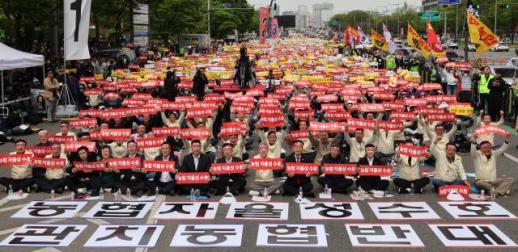 20,000 Farmers rally in Yeouido against agricultural cooperatives act revision SEOUL, April 21 (AJP) - About 20,000 farmers and agricultural cooperative heads gathered in Yeouido on Tuesday to strongly oppose the government's push to revise the Agricultural Cooperatives Act, calling it an "infringement on autonomy." According to the National Agricultural Cooperative Federation (NACF) on April 21, agricultural cooperative heads and farmers from across the country held the 'Farmers' Rally to Defend Agricultural Cooperative Autonomy' in Yeouido, Seoul, that afternoon, officially expressing their opposition to the government's proposed revision. Participants presented five key demands through a resolution statement: halting government oversight that infringes on agricultural cooperative autonomy, abolishing toxic provisions that undermine legal stability, maintaining supervisory authority over subsidiaries, withdrawing the creation of an inefficient audit body, and stopping attempts to change the direct election system for the federation president. 2026-04-22 12:28:09
 -
 CATL Unveils Semi-Solid Battery With 1,500 km Range and 6-Minute Fast Charge Up to 1,500 km on a single charge, full charge in 6 minutes 30 seconds, sodium battery mass production within the year... CATL (Ningde Shidai), China’s top battery maker by global market share, on the 21st unveiled new battery technologies and a product roadmap as competition in electric-vehicle batteries intensifies. The company’s announcements were widely seen as an effort to widen its lead. According to Chinese media including 21st Century Business Herald, CATL held a “Super Tech Day” event on the 21st. The main highlight was a “condensed-state” version of its flagship Qilin battery. CATL described the technology as a high-performance semi-solid battery — widely viewed as a step just short of an all-solid-state battery. CATL said it applied its own semi-solid electrolyte technology, combining an ultra-high-concentration nickel cathode with a silicon-based anode. The company put the energy density at 350 Wh/kg, among the highest levels for mass-produced batteries. Gao Huan, CATL’s chief technology officer, said the company upgraded from a liquid electrolyte to a condensed-state electrolyte to address safety issues “at the root.” Using a condensed-state electrolyte instead of a liquid reduces leakage risk and can significantly lower the chance of fire, he said. In driving tests, CATL said a premium sedan equipped with the battery traveled up to 1,500 km on a single charge. CATL also said the battery pack weighs less than 650 kg and has a volume of 309 liters — about 400 kg lighter and 225 liters smaller than a lithium iron phosphate, or LFP, battery capable of about 1,500 km under the same conditions. The company said the battery retains more than 85% of its capacity at minus 20 degrees Celsius and supports ultra-fast charging at 10C output, allowing a charge to 80% in about 10 minutes. CATL said the condensed-state battery is slated for premium models such as the Nio ET9 and Huawei M9, with mass production planned from the third quarter of this year. It also said the pilot production line has achieved a yield of more than 95%. Industry observers described the announcement as a potential turning point as power-battery technology moves from liquid electrolytes toward solid electrolytes. They said higher energy density and longer range could accelerate adoption of premium EVs and broaden potential uses in emerging markets such as low-altitude aircraft and ultra-long-haul commercial vehicles. CATL also unveiled its third-generation Shenxing ultra-fast-charging battery. The company said it achieved a full charge in just six minutes at room temperature, setting a new benchmark for charging speed. That would be faster than the roughly nine-minute full charge claimed last month by rival Chinese automaker BYD for its second-generation Blade battery. CATL also announced plans to begin mass production of sodium-ion batteries within the year. Sodium batteries are seen as a next-generation technology that could reduce reliance on lithium, cobalt and nickel, drawing attention for cost stability and supply-chain considerations. CATL also said it will accelerate expansion of battery swapping and charging infrastructure. Working with Chinese automakers, it plans to build 100,000 charging and battery-swap stations by the end of 2028. CATL attributed its technology push to heavy research and development spending. Chairman Zeng Yuqun said the company invested more than 100 billion yuan in R&D over the past decade, including 20 billion yuan last year. He said CATL holds more than 60,000 patents and has ranked No. 1 for six consecutive years in patent application growth. 2026-04-22 12:27:19
 -
 Police Seek Arrest Warrant on Murder Charge in Cargo Truckers Union Death Police have launched a full investigation into a fatal incident at a rally by the Cargo Truckers Solidarity Division of the Korean Confederation of Trade Unions’ Public Transport Workers’ Union. South Gyeongsang Provincial Police said Tuesday that its major crimes unit applied for an arrest warrant for a nonunion man in his 40s, identified as A, on suspicion of murder after he drove a cargo truck into the crowd during a rally on April 20 in front of the CU Jinju Logistics Center (BGF Logistics Jinju Center) in Jinju’s Jeongchon-myeon. Police said one union member died and two others were injured. A was initially arrested on an emergency basis on suspicion of aggravated assault. Police later applied the murder charge after concluding there was implied intent, according to the report. Investigators reviewed video from the scene and analyzed the truck’s digital tachograph (DTG) data, it said. In questioning, A was quoted as saying the scene was chaotic and he drove to get out quickly, and that he did not intend to injure anyone. Police also applied for arrest warrants for two union members, identified as B, in his 60s, and C, in his 50s, on suspicion of offenses including obstructing official duties with violence. B is accused of driving a van during the rally and injuring some police officers. C is accused of using a weapon at the same rally site on April 19 to attempt self-harm or of threatening police by saying he would harm unspecified people.* This article has been translated by AI. 2026-04-22 12:18:17
 -
 FSS: More Financial Firms Put Consumer Protection on Board Agendas and KPIs Financial firms are increasingly adopting management practices that put consumer protection at the center, South Korea’s Financial Supervisory Service said. The watchdog said that, among 77 companies subject to its financial consumer protection assessment, 69 now report their consumer protection management strategy to their boards of directors. It also said 15 companies operate a consumer protection-related subcommittee within the board. The FSS said the biggest shift is the board’s role. The number of companies that directly report consumer protection strategies and policies to the board rose to 69 from 55, while those that set up a related board subcommittee increased to 15 from two. The agency said consumer protection is moving beyond day-to-day operations and into discussion at the top decision-making level. The FSS cited examples. Hana Securities runs a consumer risk management committee led by outside directors and regularly reviews related agenda items. Tongyang Life appointed an outside director with expertise in consumer protection policy and then created a Financial Consumer Protection Committee. The agency said boards are shifting from simply receiving reports to making judgments themselves. The standing of chief consumer officers, or CCOs, has also strengthened. The FSS said 64 companies granted CCOs the right to reach prior agreement on key matters such as KPI design and the authority to demand improvements. It said 51 companies now guarantee CCO terms of at least two years, giving consumer protection units a minimum level of authority to check sales-driven structures. Samsung Securities changed the appointment and dismissal of its CCO to a matter requiring a board resolution and put the CCO’s authority in writing, the FSS said. KB Card extended the CCO term to three years and arranged for an effective veto to apply in key decisions, it said. Changes are also spreading to performance and compensation systems. The FSS said 69 companies reflected consumer protection indicators in CEO KPIs, and some firms moved to expand related organizations and staffing. Still, the FSS said more work is needed for the system to take hold. It said 41 companies — about half — appointed directors with consumer protection expertise, and 45 reflected related indicators in employee KPIs. Follow-up actions managed through IT systems also fell short of half, it said. * This article has been translated by AI. 2026-04-22 12:05:36
 -
 Korea’s Resident Foreign-Currency Deposits Post Record $15.37B Drop as Won Slides Into 1,500s Resident foreign-currency deposits in South Korea posted their biggest monthly drop on record last month as the won-dollar exchange rate surged and moved in the 1,500-won range. The Bank of Korea said increased demand for currency exchange and outflows tied to overseas investment both weighed on balances. According to the central bank’s “Trends in Resident Foreign-Currency Deposits” released on April 22, resident FX deposits at foreign-exchange banks totaled $102.17 billion at the end of March, down $15.37 billion from a month earlier. Resident FX deposits refer to foreign-currency deposits held domestically by Korean nationals and companies, foreigners who have lived in South Korea for at least six months, and foreign companies operating in the country. The balance rose in November last year (+$1.7 billion) and December (+$15.9 billion), then fell in January (-$1.4 billion) and February (-$490 million). By currency, dollar deposits totaled $85.64 billion, down $10.36 billion. The central bank cited stronger corporate demand for won and larger currency conversions as the exchange rate rose to 1,530.1 won per dollar at the end of March from 1,439.7 at the end of February. It also pointed to declines in securities firms’ client deposits, overseas investment execution and payments for current transactions. Euro deposits fell $3.28 billion to $6.31 billion, reflecting settlement remittances to overseas parent companies. Yen deposits declined $1.49 billion to $7.82 billion due to securities firms’ client deposits and current-transaction payments. By holder, corporate deposits dropped $13.43 billion to $86.8 billion, while individual deposits fell $1.93 billion to $15.37 billion. By bank type, FX deposits at domestic banks decreased $11.36 billion to $87.24 billion. Deposits at local branches of foreign banks fell $4.0 billion to $14.93 billion.* This article has been translated by AI. 2026-04-22 12:04:47
 -
 Korea Fines SM Hwajin, Korea Cubic 2.6 Billion Won for Bid-Rigging Auto Interior Contracts South Korea’s Fair Trade Commission said Tuesday it issued corrective orders and fined SM Hwajin and Korea Cubic a combined 2.6 billion won ($1.9 million) for colluding in bids for surface treatment of vehicle interior materials. The two companies are suppliers to Hyundai and Kia and together hold a 100% share of the automakers’ bidding market for hydrographic transfer, a surface-treatment method used on interior materials, the commission said. The commission said the firms took part in Hyundai and Kia bids held from September 2020 to April 2023 to select contractors for interior surface-treatment work for five new models, including the Sportage, EV9, Santa Fe and EV3. According to the commission, the companies agreed in advance on the expected winners and bid prices. SM Hwajin was to win the interior surface-treatment volume for four models, including the Sportage and EV9, while Korea Cubic was to win the volume for the Palisade. The commission said the conduct violated Article 40(1) of the Monopoly Regulation and Fair Trade Act. It imposed fines totaling 2.591 billion won — 1.632 billion won on SM Hwajin and 959 million won on Korea Cubic — along with corrective orders. The commission said it will strengthen monitoring of collusion in intermediate goods and parts, citing the sector’s broad spillover effects across upstream and downstream industries, and will respond strictly when violations are confirmed.* This article has been translated by AI. 2026-04-22 12:03:27
 -
 South Korea’s February Births Rise 13.6% for 20th Straight Month, but Population Still Shrinks South Korea’s number of births in February rose 13.6% from a year earlier, extending an increase to 20 straight months, according to the National Data Center. Births increased in every province and major city, and the total fertility rate moved closer to 1.0. Still, the country’s overall population continued to decline for the 76th consecutive month. In its “February 2026 Population Trends” report released Tuesday, the agency said 22,898 babies were born in February, up 2,747 (13.6%) from the same month a year earlier. Births have been rising for 20 months since July 2024, when they increased 7.8%. The total fertility rate — the average number of children a woman is expected to have over her lifetime — was 0.93, up 0.10 from a year earlier. Births rose year over year in all provinces and major cities. By birth order, the share of first-born children rose 1.2 percentage points from a year earlier, while the shares of second-born and third-or-higher births fell 0.5 and 0.6 points, respectively. Deaths totaled 29,172 in February, down 1,069 (-3.5%) from a year earlier. Deaths increased in five provinces and major cities, including Busan and North Chungcheong, and decreased in 12, including Seoul and Daegu. With deaths exceeding births, the natural population change was minus 6,275. Natural decrease has continued for 76 consecutive months since November 2019, when it was minus 1,685. Marriages, often seen as a leading indicator for births, totaled 18,557, down 811 (-4.2%) from a year earlier. Divorces fell to 6,197, down 1,149 (-15.6%). In the first quarter, the number of people who moved was 1.792 million, up 2.3% (40,000) from a year earlier. The migration rate rose 0.3 percentage points to 14.3%. Net migration by province and major city showed net inflows in seven areas, led by Gyeonggi (11,946), Seoul (3,955) and Incheon (3,740). Ten areas posted net outflows, including South Gyeongsang (-5,707), Gwangju (-3,973) and North Gyeongsang (-3,480). By age, movers were most concentrated in their 20s (453,000) and 30s (378,000). Migration rates were highest among people in their 20s (32.6%) and 30s (23.0%). Last month, 609,000 people moved, up 11.0% from March 2025. The March migration rate — movers per 100 people — was 14.1%, up 1.4 percentage points from a year earlier. Moves within the same province or major city accounted for 61.2%, while moves between provinces and major cities made up 38.8%. From a year earlier, within-area moves rose 9.1% and between-area moves increased 14.5%. Net migration in March showed net inflows in seven areas, including Gyeonggi (2,165), Incheon (1,586) and North Chungcheong (1,533). Net outflows were recorded in South Gyeongsang (-1,648), Gwangju (-1,547) and Ulsan (-1,143). * This article has been translated by AI. 2026-04-22 12:03:00
 -
 USFK commander warns against 'political expediency' in wartime opcon transfer SEOUL, April 22 (AJP) - Gen. Xavier Brunson, commander of United States Forces Korea (USFK), warned Tuesday that “political expediency should not outpace the conditions” in discussions over the transfer of wartime operational control (OPCON), as Seoul pushes to complete the transition within the current administration. Testifying before the U.S. Senate Armed Services Committee, Brunson stressed that the focus should remain on meeting the necessary requirements rather than adhering to a fixed timeline. His remarks come as the government of Lee Jae Myung pushes to complete the wartime OPCON transfer within its term, with the timeline to be determined based on agreed conditions under the allies’ framework. “We’ve got to stay focused on the conditions because the United States is safer that way and the Republic of Korea is safer that way,” Brunson said. Under this framework, the OPCON transition hinges on three key conditions: South Korea’s military capability to lead combined defense; the alliance’s comprehensive ability to respond to North Korea’s nuclear and missile threats; and a security environment on the Korean Peninsula and in the broader region conducive to a stable transfer. Seoul’s five-year state policy plan, unveiled in August, includes the goal of reclaiming OPCON, with speculation that a target year for the transition could be proposed at the annual Security Consultative Meeting (SCM) in Washington in October. The USFK commander also reaffirmed his position that the focus of U.S. forces in Korea is shifting from troop levels to capabilities. “The Korean Peninsula is key strategic terrain vital to defending the American homeland and advancing American interests in the region,” he said, noting that USFK is undergoing modernization to address rapidly evolving strategic challenges. “That’s why my focus remains strictly on capabilities over numbers,” Brunson added, emphasizing that while forward deployment remains a baseline, understanding the shift from force size to operational capability requires prioritizing the specific capabilities needed on the peninsula. His remarks come amid broader discussions under the administration of Donald Trump on adjusting the global posture of U.S. forces in line with a new National Security Strategy, fueling speculation that some USFK units could be redeployed or restructured as part of efforts to counter China. Brunson also pointed to USFK participation in Indo-Pacific Command exercises, saying it demonstrates the potential to project capabilities from Korea to support deterrence across the region. His comments are seen as signaling a possible expansion of USFK’s role beyond deterring North Korea to contributing to broader efforts to counter China in the Indo-Pacific. On reports that a Terminal High Altitude Area Defense (THAAD) system had been moved to the Middle East amid tensions involving Iran, Brunson denied any such transfer. “We’ve not moved any THAAD systems. So THAAD still remains on the peninsula currently,” he said, marking the first public confirmation by a senior U.S. official. He added that munitions are being sent “forward” and are “sitting right now waiting to move,” though it remains unclear whether he was referring to THAAD-related components or general ammunition. 2026-04-22 11:57:30