
Journalist

Lim, Kwu Jin
-
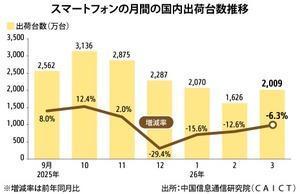 China’s March Smartphone Shipments Fall 6.3%, Down for Fourth Straight Month China’s domestic smartphone shipments in March 2026 fell 6.3% from a year earlier to 20.087 million units, according to the China Academy of Information and Communications Technology, a think tank under the Ministry of Industry and Information Technology. The pace of decline narrowed by 6.3 percentage points from the previous month, but shipments fell for a fourth consecutive month. Total mobile phone shipments, including smartphones, dropped 7.1% to 21.15 million units. Domestic brands accounted for 84.1% of the total, down 1.4 percentage points from the previous month. Shipments of models compatible with fifth-generation, or 5G, networks rose 1.3% to 19.667 million units, returning to growth and making up 93.0% of the total. Mobile phone models launched domestically in March plunged 70.3% to 19, including a 68.8% drop in smartphone models to 15. The number of 5G-compatible models released fell 60.6% to 13. For January through March, domestic smartphone shipments fell 11.6% from a year earlier to 57.04 million units. Total mobile phone shipments, including smartphones, declined 12.7% to 60.805 million units, of which 5G-compatible models fell 9.1% to 55.468 million units. Over the same period, 79 mobile phone models were launched, down 30.1%. Smartphone models released fell 22.6% to 65, and 5G-compatible models dropped 23.8% to 48.* This article has been translated by AI. 2026-04-29 11:33:00
 -
 People Power Party leader Jang Dong-hyeok unveils regional economy, livelihood pledges Jang Dong-hyeok, leader of the People Power Party, announced region-specific pledges on the 29th, saying he would revive local economies and people’s livelihoods with policies that “open up” opportunities rather than “block” them. Speaking at a news conference at the National Assembly, Jang said he would “energize regional economies so that people’s lives improve.” He said South Korea’s economy faces an “unprecedented crisis,” citing surging prices and a falling potential growth rate, and warned that stagflation is becoming reality. He said repeated shocks to the national economy have hit regional economies and households even harder. Jang also criticized the Lee Jae-myung administration, saying it is continuing a “runaway” course without brakes and pushing the country “to the edge.” He said the People Power Party would “stop it and set things right.” As key pledges on regional economies and livelihoods, he proposed steps to narrow the housing-market divide between the Seoul metropolitan area and the provinces, introduce a tax incentive to promote domestic production (a “Korea-style IRA”), build safeguards for small and midsize business succession, and expand discounts on road-occupation fees. On boosting provincial real estate, Jang said the party would gradually ease debt service ratio (DSR) rules in the provinces to match those in the Seoul area, raising loan limits and expanding homebuying opportunities for end users. He also said the party would pursue a plan to exclude purchases of unsold homes in the provinces from the home-count used in housing-demand calculations. On a “Korea-style IRA,” he said support would cover all industries at high risk of manufacturing hollowing-out, and would specify a domestic-purchase share requirement so that tax benefits extend across the domestic production ecosystem. Jang also said he would push to enact a “Special Act on Small and Midsize Business Succession,” providing institutional support for succession at companies run for at least 10 years by owners age 60 or older. He said the plan would also support third-party succession and succession through mergers and acquisitions. He added that, taking into account the share of non-tax revenue at local governments, the party would expand the scope of road-occupation fee reductions from housing to buildings and other structures. * This article has been translated by AI. 2026-04-29 11:30:35
 -
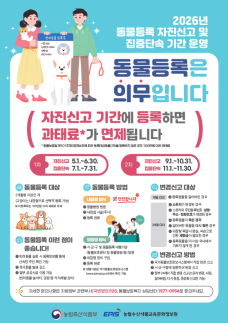 South Korea to Accept Voluntary Pet Dog Registration Reports Through June South Korea’s Ministry of Agriculture, Food and Rural Affairs said Tuesday it will run a first voluntary reporting period for animal registration through June and then carry out intensified enforcement in July. Under the Animal Protection Act, pet dogs aged 2 months or older must be registered with the local government. Owners who fail to register or do not report changes may face administrative fines of up to 1 million won or up to 500,000 won. Fines will be waived for those who register or report changes during the voluntary period. The ministry said it will also step up publicity for animal registration during the voluntary period and conduct a monthlong crackdown in July after it ends. It plans to operate a second voluntary reporting and enforcement period starting in September. “Animal registration is the first step in accepting a pet dog as a member of the family and the best way to prevent pets from going missing,” said Lee Yeon-sook, director of the ministry’s Animal Welfare Policy Division. * This article has been translated by AI. 2026-04-29 11:29:50
 -
 South Korea’s Official Apartment Prices Rise 9.13% in 2026; Seoul Up 18.60% The nationwide average of South Korea’s officially assessed prices for multi-family housing rose 9.13% from a year earlier, the Land Ministry said Tuesday, finalizing figures that affect property-related taxes. The Ministry of Land, Infrastructure and Transport said it will publish the assessed prices on April 30 for 15.85 million households nationwide, calculated as of Jan. 1. The final numbers reflect a public review and opinion-gathering period held from March 18 to April 6 for homeowners and local governments. The ministry said it readjusted prices in 1,903 cases where submitted opinions were deemed valid. A total of 14,561 opinions were filed on this year’s assessed prices, more than triple last year’s 4,132, when the increase rate was lower. The figure, however, was below the 49,601 opinions filed in 2021, when the increase rate neared 19%. Most submissions — 11,606 — asked for lower assessed prices, while 2,955 sought increases. By region, Seoul accounted for the most with 10,166 submissions, followed by Gyeonggi Province with 3,277 and Busan with 257. Requests for downward adjustments were concentrated in areas where assessed prices jumped sharply, including Seoul’s Gangnam area and neighborhoods along the Han River, amid concerns about higher property holding taxes. After the review, the nationwide average increase was set at 9.13%, down 0.03 percentage points from the draft figure of 9.16%. Seoul posted the biggest rise at 18.60%, but that was trimmed by 0.07 percentage points from the draft. Gyeonggi’s increase was 6.37%, down 0.01 percentage points. By housing type, apartments generated the most submissions with 11,887, followed by multi-unit homes with 2,281 and row houses with 393. The ministry said 13.1% of all opinions were reflected in the final prices. The finalized assessed prices will be available starting April 30 on the “Real Estate Official Price” website or at the civil service office of the relevant city, county or district office. Objections may be filed through May 29, and the ministry said it will conduct a re-investigation and reply individually with results by June 26. * This article has been translated by AI. 2026-04-29 11:29:01
 -
 Registration Opens for 2026 Seoul Foreigners Palace Walk, Set for May 31 The 2026 Seoul Foreigners Palace Walk, hosted by Aju Media Group (Aju Economy·ABC·AJP), will be held May 31 at the Play Yard of Gwanghwamun Square in central Seoul. Registration opens on the 29th on a first-come, first-served basis. The event brings together foreign residents, international students, tourists and local citizens to walk through major palaces and traditional cultural sites in downtown Seoul. The roughly 7-kilometer route starts at Gwanghwamun Square and passes Gyeongbokgung Palace, Bukchon-ro, Jeongdok Library, Changdeokgung Palace, Changgyeonggung Palace and Jogyesa Temple before returning to the square. On the day of the event, organizers will offer cultural performances and K-culture photo zones. All participants will receive commemorative items including a short-sleeve T-shirt, a hat and snacks. Participation is free, and applications will be accepted through a dedicated page on the Aju Economy website. ◇ Date/Time: May 31, 2026 (Sun.), 8 a.m.-2 p.m. (start 9 a.m.) ◇ Venue: Gwanghwamun Square Play Yard ◇ Course: About 7 km (Gwanghwamun Square→Gyeongbokgung Palace→Changdeokgung Palace→Changgyeonggung Palace→Jogyesa Temple→Gwanghwamun Square) ◇ Fee: Free (first 3,000 applicants) ◇ Souvenirs: Short-sleeve T-shirt, hat, snacks ◇ Eligible: Open to foreigners, international students, tourists and citizens ◇ Host: Aju Media Group (Aju Economy·ABC·AJP) ◇ How to apply: Dedicated application page on the Aju Economy website ◇ Link: www.ajunews.com (click the banner on the left side of the homepage) ◇ Inquiries: kkhj7782@ajunews.com* This article has been translated by AI. 2026-04-29 11:28:15
 -
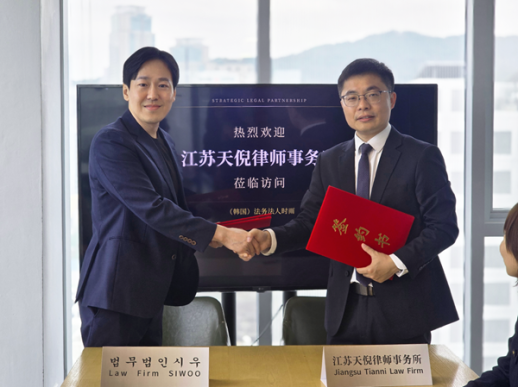 Siwoo Law Firm Signs MOU With China’s Jiangsu Tianni Law Firm Siwoo Law Firm has expanded its on-the-ground legal cooperation network in China by signing a strategic memorandum of understanding with TIANNI Law Firm, based in Nanjing, Jiangsu province. Siwoo said it signed the MOU on the 20th at its Seoul office in Seocho-dong. Attorney Ryu Seung-ho of Siwoo and Managing Attorney Zhang Zhihua of Tianni attended the ceremony and signed the agreement. Ryu oversees international work at Siwoo and handles legal matters involving greater China. Zhang serves as chair of the Duty Crime Prevention and Defense Committee of the Jiangsu Lawyers Association, Siwoo said. Siwoo has built working relationships with law firms in major Chinese cities including Beijing, Shanghai, Guangzhou and Xi’an. After forming a partnership last year with Shandong Zhongsheng Chengtai Law Firm, Siwoo said the addition of Jiangsu Tianni as an official MOU partner further broadens its base in China. Tianni, founded in 2019, operates its headquarters in Nanjing and branch offices in Taizhou in Jiangsu and in Yadong, Yadong County, in Rikaze, Tibet, Siwoo said. Taizhou is considered a manufacturing hub in the Yangtze River basin, while Yadong is a border trade port near India and Bhutan. Siwoo said the footprint gives it a local partner base to respond to legal demand tied to the East China economic region as well as transactions linked to South Asia. Tianni works in civil and commercial matters, international trade, corporate legal services and intellectual property, and has experience handling cross-border cases, Siwoo said. Practical cooperation with Siwoo will be led by Tianni partner attorney Luo Wei, who specializes in civil-commercial and cross-border matters. Under the agreement, the firms will cooperate on advisory work for Korean and Chinese companies entering each other’s markets and making investments, international trade and commercial disputes, intellectual property protection, company formation and tax-related advice. When legal needs arise involving either country, they plan to set up a priority referral and engagement system and, depending on the case, form joint response teams to provide integrated legal services. The firms also agreed to share client and network resources and to strengthen competitiveness in the global legal services market through joint marketing and information exchanges. Siwoo said it is expanding cross-border legal services in Vietnam, China, Japan and North America through a group structure in which specialists in corporate legal affairs, tax and accounting, and family and inheritance work together. “This agreement will serve as a foundation to support clients’ overseas expansion and investment risks in a more systematic way through cooperation with a capable local law firm in China,” Ryu said. “We will continue to expand global partnerships and provide integrated, client-centered legal services.” The two firms said they plan to use the MOU to build a long-term, stable cooperative relationship and support clients’ global activities across a range of Korea-China business areas.* This article has been translated by AI. 2026-04-29 11:27:20
 -
 Samsung Electronics Targets Heat Pumps as Key Growth Engine in Home Appliances Revamp As Samsung Electronics overhauls its underperforming home appliance business, it is putting heat pumps at the center of its next growth push. The company said it will move more aggressively into electrified heating in South Korea, building on proprietary heat pump technology it says has been recognized in Europe and other global markets. Song Byeong-ha, a group leader in Samsung Electronics’ DA (home appliances) business, said at a media briefing on April 29 for the company’s newly launched Korea-specific “EHS heat pump boiler” that heat pumps are “a key solution” for switching to electric heating and achieving carbon neutrality. “Based on proven technology and global R&D infrastructure, we will continue to innovate so domestic consumers can enjoy both stable heating performance and energy efficiency,” Song said. A heat pump absorbs heat energy from outside and uses it as an indoor heat source. It operates on a vapor-compression cycle in which a refrigerant repeatedly changes between liquid and gas, absorbing and releasing heat. The principle is similar to an air conditioner: refrigerant that has absorbed outside heat is compressed into a high-temperature, high-pressure gas, and the heat is transferred through a heat exchanger to indoor air or water. After releasing heat, the refrigerant expands, cools and returns to a liquid state that can absorb heat again. Samsung said its heat pump uses a large-capacity heat exchanger and a more efficient valve structure inside the compressor to reduce energy loss during compression. The company said the system can supply about five times as much heat energy as the electrical power it consumes. Samsung also said the system is designed to provide stable heating in severe cold. It said high-efficiency refrigerant compression and anti-icing technology allow operation at temperatures as low as minus 25 degrees Celsius, and that it can reliably supply hot water up to 70 degrees Celsius even at minus 15 degrees Celsius. Song cited a user case in Yangpyeong, saying temperatures there fell to minus 15 degrees Celsius in January and the home maintained an indoor temperature of 15 degrees Celsius for about 20 days, leaving the customer “very satisfied.” He said oil boiler users often turn systems on and off to manage fuel costs, while a heat pump can be left running, offering a convenience advantage. Samsung said heating costs can be reduced by up to 53% compared with typical city gas. Song said results vary depending on the relative prices of gas, oil and electricity, but the Yangpyeong customer cut heating costs by 53% after switching to a heat pump. He added that after about 2.5 to 3 years, a heat pump becomes clearly more cost-effective than city gas. Samsung said carbon dioxide emissions are about 60% lower. It also said the product uses R32 refrigerant, which it said has a global warming potential 68% lower than R410A, a refrigerant commonly used in residential air conditioners and other heating and cooling equipment. Song acknowledged limits, including difficulty installing the system in high-rise buildings such as apartments and higher upfront installation costs. He said heat pumps are currently optimized for typical houses, and that Samsung is working with Samsung C&T, a Samsung Group affiliate, to study what technology best fits high-rise apartments of 20 floors or more. He said the company expects to disclose results soon. Separately, the government began a heat pump boiler support program this month for households using briquette or kerosene boilers and for areas without city gas supply in major local governments including Jeju, South Jeolla and South Gyeongsang. Applicants can check eligibility through local government notices and apply in person. Eligible households can receive subsidies after installation is completed and verified through an on-site inspection by the local government. The subsidy can cover up to 70% per household, including purchase and installation costs. * This article has been translated by AI. 2026-04-29 11:25:13
 -
 Lotte Engineering Wins South Korea Certification for Quake-Resistant Fire Piping Brace Lotte Engineering & Construction said Tuesday that a quake-resistant firefighting piping technology it co-developed with Doosan E&C, HL D&I Halla and MakeSoon has received a construction new-technology certification from the Ministry of Land, Infrastructure and Transport (No. 1043). The technology, an integrated four-direction anti-sway brace for vertical and horizontal piping, is designed to prevent damage to firefighting pipes during earthquakes. The company said South Korea’s market for seismic bracing of firefighting piping has relied entirely on imported products, and the new system represents successful localization and domestic production. Under conventional two-direction bracing, pipes located away from the brace could be damaged by leverage effects. The new design combines two braces into a single integrated device, supporting the pipe in four directions at the same time and significantly improving seismic performance, the company said. Lotte Engineering said the method also showed environmental and cost benefits. For an underground parking garage in a 500-household apartment complex, it can reduce installation points to 25 from 39 under existing methods. It also cuts carbon dioxide emissions by about 51% and reduces raw material use by about 50%, it said. The company said the technology has also received related certifications, including designation as a disaster-safety new technology (NET) and green technology certification. It has been applied at multiple sites, including Hadan Lotte Castle and Seomyeon Lotte Castle Eluce, and Lotte Engineering said it plans to expand use nationwide, including at Munhyeon Lotte Castle Infiniel and Daejeon Lotte Castle The First. “Localizing a seismic technology that had a high dependence on overseas products and maximizing safety is highly meaningful,” a Lotte Engineering official said. “Because it is an innovative, eco-friendly method that reduces material use, we will continue to expand on-site applications.”* This article has been translated by AI. 2026-04-29 11:24:04
 -
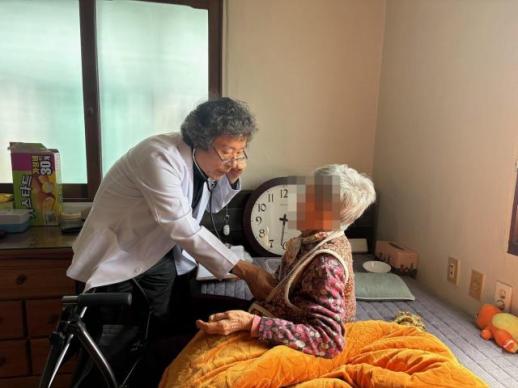 Nonsan Expands Home-Visit Medical Care to Reach Homebound Seniors “I don’t have to drag my sick body to the hospital.” A home-visit medical service introduced by Nonsan City in South Chungcheong province is drawing strong response from residents with limited access to care. The program, a long-term care home medical center service for seniors with mobility problems, is being cited locally as a new model for public health care. The service targets long-term care beneficiaries who have difficulty getting outpatient treatment. A team from Kim Hyeonjang Surgical Clinic, including medical staff and a social worker, visits patients at home to provide examinations and prescriptions, health monitoring, medication guidance and connections to care resources. Doctors assess patients on site and issue prescriptions, while nurses explain day-to-day health management. Social workers link patients to needed care services, providing medical and welfare support together. The city said the team also focuses on explaining results in detail to caregivers to help ease the burden of care. Users have welcomed the service. One senior said, “It was hard to go to the hospital because I’m not well, and it helps a lot that they come to my home.” A caregiver said, “It’s reassuring and truly helpful when they visit and explain what’s needed.” To reduce costs, the city supports part of the out-of-pocket payment for home visits. National Health Insurance subscribers pay 6,000 won, and Medical Aid recipients pay 2,000 won. Nonsan City said it expects the program to help prevent conditions from worsening, reduce unnecessary hospitalizations and ease caregiver burdens, shifting care from hospital-centered treatment to support rooted in daily life. A city official said home-visit care supports health and daily care in a person’s living space and plays a key role in improving access for residents who have difficulty traveling. The official said the city will continue expanding services by strengthening cooperation with local medical institutions. The city’s experiment with “care that comes to you” is being watched as a possible new standard for regional public health care.* This article has been translated by AI. 2026-04-29 11:23:16
 -
 NHN Dooray! Unveils AI Agent to Automate Workflows, Targets Finance Sector Growth “Generative AI used to talk. Now it acts. If a project is delayed, it finds the work on its own, messages the right people, and summarizes the results and leaves them in the wiki. Dooray AI will be a ‘member’ that works with you, not just a tool,” Baek Chang-yeol, CEO of NHN Dooray, said at a news briefing Tuesday in Pangyo. Baek said collaboration software is shifting from assistance to execution, as companies move beyond simple Q&A to “AI agents” that carry out tasks. NHN Dooray introduced a new “Dooray AI Agent” built into its collaboration platform, Dooray!, and outlined adoption results and its strategy focused on the public and financial sectors. The company launched its subscription-based AI service, DoorayAI, in 2024. Baek said the new agent is a step forward, moving from summarizing email and messenger content to taking actions based on data. He said the agent can automatically detect delayed tasks in a project and notify the person in charge, or capture meeting discussions in real time and turn them into documents. “The agent joins as the same kind of member as a person, entering messenger chats and projects to work alongside employees,” he said. Baek said the capability comes from Dooray’s data structure, which integrates personal tools such as email, messenger and calendars with shared spaces such as projects and wikis, allowing the AI to understand context and act. “For AI to work properly, you need not only personal data but also an organization’s shared data,” he said, calling Dooray’s coverage of both areas a competitive strength. NHN Dooray said revenue in its software-as-a-service business has been growing about 40% a year, and it has maintained the top position in the public sector by number of institutions served. In finance, it said it has secured 25 institutions, including Woori Financial Group and IBK Industrial Bank of Korea. Baek said winning 25 finance references in a year was a result the market would not easily expect from a small organization, and said it showed both service quality and speed of expansion. At the briefing, Woori Financial shared its rollout. Yoon Jong-pil, a deputy general manager in the ICT Planning Department at Woori Financial Holdings, said network-separation environments had made it difficult to use subscription software or generative AI for internal work, which he said went beyond inconvenience and hurt competitiveness. Woori reviewed SaaS-based collaboration tools to address the issue, comparing about 10 solutions, domestic and foreign, before choosing Dooray, Yoon said. He cited price competitiveness, ease of customization, and an all-in-one structure integrating email, messenger and task management. Yoon said usage rose sharply after adoption. Connections that were about 1,600 at the early stage of internal-network deployment in March 2025 have increased to more than 30,000 a month, he said. He added that generative AI use has moved from simple testing to use in actual financial work. “At first, there were many curiosity-driven questions, but now it has become a practical tool that improves productivity,” Yoon said, adding that 88% rated it positively in an employee satisfaction survey. Baek said market conditions are also turning favorable as the Financial Services Commission eases network-separation rules, lowering barriers to SaaS and AI adoption and accelerating cloud transitions in finance. He said approvals used to take significant time, but adoption can now move quickly if security standards are met, calling it an opportunity for Dooray, which he said already meets the standards. NHN Dooray said it plans to make growth in finance a core pillar this year, and it expects financial-sector revenue to grow about sevenfold from a year earlier as more institutions prepare new deployments. “In the end, AI is about how much you can automate and make work more efficient,” Baek said. He said Dooray lowered barriers to AI adoption with a structure that can be deployed with a few clicks, and is now expanding into actual task execution through agents. He added that with results proven in security-sensitive areas such as finance and the public sector, adoption could spread faster. * This article has been translated by AI. 2026-04-29 11:21:33