
Journalist

Lim, Kwu Jin
-
 Global Tea Brand CHAGEE Enters South Korea, Pledges Focus on ‘Real Tea’ Experience Global modern tea brand CHAGEE has entered the South Korean market, pitching tea’s natural flavor and an in-store experience as an alternative in a coffee-dominated beverage scene. CHAGEE on April 28 held a media day at its Gangnam flagship store in Seoul to outline its Korea launch and brand strategy. Kim Jwa-hyeon, CEO of CHAGEE Korea, and Kim Jeong-hee, the company’s chief marketing officer, presented the brand’s philosophy, products and store concept. The company says its mission is to “connect people through a good cup of tea,” positioning itself as a modern take on premium tea. Founded in China’s Yunnan province in 2017, CHAGEE now operates about 7,000 stores across China, Southeast Asia and the United States, among other markets. Kim Jwa-hyeon said the company sees growing interest in tea as more than a drink. “There is a growing trend to expand tea into an everyday experience,” he said, adding that South Korea’s high expectations for quality and experience align with CHAGEE’s direction. CHAGEE will open three stores simultaneously on April 30: the Gangnam flagship, a Sinchon location and a store at Yongsan’s I’Park Mall. The company said the Gangnam store will concentrate the brand experience, Sinchon will target younger consumers, and Yongsan will serve as a hub for a broader customer base. CHAGEE said its product strategy centers on “the natural flavor of tea,” led by milk tea made with tea brewed in-store and fresh milk. It is emphasizing balance over intense sweetness. Kim Jeong-hee said the company designed “the entire process — from selecting tea leaves to extraction to drinking — as a single experience.” The Gangnam store is built around a tea bar and is designed for customers to stay and drink, rather than focusing only on takeout. The company said it incorporated Korean architectural elements and collaborations with artists to reflect local sensibilities. For now, CHAGEE will operate directly run stores. Kim Jwa-hyeon said the company will focus first on managing customer touchpoints and delivering a consistent brand experience, adding that franchising will be considered later depending on market response. At the stores, drinks were priced at 4,900 to 5,600 won for regular sizes and 5,600 to 6,600 won for large sizes. The menu will initially follow global standards, with localized items to be introduced later to reflect Korean tastes, the company said. CHAGEE said it is prioritizing experience-led growth over short-term buzz. Under the message “Real Tea, Real Moments,” it plans to encourage organic expansion through store experiences and customer engagement. “I believe in the power of a cup of tea, and we will sincerely share that experience with Korean consumers,” Kim Jwa-hyeon said. “I ask for your interest and expectations for the journey CHAGEE will build in Korea.” * This article has been translated by AI. 2026-04-28 17:09:48
 -
 Korean Banks Face Rising Delinquencies as Government Pushes More Corporate Lending Banks are growing increasingly concerned about asset quality as government efforts to curb household lending and expand so-called productive finance push more credit toward companies. With the economy slowing, a rapid expansion of lending to weaker firms could become a threat to banks’ balance sheets, the industry says. According to the financial sector on the 28th, the average overall delinquency rate for the four major banks — KB Kookmin, Shinhan, Hana and Woori — rose to 0.36% in the first quarter, covering both household and corporate loans. That was up 0.06 percentage points from 0.30% at the end of last year. The delinquency rate refers to the share of loans with both principal and interest overdue by more than one month. Delinquencies at regional banks, which have a higher share of lending to local small and midsize businesses, have crossed the 1% level seen as a psychological threshold. As of the fourth quarter of last year, the average delinquency rate at four regional bank affiliates under BNK Financial Group and JB Financial Group was 1.07%, up 0.29 percentage points from 0.78% a year earlier. With regional downturns persisting, analysts said the upward trend could continue this year. The challenge, bankers say, is that delinquencies are rising just as policy-driven expansion of productive finance makes loan growth hard to avoid. As corporate lending increases quickly and delinquencies climb, banks face pressure to expand credit while also tightening risk management. Unlike collateral-heavy household loans, corporate loans are more exposed to spillover defaults when the economy weakens. The industry also points to growing numbers of higher-risk borrowers as downside pressure on the economy has increased since the Middle East war, signaling weaker capacity for companies to repay debt on time. In the Bank of Korea’s survey on financial institutions’ lending attitudes, the corporate credit risk index for the second quarter rose from the previous quarter to 25 for large companies and 36 for small and midsize firms. The index measures the risk of delinquency or default, with higher figures indicating greater risk. If rising credit risk leads to more troubled borrowers and keeps delinquencies climbing, banks’ asset-quality burden could intensify. Warning signs are already showing in key indicators. The four major banks’ average nonperforming loan coverage ratio fell to 153.8% in the first quarter from 172% at the end of last year, down 18.2 percentage points. The ratio compares loan-loss reserves with substandard loans that are more than three months overdue and is a major gauge of banks’ ability to absorb losses. A lower ratio indicates weaker loss-absorbing capacity. The balance of nonperforming loans rose about 12% from the end of last year to 5.0773 trillion won. Banks also warn that aggressive corporate lending could hurt profitability. Policy projects require interest rates to be set below certain levels, and commercial banks with relatively higher funding costs can see margins shrink. In some large projects, loan rates have been set about 0.5 to 6 percentage points below the market average, making negative margins unavoidable once funding costs are considered, according to the industry. Banks also cited added burdens from expanding inclusive finance for vulnerable groups and support tied to prolonged Middle East-related risks. A financial industry official said expanding productive finance is necessary, but warned that running it at a fast pace with a focus on performance could bring side effects such as bad loans. The official added that banks face a difficult task of meeting government policy direction and social expectations while also raising shareholder returns under value-up initiatives. * This article has been translated by AI. 2026-04-28 17:07:56
 -
 SK Hynix to Redeem Remaining Exchangeable Bonds Early, Cutting Debt by 133 Billion Won SK Hynix said in a regulatory filing on 28일 that it will exercise a cleanup call to redeem the remaining portion of foreign-currency exchangeable bonds it issued overseas in 2023. The face value of the bonds to be repurchased is about 132.7 billion won, representing 5.9% of the total issuance of about 2.2377 trillion won. A cleanup call allows an issuer to redeem bonds early and end the creditor-debtor relationship once the outstanding balance falls to 10% or less. Investors can choose to exchange their bonds for shares or receive cash repayment. Given that the current share price is far above the exchange price, investors are widely expected to opt for share exchanges. With the remaining unredeemed exchangeable bonds set to be fully retired, the company expects its accounting debt to fall by about 133 billion won, which is also expected to lower its borrowing ratio. * This article has been translated by AI. 2026-04-28 17:07:13
 -
 Court Temporarily Halts FIU’s Partial Business Suspension of Coinone for One Month A partial business suspension ordered against South Korean virtual asset exchange Coinone, which had been set to take effect on the 29th, has been put off for one month. According to the legal community and the virtual asset industry on the 28th, the Seoul Administrative Court decided to temporarily suspend the effect of the sanction until May 29 in a lawsuit Coinone filed against the head of the Financial Intelligence Unit (FIU) seeking to overturn the partial suspension, along with Coinone’s request for a stay of enforcement. The court’s move pauses the sanction while it reviews the stay request and reaches a final judgment. It is not a final decision on the stay petition. The FIU held a sanctions review committee meeting on the 13th and imposed a three-month partial business suspension on Coinone from April 29 to July 28, citing violations including duties to block prohibited transactions and to verify customer identities. It also levied an administrative fine of 5.2 billion won. Coinone filed the cancellation suit and the stay request with the Seoul Administrative Court on the 27th, two days before the suspension was to begin. The decision means Coinone will not be subject to the planned partial suspension for the next month. Coinone’s legal challenge adds to a widening court fight between virtual asset exchanges and regulators. Upbit and Bithumb have also filed administrative lawsuits and sought stays to contest FIU sanctions. * This article has been translated by AI. 2026-04-28 17:05:03
 -
 Corporate Credit Downgrades Accelerate, Testing Banks’ Bad-Loan Risk Banks have begun regular corporate credit-rating reviews as Middle East-driven geopolitical risks and tougher U.S. tariff barriers add downward pressure on manufacturers’ credit profiles. Corporate delinquencies have jumped nearly fourfold in just three months, but banks, constrained by regulators’ “productive finance” policy stance, have been reluctant to raise rates or pull credit from borrowers facing downgrades. According to the financial industry on Monday, major banks started this month’s periodic reviews using companies’ 2025 year-end financial statements. The reviews cover all firms with lending relationships at each bank. Ratings are determined by factors including sales, operating profit, cash holdings, interest coverage and technology capabilities. Because the results influence future loan limits and interest rates, the process is a core task for banks’ corporate-finance units. This year’s reviews are expected to be stricter than usual, as volatility in raw-material prices tied to Middle East risks and stronger U.S. protectionism hit export-dependent manufacturers at the same time. Signs of weakening credit are already emerging across major industries. In steel, global rating agency S&P cut POSCO’s rating to BBB+ from A-. Korea Ratings lowered LG Chem’s outlook this month to negative from stable. NICE Investors Service assigned EcoPro an A- rating on its senior unsecured bonds, below its previous A level. In solar, Hanwha Solutions is under downgrade pressure with net debt of about 12 trillion won. In construction, Daewoo Engineering & Construction and others facing reduced housing move-in volumes received negative outlooks. The problem, bankers say, is that downgrades are not translating into higher financing costs as they typically would. Normally, weaker ratings lead to higher interest rates or reduced lending. But with authorities emphasizing “productive finance” to cushion the economy, banks are being pushed to maintain or extend loans even as they recognize rising credit risk. That dynamic is weighing on bank soundness. If banks cannot fully price the added risk, they struggle to secure returns commensurate with exposure. As delinquencies rise, some warn that potential bad loans could accumulate without being immediately reflected on balance sheets. Delinquency indicators are climbing quickly. At the five largest banks — KB, Shinhan, Hana, Woori and NH NongHyup — the delinquency rate for large corporations rose to 0.13% in the first quarter from 0.03% at the end of last year. The rate for small and midsize companies increased to 0.57% from 0.49%. Real estate delinquencies hit the highest levels across major banks, and the delinquency rate for sole proprietors also reached a record high of 0.56%. The outlook remains uncertain. If the recovery is delayed, some expect “delayed restructuring,” with problems at companies reliant on support surfacing later. If policy constraints ease, others warn that rate hikes and credit tightening could come at once, sharply increasing corporate burdens. A financial industry official said, “This year we have no choice but to be conservative in assigning ratings, but in reality more companies are getting their loans extended,” adding, “The gap between policy and market logic is widening.”* This article has been translated by AI. 2026-04-28 17:03:28
 -
 Hyundai Duty Free Opens New Incheon Airport DF2 Zone, Targets 1 Trillion Won in Annual Sales Hyundai Duty Free has begun operations in Incheon International Airport’s DF2 zone, expanding its footprint to three of the airport’s six duty-free areas: DF2, DF5 and DF7. The company said it is now the airport’s largest duty-free operator and the only one there offering every major category, from luxury and fashion to cosmetics and liquor. The company said Tuesday it started full-scale business in DF2 across the airport’s Terminal 1 and Terminal 2. The DF2 zone covers 4,571 square meters (about 1,382 pyeong). A total of 287 brands have moved in, including cosmetics and fragrance labels such as Chanel Beauty, Dior, Yves Saint Laurent and Estée Lauder, and liquor, tobacco and food brands including Ballantine’s, Johnnie Walker, Hennessy and CheongKwanJang. The operating term runs through June 30, 2033, and can be extended by three years to as late as April 2036, for up to 10 years in total. Stores are open daily from 6:30 a.m. to 9:30 p.m., with some cosmetics, liquor and tobacco shops operating 24 hours. Hyundai Duty Free said its existing DF5 and DF7 zones already host the airport’s widest selection of luxury brands, including Chanel, Louis Vuitton, Prada, Gucci, Loewe and Burberry. With DF2 added, the company said it is positioned to capture a broader range of high-end shopping demand. Targeting overseas travelers, the company has also set up a “K-cosmetics zone” near Gate 248 on the third floor of Terminal 2’s duty-free area. It features about 40 Korean beauty brands, including Medicube, Torriden, Wellage and Abib, and offers experiences such as AI-based skin analysis and personal color consultations. Hyundai Duty Free said it is considering joint marketing with its parent company, Hyundai Department Store. Plans include a pop-up at The Hyundai Seoul to guide customers on duty-free shopping, and a review of ways to bring Hyundai Department Store fashion, food and intellectual property content into the airport duty-free shops. The company said it posted its first full-year profit last year, seven years after launch, helped by tighter management and a recovery in passenger demand. It said the airport expansion is expected to support continued quarterly profitability and could lift annual sales at Incheon alone to more than 1 trillion won. Chief Executive Park Jang-seo said, “With the operation of the DF2 zone, we have become the largest operator at Incheon International Airport, and we expect to generate more than 1 trillion won in annual sales from the airport alone.” Park added that the company will keep a profitability-first approach at both its airport and downtown stores, while sharpening merchandising and marketing to build a stable growth structure and “lead duty-free shopping trends” as a top player in the domestic market.* This article has been translated by AI. 2026-04-28 17:01:12
 -
 Lotte Fine Chemical Q1 2026 Operating Profit Jumps 73.9% to 32.7 Billion Won Lotte Fine Chemical reported preliminary first-quarter 2026 results on the 28th, posting revenue of 510.7 billion won and operating profit of 32.7 billion won. Revenue rose 14.6% from a year earlier, while operating profit jumped 73.9%. The company cited stronger earnings from higher sales of TMAC (tetramethylammonium chloride aqueous solution), a raw material used in semiconductor developer solutions, amid a boom in the chip market. It also pointed to higher international prices for ECH (epichlorohydrin), a feedstock for epoxy resins, and increased sales from expanded capacity for Heros, a cellulose-based paint additive. Lotte Fine Chemical said profitability is expected to improve further in the second quarter as it steps up eco-friendly businesses. The company has entered the ammonia marine-fuel supply (bunkering) market and said it succeeded in commercializing the business on April 23, positioning itself as a leading company in clean ammonia. It is also preparing to break ground on a new plant for higher value-added products. Handuck Chemical, a Lotte chemical affiliate that produces TMAH (tetramethylammonium hydroxide) used in semiconductor developer solutions, plans to start construction of a new plant in Pyeongtaek in the second quarter. TMAC is a key raw material for developer solutions used in semiconductor circuit etching processes, and Lotte Fine Chemical said it has the world’s No. 1 TMAC production capacity. Chief Executive Jeong Seung-won said, "In the first quarter, profitability improved sharply due to factors including increased sales of TMAC, a raw material for semiconductor developer solutions, amid a boom in the semiconductor market." He added, "This year will be one in which we deliver visible results in the ammonia marine-fuel business and core semiconductor materials businesses we have been pursuing to strengthen eco-friendly and higher value-added operations."* This article has been translated by AI. 2026-04-28 17:00:21
 -
 Lotte Department Store’s Incheon Branch Completes 3-Year Renovation, Targets 1 Trillion Won in Annual Sales Lotte Department Store’s Incheon branch has completed a sweeping renovation that took about three years, and the retailer said it is aiming to become the first department store in western Seoul metro area to reach 1 trillion won in annual sales. The Incheon store will hold a “grand open” event on May 1, Lotte said Monday, marking the final stage of the renovation that has been carried out in phases since 2023. The overhaul centered on an upscale strategy to match fast-changing local demand. After opening the premium food hall “Food Avenue” in late 2023, the store added a large beauty zone, kids section, and women’s and luxury fashion areas the following year. Despite lengthy construction-related disruptions, the store’s annual sales topped 8.3 trillion won last year, its first time surpassing 8 trillion won. That was up more than 10% from 2022, before the renovation. Sales in the first quarter of this year rose by more than 20%. Lotte also reported a shift in its customer mix. The Incheon branch’s share of its top-tier “Avenuel Black” VIP customers increased, and sales from preferred customers rose about 20% from a year earlier. Food Avenue, built around well-known restaurants to attract younger diners, helped drive new and repeat visits among customers in their 20s and 30s, the company said. Compared with before the renovation, both the number of new customers in that age group and their sales rose about 30%. Total visits to the renovated food hall surpassed 15 million cumulatively through last year. A key addition is the first-floor “Luxury Hall,” completed this month. Starting with Piaget and Bulgari, high-end jewelry brands including Tiffany, Boucheron and Graff have opened in sequence this year. Moncler also reopened in what Lotte said is its largest store in South Korea. With the luxury lineup expanding to more than 50 brands, luxury goods accounted for more than 30% of sales as of the first quarter. Lotte said it is also launching the “Lotte Town Incheon” project to turn the surrounding area into a mixed-use destination combining shopping and culture. With the department store renovation as phase one, the company plans to begin phase two in the second half of this year by modernizing the Incheon Intercity Bus Terminal. The aging terminal, which draws an average of 7,000 visitors a day, will be relocated to a nearby site and rebuilt to improve convenience, Lotte said. The existing site will be redeveloped, with the goal of building a third major “Lotte Town” after Myeongdong and Jamsil. Beginning on the official reopening day, the store will also run a customer appreciation event featuring hands-on programs for families, including a kids art station, a picnic garden and a pop-up liquor shop offering craft beer and traditional Korean alcohol. “Incheon has wrapped up a premium renovation spanning three years and has completed preparations to enter the ‘next 1 trillion-won department store’ tier,” said Jeong Dong-pil, head of Lotte Department Store’s Incheon branch. “Through major innovation in customer experience, we will continue to grow it into a next-generation premium department store with competitiveness that goes beyond the region.”* This article has been translated by AI. 2026-04-28 16:57:26
 -
 Doosan Bobcat Q1 2026 Operating Profit Rises 3.5% to 207 Billion Won Doosan Bobcat said in a regulatory filing on the 28th that it posted first-quarter 2026 revenue of 2.2473 trillion won and operating profit of 207 billion won. Revenue rose 7.1% from a year earlier and operating profit increased 3.5%. Net profit climbed 15.9% to 131.4 billion won, helped by lower financial costs. In dollar terms, revenue and operating profit increased 6.2% and 2.6%, respectively, maintaining an overall growth trend. By region, Europe, the Middle East and Africa grew 18% on a recovery in demand for compact equipment, leading results. North America rose 3% as forklift sales rebounded. Asia, Latin America and Oceania increased 4% on higher sales in South America, China and India. By product, compact equipment revenue rose 7%, and industrial vehicles grew 4% on expanded sales in North America. Portable power revenue fell 18% due to delays in a key customer’s sales schedule. Doosan Bobcat said it is maintaining an annual minimum dividend of 1,600 won per share and a quarterly dividend policy under its corporate value enhancement plan. Its board on the 28th set the first-quarter dividend at 400 won per share.* This article has been translated by AI. 2026-04-28 16:54:18
 -
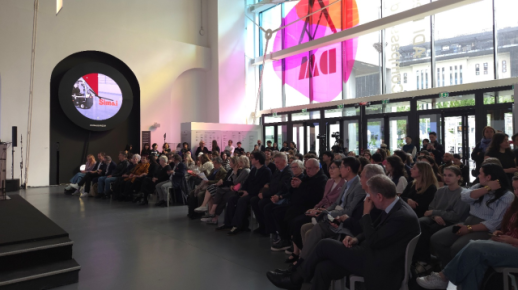 Kookmin University holds inaugural DBEW international design awards in Milan SEOUL, April 28 (AJP) - Kookmin University and the Association for Industrial Design hosted the first Design Beyond East & West Award ceremony at the ADI Design Museum on April 21, coinciding with the opening of Milan Design Week, the prominent South Korean university said Tuesday. The international competition received over 800 entries from 44 countries, focusing on creative design education and outcomes for the future society in the age of artificial intelligence. Unlike traditional design competitions, the Design Beyond East & West (DBEW) Award recognizes both students and their educators for collaborative achievements in fields such as architecture, space design, product design, and visual communication. The event served as an open forum for students, educators, and experts to discuss the future of the industry. The ceremony was attended by prominent figures, including Jury Chair Paola Antonelli, Stefano Giovannoni, and John Thackara. Lorenzo Imbesi, President of Cumulus, and Emilia Gatto, the Italian Ambassador to South Korea, delivered congratulatory remarks emphasizing international solidarity. The Gold Prize was awarded to Baoyi Huang and Professor David Buck from the University of Sheffield for their project, "Ecological Samsara – Soundscape Transformation of Parkwood Springs." Silver prizes were awarded to teams from HTW Berlin University of Applied Sciences, Avantika University, and L'École de design Nantes Atlantique. Andrea Cancellato, Director of the Association for Industrial Design (ADI) Design Museum, noted that the awards grew from a memorandum of understanding signed with Kookmin University last year. "This award is the only model in the world that honors both the educator and the student simultaneously," Cancellato said, adding: "It is an important milestone for the museum in strengthening ties with Asia." Paola Antonelli, who chaired the jury, highlighted that the devotion of teachers is often undervalued and that the DBEW Award brings the necessary attention to the noble value of the educators. Fellow juror John Thackara added that after decades in education, he believes that value lies in the dialogue during the process rather than just the finished result. During a concurrent forum titled "Future-Oriented Redefinition of Design Education," participants discussed the necessity of critical thinking in the AI era. Students at the forum called for curricula that better integrate research with industrial execution and provide a deeper understanding of business mechanisms. The award program is rooted in the work of the Oriental Culture & Design Center (OCDC) at Kookmin University, established by Director Choi Kyung-ran. The center has spent 20 years researching the essential values of design in Asia, providing the foundation for the current international competition. "The DBEW Award is a stage that demonstrates the potential of a global education cluster where universities share technology and philosophy to solve common human problems beyond borders," said Chung Seung-ryul, President of Kookmin University. "It will serve as a practical compass and a new role model for design education in the AI era." The organizers have begun preparations for next year's competition, with schedules for future submissions and forums to be announced on the official DBEW website. 2026-04-28 16:48:20