
Journalist

MIN JAE YONG
-
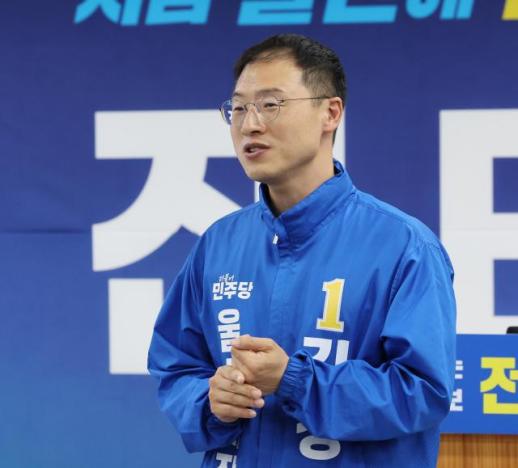 AI Takes Center Stage in Regional Growth Strategies Ahead of Local Elections As the June 3 local elections approach, candidates from Gangwon, Busan, and Ulsan are positioning artificial intelligence (AI) as a key element of their regional growth strategies. The common theme among them is to expand the AI industry, which has been concentrated in the capital region, into local areas and to create new growth engines by integrating AI with regional industries. In particular, Gangwon is focusing on securing AI infrastructure, Busan aims to establish itself as an AI hub, and Ulsan is prioritizing the transformation of its manufacturing sector through AI, leading to a competitive landscape of AI pledges tailored to each region's industrial structure. The race for the Gangwon Special Self-Governing Province governor has highlighted the importance of attracting the National AI Computing Center. Woo Sang-ho, the Democratic Party's candidate for governor, has made this a central promise of his campaign. Woo stated, "This is the largest investment project in Gangwon's history, estimated to be worth between 20 trillion and 70 trillion won. We will secure both advanced companies and youth jobs based on AI infrastructure." He has also urged large corporations to prioritize hiring local talent in connection with policies aimed at fostering the AI industry. Kim Jin-tae, the People Power Party's candidate for Gangwon governor, is advocating for a strategy focused on developing future industries through the establishment of a semiconductor cluster and attracting advanced companies. His plan includes training semiconductor personnel and building test beds to expand Gangwon's advanced industrial ecosystem. In Busan, the competition to become an AI hub is intensifying. Jeon Jae-soo, the Democratic Party's candidate for Busan mayor, has proposed creating a customized AI belt by dividing the city into three areas: South, East, and West Busan. He envisions developing South Busan, home to the Busan New Port's 7th terminal, into a center for marine and logistics AI, while East Busan will leverage existing content infrastructure, such as the Busan International Film Festival (BIFF), to create a media AI special zone. This strategy aims to focus on nurturing AI-based content industries, including film, drama, and gaming. In West Busan, centered around Saha District, plans are in place to establish an 'AI Industry Operations Center' to enhance productivity and equipment utilization in aging manufacturing plants through AI. Park Hyung-jun, the People Power Party's candidate for Busan mayor, emphasizes the importance of data for Busan's tailored AI initiatives. He plans to organize data from Busan's six key industries—port, marine, shipbuilding, manufacturing, finance, and civilian life—for AI learning and inference, and to establish a 'Busan AI Hub' that will provide over 200 types of public data (APIs) for free. He aims to create 50,000 related jobs by 2035. In Ulsan, the focus is on the transformation of the manufacturing sector through AI. Kim Sang-wook, the Democratic Party's candidate for Ulsan mayor, has proposed integrating AI into Ulsan's key industries, including shipbuilding, automotive, and petrochemicals, to enhance industrial competitiveness. His main pledges include expanding smart factories using data from manufacturing sites and creating an industrial AI ecosystem. Kim Doo-gyeom, the People Power Party's candidate for Ulsan mayor, has made the 'AI Capital Ulsan' strategy a key promise. He plans to promote the AI transformation of Ulsan's core manufacturing industries, including shipbuilding, automotive, and petrochemicals, based on the expansion of data centers by SK and Amazon Web Services (AWS). His strategy also includes maximizing local industrial competitiveness through the expansion of smart manufacturing and the utilization of industrial data.* This article has been translated by AI. 2026-05-21 22:13:16
 -
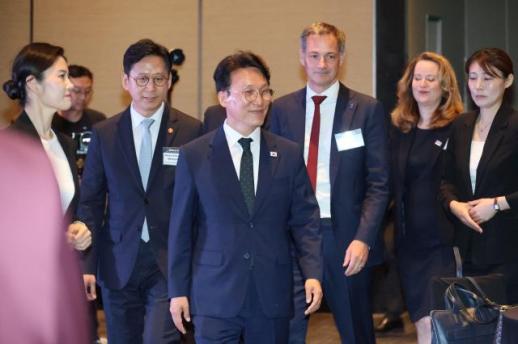 Prime Minister Kim Meets UNDP Chief to Discuss AI Collaboration Kim Min-seok, the Prime Minister of South Korea, met with Alexander de Croo, the Administrator of the United Nations Development Programme (UNDP), to discuss enhancing cooperation in global artificial intelligence (AI) initiatives and expanding collaboration with international organizations. According to Yonhap News, during their meeting, Prime Minister Kim expressed gratitude for de Croo's leadership in facilitating South Korea's participation in the UNDP's Global AI Hub. Earlier that day, the South Korean government hosted a Global AI Hub Vision Declaration ceremony in Seoul, attended by representatives from nine international organizations, including the UNDP, who united in their commitment to advancing the AI Hub. Kim emphasized South Korea's intention to increase its contributions to international organizations, including the UN, as a responsible leading nation amid challenging global circumstances. He called for strengthened cooperation across various sectors. Additionally, he urged greater involvement and support from the Korean public and businesses, including youth, in UNDP activities. In response, de Croo noted, "The relationship between South Korea and UNDP began in the aftermath of the Korean War, but it has achieved remarkable progress. As a result, South Korea is now one of the most stable contributing countries to UNDP." He added, "The Global AI Hub Vision Declaration we held today signifies the opening of new horizons for cooperation between South Korea and UNDP, and I will work to strengthen our collaboration further."* This article has been translated by AI. 2026-05-21 22:09:40
 -
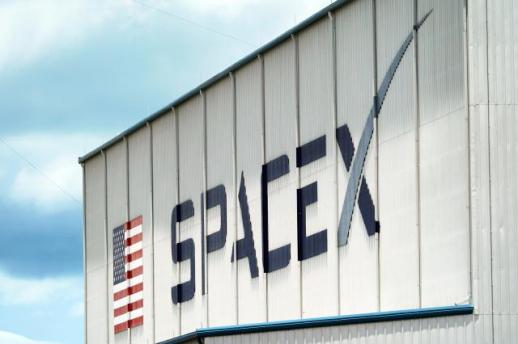 SpaceX Plans to Build Cities on the Moon as IPO Approaches Aerospace company SpaceX has publicly released its investment prospectus ahead of its initial public offering (IPO) filed with the U.S. Securities and Exchange Commission (SEC). According to Yonhap News on May 21, the prospectus, published on the SEC's website, states that SpaceX has applied for the listing of its Class A common stock on the Nasdaq and Nasdaq Texas under the ticker symbol 'SPCX.' SpaceX aims to raise a record $75 billion through the IPO. If successful, the company's valuation is expected to reach $1.75 trillion. The prospectus outlines SpaceX's mission to "ultimately build cities on the Moon and other planets." Additionally, as of March 31 of this year, the company has successfully launched a total of 7,400 tons of cargo into orbit, boasting a 99% mission success rate for its Falcon rockets. The company plans to conduct an IPO roadshow for institutional investors starting June 4, with the listing process expected to conclude by June 12. Class A shares will be available for general investors, while a select few insiders, including CEO Elon Musk, will hold Class B shares with ten times the voting power. Notably, Musk will retain over 80% of the total voting rights even after the IPO. He also has protections in place that prevent him from being dismissed without his consent, and any legal claims from shareholders must go through arbitration. Goldman Sachs is the lead underwriter, with Morgan Stanley, Bank of America, Citigroup, and JPMorgan serving as co-managers. Mirae Asset Securities is also included in the underwriting group. The prospectus leaves the allocation of SpaceX's public offering shares to each co-manager blank. However, it appears that a domestic public offering in Korea will be difficult. The prospectus states that "the Class A common stock offered under this prospectus has not been registered under the Korean Capital Markets Act (FSCMA) and will not be registered in the future," indicating that the shares will be offered privately in Korea under the FSCMA. Meanwhile, Mirae Asset Securities is reported to have invested approximately 800 billion won in SpaceX, with speculation that the Mirae Asset Group may receive around $5 billion worth of public offering shares.* This article has been translated by AI. 2026-05-21 22:07:28
 -
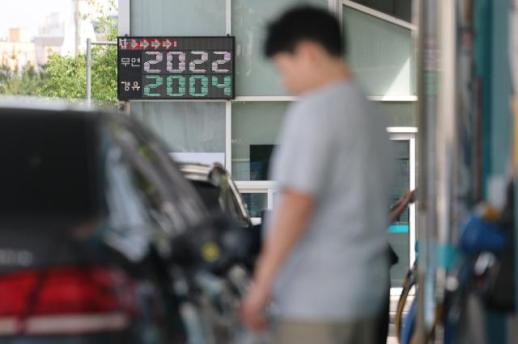 South Korea Freezes Sixth Oil Price Cap Amid Global Market Stability The South Korean government has decided to freeze the sixth oil price cap, marking the fourth time since the second cap was implemented. Previously announced every two weeks, the oil price caps will now be adjusted every four weeks. The Ministry of Trade, Industry and Energy announced on May 21 that the sixth oil price cap, effective from midnight on May 22, will maintain the prices at 1,934 won per liter for regular gasoline, 1,923 won for diesel, and 1,530 won for kerosene. The government implemented the oil price cap system on March 13 in response to rising inflation pressures due to international oil prices exceeding $100 per barrel. The initial cap set prices at 1,724 won for regular gasoline, 1,713 won for diesel, and 1,320 won for kerosene. The second cap, effective from March 27, set the prices at 1,934 won for gasoline, 1,923 won for diesel, and 1,530 won for kerosene. The third and fourth caps were also frozen, with the current prices remaining unchanged. The decision to freeze the price cap again was influenced by the lack of significant changes in international circumstances since the last adjustment. The cumulative factors contributing to price increases continue to exert pressure on inflation and the cost of living. Yang Gi-wook, head of the Ministry's Resource Security Division, stated, "While there seemed to be progress in the ceasefire negotiations between the U.S. and Iran, they are currently at a standstill, and the U.S.-China summit has not yielded clear results. International oil prices are hovering around the $100 mark, and there have been no significant changes since the fourth price cap decision." He added, "The cumulative increase factors for gasoline have slightly risen to the upper 200 won range, while diesel and kerosene have decreased to the mid-300 won and mid-400 won ranges, respectively." Sales of oil products continue to decline compared to the previous year. In May, gasoline sales decreased by 2% and diesel by 6% compared to the same month last year. Over the past ten weeks since the price cap was implemented, gasoline sales dropped by 8%, and diesel sales fell by 8% compared to the same period last year. Prices at gas stations have mostly remained stable. The government has also decided to extend the adjustment period for the price cap from two weeks to four weeks. Previously, the Ministry adjusted the price cap every two weeks to respond quickly to market changes. However, with the ongoing stalemate in the Middle East conflict, international oil price volatility has decreased. This change aims to enhance predictability and stability for gas station operators, the general public, and drivers reliant on their vehicles for economic activity. Yang emphasized, "If there are changes in the situation, we will adjust the price cap regardless of the schedule. If the situation in the Strait of Hormuz changes, we will immediately begin adjustments. If there are no changes in the Strait of Hormuz, the likelihood of stabilization appears low, so we will monitor the situation closely." Regarding the recent agreement to pursue an oil swap system with Japan during the Korea-Japan summit, he noted, "We have reached a consensus on the general direction, but we need to specify the details through discussions with private companies. Japan has significant reserves, but South Korea has superior refining capabilities, suggesting there may be mutually beneficial solutions to explore." He further explained, "Given Japan's relatively long territory, it may be effective to utilize Ulsan's refining facilities for areas adjacent to the East Sea. We have examined various aspects, including storage facilities, leading to the Korea-Japan agreement. Further details will be developed in the future."* This article has been translated by AI. 2026-05-21 22:04:46
 -
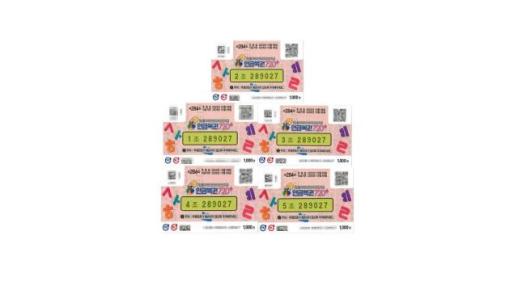 Lottery Winner Shares Surprising Story After Winning Pension Lottery "One day, I suddenly felt like buying a lottery ticket, so I went to a lottery shop and bought both lotto and pension lottery tickets." As interest grows in the winning numbers for the 316th Pension Lottery 720+ on May 21, the story of a winner from the 284th Pension Lottery 720+ has captured attention. The winner, who claimed 1st place (1 ticket) and 2nd place (4 tickets), shared their experience on the Donghaeng Lottery winner's bulletin board, stating, "One day, I suddenly felt like buying a lottery ticket, so I went to a lottery shop and bought both lotto and pension lottery tickets. Later, while checking the tickets at home using the QR code, I discovered I had won 1st place in the pension lottery." The winner expressed disbelief, saying, "I was so surprised that I checked it several times to make sure it was real. Even now, it doesn't feel real. I bought the tickets just for fun, thinking, 'There's no way I'll win,' and now I'm so grateful and happy to have received such great luck." The individual purchased the tickets at a lottery shop in Cheongsan-myeon, Goheung-gun, Jeollanam-do. When asked about their usual lottery purchases, they replied, "I usually buy lotto and pension lottery tickets, and occasionally Spitto." Regarding plans for the winnings, the winner stated, "I still can't believe it, so I haven't made any specific plans yet." Meanwhile, the winning numbers for the 316th Pension Lottery 720+ will be available after 7:05 PM today.* This article has been translated by AI. 2026-05-21 22:03:00
 -
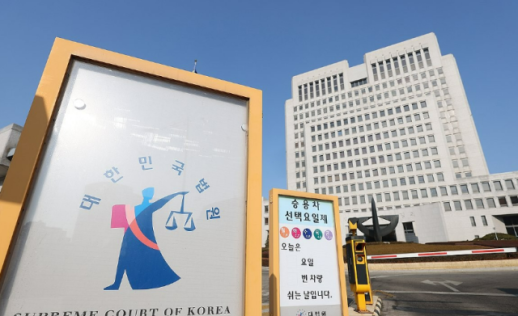 Supreme Court Rules Tattooing by Non-Medical Professionals Is Not a Violation of Medical Law The Supreme Court has ruled that the typical tattooing practices performed by non-medical professionals do not constitute unauthorized medical practice. This marks a significant change in legal precedent after 34 years since the court's previous ruling in 1992 that deemed such actions a violation of medical law.On May 21, the Supreme Court's full bench unanimously overturned the lower court's ruling that had imposed fines on defendants A and B for violating medical law and sent the case back to the Seoul Western District Court and Suwon District Court with an acquittal recommendation.Defendant A was charged with performing scalp tattooing at a beauty salon in Yongsan, Seoul, from January to December 2020, while Defendant B was charged with providing lettering tattoos at a fashion accessory store in Seongnam, Gyeonggi Province, in May 2019. Both were fined 1.5 million won and 1 million won, respectively, in the first and second trials.The key issue in these cases was whether typical cosmetic tattooing practices fell under the unauthorized medical practices prohibited by Article 27, Section 1 of the former medical law.The Supreme Court stated, "The typical cosmetic tattooing practices performed by the non-medical defendants do not constitute unauthorized medical practices as defined by Article 27, Section 1 of the former medical law." It added that the lower court had maintained the guilty verdict from the first trial, which misinterpreted the legal principles regarding medical practices and affected the judgment.The court explained, "Since the Supreme Court's ruling in May 1992, which classified eyebrow tattooing as unauthorized medical practice, advancements in medical technology and changes in the healthcare environment have significantly improved access to medical services for consumers. Additionally, the general public's knowledge and practice of health and hygiene have markedly improved."It further noted, "Individuals seeking tattoos are in a position to freely decide whether to undergo tattooing as a means of expressing their individuality and pursuing happiness, based on information regarding the health risks and management associated with typical cosmetic tattooing practices."The court emphasized that when determining whether typical cosmetic tattooing constitutes unauthorized medical practice, various interpretations should favor the constitutional rights of individuals seeking tattoos, including their freedom of occupation, freedom of expression, and the right to pursue happiness.Moreover, the court pointed out that tattooing requires not only technical skills for safe procedures but also the ability to achieve a desired level of aesthetic quality, which is not necessarily possessed by medical professionals. It warned that a blanket prohibition against non-medical professionals could infringe upon the constitutional rights of individuals seeking cosmetic tattooing, including their general personality rights and freedom of expression derived from Article 10 of the Constitution.A Supreme Court official stated, "According to the full bench ruling, typical cosmetic tattooing practices are no longer considered unauthorized medical practices under Article 27, Section 1 of the former medical law. Comprehensive regulations regarding this matter are expected to be implemented under the Tattoo Law and related legislation, which will take effect on October 29, 2027."The official added, "However, even before the implementation of the Tattoo Law, if a tattoo artist causes injury due to negligence, it does not negate the possibility of criminal penalties or the introduction of regulations to protect public health as defined by relevant laws such as the Criminal Code or Public Health Management Act."* This article has been translated by AI. 2026-05-21 22:00:25
 -
 Starbucks Controversy Sparks Industry Reassessment of Promotions The controversy surrounding Starbucks Korea's 'Tank Day' event is reverberating throughout the retail industry. The promotion, which coincided with the May 18 Democratic Uprising Memorial Day, has faced criticism for trivializing historical trauma. This concern intensified after President Lee Jae-myung referenced a Musinsa advertisement from seven years ago. Retailers are now reviewing not only their ongoing promotions but also past advertisements and content, adopting a cautious approach in light of the situation. According to industry sources on the 21st, a beauty company is currently assessing its ongoing promotions, previously distributed advertisements, and social media content. A company representative stated, "We are examining whether there are any inappropriate historical references following the Starbucks Korea Tank Day controversy." The household goods sector is experiencing a similar response. Although there has been no official directive from the company, it is reported that departments have been asked to review existing marketing content. A company representative explained, "In light of the Tank Day controversy and the renewed discussion of past advertisements, we are proactively checking for any potentially problematic elements." The industry's heightened sensitivity stems from the potential for the historical trivialization controversy sparked by Starbucks to extend to past content. The day before, President Lee publicly criticized a 2019 Musinsa advertisement featuring the phrase, "I slammed the desk and said, 'Oh my,'" which was noted for evoking memories of the late Park Jong-cheol's torture and death. In response to the President's remarks, Musinsa issued another apology, stating, "We deeply acknowledge that the wounds left by our hasty judgment seven years ago are not trivial even today." The controversy surrounding Musinsa had been resolved through the deletion of the content, an official apology, and visits to the bereaved families and the Park Jong-cheol Memorial Association for further apologies. CEO Jo Man-ho and other executives personally sought forgiveness, and it is reported that the association accepted Musinsa's apology. Following this, Musinsa invited history instructor Choi Tae-sung to conduct historical education for its employees. CEO Jo continues to be active as a member of the Park Jong-cheol Memorial Association. The retail industry believes this controversy could extend beyond a single company and affect the entire sector. The fact that President Lee received information about the Musinsa advertisement has raised concerns among businesses. There is a possibility that previously created advertising phrases or images could resurface through online reports. The Starbucks Korea controversy has also escalated into discussions of executive accountability. Jeong Yong-jin, chairman of Shinsegae Group, Starbucks Korea's parent company, has been reported for defamation, and there are calls for his resignation. An industry source stated, "In the future, marketing approvals will likely involve stricter scrutiny of expressions that could be linked to historical events, social tragedies, or specific individuals." In fact, Starbucks Korea has temporarily suspended some promotions and marketing schedules ahead of the summer peak season. The company announced through an internal notice the day before, "We are postponing or canceling events with a heavy sense of responsibility and a reflective mindset." They also decided not to operate their booth at the '18th Seoul Jazz Festival' scheduled for the 22nd to 24th. Summer is the peak season for beverage sales in the coffee franchise industry. Consequently, the postponement or cancellation of major events by Starbucks is expected to impose unavoidable pressure on short-term sales. An industry insider remarked, "This controversy has attracted international media attention and prompted responses from Starbucks headquarters. If similar issues arise with the company's name mentioned, the brand burden is significant, leading companies to act more swiftly than usual."* This article has been translated by AI. 2026-05-21 21:57:39
 -
 Starbucks Faces Boycott and Customer Exodus Amid Tank Day Controversy The controversy surrounding Starbucks Korea's "Tank Day" has escalated into a boycott movement, refund relays, and political and ideological disputes. Industry experts warn that this situation could undermine Starbucks' core competitive advantage, its loyal customer base, brand image, and overall revenue structure. As of May 21, posts sharing methods for refunding Starbucks cards have rapidly spread across online communities and social media platforms. Some users have encouraged participation in the boycott by posting screenshots of their membership cancellation on the Starbucks app or refund certification photos. Videos showing users smashing Starbucks tumblers and mugs with hammers, dubbed "boycott certifications," have also emerged. Additionally, tips for covering or marking out the Starbucks logo on their products with stickers have been shared. The backlash has reached the political arena and local communities, with criticism that Starbucks has belittled the May 18 Gwangju Democratization Movement. Within the Democratic Party, a directive has been issued to avoid entering Starbucks locations, and organized boycotts have begun in the Gwangju and Jeonnam regions among local governments and businesses. On May 21, the city of Gwangju released a statement declaring that it views the Starbucks Korea incident not merely as a mistake by a staff member but as a significant social disaster caused by a CEO lacking historical awareness. The city announced a ban on using Starbucks gift cards at various events it organizes. Gwangju Bank, which has previously distributed Starbucks products to thousands during major events like savings and card launches, has also announced a complete halt to its distribution of Starbucks products and mobile coupons. Industry analysts are closely monitoring the potential impact of the boycott, refund requests, and app cancellations on Starbucks' customer retention structure, which has been crucial to its growth. Starbucks has employed a strategy that combines a prepaid charging system with a rewards program to keep loyal customers within its ecosystem. According to the Financial Supervisory Service's electronic disclosure system, SCK Company reported a record prepaid balance of 427.6 billion won at the end of last year, with total contractual liabilities, including unused reward points, reaching 454.3 billion won. However, the growth rate of prepaid balances has noticeably slowed due to intensified competition in the café industry. The growth rate for Starbucks' prepaid balance, which reached 19.1% in 2022, dropped to 8.2% last year. Analysts suggest that the rapid penetration of low-cost coffee brands into Starbucks' core market is diminishing its appeal to loyal customers. In this context, the possibility of accelerated customer attrition due to the current situation cannot be ruled out. Above all, it seems inevitable that the brand's image will suffer. Some conservative online communities have referred to Starbucks as "Patriotbucks" and "Anti-Communist Café," launching a "support movement" alongside AI-generated images of former President Chun Doo-hwan. Concerns are rising that if the brand becomes a proxy in ideological conflicts, it could lead to a permanent loss of general customers. There are also speculations that if the situation escalates into a political issue, Starbucks' headquarters in the U.S. may intervene directly. The company has emphasized its neutrality, stating on its official website that "Starbucks is not a political organization." If the headquarters does intervene, the call option clause in the equity agreement with Shinsegae Group could be triggered. In July 2021, E-Mart acquired additional shares from Starbucks Coffee International (SCI), the U.S. parent company, and currently holds a 67.5% stake in Starbucks Korea. However, the call option held by the headquarters includes a clause that allows it to acquire all of E-Mart's shares at a 35% discount to fair value if the contract is terminated due to E-Mart's fault. If the headquarters were to reclaim management rights due to brand value deterioration, it could lose a key cash cow with annual sales of 3.238 trillion won, placing significant pressure on Shinsegae Group. Lee Jong-woo, a professor of retail marketing at Namseoul University, stated, "It is quite dangerous for a consumer-facing brand to become embroiled in political controversies. There needs to be authentic actions that consumers can understand, such as supporting content related to democratic values or contributing to education, to turn the situation around."* This article has been translated by AI. 2026-05-21 21:55:13
 -
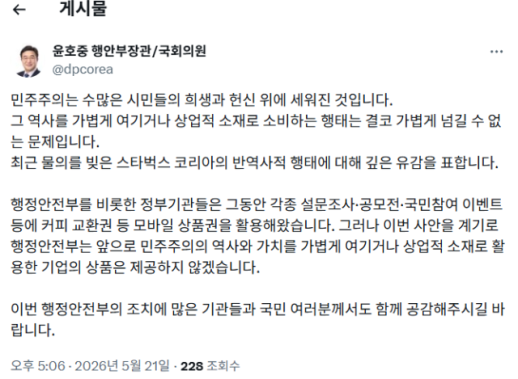 Yoon Ho-jung: Government to Halt Starbucks Promotions Over Controversy Yoon Ho-jung, the Minister of the Ministry of Interior and Safety, announced that the government will cease providing promotional items from Starbucks Korea following controversy surrounding the company's planned 'Tank Day' event coinciding with the May 18 Democratic Uprising memorial. On May 21, Yoon stated on X, "Democracy is built on the sacrifices and dedication of citizens," adding, "Disregarding that history or commodifying it is not something we can take lightly." He expressed deep regret over Starbucks Korea's "anti-historical behavior" that sparked recent outrage. Yoon explained that government agencies, including the Ministry of Interior and Safety, have previously utilized mobile gift cards, such as coffee vouchers, for surveys, contests, and public participation events. He emphasized that, moving forward, they will not provide products from companies that undermine the history of democracy or exploit social values for commercial gain. He also expressed hope for understanding and participation from other institutions and the public. Earlier, President Lee Jae-myung also criticized the matter strongly, calling it an act that "insults the sacrifices and struggles of citizens" and labeling it an inhumane behavior that denies democratic values. He stated that there must be moral, administrative, legal, and political accountability, questioning whether an apology would be forthcoming. The controversy erupted when Starbucks Korea used phrases like 'Tank Day' and 'Bang on the Desk' in a tumbler promotion set to begin on May 15. As criticism grew that these expressions trivialized the May 18 Democratic Uprising and the torture and death of Park Jong-cheol, the company decided to halt the event. Following this, Chairman Jeong Yong-jin issued a public apology, stating, "I take full responsibility for this matter."* This article has been translated by AI. 2026-05-21 21:52:16
 -
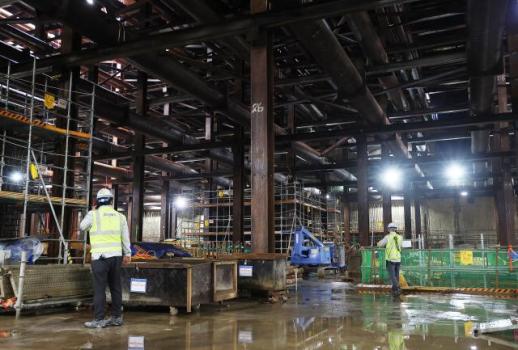 Lee Criticizes President Yoon for Interfering in Elections Over GTX-A Issues Jang Dong-hyuk, leader of the People Power Party, criticized President Lee Jae-myung on May 21 for allegedly interfering in the upcoming elections by directing an investigation into the missing rebar issue at the GTX-A Samsung Station construction site. Jang shared an article on his Facebook page detailing President Lee's instructions to the Ministry of Land, Infrastructure and Transport regarding the rebar situation, stating, "Jung Won-o (the Democratic Party's candidate for Seoul mayor) is struggling, so Lee Jae-myung is in a hurry." He linked the government's push for a special investigation into incidents involving President Lee to the current situation, questioning, "Is the Ministry of Land, Infrastructure and Transport, which is responsible for the incident, being told to cover up its mistakes?" Jang added, "Seoul citizens already know the truth about Jung Won-o, so it won't matter," and challenged, "If you're innocent, let's have a debate about Samsung Station." Earlier, Jung Won-o called for a halt to the GTX-A Samsung Station construction, suggesting that it should be paused until safety concerns are addressed. The Democratic Party announced plans to hold a task force meeting on May 22 to investigate the allegations surrounding the missing rebar. In response, Oh Se-hoon, the People Power Party's candidate for Seoul mayor, criticized Jung, saying, "He is only focused on amplifying public anxiety to gain an electoral advantage. The Ministry of Land and the Korea Railroad Corporation concluded after 17 days of test operations that there are no safety issues, yet he wants to stop it for political reasons." Lee Jun-seok, leader of the Reformist Party, remarked, "Saying that the GTX-A Samsung Station construction should be stopped is essentially declaring that you want to disrupt the commuting routes for residents of Hwaseong. Using safety as an excuse to halt the GTX project is merely a political maneuver against candidate Oh." He emphasized, "I will not stand by while the Democratic Party sacrifices the commuting routes of Hwaseong residents for their electoral calculations. We cannot allow the already delayed full opening of GTX-A to be postponed further due to the political logic of candidate Jung and the Democratic Party."* This article has been translated by AI. 2026-05-21 21:51:00