
Journalist

Michael Z. Green
-
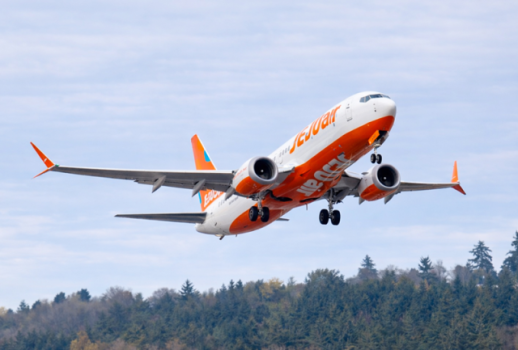 Jeju Air launches trial route to make Jeju more accessible to international visitors SEOUL, May 12 (AJP) - Jeju Air has begun trial operations on a route linking Incheon and Jeju, the low-cost carrier said on Tuesday. The airline will operate the route twice a week for three months on a trial basis to gauge demand, aiming to make it easier for foreign tourists arriving from overseas to reach the southern resort island. The first flight for the route departed from Jeju International Airport at 9:45 a.m. earlier in the day and arrived in Incheon at 11 a.m. Flights will be available on Tuesdays and Saturdays through the end of this month, then switch to Mondays and Fridays starting next month. Until now, foreign tourists arriving in Incheon had to travel to a separate airport such as Gimpo to fly to Jeju. The new route makes travel to Jeju more convenient for international passengers. The number of foreign tourists to Jeju has been rising rapidly. According to the Jeju Tourism Big Data Service Platform, 2.24 million foreign tourists visited Jeju last year, up 17.7 percent from 1.91 million a year earlier. The number of foreign visitors in the first quarter of this year also rose 29.3 percent from the same period last year. The route could also be good news for Jeju residents. Amid growing demand for long-haul international flights, travelers departing from Jeju, particularly those heading to Europe or the U.S. would no longer need to make an extra trip to Gimpo, saving time and reducing travel hassle. "Foreign arrivals to Jeju are on the rise, and we hope this new route will support balanced regional tourism growth while improving travel convenience for Jeju residents," a Jeju Air spokesperson said. 2026-05-12 14:49:35
 -
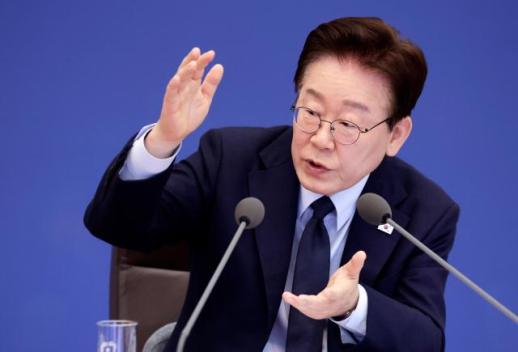 Seoul hints at fiscal expansion for H2 and 2027, sending bond yields to hike-cycle highs SEOUL, May 12 (AJP) — President Lee Jae Myung on Tuesday openly challenged the long-held policy rationale for fiscal tightening to rein in South Korea’s highly leveraged economy, signaling a more expansionary fiscal stance for the second half of this year and 2026 as growth concerns deepen amid prolonged Middle East tensions. “This is a time for investment to bolster growth potential,” Lee said during an emergency cabinet meeting, ordering the government to draft an “aggressive fiscal” strategy in next year’s budget and the supplementary spending plans for the second half. Lee defended proactive government spending, arguing that stimulus coupons distributed last year generated additional consumption of roughly 430,000 won ($310) per recipient, which he said demonstrated that fiscal support can meaningfully revive the economy. He also pushed back against concerns over the country’s debt burden, claiming South Korea’s actual government debt level remained only around 10 percent of gross domestic product. The remark appeared to reference an International Monetary Fund calculation that estimated South Korea’s net debt at 10.3 percent of GDP. However, the IMF figure excludes substantial liabilities such as pension obligations and debt held by state-run enterprises. According to the Ministry of Economy and Finance, South Korea’s broader national debt measure, known as D1 and encompassing both central and local government debt, recently stood at around 49 percent of GDP. Public sector debt, or D3 — which also includes non-financial public institutions — is estimated at roughly 68 percent. Markets interpreted Lee’s comments as a clear signal of fiscal expansion as the government braces for slowing growth and mounting uncertainties from the prolonged conflict in the Middle East. Bond yields, already revisiting levels last seen during the 2023 tightening cycle, rose further on expectations of increased debt issuance tied to fiscal expansion. The benchmark three-year government bond yield climbed 4.6 basis points to 3.644 percent on Tuesday, while the 10-year yield rose 5.2 basis points to 4.002 percent — returning to levels seen in November 2023, when the Bank of Korea’s policy rate stood at 3.5 percent during the height of post-pandemic inflation fighting. Liquidity conditions, however, remain ample. According to the Bank of Korea, the growth rate of broad money supply, or M2, recently expanded about 4.9 percent from a year earlier, relatively elevated compared with other major economies such as the United States and Japan. At the same time, the money multiplier under the revised M2 standard stood at 13.56 as of February, well below levels above 20 seen before the 2008 global financial crisis. The money multiplier — calculated by dividing M2 by the monetary base — measures how effectively central bank liquidity circulates through the economy via deposits and lending. The figures suggest liquidity itself may not be the core problem, but rather weak transmission into actual consumption and investment. Some economists argue that improving the distribution and circulation of capital through structural reforms and targeted policy measures may be more effective than relying solely on debt-financed fiscal expansion. The Bank of Korea is scheduled to release its March money supply data on Wednesday. 2026-05-12 14:27:20
 -
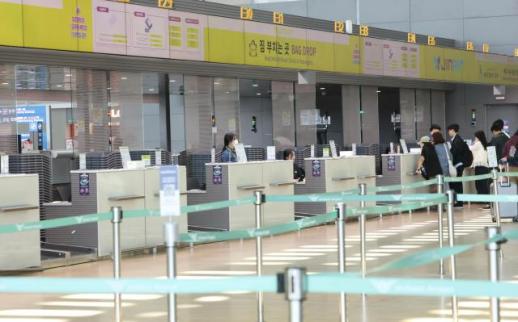 Fuel shock pushes Korean LCCs back into pandemic-like survival mode SEOUL, May 12 (AJP) - A spike in fuel prices, war-related travel restrictions and passenger jitters are pushing South Korea's budget carriers back into pandemic-era survival mode, forcing them to delay hiring as well as streamlining payrolls and flights as they try to ride out the Gulf crisis. Jin Air, a low-cost carrier under Korean Air, has informed 50 newly hired cabin crew members that they will start work in the fall instead of this week as originally planned, citing "emergency management conditions" caused by the Middle East-driven energy crisis. The airline hired 100 cabin crew members in the first half of the year, half of whom have already begun work. Despite the last-minute delay, Jin Air said it remains committed to honoring the hires. The carrier has already introduced a series of emergency cost-cutting measures, including an indefinite delay in annual safety bonus payments for employees. It has also cut 176 round-trip flights through this month to reduce fuel costs, trimming routes to destinations such as Guam and Phu Quoc Island in Vietnam. Further reductions are expected once June schedules are finalized. Low-cost carriers, whose overseas networks are heavily concentrated on Southeast Asian leisure routes, have cut around 1,000 international round-trip flights over the past two months amid the Middle East conflict. The pressure has intensified as Singapore jet fuel prices, the benchmark for Asia's aviation industry, surged to an average of $214.71 per barrel between March 16 and April 15, about 2.5 times higher than prewar levels. Airlines are increasingly concerned that higher fuel surcharges could weaken summer travel demand as operating costs continue to climb. Other budget carriers have also begun introducing unpaid leave and other belt-tightening measures. Jeju Air, the country's largest low-cost carrier, began accepting applications this week for voluntary unpaid leave among cabin crew members for June. T'way Air introduced unpaid leave for cabin crew for May and June, while Aero K, a smaller budget airline, offered voluntary unpaid leave to all employees for May. The Ministry of Employment and Labor held an emergency meeting late last month to assess postwar labor market conditions and worried that the airline industry could face broader restructuring if the conflict drags on. 2026-05-12 14:16:26
 -
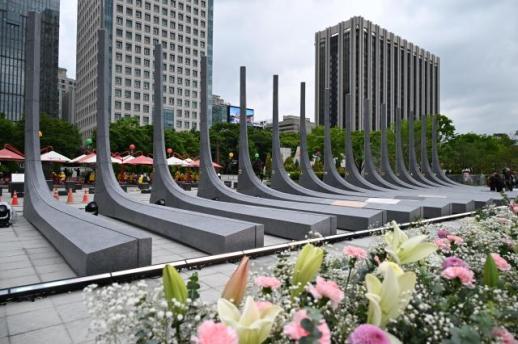 Seoul's Gwanghwamun Square gets Korean War memorial garden SEOUL, May 12 (AJP) - A memorial garden dedicated to soldiers who died in the Korean War was opened to the public at Gwanghwamun Square in central Seoul, the Seoul Metropolitan Government said on Tuesday. Earlier in the day, a ceremony celebrating its completion was held, attended by war veterans and ambassadors from the 22 countries that sent troops and provided support during the 1950–53 Korean War. According to the city government, the space dubbed the "Garden of Gratitude" aims to make the square, which draws about 27 million visitors a year, a place to reflect on the values of freedom and peace in daily life, and a symbolic space for South Korea's liberal democracy. Construction began in November last year and wrapped up in about six months, despite a temporary halt over procedural issues and controversy surrounding its rifle-shaped sculptures. The garden features a 6.25-meter-tall installation consisting of 23 rifle-shaped sculptures, which symbolize the dedication of countries that provided assistance during the war to defend freedom and peace. The installation was created using granite donated by seven countries including Belgium, Germany, Greece, India, Luxembourg, the Netherlands, and Norway, as a reflection of solidarity and cooperation with the international community. Stone from five additional countries including Australia, Sweden, Thailand, Turkey, and the U.S. is scheduled to be added by the end of this year. The garden also includes an underground exhibition hall for remembrance and reflection. A nighttime lighting show will run six times a day, every 30 minutes, with each session lasting 10 minutes and featuring lights projected from the 23 sculptures. Guided tours of the garden will be offered starting Wednesday. They will also be available in English. "The Garden of Gratitude will be more than a landmark in the capital as it will be a place of memory and connection that links the world and generations," said acting Seoul Mayor Kim Seong-ho. He added that the city will continue to uphold the values of freedom and peace and fulfill its role and responsibilities as part of the international community in working toward a better world. 2026-05-12 14:14:50
 -
 Avignon Festival to spotlight Korean language and contemporary performing arts SEOUL, May 12 (AJP) - The Avignon Festival, one of the world’s leading performing arts festivals, will spotlight the Korean language and contemporary Korean productions during its 80th edition in July, marking the first time an Asian language has been selected as the festival’s official invited language. The Korean-language spotlight program coincides with the 140th anniversary of diplomatic relations between South Korea and France, highlighting the growing cultural exchange between the two countries beyond the global popularity of K-pop, film, and television dramas. Held annually in the southern French city of Avignon, the festival runs from July 4 to 25 and is regarded as one of Europe’s most influential theater and live performance events. Founded in 1947 by French actor and director Jean Vilar, the festival is known for presenting contemporary and experimental productions in historical venues across the city. This year’s program also marks the first time the festival has centered on a single national language as part of its invited language initiative, which highlights the arts and culture of a selected linguistic community each year. English, Spanish, and Arabic were previously featured in 2023, 2024, and 2025, respectively. A total of nine Korean productions will be presented in the festival’s official "In" program, the main section featuring curator-selected works staged across the festival’s principal venues. Among the featured productions is "Oiseau," a staged reading based on Nobel Prize-winning author Han Kang’s novel "We Do Not Part." The performance will take place at the Cour d’Honneur of the Palais des Papes, the festival’s signature venue, and will star French actress Isabelle Huppert alongside Korean actress Lee Hye-young. Other Korean works include playwright and director Jaha Koo’s "Cuckoo," "Haribo Kimchi" and "The History of Korean Western Theatre." Additional productions explore themes ranging from Jeju Island’s haenyeo culture and the Jeju April 3 uprising to the climate crisis and contemporary Korean identity. They include “MULJIL,” "Island Story," "1 Degree Celsius," "KIN: Yeonhee Project I" and "Snow, Snow, Snow." The lineup reflects the expanding global reach of contemporary Korean performing arts as Korean-language productions continue to gain visibility on major international stages. 2026-05-12 13:59:29
 -
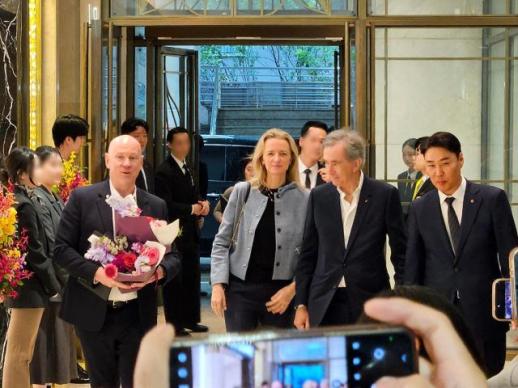 Arnault Seoul tour signals Dior reckoning in split luxury market SEOUL, May 12 (AJP) - Just 30 centimeters behind LVMH Chairman Bernard Arnault during his closely watched Seoul tour walked the executive many luxury insiders believed was carrying the real assignment of the trip: Delphine Arnault, tasked with reassessing Christian Dior’s position in one of the world’s most influential — and increasingly polarized — luxury markets. While cameras followed the world’s most powerful luxury executive through Seoul’s flagship department stores and high-end retail districts, industry attention centered on whether Dior could regain footing in South Korea after losing momentum in a market that once symbolized the global luxury boom. Korea remains the world’s highest per-capita spender on personal luxury goods, with consumers spending roughly $325 annually per person on luxury products, according to Morgan Stanley — higher than consumers in the United States or China. Morgan Stanley analysts noted that “South Korean buyers' demand for luxury goods is due to both an increase in purchasing power and an external desire to show off their social status.” The country’s luxury market, valued at more than $16 billion, has become strategically indispensable for global brands not only because of spending power but because Seoul increasingly functions as a trend laboratory for younger Asian consumers. Yet beneath the headline figures, the Korean luxury market has undergone a sharp structural shift. “Brand performance remained highly polarized in 2025,” Bain & Company noted in a recent global luxury report, adding that “the absolute luxury tier continued to hold strong,” while aspirational luxury demand weakened amid deteriorating consumer sentiment. That polarization has become especially pronounced in South Korea. Luxury spending has increasingly split into a two-speed market: recession-resistant VVIP consumers continue concentrating purchases on heritage houses such as Hermès, Chanel and Louis Vuitton, while younger buyers in their 20s and 30s — once the engine of Korea’s luxury boom — are retreating under high interest rates, inflation, weak wage growth and a housing market that has drifted out of reach. Nam Sung-hyun, an analyst at IBK Investment & Securities, described the widening divide bluntly: “While lower-income brackets see reduced spending power, the upper classes, who can increase income through assets, have even greater spending capacity.” That divergence has created clear winners and losers across the luxury sector. While ultra-premium houses continued posting record sales growth in Korea, brands positioned closer to aspirational luxury have struggled to maintain momentum as discretionary spending weakens. Industry analysts say Dior became particularly exposed because of its aggressive expansion among Korea’s MZ generation — millennials and Gen Z — through celebrity ambassadors, social media marketing and entry-level luxury products. The strategy thrived during the post-pandemic “flex” consumption boom. But the same younger consumers who fueled Korea’s luxury surge have now become the most vulnerable to economic pressure. Higher borrowing costs, slowing growth and mounting household burdens have begun eroding aspirational consumption, leaving brands dependent on trend-sensitive younger buyers increasingly exposed. Meanwhile, wealthy VVIP consumers have consolidated spending further toward the most established heritage houses with the strongest exclusivity and resale value. Against that backdrop, Delphine Arnault’s detailed inspection of Seoul department stores and flagship operations drew outsized industry attention. As CEO of Dior Couture and a central figure in the future leadership of LVMH, her visit was widely interpreted within the industry as more than ceremonial succession optics. Instead, it was viewed as part of a broader strategic reassessment of how Dior positions itself in Korea at a time when the market increasingly rewards ultra-premium exclusivity over mass aspirational desirability. For global luxury groups, South Korea is increasingly serving as an early indicator of broader shifts likely to spread across Asia: younger consumers remain culturally influential and digitally powerful, but sustaining luxury demand now requires balancing social-media-driven accessibility with the exclusivity demanded by high-net-worth clientele. In that sense, the Seoul trip was not simply about Korea. It was about the future direction of the global luxury industry itself. 2026-05-12 13:57:58
 -
 Google says it blocked AI-assisted cyberattack plot, warns of North Korean hacking activity SEOUL, May 12 (AJP) - Google claimed it had preemptively blocked hackers who were preparing large-scale cyberattacks using artificial intelligence and identified North Korean state-linked hacking activities leveraging AI to refine cyber operations. According to its report published on the Cloud Security blog, Google’s Threat Intelligence Group (GTIG) uncovered a threat actor believed to have used AI in preparations for a “zero-day” attack campaign. Google said the actor appeared to be planning broad operations, but the company’s early intervention likely prevented the attacks from being executed. A zero-day attack exploits previously unknown software vulnerabilities before developers can issue security patches, making such intrusions especially difficult to defend against. The disclosure adds to mounting concerns in the cybersecurity industry that rapid advances in AI-assisted vulnerability detection could accelerate the discovery and weaponization of software flaws. According to the report, the attackers sought to exploit vulnerabilities to bypass two-factor authentication systems. Google stressed there was no evidence its own AI model, Gemini, had been used in the operation. While Google did not identify the actor behind the attempted attacks, it separately warned that state-backed hacking groups linked to China and North Korea are showing “particular interest” in applying AI to cyber operations. The company said such groups are adopting increasingly sophisticated AI-assisted techniques for vulnerability discovery and exploitation, including integrating specialized, high-quality security datasets into their workflows. Google specifically highlighted North Korean hacking group APT45, saying there were indications the group had conducted automated research by repeatedly submitting thousands of prompts to analyze vulnerabilities and validate exploit code. “Attackers are not hesitating to experiment and innovate, and neither are we,” Google said in the report, adding that it is sharing research findings and defensive measures across the cybersecurity and AI communities to stay ahead of evolving threats. The warning comes amid broader concerns over AI-powered cyber threats following Anthropic’s recent announcement of “Claude Mitos,” an AI model reportedly capable of expert-level vulnerability discovery. Anthropic said access to the model would initially be restricted to selected companies and institutions because of security concerns. Security experts have also warned that threat actors may be able to assemble comparable cyber capabilities by combining already publicly available AI models. Meanwhile, OpenAI recently introduced “GPT-5.5-Cyber,” a cybersecurity-focused AI model reportedly accessible only to a limited group of researchers and organizations. 2026-05-12 13:55:35
 -
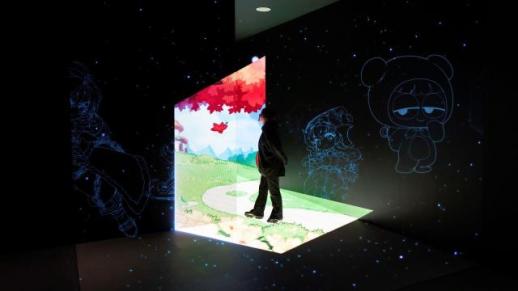 Nexon reopens revamped Jeju game museum SEOUL, May 12 (AJP) - Nexon reopened its museum on Jeju Island after a four-month renovation, recasting Asia's first computer museum as a destination devoted to the South Korean publisher's three-decade catalogue of online games and the players who built its communities. The Jeju City venue, originally launched in July 2013 as the Nexon Computer Museum, has been rebranded simply as Nexon Museum, its grand opening on Tuesday. The overhaul shifts the institution away from a hardware-focused chronicle of computing history toward a player-centered experience drawing on Nexon titles such as MapleStory, Mabinogi, and Dungeon & Fighter. Visitors who log in with their Nexon account upon entry have their personal play records pulled into a customized tour, with characters and intellectual property tied to their most-played games appearing throughout the exhibition. Guests without an account are assigned a random title to introduce them to the company's portfolio. Two permanent exhibitions span the three-story building. "Players: Don't Die! Keep Up!" occupies the first and second floors, while "Hello, My OOO!" — billed by the museum as the renovation's centerpiece — fills the third floor with immersive media art that summons each visitor's digital memories into physical space. The second floor also houses an archive of Korean PC package games from the 1980s to the 2000s, including roughly 2,500 digitized gaming magazines and a documentary marking Nexon's 30th anniversary. "Nexon Museum aims to become a new hub for game culture that players can cherish," said Park Doo-san, director of the Nexon Museum. "We will continue to present diverse content that allows players to encounter their experiences and memories in the real world." Nexon, listed on the Tokyo Stock Exchange, became the first Korean game publisher to surpass 4 trillion won ($2.69 billion) in annual revenue in 2024, drawing 48 percent of first-quarter 2025 sales from South Korea and 33 percent from China, its second-largest market. 2026-05-12 13:43:59
 -
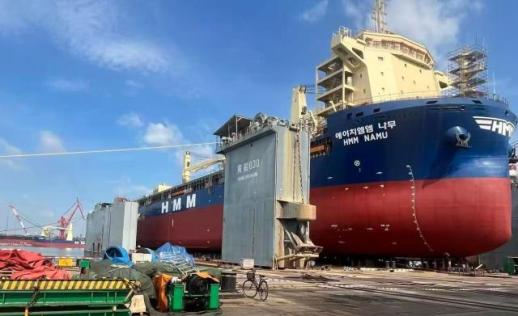 ASIA INSIGHT: Iran war story by Seeker of Truth -- Truth, Justice and Freedom Sinokor Chairman Tae-soon Jung’s Breakthrough in the Strait of Hormuz: The Diverging Fate of Korean Shipping, from the Basra Energy to HMM’s Namwoo The waters of the Middle East are burning again. Yet this fire is not confined to a military clash among Iran, the United States and Israel. It is a blaze threatening the arteries of the global economy and shaking the very heart of industrial civilization. The Strait of Hormuz, through which roughly one-fifth of the world’s seaborne oil passes, is not merely a narrow channel of water. It is the great artery of modern capitalism. When gunfire erupts there, Wall Street trembles, Seoul’s exchange rate wavers, Europe’s factories begin to calculate costs anew, and China’s manufacturing machine feels the pressure. Humanity has entered an age of artificial intelligence, semiconductors and financial algorithms, yet the most basic flow of energy still depends on the sea and the oil tanker. In that very strait, two sharply contrasting scenes recently unfolded for the Korean shipping industry. One was the successful passage of Sinokor Merchant Marine’s very large crude carrier, the Basra Energy, which reportedly sailed through the dangerous waterway with its automatic identification system turned off and safely transferred two million barrels of crude oil. The other was the attack on HMM’s Namwoo, which suffered a hole in its hull and a fire after being struck by an unidentified flying object. It was the same sea. It was the same war. But the outcomes were starkly different. That difference was not a matter of mere luck. It was a difference in philosophy toward shipping itself, a difference in the capacity to read risk. More deeply, it was a difference in understanding the nature of management, organization and human judgment. The Strait of Hormuz has long been a place where the desires of civilization collide. Since the age of the Persian Empire, this waterway has been a critical gateway connecting the Silk Road and the trade routes of the Indian Ocean. The Persians understood thousands of years ago that whoever controls the chokepoint can move the world. That gatekeeping instinct remains embedded in Iran’s strategic DNA. The United States possesses overwhelming military power, aircraft carriers and bombers. Iran, by contrast, uses the narrowness of the strait and the logic of asymmetric warfare. It relies on drones, mines, fast boats, missiles, electronic warfare and psychological pressure. Its strategy is not a head-on contest but the use of tension and fear. Sun Tzu wrote in The Art of War, “War is a matter of vital importance to the state.” He also wrote, “All warfare is based on deception.” Iran is applying precisely this logic. It does not confront the vast American fleet directly. Instead, it attacks a ship, launches a drone, raises insurance premiums and spreads fear through markets. Then global finance begins to shake before the war itself fully expands. That is the essence of the Hormuz crisis. The attack on the Namwoo was not a simple maritime accident. The reported damage — a hole roughly five meters wide and seven meters deep — amounted to the consequences of a military strike. The government investigation concluded that the damage was caused by an external impact from an unidentified flying object. Twenty-six Korean vessels and 158 Korean seafarers remain in the waters inside the Strait of Hormuz under intense strain. They have effectively been trapped at sea for more than two months. Every day, crews check radar, listen nervously for drones at night and wait without knowing when the next attack may come. The sea is already a lonely place. A sea under war eats away at the human spirit. Yet amid this danger, Sinokor chose a different path. Its Basra Energy loaded crude oil at an ADNOC terminal in the United Arab Emirates, switched off its tracking signal and passed through the Strait of Hormuz. It eventually reached the Fujairah terminal safely. The voyage left a deep impression on the global shipping community because, in the present environment, passing through Hormuz is close to a life-risking operation. Here, one fact matters greatly: Sinokor Chairman Tae-soon Jung began his career as a navigator. A man who has experienced the sea with his own body sees differently from a manager who knows only numbers. He understands currents, waves, the balance of a vessel and the fear of a crew. He knows the atmosphere of a dangerous sea. He knows the decisions a captain must make at night and how a ship trembles in a storm. Such knowledge cannot be learned from a spreadsheet. In recent years, Jung has aggressively secured very large crude carriers. Some in the industry called it an excessive bet. But he understood what would become most valuable if the war dragged on. It was not merely the tanker itself. It was “movable storage.” If Hormuz is blocked, oil-producing countries cannot export their crude. Onshore storage has limits. Eventually, the VLCC itself becomes a floating storage facility. In fact, some VLCCs have recently earned substantial profits not simply by transporting crude but by serving as storage at sea. This is the essence of shipping. Shipping is not just logistics. Shipping is finance, and it is geopolitics. A single oil tanker carries within it the price of crude, exchange rates, insurance premiums, military risk, futures markets and global financial flows. The world’s greatest shipping companies are therefore not merely transport operators. They are enormous financial players. The representative examples are A.P. Moller-Maersk and MSC. Denmark’s Maersk began in a small northern European country but grew into a company that shapes the global logistics system. It does not merely operate ships. It integrates ports, warehouses, supply-chain data, finance and insurance. MSC, too, became the world’s largest container carrier through aggressive fleet expansion. What these companies have in common is that they became larger in times of crisis. The oil shocks of the 1970s, the downturns of the 1980s, the 2008 financial crisis and the Covid-19 pandemic all shook the shipping industry to its foundations. Yet those companies that survived emerged with even greater market power. Shipping is ultimately an industry of scale, capital strength and the ability to bear risk. The Tao Te Ching says that the great nation stays low, like the sea. The sea is indeed the lowest place. Yet it is precisely from that low place that the world is connected. Shipping is the industry that moves the world from civilization’s lowest plane. Today, the world is intoxicated by the AI revolution. Semiconductors, generative AI, quantum computing and robotics are said to be the core of the future economy. But no matter how advanced AI becomes, crude oil, liquefied natural gas, iron ore and grain still move by ship. AI may be the brain of civilization. Shipping is its bloodstream. If the bloodstream is blocked, the brain also stops. The Hormuz crisis leaves several important lessons for the global economy. First, diversification of energy supply chains is no longer optional. It is a matter of survival. Korea, Japan and China remain heavily dependent on Middle Eastern oil. American shale oil, Australian LNG, and resource development in Africa and South America will therefore become even more important. Second, shipping will become an even more strategic industry. National security, energy security and supply-chain resilience all depend on the sea. Third, shipping may become increasingly militarized. The boundary between civilian shipping and military security is likely to grow more blurred. The United States and China already regard maritime power as central to national strategy. The South China Sea, the Taiwan Strait, Hormuz and the Red Sea are all connected in one strategic chain. Fourth, an era of AI-based maritime risk management is likely to arrive. Satellite intelligence, drone surveillance, insurance data and military information will be integrated by AI to calculate optimal routes. Yet the final decision will still be made by human beings. In extreme crisis, intuition and courage matter more than numbers. The Cheonbugyeong declares, “In the human being, heaven, earth and humanity become one.” It is ultimately the human being who reads the sea. It is the human being who endures fear. It is the human being who makes the final decision. Sinokor’s passage through the Strait of Hormuz under Chairman Jung is not merely a shipping story. It is a scene that shows what true competitiveness means in modern industrial civilization. Technology matters. Finance matters. But what matters most in the end is human insight, responsibility and the courage to bear risk. By contrast, the attack on the Namwoo exposes the cold reality of the age of globalization. Global supply chains cannot be sustained by efficiency alone. When peace and order collapse, the first place to tremble is the sea. The Bible says, “The purposes of a person’s heart are deep waters.” On the dark waters of the Strait of Hormuz, the world now faces an old question once again. Who will read this danger? Who will protect the bloodstream of the world? And who will survive to the end? 2026-05-12 13:36:58
 -
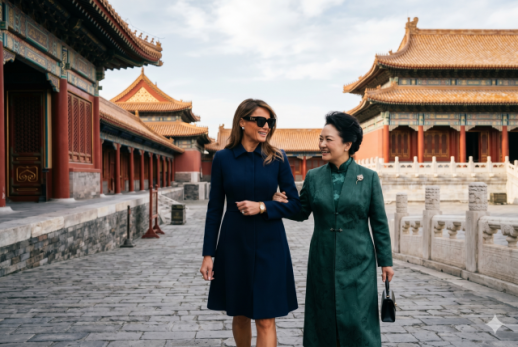 ASIA INSIGHT: Soprano and model to anchor fragile US-China Summit SEOUL, May 12 (AJP) - In November 2017, inside the amber-hued silence of the Forbidden City, Donald Trump handed a tablet computer to Xi Jinping and Peng Liyuan. On the screen, a small, blonde girl sang a folk song and recited ancient poetry in Mandarin. The girl was Arabella Kushner, the American president’s granddaughter. As she watched the video, Peng—a woman whose own soprano voice once stirred the nationalist fervor of a billion people—beamed with the practiced appreciation of a fellow artist. Xi famously graded the child’s performance an A-plus. It was a moment of hyper-stylized intimacy, a calculated exchange of cultural capital that did more to stabilize the volatile superpower rapport than a dozen white papers on trade deficits ever could. As the two leaders prepare to descend upon Beijing tomorrow, the global focus has naturally settled on the hard metrics of power. The world is watching the price of Iranian light crude, the export quotas for rare earth minerals, and the existential race for artificial intelligence. Yet the true temperature of the summit is taken in the quiet spaces between the spouses. In this high-stakes theater, Melania Trump and Peng Liyuan are not merely sidecar figures. They are the primary civilizational solvent of the summit. Their rapport is not born of a shared political ideology, but of a shared, professionalized visibility that functions as the only remaining warmth in a relationship that has otherwise turned to ice. There is a structural symmetry to these two women that defies their vastly different origins. Peng is a creature of the stage, a former major general in the People’s Liberation Army whose pre-marriage career as a famous singer made her a household name across China. She understands that in Beijing, performance is synonymous with policy. Melania Trump spent her career as a high-fashion model, a profession that demands the mastery of the silent gaze and the use of attire as a form of non-verbal communication. Both are artists of the image. They understand that in a world of clashing empires, the aesthetic is often the only remaining bridge when the language of diplomacy fails. While their husbands frequently lapse into the language of zero-sum competition, the first ladies have established a parallel track of high-culture rapport. They share a fundamental understanding of the power of the frame. During past encounters, they have leaned into this mutual discipline, using silence as a diplomatic tool. They are the velvet architecture that masks the brutalist edges of the negotiations, presenting a united, elegant front while their husbands calculate the cost of steel and sovereignty. The decision to host the Trumps at the Temple of Heaven this May is less a gesture of hospitality and more a tactical exercise in sacred geography. For half a millennium, Chinese emperors walked these grounds not as masters, but as supplicants, performing rigid ceremonies to prove they were worthy of the sky’s favor. The very stones are a map of a lost humility—the circular altars reaching for a heaven that demanded order in exchange for rain and peace. Today, however, that cosmological humility has been replaced by a transactional ego. By granting the Trumps access to these restricted inner sanctums, Xi Jinping is effectively staging a modern coronation for his guest. It is a masterful deployment of imperial flattery, treating the American president as a visiting monarch to distract from the cold realities of semiconductor export bans and regional containment. Within this gilded trap, the chemistry between Peng and Melania becomes a strategic necessity. As the men retreat into the shadows of the Hall of Prayer for Good Harvests to haggle over the Strait of Hormuz and deep-learning models, the first ladies must maintain the necessary fiction of civilizational friendship. They act as human shields against the friction of two colliding systems. If Peng can project an aura of maternal stability and Melania can offer her signature, statuesque poise, they provide the "managed" element of managed competition. They signal to the markets—and to anxious neighbors in Seoul—that even if the men are ready to burn the house down, the women are still tending to the furniture. When the final tea is poured and the cameras are shuttered, the stones of the Circular Mound Altar will remain, indifferent to the transactional egos of the men who walked upon them. We are left with the haunting realization that while empires are built on the cold logic of trade and territory, they are often preserved by the discipline of those who know how to stand still. In the calculated silence of the spouses, we find a fleeting, fragile peace—a reminder that the most sophisticated weaponry of the century may not be a missile or a microchip, but the quiet, impeccable maintenance of the mask. 2026-05-12 13:32:13