
Journalist

Milad Haghani
-
 Wellmade Strengthens Summer Collection Amid Strong May Sales Sejong Group's fashion retail brand Wellmade is set to continue its strong sales momentum in the first half of the year by promoting the summer collection of its women's brand Daily List. According to Sejong Group on May 21, Wellmade has recorded a 34% increase in sales compared to the same period last year. The company's promotional events and online and offline campaigns during May, which is Family Month in Korea, have garnered positive consumer responses. Daily List also contributed to this sales growth, with its sales rising 27% year-over-year this month. Cumulatively, sales for the year have increased by 17%, driving strong performance in the first half. In response, Daily List is launching its '2026 Summer Collection.' This collection, themed 'Light Moves,' focuses on lightweight and comfortable wear for the summer season. It features premium materials to enhance practicality and seasonal appeal. Key items include a tape-point jumper and a hooded string jumper, both made from sheer materials and reflecting the mint core style. These products offer UV protection, making them suitable for everyday wear and outdoor activities. Additionally, the collection includes printed long-sleeve shirts, patterned collar dresses, string vests, and elastic half pants. Some items can be styled as coordinated sets. A Wellmade representative stated, "We aim to maintain the strong performance of the first half into the second half with this summer collection." Meanwhile, Wellmade's online sales surged by 65% last year. During the winter season, sales increased by 10% due to strong outerwear sales. Sejong attributes the improved performance to product planning tailored to the customer bases of its key brands, including Indian, Bruno Baffi, and Daily List.* This article has been translated by AI. 2026-05-21 17:43:45
 -
 America-first policy to outlast Trump, says his former chief of staff SEOUL, May 21 (AJP) - Former White House chief of staff Mick Mulvaney said the “America First” brand of economic nationalism and a more restrained U.S. approach to overseas engagement are likely to remain defining features of Washington’s policy landscape long after Donald Trump leaves office. Speaking at a luncheon hosted by the American Chamber of Commerce in Korea at the Grand Hyatt Seoul, Mulvaney said protectionism and economic nationalism reflect broader structural shifts that will shape U.S. policy for years to come. Mulvaney, who briefly served as acting White House chief of staff during Trump’s first term, offered a wide-ranging assessment of the second Trump administration, U.S. foreign policy, trade tensions and the future of the U.S.-Korea economic partnership before more than 120 executives and business leaders. The fireside chat was moderated by AMCHAM Chairman and CEO James Kim. Drawing on his experience in the first Trump administration, Mulvaney said he sees four long-term trends emerging from Washington that are likely to outlast Trump himself: entrenched protectionism and economic nationalism, growing reluctance among Americans to support prolonged overseas engagement, persistently elevated inflationary pressures and a greater willingness by Washington to intervene in strategic industries and private-sector markets. “These are not temporary developments,” Mulvaney said. The discussion also focused on the future of the U.S.-Korea economic partnership amid record bilateral investment and expanding cooperation in semiconductors, shipbuilding, energy, artificial intelligence and advanced manufacturing. Mulvaney highlighted Korea’s growing role as a strategic economic partner and regional innovation hub within the evolving U.S. policy landscape. Asked how Trump views Korea, Mulvaney joked that Trump “doesn't really trust anybody,” adding that the president tends to see even close allies as benefiting from U.S. security commitments. Mulvaney said Trump evaluates foreign countries largely through two lenses: defense spending as a share of gross domestic product and trade deficits with the United States. In that context, he said Korea was “not in the really really bad club,” noting that Trump had been more frustrated during his first term with some European countries that he believed spent too little on defense. At the same time, Mulvaney said Trump understands the geopolitical importance of countries such as Korea, Japan and Australia. Describing the U.S. presidency as “the most isolated job” in the world apart from perhaps the pope, Mulvaney said the version of Trump portrayed on NBC’s “The Apprentice” closely resembles the real person. Unlike many politicians, he added, Trump is not particularly pretentious. Asked how business leaders and foreign officials should deal with Trump, Mulvaney advised them to be direct and straightforward. “His bullshit-meter is really really sensitive,” he said after briefly apologizing to the audience for swearing. Mulvaney also said Trump prefers doing business with people he personally enjoys being around. He cited Shinzo Abe as one of the foreign leaders who managed Trump most effectively during his first term, saying Abe understood the importance of personal rapport and even played golf with Trump despite being “one of the worst golfers in my lifetime.” Mulvaney added that Trump had been “really upset” by Abe’s assassination. He contrasted Trump’s first and second presidential transitions, saying Trump did little preparation before his unexpected 2016 victory but spent four years planning personnel and Cabinet appointments ahead of his 2024 return. Looking ahead to the Nov. 3 midterm elections, Mulvaney said he does not expect the administration’s policy direction to shift significantly even if Democrats regain control of the House or Senate. He also warned that ongoing wars and geopolitical instability are unlikely to ease anytime soon, factors he said will continue shaping the global business environment. Mulvaney also dismissed claims that Trump’s tendency to leave sentences unfinished reflects mental decline, saying the president has “always spoken that way.” 2026-05-21 17:42:12
 -
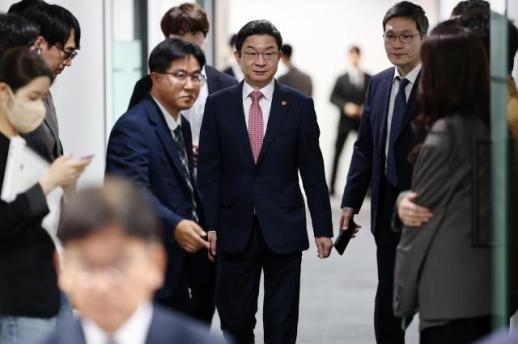
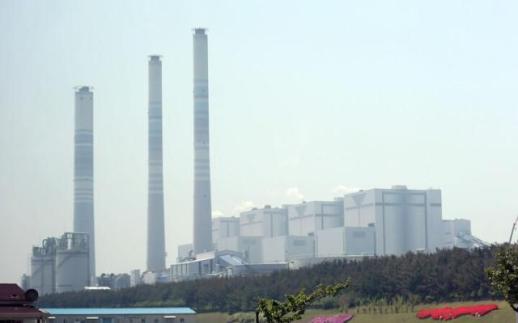 Energy Legislation Advances, Including Coal Phase-Out Support Legislation supporting the energy transition agenda of the Lee Jae-myung administration is advancing in the National Assembly. Key measures include a special law to support regions affected by coal plant closures, reforms to the Renewable Portfolio Standards (RPS), and amendments to three laws aimed at timely power grid construction. On May 21, Lee Ho-hyun, the Deputy Minister of the Ministry of Climate, Energy and Environment, held a briefing at the government complex in Sejong, stating, "Laws have been passed that will facilitate a just transition while enhancing local acceptance as we move toward a carbon-neutral energy mix. This is significant in establishing a regulatory framework to achieve our energy transition goals." The National Assembly's Climate, Energy, and Environment Committee approved 46 bills during a plenary session on May 19, including the 'Special Law on Support for Workers and Regions Affected by Coal Power Plant Closures' and amendments to the Renewable Energy Act. The coal plant closure support law addresses potential large-scale unemployment and economic downturns in regions affected by the closure of coal power plants. It focuses on institutional support for worker job transitions, employment assistance, and the development of alternative industries in these areas. The special law allows the national and local governments to prioritize the development of zero-carbon energy industries using the infrastructure of decommissioned coal power plants. It also mandates the establishment of local transition councils that include representatives of workers and residents to ensure their participation in the planning process for regional support. Notably, the law provides a basis for designating certain coal power plants as security power generation facilities instead of approving closure plans if deemed necessary for the reliability and stability of the power supply. The government has expressed concerns about job insecurity for workers, the impact on partner companies, and regional economic downturns as the closure of coal power plants accelerates in the transition to carbon neutrality. Several coal plants, including the Taean Unit 2 this year and the Hadong Units 1-3, Boryeong Units 5-6, and Samcheok Units 3-4 next year, are scheduled for closure. As a result, the government aims to minimize regional shocks during the closure process while maintaining the stability of the power supply. Deputy Minister Lee stated, "The principle is to phase out coal power by 2040, but we are considering a concept of security power that can be temporarily utilized in emergency situations, taking into account the power supply situation and regional conditions." He added, "A detailed roadmap for closure and compensation will be discussed in conjunction with the 12th Basic Plan for Power Supply and Demand." Additionally, the amendment to the Renewable Energy Act, which reforms the RPS system, has been passed. This amendment aims to gradually phase out the RPS system, which has been in operation since 2015, and transition to a long-term fixed-price contract market. Going forward, new renewable energy projects will be operated through a long-term fixed-price contract market based on capacity units. The existing 29 RPS obligated entities will be managed separately as eight public sector entities and 21 private sector entities. Moreover, amendments to three laws related to timely power grid construction (the Special Law on Power Grids, the Electricity Business Act, and the Act on Promotion of Power Generation Development) were also approved in this committee session. The amendments include provisions for private companies to construct certain sections of the national power grid and then transfer ownership to Korea Electric Power Corporation (KEPCO) under a Build-Transfer (BT) model. The government sees the need to leverage private capabilities as demand for the power grid surges due to the expansion of renewable energy and the growth of the artificial intelligence (AI) industry.* This article has been translated by AI. 2026-05-21 17:42:00
 -
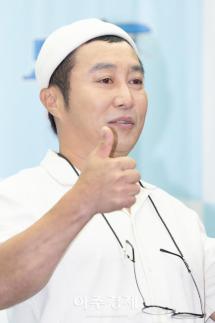 Kim Byung-man Apologizes for Arriving Late to Press Conference 코미디언 김병만이 TV조선 '생존왕2' 기자간담회에 지각한 것에 대해 사과했다. On May 21, comedian Kim Byung-man issued an apology for arriving late to the press conference for TV Chosun's "Survivor King 2." He posted a lengthy message on his social media, stating, "I am writing this to apologize for my tardiness at the production announcement due to my oversight." He explained, "I traveled from Jeju on May 19 to attend the press conference on May 20. I was preparing for the event and had scheduled morning activities, but I failed to consider the sudden weather changes and traffic conditions due to rain." Kim acknowledged, "I made the journalists wait, and as a result, my mistake caused a delay in the event schedule. I sincerely apologize for this and will be more careful in adjusting my schedule in the future." He added, "I apologize once again to everyone who experienced inconvenience and difficulties because of me. The entire staff and cast worked passionately on location in a remote area of Taiwan. I hope my oversight does not diminish expectations for the program. I appreciate your continued interest and support." On May 20, Kim Byung-man arrived over 20 minutes late to the press conference held at TV Chosun's Gasan studio in Geumcheon-gu, Seoul, sparking controversy.* This article has been translated by AI. 2026-05-21 17:39:19
 -
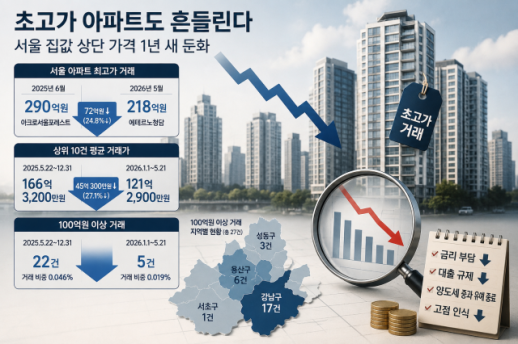 High-End Apartment Transactions in Seoul Slow Down The high-end apartment market in Seoul has seen a decline in transaction values compared to a year ago. While transactions in key areas like Gangnam and Yongsan continue in the 10 billion won range, the trend of large transactions in the 20 billion to 30 billion won range has noticeably slowed down. An analysis of real transaction data from the Ministry of Land, Infrastructure and Transport revealed that the highest apartment transaction this year was for a 231.2798 square meter unit at 'Aeterno Cheongdam' in Gangnam, which sold for 2.18 billion won. In contrast, the highest transaction recorded in the past year was a 273.928 square meter unit at 'Acro Seoul Forest' in Seongdong-gu, which sold for 2.9 billion won last June. The average price of the top 10 transactions has also decreased. This year, the average price for the top 10 apartment transactions in Seoul was 1.2129 billion won, down from 1.6632 billion won from May to December last year. This represents a decrease of 450.3 million won, or 27.1%. The frequency of transactions exceeding 10 billion won has also declined. From May 22 to the end of last year, there were 22 transactions over 10 billion won, but only five have occurred by May 21 this year. The proportion of transactions over 10 billion won has dropped from 0.046% to 0.019% during the same period. However, some analysts suggest that the high-end market is not experiencing a complete downturn. Transactions in the 10 billion won range continue in core areas of Gangnam and Yongsan. Notable transactions this year include 'Nine One Hannam' in Yongsan, selling for between 14 billion and 15.7 billion won, 'Shinhyundai 11th' in Gangnam at 11 billion won, and 'Raemian One Pentas' in Seocho at 10 billion won. Regionally, Gangnam has shown a significant concentration of high-value transactions. Of the 27 transactions over 10 billion won in the past year, 17 occurred in Gangnam, followed by six in Yongsan, three in Seongdong, and one in Seocho. Expanding the scope to transactions over 5 billion won, Gangnam accounted for 253 transactions, while Seocho had 150, with Yongsan and Seongdong recording 30 and 29 transactions, respectively. In terms of specific complexes, 'Nine One Hannam' and 'Shinhyundai 11th' each had the highest number of transactions at five. 'Acro Seoul Forest' and 'Apgujeong Hyundai 6th and 2nd' each recorded three transactions. This indicates that the high-end market is primarily driven by emerging luxury complexes in the Hannam and Seongsu areas, as well as redevelopment projects in Apgujeong. Additionally, the expiration of the temporary suspension on capital gains tax for multiple homeowners is seen as a variable affecting the market. With increased tax burdens and land transaction regulations, buyers are becoming more selective in their pricing within the high-end market. A real estate industry official stated, "The high-end apartment market is experiencing a slowdown in transaction values rather than a complete halt. While high-value transactions continue in prime locations, the atmosphere of consecutive large transactions around 20 billion won, as seen last year, has weakened somewhat."* This article has been translated by AI. 2026-05-21 17:36:14
 -
 AJP Focus: Samsung strike on hold, but shareholders see a new battle beginning SEOUL, May 21 (AJP) - The chip lines at Samsung Electronics ran uninterrupted Thursday morning. What had been dreaded as the opening day of an unprecedented 18-day walkout instead turned into relief rally on the market after labor and management reached a last-minute settlement shortly before midnight. Samsung shares surged as much as 7 percent during trading and closed at a fresh record high as markets priced out the immediate risk of production disruption at the world’s largest memory-chip maker. But not all existing shareholders were pleased. Two separate shareholder advocacy groups staged demonstrations in Seoul on Thursday, arguing that the tentative wage agreement could severely undermine future shareholder returns and destabilize Samsung’s long-term financial structure if institutionalized. At the center of the controversy is the newly agreed compensation framework for semiconductor employees. Under the tentative deal, the union secured a structure that effectively allocates bonuses equivalent to 12 percent of operating profit — consisting of a 1.5 percent Overall Performance Incentive (OPI) and a 10.5 percent special management bonus for chipmaking divisions. According to consensus estimates compiled by FnGuide, Samsung Electronics is projected to post operating profit of around 348 trillion won ($252 billion) in 2026 amid the continuing global AI semiconductor boom. If the company executes the agreed formula in full, more than 41 trillion won could be recognized as labor compensation in a single year. For shareholders, the issue is not simply the size of the payout but its collision with Samsung’s existing capital return framework. Samsung previously pledged to return 50 percent of free cash flow generated between 2024 and 2026 to shareholders through dividends and share buybacks. But if tens of trillions of won are absorbed into operating expenses before profits flow into free cash generation, shareholder distributions could shrink sharply. Activist groups estimate the reduction in shareholder return capacity could exceed 15 trillion won. Industry experts note that while such a payout structuralizes financial risks, management faced an unavoidable dilemma regarding human capital. "From a financial perspective, 41 trillion won is an astronomical sum, equivalent to the capital required to build a massive, state-of-the-art semiconductor fabrication line," said Lee Jong-hwan, a professor of system semiconductor engineering at Sangmyung University. "However, Samsung's biggest fear right now is a 'domino-effect' drain of its core talent to SK Hynix or foreign competitors. From management's perspective, securing talent retention was likely deemed a safer, more urgent path for long-term survival than immediate infrastructure expansion." A small delegation from the “Korea Shareholder Movement Headquarters” gathered near the residence of Lee Jae-yong on Thursday, condemning what they described as an excessive inward transfer of corporate profits. Min Kyung-kwon, head of the organization, argued that the structure may violate Article 462 of South Korea’s Commercial Act governing dividend calculations. The group contends that distributing large-scale bonuses directly tied to pre-tax operating profit without shareholder approval amounts to what it called a “disguised illegal dividend.” The activists also questioned the sustainability of the formula during the semiconductor industry’s notoriously volatile downcycles. “Semiconductors are not a permanently booming industry,” one protester said during the rally. “If operating profit collapses during the next downturn, how can the company survive while structurally locked into massive payouts?” The group further criticized what it described as a widening disconnect between management, labor and shareholders, arguing that top executives themselves could indirectly benefit from profit-linked compensation structures while ordinary shareholders absorb the dilution in corporate value. Using ACT, an online minority shareholder platform reportedly containing around 13,000 verified Samsung shareholders, the activists are now preparing a potential nationwide class-action campaign. If Samsung’s board formally approves the tentative agreement, they say they plan to pursue breach-of-trust complaints against consenting directors and seek legal action to invalidate the board resolution. Elsewhere in Seoul, another shareholder organization calling itself the “Samsung Electronics Shareholder Action Practice Headquarters” held a parallel rally near Hangangjin Station in Yongsan District. That group framed the dispute less as a legal issue than a broader social and economic imbalance. Its members argued that highly paid workers in the semiconductor sector were demanding disproportionate rewards while many ordinary workers across South Korea continue to earn annual salaries below 30 million to 40 million won. The organization also renewed calls for the government to invoke emergency adjustment powers — a rarely used legal mechanism allowing authorities to suspend strikes temporarily in industries deemed vital to the national economy. The group argued that semiconductors should effectively be treated as strategic national infrastructure similar to police, electricity or transportation systems because of their central role in exports, employment and supply chains. Some members called for permanent legal restrictions on strikes within the semiconductor industry altogether, warning that prolonged labor instability could damage South Korea’s global competitiveness during a critical phase of the AI race. Furthermore, observers warn that the settlement could set a precedent that fundamentally alters the labor landscape across South Korean industries. "This deal could open the floodgates," Professor Lee warned. "Not only will non-memory units and other Samsung affiliates demand identical transparent, profit-linked bonus structures, but major automotive giants and their supply chain networks will face immense pressure from unions to replicate this formula. It triggers a nationwide structural shift in corporate profit distribution." For now, the immediate crisis has passed. Production remains stable. Markets have calmed. The feared supply-chain disruption that had alarmed investors, policymakers and global technology customers alike has been avoided. Yet the settlement appears to have exposed a deeper structural fault line inside corporate South Korea. The conflict is no longer confined to labor versus management. It is increasingly evolving into a three-way confrontation between labor, capital and shareholders over who ultimately owns the gains generated by the AI-era semiconductor boom. 2026-05-21 17:33:10
 -
 Seoul Mayoral Candidates Launch Campaigns Ahead of June 3 Election Jung Won-o of the Democratic Party and Oh Se-hoon of the People Power Party officially launched their campaigns for the Seoul mayoral election on May 21. The two candidates began a 13-day campaign across the city, engaging in a fierce contest for votes. On the first day of the official campaign, both candidates visited key locations at midnight. Jung went to the Dongseoul Postal Center in Gwangjin-gu, while Oh visited the Garak Agricultural and Marine Products Wholesale Market in Songpa-gu. Jung encouraged workers on the night shift and personally moved packages in the sorting area, while Oh greeted wholesalers and assisted with the auction of cabbage and radishes. Later, they traveled throughout Seoul to appeal for voter support. Jung held his official launch event at Wangsimni Station in Seongdong-gu, which he considers his political hometown, having served as the district's mayor for three terms. He emphasized that this election is about changing the capabilities of local government, urging citizens to vote for a revitalized local economy and a safer Seongdong. Following the launch, Jung continued campaigning near Konkuk University, at a bus terminal, and around Gangnam Station. He criticized Oh's safety awareness regarding the construction site of the GTX-A line at Samsung Station, where missing rebar was discovered. Jung claimed it was a clear case of poor construction, stating, "If Oh had been concerned about safety, this issue would have been reported to the mayor." Oh, after the sun rose, expressed his aspirations for the election in Samyang-dong, where he spent his childhood. He stated, "This election should call for a shift in the government's livelihood policies and serve as a warning to the Blue House against the path of dictatorship." Former lawmaker Yoo Seung-min, known for his centrist stance, joined Oh to lend support. Yoo remarked, "The candidate who prioritizes housing welfare for Seoul citizens should become the mayor, and I will actively assist Oh, who shares this vision." Oh then visited several districts, including Seodaemun, Yeongdeungpo, Guro, Seongbuk, and Dongdaemun, highlighting the government's failures in real estate policy that have led to a shortage of rental properties and skyrocketing rents. He urged voters to hold the government accountable for its real estate missteps. Oh concluded the first day of campaigning with a rally in Cheonggye Plaza during rush hour, before moving to Gangnam Station to wrap up the day's events. The official campaign period for the 9th nationwide simultaneous local elections, scheduled for June 3, lasts for 13 days until the day before voting on June 2. Early voting will take place over two days, on May 29 and 30. 2026-05-21 17:27:42
 -
 FSC to offer low-rate insurance for 10 Korean ships near Hormuz SEOUL, May 21 (AJP) - Financial Services Commission Chairman Lee Eok-won said Thursday the government will provide low-rate marine insurance for 10 vessels operated by small and midsized Korean shipping companies currently waiting near the Strait of Hormuz. Lee made the remarks during a meeting with shipping companies, policy lenders and insurers in Seoul, the fourth in a series of industry-finance meetings aimed at supporting sectors hit by the Middle East conflict. “The high and prolonged waves triggered by the Middle East war are increasing the management burden on shipping companies through higher operating costs, including fuel expenses, and opportunity costs from route restrictions,” Lee said. He said smaller shipping firms could face difficulties securing insurance for their vessels’ safe return, as marine insurance for large and special risks depends heavily on overseas reinsurers. Under the support plan, 10 domestic nonlife insurers will jointly underwrite war-risk insurance for the vessels without relying on overseas reinsurance. The participating insurers include Hyundai Marine & Fire Insurance, Samsung Fire & Marine Insurance, Meritz Fire & Marine Insurance, KB Insurance and Hanwha General Insurance. The coverage is expected to total about 300 billion won ($200 million) based on the value of the vessels subject to the insurance. The FSC said the insurance will be offered at the lowest rate available among domestic shipping companies, including large carriers. If a lower rate is later applied to another Korean vessel after the contracts are signed, the same rate will be applied retroactively through measures such as premium refunds. The support measure takes effect immediately. Lee also said the FSC will review, in consultation with relevant ministries, ways to establish a standing reinsurance program to expand coverage to major vessels with significant impact on the national economy. Regarding Namu, a midsized bulk carrier operated by HMM that caught fire after an external attack, Lee urged insurers to swiftly proceed with related procedures so that reasonable compensation can be provided. 2026-05-21 17:26:20
 -
 Concerns Grow Over Wage Gap After Samsung's Labor Agreement The small business sector expressed concerns that the recent wage agreement between Samsung Electronics and its labor union will exacerbate the wage and benefits gap between large and small enterprises. In a statement released on May 21, the Korea Federation of Small and Medium Businesses noted, "The conclusion of this negotiation is significant as it alleviates concerns over production disruptions at a major company that has a substantial impact on our economy amid intensifying global semiconductor competition." However, the federation added, "Small business workers and employers feel heavy-hearted watching the negotiations, and there are lingering doubts about whether fair compensation and rewards have been provided to partner small businesses amid discussions of performance bonuses amounting to hundreds of millions of won." On the night of May 20, Samsung Electronics and its labor union signed a tentative agreement on the 2026 wage negotiations at the Gyeonggi Provincial Labor Office in Suwon. The agreement maintains the existing Excess Profit Performance Incentive (OPI) and introduces a special management performance bonus system for the semiconductor (DS) division. The OPI will be paid based on business performance selected by mutual agreement, while the special management performance bonus for the DS division will be set at 10.5% of the agreed business performance. The Korea Federation of Small and Medium Businesses pointed out, "The deepening polarization between large and small enterprises is one of the most serious issues in our society," emphasizing that small business workers earn only half of what their counterparts in large companies make, with even larger gaps in bonuses and benefits. It further stated, "The competitiveness of our country's semiconductor industry, recognized as a global leader, is the result of thousands of partner companies and small businesses in materials and components working together as one team, and the contributions and roles of these partner small businesses must be fairly evaluated." The federation expressed hope that Samsung's promised co-growth measures would lead to effective strategies that promote research and development, facility investment, and wage increases for partner companies.* This article has been translated by AI. 2026-05-21 17:23:54
 -
 KOSPI outperforms Asian peers with record point gain on Nvidia boost, Samsung labor deal SEOUL, May 21 (AJP) - South Korean stocks sharply outperformed regional peers Thursday, as Nvidia’s upbeat earnings and Samsung Electronics’ tentative labor deal triggered a powerful rally in Seoul’s chip-heavy market despite mixed trading across Asia. The KOSPI jumped 606.64 points, or 8.42 percent, to finish at 7,815.59, dwarfing other gains across Asia. Japan’s Nikkei 225 rose more than 3 percent, while Chinese and Taiwanese shares lost ground, underscoring the strength of Korea’s rebound. The daily point gain marked the largest on record, surpassing the previous record increase of 490.36 points set on March 5. It was also the first time since May 14 that the index closed above the 7,800 mark. The index opened 3.85 percent higher at 7,486.37 and extended gains throughout the session, touching an intraday high of 7,819.23. The rapid rally triggered buy-side sidecar curbs in both the KOSPI and KOSDAQ markets in early trading, the first simultaneous activation in both markets since April 8. The rebound was also supported by easing geopolitical concerns and a pullback in oil prices, after U.S. President Donald Trump said negotiations with Iran were in the “final stages,” raising hopes for a potential easing of Middle East tensions. U.S. Treasury yields also retreated overnight, helping restore risk appetite across global markets. Investor sentiment was also supported by stronger-than-expected earnings from Nvidia, widely seen as a bellwether for global artificial intelligence demand. Nvidia reported its 12th consecutive quarter of record revenue, while adjusted earnings per share came in at $1.87, above Wall Street’s estimate of $1.76. The results reinforced expectations that global AI infrastructure spending remains strong, lifting demand for Korean semiconductor shares tied to high-bandwidth memory and advanced AI chip supply chains. Samsung Electronics’ tentative wage agreement with its labor union further fueled the rally, easing concerns over a possible strike at the country’s largest chipmaker. The deal came late Wednesday, shortly before a planned walkout was set to begin. Institutional investors led the rally, buying 2.883 trillion won ($1.91 billion) worth of shares on the main bourse. Retail investors sold 2.647 trillion won, while foreign investors offloaded 233 billion won. Most large-cap shares ended sharply higher. Samsung Electronics jumped 8.51 percent to close at 299,500 won after the tentative labor deal eased concerns over production disruptions. SK hynix surged more than 11 percent to 1,940,000 won, reflecting renewed optimism over AI memory demand. SK Square also rallied, while Samsung Electronics preferred shares, Samsung Life Insurance and Samsung C&T gained strongly. Samsung Electro-Mechanics rose 13.48 percent, Samsung Life Insurance climbed 13.78 percent and Samsung C&T advanced 12.96 percent. LG Electronics hit the daily upper limit, soaring 29.83 percent to 235,000 won, as investors priced in expectations for growth in its robotics and physical AI businesses. Automakers also posted strong gains. Hyundai Motor jumped 12.50 percent to 666,600 won, while Hyundai Mobis surged 25.2 percent to 670,000 won on expectations that it could benefit from Hyundai Motor Group’s expansion into humanoid robots and physical AI. The tech-heavy KOSDAQ also rebounded after four consecutive sessions of losses, rising 49.90 points, or 4.73 percent, to close at 1,105.97. Foreign investors and institutions bought 137 billion won and 139 billion won, respectively, while retail investors sold 258 billion won. Semiconductor equipment and robotics shares led gains on the secondary market. Wonik IPS rose 11.97 percent, EO Technics climbed 18.8 percent and Rainbow Robotics advanced 16.5 percent. By sector, electronics products led the gains with a 29.1 percent rise, followed by auto parts with 17 percent and display panels with 16.1 percent. Among themes, major IT shares climbed 14.6 percent, major automakers rose 13.7 percent and electric wire-related stocks gained 13.1 percent. The dollar remained strong at 1,506.1 won after briefly retreating to the 1,490-won range earlier in the session. 2026-05-21 17:21:17