
Journalist

Nino Antadze
-
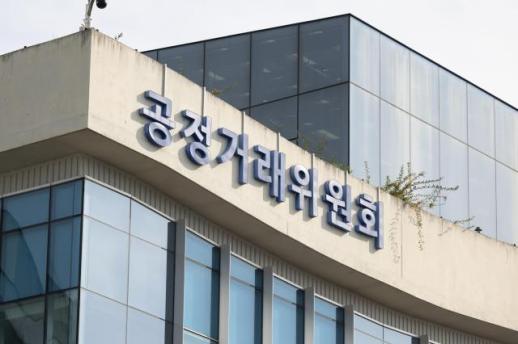 Construction Firms Penalized for Shifting Liability to Subcontractors Construction companies that shifted the responsibility and costs of industrial accidents to subcontractors have faced penalties from regulatory authorities. The Fair Trade Commission announced on May 17 that it imposed corrective orders and fines totaling 729 million won (approximately $550,000) against KR Industries, Dasan Construction Engineering, and NC Construction for violations of subcontracting laws. This action follows an investigation initiated by the Fair Trade Commission in July of last year, focusing on safety-related subcontracting practices in the construction industry. Amid a rise in serious accidents and fatalities on construction sites, the commission scrutinized the practice of main contractors excessively shifting safety management responsibilities onto subcontractors. According to the Ministry of Employment and Labor, there were 605 reported fatalities due to industrial accidents last year, with 286 of those occurring in the construction sector. Notably, the number of fatalities at small construction sites with contracts valued under 500 million won increased by 25 compared to the previous year. The Fair Trade Commission identified a troubling trend where small subcontractors, often lacking the capacity for adequate safety management, bore the brunt of liability. The investigation revealed that these companies included clauses in their contracts that placed the full burden of costs and responsibilities related to accidents on the subcontractors. KR Industries, for instance, established terms in 41 subcontracting agreements with 29 subcontractors from July 2018 to May 2026, stating that "the subcontractor assumes all civil and criminal liability in the event of an accident." Dasan Construction Engineering was found to have imposed 11 unfair clauses, including requiring subcontractors to cover settlement costs for accident victims and allowing deductions from payments for accident-related expenses. Additionally, the company was cited for issuing contracts up to 112 days after the start of construction or providing contracts that omitted payment conditions. NC Construction also included clauses in its contracts that shifted all responsibilities and costs related to safety incidents to subcontractors. Some contracts failed to mention provisions related to the linkage of subcontractor payments. As a result, the Fair Trade Commission imposed a fine of 312 million won on Dasan Construction Engineering for the delayed issuance of contracts and the establishment of unfair clauses. KR Industries and NC Construction received fines of 257 million won and 160 million won, respectively. NC Construction was also fined 5 million won for failing to include payment linkage provisions in its contracts. A Fair Trade Commission official stated, "We expect this to serve as a turning point in preventing main contractors from evading responsibility in transactions with smaller construction firms, which often have weaker safety management capabilities. We will continue to monitor the establishment of unfair clauses that undermine efforts to ensure industrial safety."* This article has been translated by AI. 2026-05-17 12:15:00
 -
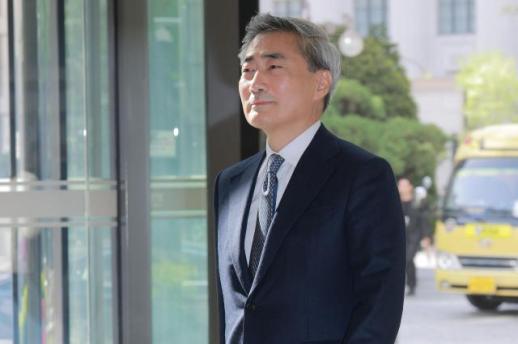 Bank of Korea Governor Shin Hyun-sung to Attend G7 Finance Track Meeting Shin Hyun-sung, the governor of the Bank of Korea, will attend the G7 Finance Track meeting, marking the first time a Bank of Korea governor has been officially invited to participate in this forum. According to the Bank of Korea on May 17, Shin is scheduled to attend the G7 Finance Ministers and Central Bank Governors meeting in Paris, France, on May 18-19 (local time). The meeting will include invited countries such as Brazil, India, and Kenya, alongside the G7 members. The G7 Finance Track serves as a platform to discuss global economic and financial issues and coordinate policy directions ahead of the leaders' summit. The discussions will later be reflected in a joint statement. Topics expected to be addressed at the meeting include global financial imbalances, critical mineral supply chains, and economic security issues related to monetary policy coordination. A Bank of Korea official stated, "During the meeting, Governor Shin plans to exchange views with finance ministers, central bank governors, and representatives from international organizations on key issues such as the global economic situation, monetary policy, and global imbalances."* This article has been translated by AI. 2026-05-17 12:13:00
 -
 Youth Unemployment Rises Amid Job Growth in South Korea South Korea's job market is experiencing deepening K-shaped polarization, with an increasing number of young people disengaging from the labor force. Despite rising employment figures, job growth is primarily concentrated in large companies and among older workers, while opportunities for youth and small businesses are dwindling. The Korea Employers Federation (KEF) released a report on May 17, highlighting key trends in the current employment landscape. The report indicates a worsening of K-shaped employment polarization, a rise in the number of young people classified as inactive, and a slowdown in labor mobility. Particularly concerning is the growing employment insecurity among young people. Last year, the number of individuals aged 20 to 30 who were inactive reached 717,000, the highest figure since such statistics began being tracked. This indicates that over 700,000 young people have exited the labor market at the entry stage. The number of inactive individuals in this age group has surged from 644,000 in 2023 to 691,000 in 2024. KEF attributes the increase in inactivity among young people to a vulnerable job structure rather than merely a lack of available positions. There is a clear trend of young individuals leaving small businesses and temporary or seasonal jobs, contributing to the inactive population. Among those aged 20 to 30 who have been inactive in the past year, the reasons for leaving their jobs were personal reasons (36.6%), dissatisfaction with working conditions (29.9%), and the end of temporary or seasonal work (19.1%). The current job market is expanding primarily in new industries, among those aged 60 and older, and within large companies, while employment in traditional industries, among those under 60, and in small businesses and temporary jobs is contracting. According to analysis from the National Data Agency, the number of employed individuals under 60 last year was approximately 21.94 million, a decrease of 0.7% from the previous year (22.08 million). In contrast, the number of employed individuals aged 60 and older rose from 6.49 million to 6.83 million, an increase of 5.3% during the same period. Polarization by company size is becoming increasingly pronounced. Small businesses, which account for about 90% of total employment, have seen their employment growth rate stagnate at around 0% since 2023. Meanwhile, employment in companies with over 300 employees increased by 6.1% last year, reaching 3.34 million, up from 3.15 million the previous year. This growth is attributed to strong exports led by large companies, particularly in the semiconductor sector. Labor mobility is also on a downward trend. Last year, the labor mobility rate was 9.8%, continuing a steady decline. This rate measures the proportion of new hires and job changes relative to the total workforce over a specific period. Both the hiring and turnover rates fell from 5.1% in 2024 to 4.9% last year. KEF analyzed that the simultaneous strengthening of companies' hiring reductions and workers' reluctance to change jobs could further entrench the dual structure of the labor market. This trend could exacerbate income inequality and dampen consumption, weakening the overall growth foundation of the economy. Lee Sang-cheol, head of KEF's Employment and Social Policy Division, stated, "While recent employment indicators show a quantitative expansion, structural imbalances such as K-shaped polarization are actually deepening. The disengagement of young people from the labor market and the slowdown in labor mobility pose warning signs that could constrain our economy's growth potential."* This article has been translated by AI. 2026-05-17 12:10:07
 -
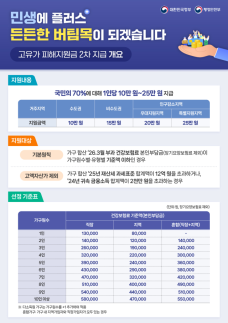 Second Round of High Oil Price Relief Payments Begins on May 18 The Ministry of the Interior and Safety announced on May 17 that the second round of high oil price relief payments will begin at 9 a.m. on May 18, available through both online and offline applications. During the first week of applications, a system based on the last digit of birth years will be implemented to manage the flow of applicants. The second round of payments will target 70% of the population, with amounts varying by region: 100,000 won in the metropolitan area, 150,000 won in non-metropolitan areas, 200,000 won in designated areas with population decline, and 250,000 won in special support regions for population decline. Additionally, individuals who missed the first application period (April 27 to May 8) will have the opportunity to apply during this second round. Applications for the second round will be accepted from May 18 at 9 a.m. until July 3 at 6 p.m., allowing for approximately seven weeks of online or offline submissions. Recipients can choose to receive their payments via credit or debit cards, prepaid cards, or local love gift certificates. Online applications will be available 24 hours a day during the application period, while offline applications will be accepted on weekdays from 9 a.m. to 6 p.m. (4 p.m. for bank branches). To prevent congestion and system overload during the first week of applications, the birth year-based system will be in effect for both online and offline applications, with the possibility of extending this system based on local conditions. Citizens wishing to receive payments via credit or debit cards can conveniently apply online through their card issuer's website, app, or call center, without being restricted by time or location. They can also apply offline at bank branches linked to their cards. Those who prefer mobile or card-type local love gift certificates can apply online through their local government's app or website. For individuals seeking paper local love gift certificates or prepaid cards, they can visit their local administrative welfare center (or community service center) with an ID to apply and receive their high oil price relief payments. The high oil price relief payments can be used for approximately three months, until August 31, after which any remaining balance will expire. Residents of special cities and metropolitan areas (including Sejong and Jeju) can use the payments within those areas, while residents of provincial regions can use them in their respective cities or counties. Recipients who receive payments through local love gift certificates can use them at participating merchants with annual sales of 3 billion won or less. Those receiving payments via credit or debit cards or prepaid cards can use them at small businesses with annual sales of 3 billion won or less, excluding certain sectors such as entertainment and gambling. Gas stations are included, allowing the use of relief funds regardless of sales volume. Minister of the Interior and Safety Yoon Ho-jung expressed hope that the high oil price relief payments will alleviate the burdens on citizens and invigorate local economies. He urged everyone to apply for the payments by July 3 and to remember to use them by August 31.* This article has been translated by AI. 2026-05-17 12:06:37
 -
 Korea Railroad Corporation President Calls for Accelerated Merger and Government Support The merger between Korea Railroad Corporation (KORAIL) and SR is progressing smoothly, with expectations that the completion date may be moved up. However, the challenges of fare freezes and substantial investment burdens have brought financial structure deterioration to the forefront as a key issue. During a press conference on May 14 at a restaurant in Gwangju, President Kim Tae-seung stated, "The integration of our organization, financial structure, and safety systems is going very well," adding, "We are trying to expedite the merger timeline as much as possible." The merger, initially expected to be completed in September, may occur sooner depending on internal preparations. Kim highlighted that once the merger is finalized, users will experience significant changes. He noted, "Reservations for KTX and SRT will be possible through a single app, and the issue of seat shortages will be noticeably improved," particularly with a substantial increase in seat availability for trains departing and arriving at Suseo Station. However, he pointed out that the financial structure remains a pressing challenge. "Our financial structure is very weak," Kim said, warning that if the situation continues, the trains may operate without generating revenue. KORAIL has not raised fares in the past 15 years, and during the merger process, it has promised a 10% discount to align with SRT fares. Kim remarked, "While fare discounts are a promise to the public, the financial pressure is significant," adding that fare increases require public agreement and political consensus, making them difficult to implement. Additionally, the burden of large-scale investments complicates matters. The KTX trains, introduced in 2004, are nearing the end of their lifespan and require complete replacement, with replacement costs estimated at around 5 trillion won. Kim believes that government support for half of the replacement costs is necessary and is currently in discussions with the government to include this in next year's budget. He emphasized that this replacement goes beyond merely updating old trains; it involves technological advancement. "We are not just replacing old trains but introducing new technology," he said, stressing that the railway technology we use must also be exportable. The issue of public service obligation (PSO) compensation is another critical variable. KORAIL has PSO support for operating losses on conventional rail, but the compensation amount is insufficient, leading to accumulated financial burdens. Kim noted, "In Europe, most routes, including high-speed rail, are PSO eligible," and added that the same should be expanded to all 27 domestic routes, although this must be approached gradually. On the same day, KORAIL demonstrated train coupling at the Honam Railway Vehicle Maintenance Center. The coupled trains underwent pre-departure checks for braking and door functions and completed a test run from Gwangju Songjeong Station to Seoul Station at 1 p.m. Coupled trains operate by connecting two trains that depart or arrive at the same station, allowing for increased passenger transport in areas where expanding service frequency is challenging, such as the bottleneck between Pyeongtaek and Osong. Han Gi-beom, head of the high-speed vehicle operations department, explained, "There is only one maintenance line at the Honam Center capable of servicing coupled trains, known as the K line," adding that connecting two KTX-Sancheon trains, each approximately 201 meters long, allows for maintenance of up to about 402 meters.* This article has been translated by AI. 2026-05-17 12:04:43
 -
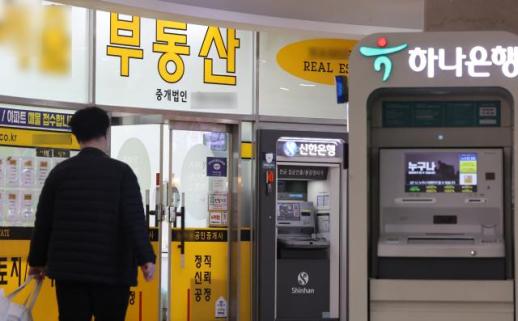 Household Loans Increase by 2.1 Trillion Won, Driven by Housing Loans Last month, household loans from banks increased significantly, primarily driven by housing-related loans. According to the Bank of Korea's report on 'Financial Market Trends' released on May 17, the balance of household loans from deposit banks, including policy mortgage loans, stood at 1,174.9 trillion won at the end of last month, marking an increase of 2.1 trillion won from the previous month. The rise in household loans was largely attributed to an increase in housing loans. The balance of housing loans rose by 2.7 trillion won to 937.6 trillion won last month. After remaining stable in March, housing loans turned upward in April due to increased housing transactions and demand for interim payments, despite a slowdown in demand for rental funds. In contrast, the balance of other loans, including credit loans, decreased by 600 billion won to 236.5 trillion won. This decline followed an increase in March driven by stock investment demand, but in April, repayments increased as individuals sold off stocks. Park Min-cheol, head of the Bank of Korea's Market Analysis Team, stated, "Overall, household loans showed a relatively low growth rate and did not deviate significantly from the government's total management target." The balance of corporate loans from banks reached 1,397.7 trillion won, reflecting an increase of 10.7 trillion won from the previous month. Loans to small and medium-sized enterprises rose by 5.7 trillion won, driven by demand for corporate lending and value-added tax payments from major banks. Corporate loans to large enterprises increased by 5 trillion won from the previous month due to heightened demand for repayments of short-term notes, dividend payments, and corporate bond redemptions at the end of the quarter. As for corporate bonds, the scale of net repayments surged from 300 billion won in March to 3.9 trillion won as companies increased funding through commercial paper and loans amid rising interest rate volatility. Regarding the outlook for household loans, Park noted, "The leading indicator for household loans can be seen in the housing market. As the housing market in the metropolitan area approaches the end of the grace period for the transfer tax on multiple homeowners, related listings have been absorbed, leading to an increase in prices and a significant rise in transaction volume. While household loans are expected to continue a limited growth trend due to tightened financial sector management, there are still factors of instability in the metropolitan housing market, so it remains to be seen whether a stable trend will emerge."* This article has been translated by AI. 2026-05-17 12:03:00
 -
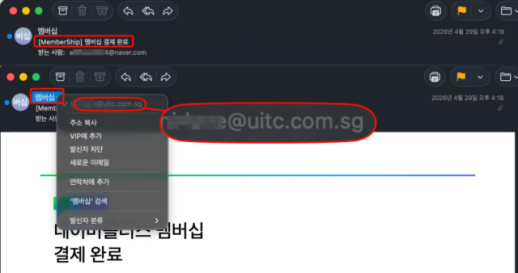 Phishing Emails Masquerading as Naver Plus Membership Notifications Phishing emails disguised as Naver Plus membership payment notifications are being circulated, aiming to steal user account information. These emails trick users into clicking links that lead to fake security pages where they are prompted to enter their passwords. According to the IT industry on May 17, Naver has issued a warning through its customer service about phishing emails posing as "Naver Plus Membership Payment Completed" notifications, urging users to exercise caution. Naver stated, "The phishing emails are titled 'Payment Completed.' The company clarified, "Official Naver notification emails do not use this format." Users should also carefully check the sender's email address, as phishing emails use domains other than the official Naver domain 'navercorp.com.' Additionally, clicking the 'Go to My Membership' button in the phishing email redirects users to a fraudulent domain. The phishing email browser displays a warning labeled 'Attention Required.' Naver emphasized, "Naver login and security settings pages only request information from 'nid.naver.com.'" If users have entered their account information on the phishing page, they should change their Naver account password as soon as possible. They should also update passwords for any other sites using the same ID and password as their Naver account. Phishing attempts impersonating Naver have been repeatedly confirmed. Last August, a new phishing scheme exploiting the frequently used 'easy login' feature was discovered. Naver has previously advised users to verify the domain in the browser's address bar when using the easy login feature.* This article has been translated by AI. 2026-05-17 11:48:55
 -
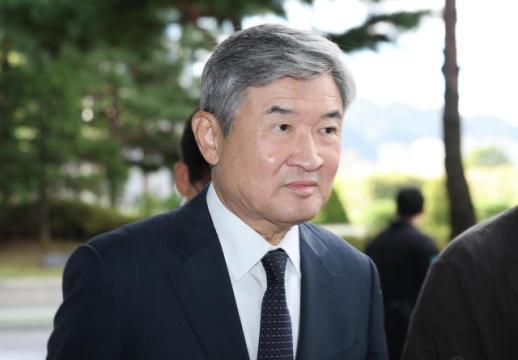 Verdict Expected for Former National Intelligence Chief Jo Tae-yong on May 21 Jo Tae-yong, the former head of the National Intelligence Service, is set to receive a verdict on charges of dereliction of duty and violating the National Intelligence Service Act for failing to report the planned emergency martial law declaration to the National Assembly. According to legal sources, the Seoul Central District Court's Criminal Division 32, led by Judge Ryu Kyung-jin, will hold the first-instance verdict hearing on May 21 for Jo, who has been indicted and detained since last November. Jo was arrested by the special prosecutor's team led by Cho Eun-seok for allegedly failing to fulfill his duties as the head of the National Intelligence Service during the emergency martial law declared on December 3, 2024. The special prosecutor's team determined that Jo neglected his responsibilities by not informing the National Assembly about former President Yoon Suk-yeol's plans for the martial law declaration, despite receiving reports from former NIS Deputy Director Hong Jang-won that the military was dispatched to arrest key political figures, including Lee Jae-myung and Han Dong-hoon. Additionally, after the martial law was lifted, Jo is accused of providing closed-circuit television (CCTV) footage of Hong's movements only to the ruling People Power Party while withholding similar footage of his own movements from the opposition Democratic Party, violating the prohibition against political involvement as stipulated in the National Intelligence Service Act. Jo also faces charges of perjury for allegedly providing false testimony to the National Assembly and the Constitutional Court, as well as submitting false responses to the National Assembly's investigation into the martial law allegations. Furthermore, he is accused of participating in the destruction of evidence related to the deletion of information from the secure phone of former President Yoon and Deputy Director Hong. During the closing arguments held on April 3, the special prosecutor's team requested a seven-year prison sentence for Jo, stating, "The defendant was aware of the unconstitutional and illegal martial law declaration plans by the president but completely ignored his constitutional duty to prevent or report it to the National Assembly." They emphasized that the head of a national intelligence agency facilitating a conspiracy to commit insurrection and attempting to destroy evidence afterward is a serious offense. In contrast, Jo's defense team firmly denied all charges throughout the trial, asserting his innocence. They argued that Jo was not in a position to be fully aware of the president's martial law declaration plans and that even if he had known, he lacked the authority to physically or legally prevent the president's decision to mobilize the military. They contended that the NIS itself was not directly involved in executing the martial law and that the submission of CCTV footage was merely a routine administrative task without any political intent to assist a specific party. They also maintained that the deletion of secure phone information was part of the agency's security protocols, not an act of evidence destruction. The upcoming verdict for Jo is expected to establish legal standards regarding the role of intelligence leaders in national crises. Legal experts suggest that if Jo's testimony during the Constitutional Court impeachment trial is ruled as perjury, it could serve as strong evidence supporting the illegality of former President Yoon's martial law declaration process.* This article has been translated by AI. 2026-05-17 11:45:54
 -
 FIFTY FIFTY Releases 'After School Exorcism Club' MV Featuring Acting Debut FIFTY FIFTY has unveiled the music video for 'After School Exorcism Club,' marking the members' first foray into acting and generating significant buzz around the project.The music video was released on the KITZ YouTube channel, showcasing the five members of FIFTY FIFTY as they transform into the characters of the exorcism club, highlighting their upcoming adventures. The video captures the essence of a high school occult comedy, featuring vibrant visuals and the members' engaging portrayals.'After School Exorcism Club' tells the story of five quirky high school girls who band together to exorcise a spirit haunting their school. As the group's first acting project, it has attracted attention even before its release. The content is part of a larger project that shares a universe with FIFTY FIFTY's upcoming album 'Imperfect-I'mperfect,' set to be released on June 1, and includes not only a short-form drama but also a feature film and mid-form series.The music video features the new album track 'STARSTRUCK,' which showcases FIFTY FIFTY's innovative approach, blending a quirky yet hip atmosphere. It connects the music and drama's narrative, allowing fans to enjoy both the album and the video content together.Following the video's release, comments have poured in, with viewers praising the members' acting skills. Comments included, "Let's go to Hollywood," "The members act really well. I was truly surprised by Kina," "It feels like a horror blockbuster," and "The story and concept seem really fun," reflecting a growing anticipation for the main content.KITZ stated, "Viewers can expect to see a different side of FIFTY FIFTY as they take on acting roles. We anticipate this will provide a new experience that combines music and storytelling."KITZ has consistently produced content featuring K-pop artists in leading roles, starting with NCT's Jeno and Jaemin in 'Wind Up,' followed by VERIVERY's Kangmin in 'Jump Boy LIVE,' and CRAVITY's Hyungjun in 'Kill the Romeo.' After 'After School Exorcism Club,' upcoming projects include Lee Min-ki and MONSTA X's Hyungwon in 'The Grim Reaper's Life Extension Project,' and Younghoon, Iruda, and Kim Dong-jun in 'Love WiFi-Gung.'Meanwhile, FIFTY FIFTY's KITZ premium short-form drama 'After School Exorcism Club' is available for viewing on KITZ.* This article has been translated by AI. 2026-05-17 11:37:46
 -
 Polls Show Democratic Candidates Leading in Seoul and Busan Recent polling indicates that candidates from the Democratic Party are leading their People Power Party counterparts in the key battlegrounds of Seoul and Busan ahead of the June 3 local elections. According to the National Election Survey Deliberation Commission, a survey commissioned by KBS and conducted by Korea Research from May 11 to 14 found that Jung Won-o, the Democratic candidate for Seoul Mayor, received 43% support, while Oh Se-hoon, the People Power Party candidate, garnered 32%. By age group, Jung received 61% support from voters in their 40s and 69% from those in their 50s, significantly outpacing Oh, who received 22% and 18% support from the same age groups, respectively. However, Oh led among voters in their 30s and those aged 70 and older, with 40% and 46% support, compared to Jung's 28% and 33%. Notably, a significant portion of voters remain undecided. Among respondents, 28% indicated they might change their preferred candidate, while 71% stated they would continue to support their current choice. In a similar survey conducted for the Busan mayoral race, Jeon Jae-soo, the Democratic candidate, received 42% support, leading Park Hyung-jun of the People Power Party, who garnered 33%. Jeon also outperformed Park among voters in their 40s and 50s, receiving 64% and 55% support, respectively, compared to Park's 19% and 32%. Park, however, led among voters aged 30 and under and those aged 70 and older, with 38% and 42% support, while Jeon received 16% and 30% in those age groups. In Busan, 20% of respondents indicated they might change their preferred candidate, while 78% expressed continued support for their current choice. The surveys were conducted with 800 eligible voters from both Seoul and Busan, using telephone interviews. The margin of error for the polls is ±3.5 percentage points at a 95% confidence level (for more details, refer to the National Election Survey Deliberation Commission website). * This article has been translated by AI. 2026-05-17 11:36:58