

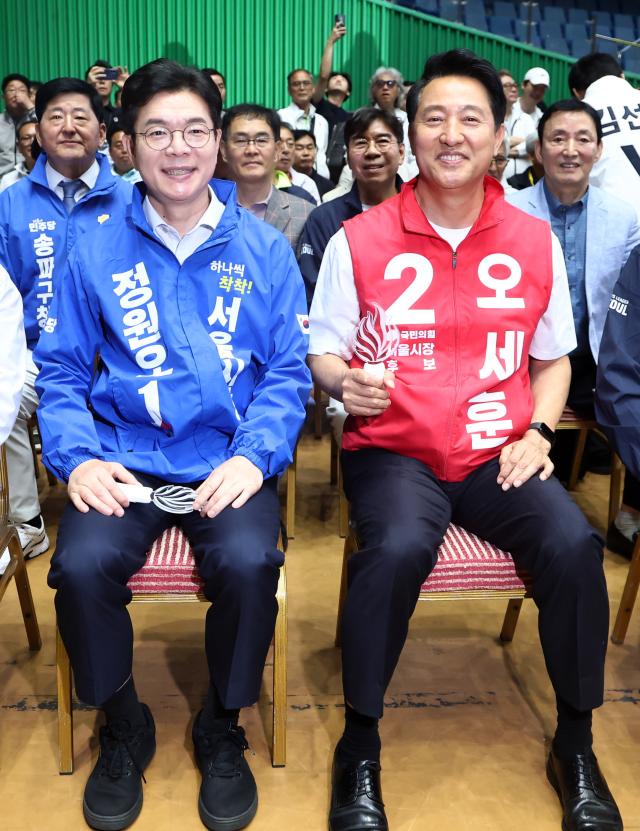
Jung Won-o, the Democratic Party candidate for Seoul Mayor (left), and Oh Se-hoon, the People Power Party candidate, attended the 2026 Seoul Citizens Sports Festival at Jamsil Indoor Stadium in Songpa-gu, Seoul, on May 16. [Photo: Yonhap News]
Recent polling results indicate that candidates from the Democratic Party are leading over their counterparts from the People Power Party in the key battlegrounds of Seoul and Busan.
According to the Central Election Survey Deliberation Commission, a poll commissioned by KBS and conducted by Korea Research from May 11 to 14 showed that Jung Won-o, the Democratic candidate for Seoul Mayor, received 43% support, while Oh Se-hoon, the People Power Party candidate, garnered 32%.
By age group, Jung received 61% support from voters in their 40s and 69% from those in their 50s, significantly outpacing Oh, who received 22% and 18% support in those age groups, respectively. However, Oh had higher support among voters aged 30 and over 70, with 40% and 46%, compared to Jung's 28% and 33% in those groups.
Notably, a significant portion of voters remain undecided. Among respondents, 28% indicated they might change their preferred candidate, while 71% stated they would continue to support their current choice.
According to the Central Election Survey Deliberation Commission, a poll commissioned by KBS and conducted by Korea Research from May 11 to 14 showed that Jung Won-o, the Democratic candidate for Seoul Mayor, received 43% support, while Oh Se-hoon, the People Power Party candidate, garnered 32%.
By age group, Jung received 61% support from voters in their 40s and 69% from those in their 50s, significantly outpacing Oh, who received 22% and 18% support in those age groups, respectively. However, Oh had higher support among voters aged 30 and over 70, with 40% and 46%, compared to Jung's 28% and 33% in those groups.
Notably, a significant portion of voters remain undecided. Among respondents, 28% indicated they might change their preferred candidate, while 71% stated they would continue to support their current choice.
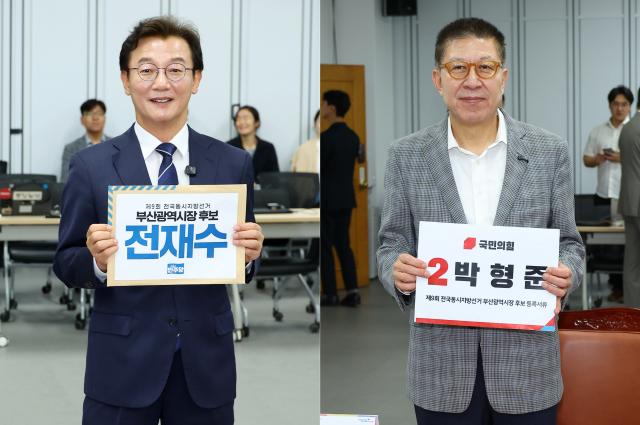
Jeon Jae-soo, the Democratic Party candidate for Busan Mayor (left), and Park Hyung-jun, the People Power Party candidate, registered as candidates for the Busan mayoral election at the Busan Election Commission on May 14. [Photo: Yonhap News]
In a similar poll conducted during the same period for the Busan mayoral race, Jeon Jae-soo, the Democratic candidate, received 42% support, leading Park Hyung-jun of the People Power Party, who garnered 33%. Jeon also outperformed Park among voters in their 40s and 50s, receiving 64% and 55% support, respectively, compared to Park's 19% and 32%. However, Park had stronger support among those under 30 and over 70, with 38% and 42%, while Jeon received 16% and 30% in those age groups.
In Busan, 20% of respondents indicated they might change their preferred candidate, while 78% expressed continued support for their choice.
The surveys were conducted with 800 voters each from Seoul and Busan, using random telephone interviews. The margin of error for both polls is ±3.5 percentage points at a 95% confidence level (for more details, visit the Central Election Survey Deliberation Commission's website).
In Busan, 20% of respondents indicated they might change their preferred candidate, while 78% expressed continued support for their choice.
The surveys were conducted with 800 voters each from Seoul and Busan, using random telephone interviews. The margin of error for both polls is ±3.5 percentage points at a 95% confidence level (for more details, visit the Central Election Survey Deliberation Commission's website).
* This article has been translated by AI.
Copyright ⓒ Aju Press All rights reserved.