

Journalist

Park Byung-hwan
-
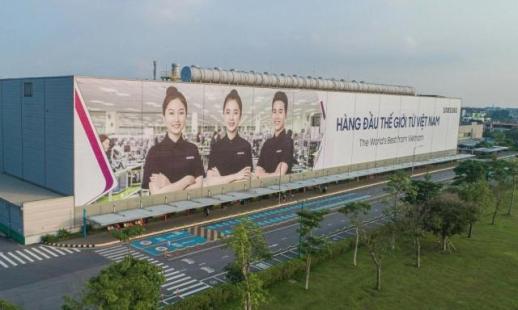 Samsung Begins Direct Purchase of Renewable Energy at Vietnam Factory Samsung Thai Nguyen (SEVT) and the TTC Duc Hue 2 solar power plant have marked the first instance of a Direct Power Purchase Agreement (DPPA) in Vietnam. As the system allowing large-scale consumers to directly contract with power producers through the national grid officially begins, interest is growing in the potential expansion of renewable energy trading and its cost structure. This has sparked both positive feedback, with calls to "continue supporting investments," and questions about who will bear the transmission costs, drawing public attention. On June 1, local media outlet VnExpress reported that the National Power System and Market Operation Organization (NSMO) announced that Samsung Thai Nguyen and the TTC Duc Hue 2 solar power plant had completed the necessary technical and legal procedures and officially commenced operations under the DPPA system. In this agreement, Samsung Thai Nguyen acts as the power buyer, while TTC Duc Hue 2 serves as the power seller. This marks the first instance of direct trading between renewable energy producers and large electricity consumers since the implementation of Decree 57/2025 in early March of last year. With this contract, Samsung's production facility is expected to receive approximately 70GWh of renewable energy annually, equivalent to the electricity consumption of about 17,000 households in Vietnam. This is also anticipated to reduce carbon dioxide emissions by approximately 46,000 tons each year. The TTC Duc Hue 2 solar power plant, located in Tay Ninh Province, is invested in by TTC Duc Hue-Long An Power Joint Stock Company. It has a designed capacity of 49MWp and began commercial operations on May 19. The plant is equipped with a battery energy storage system (BESS) and has been participating in Vietnam's competitive wholesale electricity market since early this month. The DPPA system has been a policy that foreign direct investment (FDI) companies in Vietnam have requested for early implementation. These companies have previously expressed expectations that the system would enhance competition in the energy sector. Five years ago, Samsung was among the companies that indicated interest during policy discussions. A survey by the Ministry of Industry and Trade at the end of 2023 revealed that about 20 large corporations expressed intentions to directly purchase nearly 1,000MW of electricity, with 24 renewable energy projects totaling 1,773MW indicating interest in selling. Additionally, 17 projects totaling 2,836MW are under consideration for participation. Samsung is the largest foreign investor in Vietnam, with accumulated registered capital amounting to tens of billions of dollars. In recent years, the company has aimed to increase the share of clean energy used in its global production facilities, and this contract is part of its commitment to reducing carbon emissions. ◆ Online Reactions: Support for Clean Energy Expansion vs. Questions on Transmission Costs Following the announcement, various reactions emerged online. One user expressed support for Samsung's continued investment in Vietnam. However, questions were raised regarding the use of the national grid and who would bear the transmission costs. One commenter asked, "If power is traded through the national grid, who pays for the transmission costs?" Another user noted, "Electricity is produced in Tay Ninh and consumed in Thai Nguyen, so how will it be transmitted without using the EVN grid?" They further questioned, "Ultimately, transmission must go through EVN, and infrastructure rental costs are high; has it become cheaper now?" Another user remarked, "I have a 5x15m rooftop, so if they install solar equipment, I will pay for the electricity," indicating hopes for the expansion of residential solar energy. Additionally, there were calls for more models like this to promote green power production and lower energy costs through direct connections. Meanwhile, the launch of the DPPA signifies a significant step in realizing direct trading between renewable energy producers and large electricity consumers within a regulated framework. At the same time, public interest in the use of the national grid and the cost burden structure is also increasing.* This article has been translated by AI. 2026-06-03 12:24:00
 -
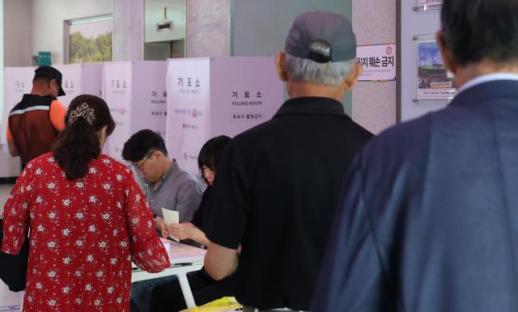 Voter Turnout Reaches 19.0% at Noon, Highest in Daegu at 23.7% As the 9th nationwide local elections are underway, the voter turnout across South Korea reached 19.0% by noon on June 3. This figure is 4.0 percentage points higher than the turnout of 15.0% recorded at the same time during the 8th local elections in 2022. According to the National Election Commission, by noon, 8,497,711 of the 44,649,908 registered voters had cast their ballots. Voting began at 6 a.m. at 14,288 polling stations nationwide. Regionally, Daegu reported the highest voter turnout at 23.7%, followed by North Gyeongsang Province at 21.7%, Gangwon Province at 21.6%, South Gyeongsang Province at 21.2%, Ulsan at 20.6%, South Chungcheong Province at 20.2%, and Busan at 20.0%. In contrast, Gwangju recorded the lowest turnout at 13.1%. Other regions with relatively low turnout included North Jeolla Province at 14.8%, South Jeolla Province at 14.9%, and Sejong at 16.8%. The metropolitan area saw turnouts of 18.6% in Seoul, 18.4% in Gyeonggi Province, and 18.2% in Incheon. This turnout figure does not include the early voting rate of 23.51% recorded on May 29-30. The rates for early voting, overseas voting, shipboard voting, and absentee voting will be combined and announced starting at 1 p.m. today. In this local election, a total of 4,227 positions will be filled, including 16 heads of regional governments, 16 education superintendents, 227 heads of local governments, 933 local council members, and 3,035 district council members. Additionally, by-elections for 14 parliamentary seats, including Pyeongtaek in Gyeonggi Province and Busan North Gap, are also taking place. Voting will continue from 6 a.m. to 6 p.m. today. Unlike early voting, voters must cast their ballots at their designated polling stations and must present a photo ID, such as a resident registration card, driver's license, or passport. Mobile IDs must be verified through an app at the polling station, and screenshots will not be accepted.* This article has been translated by AI. 2026-06-03 12:24:00
 -
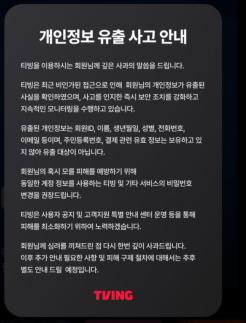 TVING Reports Data Breach Affecting User Information TVING, an online video streaming service, has reported a data breach that has compromised the personal information of some users due to unauthorized external access. On June 3, TVING announced on its official website that it had confirmed the unauthorized access to its systems, which resulted in the leakage of certain members' personal information. The company stated that it took immediate security measures upon discovering the breach and significantly enhanced its monitoring systems to prevent further damage. The leaked information includes user identification IDs, names, birth dates, genders, phone numbers, and email addresses. However, sensitive financial information such as resident registration numbers and payment details were not part of the breach. TVING clarified that it does not hold such sensitive information due to the structure of its services, thus this breach does not involve those data points. To prevent secondary damage, TVING has advised users to change their passwords immediately. The company emphasized the importance of changing passwords, especially if users have reused their TVING account credentials (ID and password) on other sites or services, as this poses a risk of identity theft. Additionally, TVING has established a dedicated customer support center and plans to focus on minimizing user impact through public notifications. Further details regarding the breach's specifics and remedial procedures will be provided as they become available. A TVING representative stated, "We are closely investigating the cause of the breach and the extent of its impact, prioritizing customer protection and taking all necessary measures. We will cooperate fully with government and relevant agencies to establish preventive measures against future incidents."* This article has been translated by AI. 2026-06-03 12:18:00
 -
 Nonghyup Distribution Supports Rural Labor in Pyeongchang Employees of Nonghyup Distribution visited Pyeongchang, Gangwon Province, to assist with labor shortages during the farming season. On June 2, Nonghyup Distribution, which operates Nonghyup Hanaro Mart, announced that its employees visited farms in the Jinbu Nonghyup area to help install support stakes for pepper plants. This volunteer activity was organized to address the worsening labor shortages in agriculture due to an aging rural population and the migration of young people to urban areas. CEO Lee Dong-geun and other employees participated in the effort. The employees assisted in setting up stakes to ensure that the pepper seedlings would not be damaged by wind and rain, allowing them to grow steadily. Installing these stakes is considered a crucial task that affects crop growth and yield. Nonghyup Distribution has been actively supporting farmers, having previously conducted similar volunteer activities in Dangjin, South Chungcheong Province, in May. A representative from Nonghyup Distribution stated, "We hope this assistance can provide some relief to farmers struggling with labor shortages during the busy farming season."* This article has been translated by AI. 2026-06-03 12:09:00
 -
 City Construction Fined 38 Million Won for Delayed Contracts and Unpaid Discounts City Construction has been found to have issued contracts late to its subcontractors and failed to pay subcontracting fees in accordance with legal standards. Despite receiving full payment in cash from the client for construction work, the company paid subcontractors significantly less than the legal requirement. On June 3, the Fair Trade Commission announced that it imposed a corrective order and a fine of 38 million won on City Construction for violating subcontracting laws. The company also received a warning for failing to pay discount fees on promissory notes. According to the Fair Trade Commission, City Construction issued contracts for 61 projects, including reinforced concrete work, to 44 subcontractors with legal requirements included in the contracts at least one day and up to 310 days after the start of construction. Additionally, while receiving full cash payments from the client for landscaping infrastructure projects contracted to 144 subcontractors, City Construction paid subcontracting fees in cash ranging from 0% to a maximum of 89%. City Construction also issued promissory notes to 82 subcontractors with due dates exceeding 60 days from the receipt of goods, failing to pay 79.36 million won in discount fees for the extended period. However, during the Fair Trade Commission's investigation, City Construction paid the full amount of the unpaid discount fees to the subcontractors, resulting in only a warning for that violation. The Fair Trade Commission determined that the delayed issuance of contracts violated the written contract issuance obligation under the subcontracting law, and the failure to maintain the cash payment ratio and unpaid discount fees also constituted violations of the law. This case highlights the need for transparency in the payment process for subcontracting fees, as the cash benefits provided by the client did not adequately reach the subcontractors. A Fair Trade Commission official stated, "We plan to continuously monitor violations of subcontracting laws by primary contractors and impose strict penalties when violations are confirmed."* This article has been translated by AI. 2026-06-03 12:03:00
 -
 Contractor Fined for Failing to Pay Subcontractor in Sehwa Academy Case School corporation Sehwa Academy has been penalized by the Fair Trade Commission for failing to pay a subcontractor despite agreeing to do so. On June 3, the Fair Trade Commission announced that it had issued a corrective order to Sehwa Academy for not paying 26.4 million won to the subcontractor as required under a direct payment agreement. In 2021, Sehwa Academy commissioned a construction project to reinforce a hazardous area at Sehwa High School in Pohang to a primary contractor, Company A. Company A then subcontracted the earthworks to subcontractor Company B, and all parties reached a tripartite agreement for Sehwa Academy to pay Company B directly for the earthworks. While Sehwa Academy had made payments according to the agreement, it withheld the final payment of 26.4 million won, citing construction defects. However, during a meeting attended by Sehwa Academy, the primary contractor, the subcontractor, and the supervisor, it was confirmed that the remaining payment for the earthworks was indeed 26.4 million won. Investigations revealed that the defects raised by Sehwa Academy were related to landscaping work performed by another company, not the earthworks. The Fair Trade Commission determined that Sehwa Academy's failure to pay the subcontractor without just cause constituted a violation of subcontracting law. Considering that the primary contractor is currently pursuing a civil lawsuit against Sehwa Academy for the payment, the Commission opted not to issue a separate payment order but instead imposed only a corrective order. This decision is significant as it reaffirms that even parties not directly involved in a subcontracting agreement, such as the contractor, have payment obligations under the subcontracting law when they agree to direct payments. A Fair Trade Commission official stated, "We will continue to monitor violations of payment obligations by contractors and take strict action when violations are confirmed to protect the integrity of subcontracting transactions."* This article has been translated by AI. 2026-06-03 12:03:00
 -
 Generative AI Becomes Ubiquitous, 92.6% Usage Rate Among 20-Somethings Generative artificial intelligence (AI) is transforming the way people search for information, shifting from traditional search engines to asking AI questions. Notably, the usage rate of generative AI among individuals in their 20s has reached 92.6%, indicating its establishment as a daily service. On June 3, the Ministry of Science and ICT released the results of its '2025 Telecommunications Business Survey.' According to the findings, the experience rate of using generative AI stands at 78.1%. Among age groups, those in their 20s reported the highest usage rate at 92.6%. Furthermore, 47.1% of respondents expressed trust in the information or news obtained through generative AI, significantly outpacing the 9.2% who did not trust it. The survey also indicated that generative AI is influencing changes in search service usage behavior. About 60% of generative AI users reported that they have replaced more than 50% of their search functions with AI. Specifically, 18.8% indicated that they have replaced 60-70% of their searches with AI, followed by 17.7% who replaced 50-60%, and 16.5% who replaced 70-80%. The tool is also being utilized extensively in work and study, with 76.4% of respondents stating that generative AI has helped improve productivity in these areas. Conversely, only 1.9% felt it was not helpful. In examining overall digital platform usage, search portals and messaging services continue to show the highest usage rates. The survey found that 98.7% of respondents used search portals, followed closely by messaging services at 98.5%, place and map services at 96.8%, e-commerce at 95.6%, and video-sharing services at 92.7%. Daily usage rates were highest for messaging services at 91.3%, followed by search portals at 85.8%, video-sharing services at 69.5%, and social networking services at 56.6%. This suggests that most citizens are using major platform services almost daily. Competition among platforms is intensifying. In the past three months, the rate of 'multi-homing,' or using two or more platforms, was highest for e-commerce at 83.9%, followed by social networking services at 79.9%, search portals at 76.9%, and place and map services at 69.1%. E-commerce users were found to use an average of 3.4 platforms, indicating a highly competitive market. In contrast, the rates for secondhand trading (25.9%) and app markets (24.9%) were relatively low, suggesting that users exhibit strong loyalty to specific platforms. Experiences of changing primary platforms were notably higher in food delivery (27.0%) and e-commerce (20.9%). However, app markets (10.3%) and messaging services (9.4%) showed lower transition rates, indicating a strong lock-in effect among users. Common reasons for not switching platforms included habits, service quality, and the desire to maintain usage history. Additionally, last year's revenue from domestic value-added telecommunications services was estimated at 502.9 trillion won, with digital platform service revenue accounting for 161.5 trillion won. These figures represent increases of 15.3% and 5.4%, respectively, compared to the previous year. According to real-time app and payment data analysis solution WiseApp and Retail, ChatGPT had 23.45 million monthly active users in April. Gemini recorded 8.45 million users, while Claude had 2.41 million. Among these, Claude saw the most significant growth compared to the same month last year, with a user growth rate of 1,148%. Gemini followed with a growth rate of 1,034%, while ChatGPT's growth was 34%. 2026-06-03 12:03:00
 -
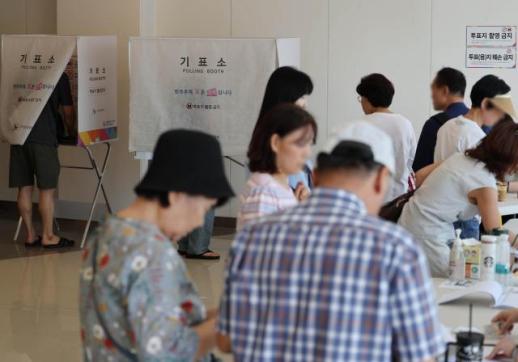 Voter Turnout at 15.0% in June 3 Local Elections with 6.71 Million Participants As the 9th nationwide local elections are underway, voter turnout across South Korea was reported at 15.0% as of 11 a.m. on June 3. This figure is 3.0 percentage points higher than the turnout of 12.0% recorded at the same time during the 8th nationwide local elections in 2022. According to the National Election Commission, approximately 670,000 voters had participated out of a total of 44,649,908 eligible voters by 11 a.m. The main voting began at 6 a.m. at polling stations nationwide. Regionally, Daegu recorded the highest turnout at 18.9%, followed by Gangwon Province at 17.7%, Gyeongsangbuk-do at 17.6%, and Gyeongsangnam-do at 16.5%. In contrast, Gwangju had the lowest turnout at 11.4%. Following Gwangju were Jeollabuk-do at 11.9% and Sejong at 12.9%. In the metropolitan area, voter turnout was recorded at 14.3% in Seoul, 14.5% in Gyeonggi Province, and 14.2% in Incheon. Additionally, the early voting turnout of 23.51%, conducted from May 29 to 30, will be added to the overall turnout starting at 1 p.m. Voting will continue until 6 p.m., and voters must bring identification such as a resident registration card, driver's license, or passport to their designated polling stations.* This article has been translated by AI. 2026-06-03 11:21:00
 -
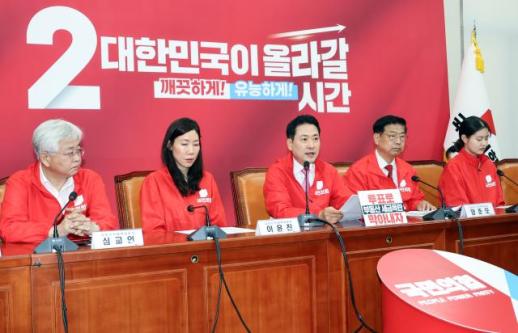 Jang Dong-hyuk Vows to Protect Citizens' Freedoms and Lives Ahead of Local Elections Jang Dong-hyuk, leader of the People Power Party, emphasized on June 3 that he is committed to protecting the constitutional order of South Korea and the freedoms of its citizens. He stated, "I will prioritize the livelihoods of the people in all policies and make every effort to safeguard their lives." During the final meeting of the election campaign committee held at the National Assembly, Jang criticized President Yoon Suk Yeol and the Democratic Party for what he described as reckless behavior. He referred to President Yoon's recent comment about correcting mistakes by apologizing and canceling decisions, arguing that it was an indication of arrogance, saying, "It shows the worst kind of arrogance, disregarding the people's concerns." Jang accused President Yoon of violating the duty of neutrality expected of a president by campaigning across the country and displaying marked ballots in front of cameras. He labeled these actions as serious illegal acts that could warrant impeachment. He also addressed the recently announced consumer price index, which showed a 3.1% increase in May, the highest rise in 26 months since March 2024. Jang stated, "The consequences of Yoon's self-serving governance have led to economic ruin and a collapse of livelihoods. The Democratic Party has nothing to boast about except stock prices, as nothing else is functioning properly." Jang predicted that the influx of money during the election period would lead to rising exchange rates and soaring prices, warning that increasing the base interest rate would cause loan rates to spike. He described the situation as a 'triple hell' of high exchange rates, high prices, and high interest rates. To address these challenges, Jang urged voters to exercise their right to vote in the local elections and the National Assembly by-elections taking place on June 3. He stated, "Abstaining from voting is equivalent to giving up your home, property, salary, and freedom. I urge everyone to go to the polls now and demonstrate the great power of the electorate. I trust in the wise judgment of the people." Meanwhile, the People Power Party interpreted a higher voter turnout in this election compared to previous ones as a reflection of public sentiment against the arrogance and recklessness of the Yoon administration and the Democratic Party. Park Sung-hoon, the party's chief spokesperson, told reporters, "We see a continuous flow of citizens and voters determined to protect our precious daily lives, freedoms, the future of South Korea, and the dreams of our children. The anger and voices of voters wanting to safeguard their homes and properties will continue to head to the polls."* This article has been translated by AI. 2026-06-03 11:15:00
 -
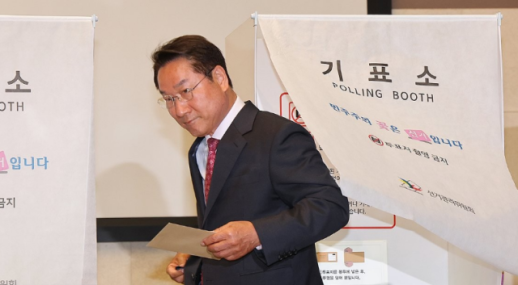 Election Commission Files Complaint Against Incheon Mayor Candidate Yoo Jeong-bok for Asset Disclosure Violation The Incheon Election Commission has filed a complaint against Yoo Jeong-bok, the People Power Party's candidate for Incheon mayor, over allegations of failing to disclose virtual assets. According to legal sources on June 3, the Incheon Election Commission submitted a complaint to the Incheon Police Agency on June 1, accusing Yoo of violating the Public Official Election Act. Yoo is alleged to have omitted part of his spouse's assets during the asset disclosure process, leading to a false report. The National Election Commission announced the day before that the amount of Yoo's spouse's assets was not the previously reported 439.881 million won, but rather 518.579 million won. Consequently, the total family assets of Yoo were determined to be 1.92297 billion won instead of the previously stated 1.844272 billion won. The Election Commission identified the omitted amount as approximately 78.69 million won. The core of the allegations revolves around the overseas virtual asset account held by Yoo's spouse. A media outlet previously reported that Yoo's spouse owned 21,000 virtual assets, which were allegedly transferred to an overseas exchange and omitted from the asset disclosure for the local election candidacy. Yoo's camp has explained that the virtual assets were investments made with proceeds from the sale of his brother's real estate, asserting that they do not represent actual assets of his spouse. However, the Election Commission has deemed that the reported asset values for both the candidate and his spouse were inaccurate, prompting the correction announcement and subsequent complaint. The Public Official Election Act stipulates penalties for candidates who publish false information regarding their own or their spouse's assets for the purpose of election. A confirmed fine of over 1 million won would result in the invalidation of the election. Previously, Park Chan-dae, the Democratic Party's candidate for Incheon mayor, also filed a complaint against Yoo and his spouse for violations of the Public Official Election Act and the Public Officials Ethics Act. Yoo's camp has countered by filing a complaint against those who raised the allegations for disseminating false information. The Incheon Police Agency's anti-corruption investigation unit plans to merge the Election Commission's complaint with the existing investigation into the Democratic Party's complaint.* This article has been translated by AI. 2026-06-03 11:06:00