
Journalist

Seo Hye Seung
-
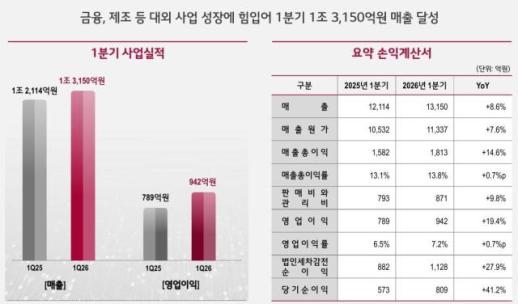 LG CNS Q1 Operating Profit Rises 19.4% to 94.2 Billion Won LG CNS said Thursday it posted broad first-quarter growth across its businesses, helped by expanding AI and cloud operations. The company said rising demand for AI transformation, along with growth in external projects, lifted both profitability and sales. LG CNS reported first-quarter revenue of 1.315 trillion won and operating profit of 94.2 billion won. Revenue rose 8.6% from a year earlier and operating profit increased 19.4%. Revenue from its AI and cloud business, a key growth driver, climbed 6.7% to 765.4 billion won, accounting for about 58% of total sales. The company said it expanded its AI transformation portfolio across industries including the public and defense sectors, finance, manufacturing, pharmaceuticals and biotech, shipbuilding and defense manufacturing. It also said it is expanding external business by providing agentic AI-based multi-agent services and has secured what it described as the largest number of AI transformation implementation cases in South Korea. LG CNS said it is also strengthening global partnerships, expanding cooperation beyond the three major global cloud providers to include OpenAI and Palantir as it targets the enterprise AI transformation market. It began supplying ChatGPT Enterprise in February and has secured about 10 corporate customers. With Palantir, it said dedicated teams are working together to identify high value-added AI transformation projects. In cloud, the company said it is boosting competitiveness through its data center design, build and operate (DBO) business. It said it won orders worth about 1 trillion won for the Samsong data center, reaffirming its position as a domestic DBO provider. It also introduced a modular AI data center that can be built within six months as it expands its infrastructure business. Revenue from its smart engineering business rose 10.4% to 227.8 billion won. The company said its smart logistics business grew on projects to build automated centers in beauty, food, fashion and defense manufacturing, and that it secured global references through its AI-based logistics optimization solution, “Mobile Shuttle.” Its smart factory business also maintained growth as projects won in defense manufacturing, shipbuilding, semiconductors and pharmaceuticals translated into revenue, the company said. It said its lightweight smart factory solution is spreading into new industries including food, medical, electronics and consumer goods, and that its agentic AI-based battery testing facility has received a positive market response. Revenue from digital business services increased 11.9% to 321.9 billion won. The company said performance was driven by next-generation system projects for major financial firms including NH NongHyup Bank, Mirae Asset Life Insurance and Shinhan Investment Corp. Looking ahead, LG CNS said it plans to expand into physical AI. It said it will pursue robot commercialization through a “full-stack RX (Robot Transformation)” service combining an industry-specific robot foundation model, hardware and a platform. It also said it has secured a broader robot lineup, including humanoids, through steps such as investing in U.S. robotics company Dexmate. The company is also expanding overseas business. It said it won an order in August last year for a hyperscale AI data center project in Jakarta worth about 100 billion won and is pushing to complete it by the end of 2026. The project is being carried out through “LG Sinar Mas,” a joint venture established with Indonesia’s Sinar Mas Group. LG CNS said it is stepping up efforts in Japan and the United States centered on enterprise solutions such as “PerfecTwin,” and is expanding its financial digital transformation business mainly across the Asia-Pacific region. 2026-04-30 10:48:19
 -
 Samsung Electronics to Supply First HBM4E Samples in Q2, Company Says Samsung Electronics said Thursday on its conference call for its 2026 first-quarter earnings that it plans to supply the first sample products of HBM4E, a high-bandwidth memory (HBM) chip, during the second quarter. The company said it will continue supplying AI-focused DRAM and NAND products, while actively responding to early memory demand for newly launched graphics processing units (GPUs) and central processing units (CPUs) expected in the second half.* This article has been translated by AI. 2026-04-30 10:47:11
 -
 Trump Says Administration Will Release More UFO Records Soon President Donald Trump said the U.S. government will again move to release as much information as possible on UFOs, also known as UAPs, or unidentified anomalous phenomena. Reuters reported that Trump said on April 29 (local time) that his administration would soon make public “as much information as possible” about UFOs. He had made similar remarks at an April 17 event in Phoenix, Arizona, saying he had found “many very interesting documents” during a review and that an initial release would begin soon. The comments reaffirm a disclosure plan he previewed in February. On Feb. 19, he said he would direct the Defense Department and related agencies to identify government documents on UFOs, UAPs and extraterrestrial life and begin the process for releasing them. The AP reported that he cited strong public interest at the time. Trump did not claim to have confirmed the existence of extraterrestrial life. He told the AP, “I don’t know if they’re real,” and said he had no opinion on the matter. The Pentagon’s past assessments have leaned against evidence of alien technology. Reuters said a 2024 Defense Department report found no proof of extraterrestrial technology in government investigations dating back to World War II, and concluded many sightings were misidentifications of ordinary objects or natural phenomena. In 2022, senior U.S. military leaders also said they had found no evidence that aliens had visited Earth or crashed here.* This article has been translated by AI. 2026-04-30 10:46:21
 -
 LG Energy Solution Says It Began Supplying 46-Series Cells From Ochang, Eyes Arizona Shipments This Year * This article has been translated by AI. 2026-04-30 10:45:13
 -
 Samsung Expects Lower Smartphone Shipments in H2, Higher Revenue on Premium Mix Samsung Electronics said Thursday on its conference call for 2026 first-quarter results that it expects the smartphone market to see lower shipments in the second half as component prices rise, but revenue to increase as sales shift toward higher-end premium models. For tablets, the company forecast declines in both unit volume and revenue, citing cost pressures and reduced promotions. For notebooks and PCs, it said revenue is expected to grow on higher average selling prices, while shipments are likely to fall. Samsung said it will pursue flagship-led growth by strengthening AI features and advancing form-factor innovation. For foldables, it said it will further refine product development to meet a wider range of user needs. * This article has been translated by AI. 2026-04-30 10:42:41
 -
 Hanwha Systems Installs Homegrown Ship Engine Control System on ROK Navy Destroyer Yang Manchun A domestically developed integrated engine control system, or ECS, has been installed for the first time on an operational naval ship in South Korea, replacing a key component that had largely relied on foreign suppliers. Hanwha Systems said it held a ceremony on the 30th at Jinhae Port in Changwon, South Gyeongsang Province, with the Navy and the Defense Rapid Acquisition Technology Research Institute to mark completion of a performance upgrade for the Yang Manchun (DDH-I) integrated engine control system. The Yang Manchun is a 3,200-ton helicopter-capable destroyer built under the KDX-I program along with the Gwanggaeto the Great and Eulji Mundeok. Under the project, the ship’s system was replaced with Hanwha Systems’ domestically produced integrated engine control system. The ship previously used equipment from overseas suppliers. Often described as a ship’s “heart,” the integrated engine control system manages propulsion, power, auxiliary equipment and damage-control systems through a single network. Hanwha Systems said the ECS is considered a core system for future ships aimed at unmanned operation, advanced intelligence and automation, alongside the combat management system, or CMS — described as the ship’s “brain” — that the company installed on the Yang Manchun in 2020. The company said the ECS effort was developed through civil-government-military cooperation. Hanwha Systems has worked since 2014 to secure key technologies in stages, collaborating with the Navy, the Defense Rapid Acquisition Technology Research Institute, the Korea Institute of Defense Technology Promotion and Research, and the Korea Institute of Machinery and Materials on defense core-technology projects. Hanwha Systems said it is currently the only company in South Korea with both domestically developed CMS and ECS technologies, and that full compatibility between the two has also enabled it to secure cockpit-style integrated bridge system, or IBS, technology. “K-ship unmanned operation and advanced capabilities will be brought forward through continued technology development, and we will work to have our unique competitiveness recognized in the global naval defense market,” said Yoo Moon-ki, head of Hanwha Systems’ naval business division. 2026-04-30 10:41:31
 -
 Korea Names Lee Jae-yu, Kim Sa-guk and Kang Ju-ryong as May Independence Activists The Ministry of Patriots and Veterans Affairs, led by Minister Kwon O-eul, said April 30 it selected Lee Jae-yu (Order of Independence, 2006), Kim Sa-guk (Patriotic Medal, 2002) and Kang Ju-ryong (Patriotic Medal, 2007) as the “May 2026 Independence Activists” for their efforts to improve harsh working conditions for Korean laborers amid Japanese colonial-era discrimination. The government posthumously awarded Lee the Order of Independence under the Order of Merit for National Foundation, and awarded Kim and Kang the Patriotic Medal under the same order, to honor their contributions. Lee (1905-1944) joined the labor movement while studying in Tokyo, working to organize Korean workers’ groups and pursue national independence and labor rights. In Seoul, he formed the “Gyeongseong Troika,” organizing worker and farmer groups and guiding student activism through reading circles as part of broader anti-Japanese efforts to build a foundation for independence. Despite repeated arrests and imprisonment, Lee refused to recant and died in 1944 at the Cheongju Protective Prison. Kim (1895-1926) was arrested and served time in 1919 while preparing the Joseon National Assembly to establish the Hansung Government. After his release, he took part actively in youth movements, traveled between Korea and Japan to organize labor groups, and stressed national unity. Kim also devoted himself to national education, establishing the Dongyang Academy affiliated with Daeseong Middle School in Gando, then fleeing Japanese repression and founding the Daedong Academy in Ningguta, Manchuria. His health deteriorated in 1924, and he returned to Korea and died at age 31. Kang (1901-1932), a worker at the Pyeongwon Rubber Factory in Pyongyang, drew public attention during a 1931 strike protesting wage cuts for Korean workers by staging what became known as the “Eulmildae rooftop protest,” calling for workers’ rights and rallying solidarity and public support. Kang was later arrested on suspicion of involvement in a Pyongyang labor union case. Her health worsened while she continued to resist in prison; she was released on medical bail but died at age 31. The ministry said Korean workers at the time faced low pay and long hours, along with colonial oppression, exploitation and ethnic discrimination, and that labor activism evolved beyond a fight for survival into resistance aimed at national independence. It said the anti-Japanese labor movement helped drive broader social change and laid the groundwork for the modern labor movement. * This article has been translated by AI. 2026-04-30 10:40:25
 -
LG Energy Solution Says North America ESS Backlog at 140 GW; Early Fixed Costs in EV-to-ESS Line Shift * This article has been translated by AI. 2026-04-30 10:35:42
-
 Samsung Electronics expects 2026 capex to rise sharply on sustained AI demand Samsung Electronics said Thursday it expects capital spending this year to rise “significantly” from a year earlier as demand for artificial intelligence remains strong. On a conference call for its 2026 first-quarter earnings, the company said it will expand investment in advanced research and development — including next-generation processes and core technologies — to secure technology leadership. It also said it plans to strengthen strategic hubs and secure additional infrastructure to respond to future demand, while closely monitoring fast-changing market conditions and executing investment flexibly. First-quarter facility investment totaled 11.2 trillion won, down 9.2 trillion won from the previous quarter. By division, the Device Solutions (DS) unit accounted for 10.2 trillion won and the display business 600 billion won. Samsung said memory spending fell from the prior quarter because investment was brought forward late last year, including the introduction of new clean rooms at its Pyeongtaek site. It said equipment investment using that space will expand this year, lifting overall capex “significantly.” For foundry operations, Samsung said spending declined from the previous quarter due to a base effect after major infrastructure investment at its Taylor, Texas, fab in the fourth quarter of last year. It said investment to start up Taylor will keep increasing this year beginning in the second quarter. Samsung previously announced plans to invest 110 trillion won this year, including research and development and capital expenditures. Of that total, it is expected to allocate 40 trillion won to R&D and 70 trillion won to capex. * This article has been translated by AI. 2026-04-30 10:34:39
 -
 Korea’s Q1 Card Spending Rises 7.2% to 322.1 Trillion Won Despite concerns about weakening consumer sentiment, card approvals in the first quarter posted solid growth, supported by stronger income conditions tied to robust domestic corporate earnings. Inflation, continued expansion in online spending and a rebound in travel demand also contributed. According to the Credit Finance Association of Korea on Wednesday, total card approvals in the first quarter came to 322.1 trillion won, up 7.2% from a year earlier. The number of approved transactions rose 5.1% to 7.2 billion. The growth rate more than doubled from 3.3% in the first quarter of last year, and the transaction-count increase was up 3.9 percentage points from a year earlier. By card type, both personal and corporate cards increased. Personal card approvals totaled 264.4 trillion won, up 6.8%, while transactions rose 5.3% to 6.82 billion. Corporate card approvals increased 8.7% to 57.8 trillion won, and transactions rose 1.9% to 380 million. Strong growth in online commerce continued. Online shopping transactions in January and February rose 8.5% from a year earlier to 46.698 trillion won. Within online shopping, food delivery and travel and transportation services increased 11.0% and 12.8%, respectively. A recovery in travel and tourism demand also lifted card use. First-quarter air passenger traffic rose 12.6%, and spending by foreign tourists surged 37.1%. The association said higher oil prices in March likely also pushed up card-approved spending on vehicle fuel. The association said uncertainty has increased and consumer sentiment could weaken due to the Middle East war that broke out in late February. Still, it said improved income and asset conditions stemming from strong domestic corporate earnings, including from expanding global semiconductor demand, along with base effects, helped drive the rise in card approvals.* This article has been translated by AI. 2026-04-30 10:33:33