
Journalist

Seo Hye Seung
-
 IBS Identifies Collagen Barrier Mechanism in Stroke, Proposes Drug Candidate South Korea’s Institute for Basic Science said it has identified what it called a root mechanism of brain damage in stroke and outlined a potential treatment approach, showing that blocking a “hydrogen peroxide–collagen production pathway” could suppress neuronal death. The research team led by IBS Center Director Lee Changjoon, working with Eulji University, said on April 28 that it found a mechanism in which rising hydrogen peroxide during stroke activates astrocytes, and type I collagen produced in the process triggers the death of nerve cells. Astrocytes typically help protect the brain and, during stroke, are known to form a glial barrier around damaged tissue to limit the spread of lesions. The team said it confirmed that this barrier can instead contribute to neuronal death, challenging the prevailing view. Based on the mechanism, the researchers developed a drug candidate, KDS12025, designed to both remove hydrogen peroxide and inhibit collagen production. In a mouse stroke model, the team said, the drug sharply reduced glial barrier formation and neuronal death, and impaired motor function returned to normal levels within a week. The team also reported effects even when the drug was given two days after onset, suggesting the possibility of extending the “golden time” window often cited as a limitation in stroke treatment. Similar results were reported in a primate model. Three days after KDS12025 was administered, lesion size decreased, and within a week, function returned in a hand that had been paralyzed, the researchers said. In a fruit-grasping test, the treated group succeeded in all 10 attempts, while the untreated group struggled because of motor impairment. The team said the primate findings support the potential for clinical application because of primates’ biological similarity to humans. Lee Boyoung, an IBS research fellow, said the team identified at the molecular level a collagen-synthesis mechanism in astrocytes driven by reactive oxygen species. “It will provide an important clue not only for stroke but also for research on degenerative brain diseases such as dementia and Parkinson’s disease,” Lee said. Yoo Seungjun, a professor at Eulji University, said that demonstrating efficacy in a primate model could help speed the transition to clinical stages. Lee Changjoon said the team succeeded in identifying a root cause and proposing a treatment strategy through a “one-stop research system” integrating basic research, drug development and preclinical work. The findings were published online April 28 in the international journal Cell Metabolism.* This article has been translated by AI. 2026-04-29 18:25:30
 -
 Foreign Buying Lifts Korea ETFs as Asset Managers Push Global Expansion As the Kospi extends its gains, overseas investors are increasing demand for South Korea-listed exchange-traded funds. According to the Korea Exchange on April 29, foreign investors bought about 510.1 billion won of the TIGER MSCI KOREA TR from March 27 through that day. They also posted net purchases of 91.2 billion won in the similarly structured KODEX MSCI KOREA TR. Korean asset managers are moving beyond basic product management and accelerating efforts to tap overseas ETF markets through local listings, equity investments and strategic partnerships. The U.S., the Middle East and India are key targets. Hanwha Asset Management is seeking to become the first Korean manager to list an ETF in the Middle East, aiming to capture new demand. It is preparing products for local investors, focusing on Gulf markets such as Saudi Arabia and the United Arab Emirates. Mirae Asset Management operates ETFs in major markets including the United States, Canada, Australia and Japan under its Global X brand. Its overseas ETF net assets account for more than half of its total, reflecting progress in its global business. Samsung Asset Management has taken a 20% stake in U.S. ETF manager Amplify, seeking to broaden its reach by listing ETF strategies proven in Korea in the local market. KB Asset Management launched what it said was the first Korea-listed ETF focused on India’s digital industry, while NH-Amundi Asset Management is expanding ETF distribution in Europe through cooperation with global manager Amundi. Korea Investment Trust Management has also listed an ETF in Vietnam and has posted strong profitability, the report said. Industry officials say the rapid growth of Korea’s ETF market has built management capabilities that are now aligning with overseas demand. “As competition in domestic ETFs intensifies, global markets are emerging as a new growth breakthrough,” an asset management industry official said. “Overseas expansion that combines local listings and strategic partnerships will expand further.” Analysts also link the trend to changes in how global money flows into Korea. As overseas investors increasingly access the Korean market through index products rather than individual stocks, ETFs are effectively becoming a gateway for investing in Korea. In response, managers are stepping up strategies to improve access by pursuing local exchange listings and building global brands, rather than relying only on products listed in Korea.* This article has been translated by AI. 2026-04-29 18:24:15
 -
 Korea’s ETF Copycat Boom Grows Despite Index Priority Rules Since the second half of last year, exchange-traded funds have been one of the main drivers of the stock market’s rise, drawing heavy inflows from retail investors seeking returns with less single-stock risk. But many ETFs are increasingly hard to tell apart, with multiple products tracking the same index or using nearly identical structures. Market participants warn that “copycat” competition is becoming entrenched. A priority-rights system was introduced to curb the problem, but its effectiveness is in doubt. ◆ Look-alike ETFs multiply According to the financial investment industry on April 29, net assets in South Korea’s ETF market totaled 431.447 trillion won as of April 28, up 45.1% from 297.1401 trillion won at the end of last year. The number of listed ETFs rose to 1,099. Even so, critics say product differentiation remains weak, with similar funds often launched around the same time whenever a theme gains attention. A prominent example is U.S. space and aerospace-themed ETFs. After Hana Asset Management launched “1Q U.S. Space Aerospace Tech” on Nov. 25 last year, the category has grown to five ETFs. Samsung Asset Management joined in March with “KODEX U.S. Space Aerospace.” On April 14, Mirae Asset Management and Korea Investment Trust Management launched “TIGER U.S. Space Tech” and “ACE U.S. Space Tech Active,” respectively. Shinhan Asset Management also introduced “SOL U.S. Space Aerospace TOP10,” promoting what it called an industry-low fee level. While details differ, the overall frameworks are largely similar. The same pattern has emerged in so-called “Samsung Electronics-SK Hynix bond-mix” products, which allocate 25% each to Samsung Electronics and SK Hynix and the remaining 50% to bonds such as Korean Treasury bonds and Monetary Stabilization Bonds. After KB Asset Management launched “RISE Samsung Electronics SK Hynix Bond Mix 50” in February, Samsung Asset Management followed on April 7 with “KODEX Samsung Electronics SK Hynix Bond Mix 50.” Hana Asset Management launched “1Q K-Semiconductor TOP2 Bond Mix 50” on April 14, and Kiwoom Asset Management introduced “KIWOOM Samsung Electronics & SK Hynix Bond Mix 50” on April 21. With essentially the same asset-allocation structure, differentiation is limited. ◆ Protections that exist mostly on paper Despite the spread of similar products, institutional safeguards have not taken hold. Protective mechanisms run by the Korea Exchange and the Korea Financial Investment Association have seen no applications or use for nearly five years, the report said. As a result, firms can design similar ETFs by making only minor adjustments to product structures. That has fueled the proliferation of look-alike funds, in contrast to the global ETF market, where managers build more differentiated lineups based on fee strategies, asset classes and management styles. Industry officials and the organizations involved cite practical limits to granting exclusivity to any single ETF. ETF structures are rarely entirely new, and it is difficult to claim rights over the underlying constituent stocks. “If you adjust the weightings or bond duration, it is recognized as a different index, so it is not easy to control,” an industry official said. Another issue is that index priority rights apply only within a narrow scope based on an index’s originality. KB Asset Management received six months of index priority rights after launching “RISE 200 Weekly Covered Call” in March 2024, with its approach recognized as distinctive for seeking extra returns by selling call options on the KOSPI 200. However, in December that year, Samsung Asset Management also received three months of index priority rights for “KODEX 200 Target Weekly Covered Call.” While both use a call-selling strategy, Samsung’s product set a target distribution rate and adjusted the option-selling ratio accordingly, presenting a partially different approach. That means a product can be treated as a separate index by modifying details while relying on the same underlying investment idea. One asset management industry official said South Korea’s ETF market is still in a formative stage and could diversify over time into more distinctive offerings, as seen recently with the emergence of active-focused managers. The official said the current wave of copycat products may be a transitional phenomenon amid rapid growth.* This article has been translated by AI. 2026-04-29 18:22:27
 -
 First Lady Kim Hye-kyung Makes 'Hope Cookies' With Children With Glycogen Storage Disease First Lady Kim Hye-kyung joined children with glycogen storage disease on April 29 to make cookies and deliver messages of encouragement. Kim, the wife of President Lee Jae-myung, visited Children’s Grand Park in Seoul’s Gwangjin District and took part in a “Hope Cookies” baking activity with children living with the rare disease. In a written briefing, presidential office deputy spokesperson Ahn Gui-ryeong said glycogen storage disease is a rare condition in which the body cannot properly break down glycogen, leading to repeated episodes of low blood sugar. She said Hope Cookies are a snack developed by parents of affected children by lowering the proportion of carbohydrates. The event was arranged as a follow-up to a “communication event with rare disease patients and families” attended by the presidential couple on Dec. 24 last year. At that event, a parent of a child with the disease appealed for greater attention to rare illnesses and presented Hope Cookies to the president. Kim said, “The story of Hope Cookies I heard on Christmas Eve stayed with me,” adding, “I really wanted to be part of making cookies that children with glycogen storage disease can eat without worry.” Wearing an apron, she baked with the children and told them, “You’re doing so well. Did you practice before coming?” She added that Hope Cookies “seem like a healthy snack that would be easy to make at home,” and said they would also go well as a late-night snack for the president. “My husband eats something at night, too, so it would be nice to make something like this for him,” she said. While the cookies baked, Kim walked around the park with the children. Afterward, she tasted the finished cookies and exclaimed, “It’s delicious.” Kim also introduced Jang Jun-woo, a student who entered Minjok Leadership Academy despite living with the disease, and told the children she hoped they would “grow up to be wonderful and healthy like Jun-woo.” After the event, she gave participants Hope Cookies and gift packages. Ahn said Hope Cookies are also planned to be delivered on Children’s Day to pediatric patients who could not attend. Ahn said the government is pursuing a plan to further lower the health insurance out-of-pocket rate for high-cost treatment for rare diseases from the current 10%, with implementation planned for the second half of this year after a vote by the Health Insurance Policy Deliberation Committee. * This article has been translated by AI. 2026-04-29 18:21:12
 -
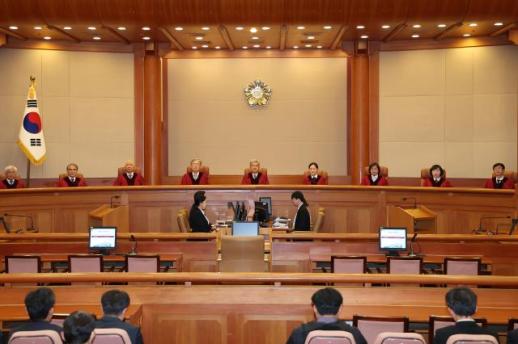 South Korea court rules mandatory patent attorney bar membership unconstitutional A provision requiring all patent attorneys to join the Korean Patent Attorneys Association violates the Constitution, South Korea’s Constitutional Court ruled Tuesday. In a constitutional complaint challenging Article 11 of the Patent Attorney Act, the court issued a ruling of “constitutional nonconformity” by a vote of 4-3-2, with four justices supporting nonconformity, three finding the provision unconstitutional and two upholding it. A ruling of constitutional nonconformity recognizes unconstitutionality but keeps the law temporarily in force to avoid disruption. The court ordered the provision to remain applicable until the National Assembly revises it, setting a deadline of Oct. 31, 2027. Six patent attorneys, including a person identified as A, were disciplined with reprimands in November 2018 by the head of the Korean Intellectual Property Office, cited for not joining the association. They sued to overturn the discipline and sought a court referral for constitutional review of the part of Article 11 covering “patent attorneys registered under Article 5(1),” but the request was denied. They then filed the constitutional complaint in January 2020. Article 5(1) requires a person qualified as a patent attorney to register with the head of the intellectual property office before starting practice. Article 11 requires those registered under Article 5(1) to join the association. The association has argued that allowing lawyers to automatically obtain patent attorney qualifications undermines professionalism and has pushed legislation to abolish the system, but it has not succeeded due to opposition from the Korean Bar Association. Conflict between the professions has continued, including the creation of a separate Korean Patent Lawyers Association by lawyer-patent attorneys who did not want to join. Justices Kim Sang-hwan, Kim Hyeong-du, Jeong Hyeong-sik and Oh Yeong-jun said the provision violates the principle against excessive restrictions and “infringes the freedom of association and occupational freedom of lawyer-patent attorneys.” They said disputes between patent attorneys and lawyers have also produced internal conflict within the association between nonlawyer patent attorneys and lawyer-patent attorneys, with the association acting to represent the interests of nonlawyer patent attorneys. In that context, they said, forcing lawyer-patent attorneys to join “excessively restricts” their freedoms. They added that striking the provision down immediately would remove the legal basis for mandatory membership and could make it difficult for the association to continue operating, explaining the decision to issue a nonconformity ruling. Justices Kim Bok-hyeong, Cho Han-chang and Ma Eun-hyeok said the legislative purpose — strengthening public-interest work through a single association and promoting development of the industrial property rights system and related industries — is significant. But they said the private harm is greater because patent attorneys have no choice but to join one association. Justices Jeong Jeong-mi and Jeong Gye-seon dissented, saying the disadvantages to patent attorneys are not greater than the public interest in improving patent attorneys’ competence and ethics and ultimately promoting development of the industrial property rights system and related industries. * This article has been translated by AI. 2026-04-29 18:19:34
 -
 Broadcast Media and Communications Commission Conditionally Renews 17 Radio Licenses; Allows Commercial Ads on tbs Traffic FM South Korea’s Broadcast Media and Communications Commission voted to grant conditional renewals to radio stations that fell short of the required score in license reviews, while also easing some rules to support management turnarounds. At its fifth plenary meeting of 2026, held April 29 at the Government Complex in Gwacheon, the commission approved three-year conditional renewals for 17 stations operated by three entities: 14 stations run by the Korean Broadcasting System, two stations run by MBC Gyeongnam Co., and Seoul’s media foundation tbs Traffic FM. The stations had scored below 650 points in earlier renewal evaluations, triggering a hearing process. The commission held hearings on April 22 to review causes of deficiencies and improvement plans before making the final decision. As renewal conditions, the commission ordered operator-specific corrective tasks, including expanded production and investment to strengthen public responsibility and local service, and steps to secure public interest functions. It said failure to meet the conditions could lead to cancellation of the renewals. For KBS’ 14 stations, the commission required tailored improvement plans for each station, including increased production and investment. For MBC Gyeongnam’s Jinju and Changwon Second FM stations, it required improvement plans and performance reports covering broadcast evaluations, disaster broadcasting, and production and investment. tbs Traffic FM was required to carry out a management normalization plan, improve its internal review system to strengthen fairness in broadcasting, and ensure transparency in the operation of donations. The commission also decided to allow commercial advertising on tbs Traffic FM, citing worsened finances since tbs was removed from Seoul’s list of funded institutions in 2024 and the need to diversify revenue raised during the hearing process. It said it could reconsider the advertising allowance if management conditions change, including any expansion of public support, to prevent harm to public interest and independence. Commission Chairman Kim Jong-cheol said the decision aimed to strengthen broadcasters’ public responsibilities while allowing flexibility to respond to changes in the business environment. He said the commission will continue to check compliance and take strict action under relevant laws if conditions are not met.* This article has been translated by AI. 2026-04-29 18:15:37
 -
 Samsung, LG bring Europe-tested heat pump boilers to South Korea market Samsung Electronics and LG Electronics are moving into head-to-head competition in South Korea’s heating market, leaning on heat pump technology already proven in Europe. Industry officials said Tuesday that LG Electronics plans to launch a new all-in-one heat pump system boiler in South Korea in May. With the outdoor unit integrated into the system, it can be installed without separate refrigerant piping work. The company said installation is also easier because it can use hot-water piping connected to existing boilers. Remote management through the LG ThinQ app is intended to improve convenience. Samsung Electronics earlier released a Korea-specific “EHS heat pump boiler.” Samsung said its heat pump solution showed a high seasonal coefficient of performance (SCOP) under a 35-degree outlet-water condition optimized for underfloor heating, and can supply thermal energy about five times the input power. The company said it provides stable heating even in temperatures as low as minus 25 degrees. Both companies have already posted tangible results in Europe, the largest market and a key base for heat pumps. Samsung has been strengthening the business with four global product lines tailored to climate-specific requirements across Europe. Its all-in-one product, offered only by Samsung, has been evaluated as maximizing operating efficiency by providing cooling, heating and hot water year-round. LG recently completed delivery of high-efficiency heat pumps to a new residential complex in the Eindhoven area of the Netherlands. It also won an order for a new housing complex in Ridderkerk and plans to begin supply from the second quarter. In the Netherlands, new homes are legally barred from connecting to the gas network, making heat pumps effectively essential infrastructure. In South Korea, wider adoption of heat pump boilers is expected to accelerate starting in 2029. The government recently announced a heat pump rollout program tied to its “2050 carbon neutrality” goal and plans to expand support to 3.5 million units by 2035. Starting this month, the government is implementing support programs in major local governments including Jeju, South Jeolla and South Gyeongsang, targeting households using coal briquette or kerosene boilers and areas not supplied with city gas. Support per household will cover up to about 70% of purchase and installation costs. * This article has been translated by AI. 2026-04-29 18:14:29
 -
 South Korea seeks ways for its ships to transit Strait of Hormuz, Foreign Ministry says South Korea’s Foreign Ministry said Tuesday it is working to find ways for South Korean ships to pass through the Strait of Hormuz, including through consultations between the South Korean and Iranian governments, after a Japanese oil tanker made the passage for the first time with Iranian approval. A ministry official said the government’s position is that, under relevant international norms, freedom of navigation and safety should be ensured as soon as possible for all vessels in the strait, including South Korean ships. “Based on this basic position, we are actively seeking ways to break the current situation, including consultations between the South Korean and Iranian governments,” the official said. The official added that the government is communicating and cooperating with related countries in various ways, while considering ship safety and the positions of shipping companies. Since the outbreak of the Iran war, 26 ships linked to South Korea have remained in the Strait of Hormuz. Chung Byung-ha, the foreign minister’s special envoy to Iran, met with Iranian Foreign Minister Seyed Abbas Araghchi and requested Iran’s cooperation to allow vessel navigation in the strait. Iranian media reported that a Panama-flagged very large crude carrier owned by a Japanese company, carrying 2 million barrels of crude, left the Strait of Hormuz on Tuesday after receiving approval from Iranian authorities. Japanese media, citing a senior Japanese government official, reported that no transit fee was paid and described the passage as “the result of negotiations by the Japanese government.” * This article has been translated by AI. 2026-04-29 18:13:39
 -
 Shinsegae Group Overhauls Strategy Office, Puts Unit Under Chairman Chung Yong-jin Shinsegae Group said it is moving to overhaul its Management Strategy Office, the group’s control tower, as it seeks faster and bolder innovation amid rapid changes in the retail environment. The company said on the 29th that it has begun practical procedures for a broad reorganization of the office to turn it into an innovation unit with stronger execution and a focus on identifying future growth engines. It said the central aim is to deliver “faster and more accurate innovation.” Shinsegae said it plans to reshape the office into an organization that drives bold internal challenges while presenting a new vision to lead South Korea’s retail market, adding that the goal is ultimately to increase customer satisfaction. As part of the restructuring, Shinsegae said it has ended Lim Young-rok’s dual role as head of the Management Strategy Office and CEO of Shinsegae Property. Lim will now focus fully on his post at Shinsegae Property, where he will concentrate on major projects including Starfield Cheongna and Hwaseong Starbay City, the group said. Until the reorganization is completed and a new strategy chief is formally appointed, Shinsegae said it will run the Management Strategy Office under Chairman Chung Yong-jin and ensure the control tower carries out its core functions.* This article has been translated by AI. 2026-04-29 18:10:19
 -
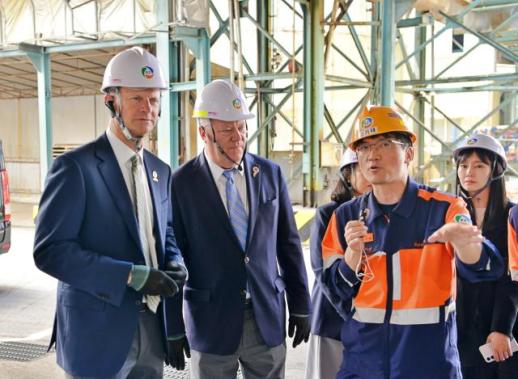 Korea Zinc, Tennessee Step Up Cooperation on U.S. Smelter Project Crucible Korea Zinc said cooperation with the state of Tennessee is accelerating as the company moves ahead with “Project Crucible,” its plan to build an integrated smelter in the United States. The company said Tennessee officials, including Lt. Gov. Stuart McWhorter, visited Korea Zinc’s Onsan smelter on April 28 and discussed ways to strengthen cooperation. Korea Zinc described the Onsan facility as a model for the planned U.S. project. Korea Zinc said the visit was arranged to help state officials better understand smelting operations and to discuss additional cooperation needed to keep Project Crucible on track. McWhorter met with Korea Zinc officials, including Kim Seung-hyeon, vice president and head of the Onsan smelter, to hear about the plant’s technology and its operating approach on environmental management and safety. The two sides also shared the company’s vision for the U.S. integrated smelter, Korea Zinc said. McWhorter said Project Crucible is expected to have a positive impact on the local economy, including job creation, and could also serve as an important opportunity to strengthen the South Korea-U.S. partnership and bolster supply chains for critical minerals to improve economic security. During the meeting, the sides discussed administrative procedures, the project schedule and operating plans needed for smooth execution, Korea Zinc said. McWhorter pledged full administrative support going forward, the company said. In comments to reporters, McWhorter again cited stronger bilateral partnership, economic security and job creation as the project’s core significance, saying it carries added weight because it is being pursued under the leadership of both governments and because stronger critical-mineral supply chains can play a major role in economic security. Asked about environmental and safety concerns raised in Tennessee, McWhorter said Korea Zinc has decades of smelting technology and operating experience. He also said the company’s silver and copper products use 100% recycled feedstock and received certification last year from global certification body SGS. McWhorter said Tennessee is working on infrastructure beyond the smelter itself, including power supply, housing for Korean personnel and training programs for local workers. He said the state holds weekly meetings with Korea Zinc and that permits under the Trump administration would allow the project to move quickly, shortening the timeline from construction to commercial operations. He added that he viewed smooth communication as a major strength in working with Korea Zinc and said he was confident the project would be carried out successfully. During the tour, Tennessee officials reviewed production processes for base metals such as zinc, lead and copper, as well as critical minerals including indium, Korea Zinc said. At a site slated for a new germanium plant, the officials expressed expectations for expanded cooperation between the two sides, the company said. McWhorter said he has held ongoing meetings with Chairman Choi Yoon-beom and other executives and again cited Korea Zinc’s communication as a strength. He said the visit broadened his understanding of the smelting industry and increased his expectations for Project Crucible. He said the state government would look for ways to actively support the project, including securing electricity and helping with administrative procedures, and expressed hope that the effort to build another world-class facility in the United States, like the Onsan smelter, would proceed successfully. Kim said that if the Onsan smelter — which he described as the world’s only facility capable of producing zinc, lead and copper as well as critical minerals — is replicated in the United States, it could become a catalyst for innovation across the smelting industry. He said the U.S. integrated smelter is planned as a smart smelter applying Onsan’s technology along with artificial intelligence and automation, and he expects the technology to be applied back at Onsan as well, creating synergy. Project Crucible is set to begin site preparation work this year and aims for completion in 2029, Korea Zinc said. After completion, the facility is expected to produce zinc, lead and copper first, followed by 13 nonferrous metals including 11 types of critical minerals designated by the U.S. government, such as indium and gallium, as well as semiconductor-grade sulfuric acid.* This article has been translated by AI. 2026-04-29 18:09:37