
Journalist

Seo Hye Seung
-
 Marathon’s 2-Hour Barrier Falls, Raising the Pace for Global Corporate Competition The marathon’s once-unthinkable 2-hour barrier has finally fallen. Sabastian Sawe crossed the finish line in London in 1:59:30. On paper, it is a little more than a one-minute improvement. But the significance goes beyond speed: It resets a limit people long treated as fixed, showing it was ultimately a matter of time and conditions, not an unbreakable wall. For years, two hours stood as a symbol in the marathon — a zone reachable only when endurance, technique and strategy aligned perfectly. Even when Eliud Kipchoge went under two hours in an unofficial setting, many viewed it as a product of special conditions. This time was different: It was set in an official race, run alongside competitors, in a way that is difficult to dispute. From this point, two hours is no longer a boundary; it is a benchmark. The moment also echoes the corporate world. Competition today is a constant effort to break records: The companies that deliver faster, more efficient results tend to lead markets. The difference is that while a marathon has a finish line, business does not. After one race ends, another begins, and the contest continues. In that sense, corporate competition resembles a series of marathons. If the semiconductor race is one event, the artificial intelligence race is another. Platform battles, electric vehicles and the energy transition each have their own finish lines. Each time a company crosses one, it returns to the starting line. Winning is not an end point; it is the start of the next contest. That is why record-setting becomes a repeated process, not a one-time event. In the past, a single innovation could dominate a market for a long time. Now, companies such as Apple, Microsoft and Google continuously improve performance and update services. Yesterday’s best becomes today’s average. Standards keep shifting and competition intensifies. This race demands both speed and stamina. In the short term, companies must sprint when new technologies emerge and markets are reshaped. The pace of change in AI already looks less like a marathon than a short-distance run. But speed cannot last without long-term endurance. Without accumulated research and development, talent and organizational capability, short-term gains can quickly fade. In the end, companies are forced to repeat sprints on a marathon course. Speed alone is not enough, and stamina alone is not enough; both must work together. Sawe’s ability to accelerate late in the race depended on endurance built early. Companies face the same reality: A late surge comes from years of preparation and investment. Moves by South Korean companies reflect that pressure. Samsung Electronics is steadily pushing benchmarks lower through semiconductor process competition and design innovation. SK hynix is continuing aggressive investment in high-bandwidth memory, opening new markets. Hyundai Motor has entered global competition in electric vehicles and autonomous driving, and LG is expanding into future industries through batteries and vehicle components. A defining feature of this competition is how quickly gaps can widen in specific fields. In core technologies such as semiconductors and AI, the distance between leaders and latecomers can expand structurally. Not every company needs to be No. 1, but falling behind in key technologies can weaken overall competitiveness. Strategies that once generated stable profits from the middle are becoming harder to sustain. Cutting records also comes with unavoidable costs. Marathoners endure extreme training; companies must commit enormous capital. Building a single semiconductor plant can cost tens of trillions of won, and constructing AI infrastructure requires astronomical spending. If those bets fail, the burden can shake an entire company. In that respect, corporate competition differs fundamentally from sports: Limits are not only about willpower, but also financial reality. As a result, moving faster must be a calculated strategy, not a blind push. Companies must choose where to concentrate and where to manage pace. It is impossible to go all-out in every race at once. Focus is essential, along with phased investment and risk diversification. Leadership is decisive in that process. Executives must judge when to accelerate and when to conserve. If they chase short-term results with excessive investment, endurance breaks down. If they respond too cautiously, they fall behind. Managing that balance is central to business. Sawe’s time shows how human limits can be redefined. It also delivers a message to companies: Limits are not fixed; they are pushed back repeatedly. But breakthroughs do not come from determination alone. They come from strategy, preparation and calculated investment. Companies do not run toward a single finish line. The moment they cross one, another race begins — and it is getting faster and more intense. The companies that survive will not simply be the fastest today, but those able to keep increasing speed over time. The day the 2-hour barrier fell was not just a day for a sports record. It was a day when the benchmark was reset. The same is true in business: Standards keep shifting and competition keeps accelerating. What matters now is not current speed, but the ability to prepare for the next one. The question is simple: Will companies be satisfied with today’s record, or start again for the next? 2026-04-27 09:18:46
 -
 Korea to Recruit Projects for 2026 Global Game Localization Support Program The Ministry of Culture, Sports and Tourism and the Korea Creative Content Agency said they will accept applications from April 27 to May 8 for projects to join the “2026 Global Game Localization Support (Overseas User Testing)” program. To help Korean games preparing to enter overseas markets improve local-market fit, KOCCA will support overseas user testing (FGT) across five regions: North America, Europe, Asia, the Middle East, and Central and South America. Selected projects will receive three rounds of overseas user testing: one offline session and two online sessions. For each online round, at least 100 local users will participate, and feedback will be collected in a structured way under real-use conditions. KOCCA said it will design the evaluations through a pre-assessment and review factors such as language, difficulty and immersion with key local users. Based on the results, it will analyze each game’s localization level and market potential and provide materials outlining recommended improvements. The program is open to game projects developed by Korean game developers seeking a direct overseas release, provided the project has no official release history in the region applied for as of the announcement date. Projects may apply if they have been released in other overseas regions or in Korea, as long as they have not been released in the target region and have a “playable build” suitable for overseas user testing (FGT). Applications can be submitted online through the KOCCA website. * This article has been translated by AI. 2026-04-27 09:13:38
 -
 Fine Digital Launches FineVu LX9 Power Rearview Mirror Dash Cam With QHD Video Fine Digital said Sunday it has launched the FineVu LX9 Power, a rearview mirror-integrated dash cam. The company said the model is designed to provide an unobstructed, wide field of view from front to rear. When a rear camera is installed inside or outside the vehicle, the E-mirror view displays the rear scene on the mirror screen. With an exterior rear camera connected, parking guide lines appear to help drivers judge direction and distance. The device uses a 26-centimeter IPS panel for a clear image with minimal color distortion from different angles. Its 2-in-1 integrated design clips onto an existing rearview mirror to reduce visual obstruction. Fine Digital said its “Smart Wide View” offers a wider rear angle than a standard mirror. Video quality is upgraded with QHD (2560×1440) recording for both front and rear. Front-and-rear HDR is intended to keep footage clear in backlighting, at night, and during sudden lighting changes such as entering or exiting tunnels and parking garages. With an optional FineVu Wi-Fi dongle, the dash cam can link to the company’s FineVu Wi-Fi app. It also supports ADAS PLUS features, including alerts when the vehicle ahead starts moving and warning sounds for lane departure linked to drowsiness or inattention. Fine Digital said the unit includes heat-dissipation design that automatically cuts power above a set temperature, along with a low-voltage protection mode for use in summer heat and in winter conditions that can lead to battery drain.* This article has been translated by AI. 2026-04-27 09:13:07
 -
 CN Motors to Relocate and Expand Headquarters Showroom, Displaying Up to 20 Vehicles CN Motors said it plans to relocate and expand its headquarters showroom to broaden displays across its full lineup. The new headquarters showroom will move to Wonchang-dong in Seo-gu, Incheon, and will be able to display up to 20 vehicles at all times, the company said, calling it a large-scale facility for the specialty-vehicle industry. Visitors will be able to compare models and options in one place. By expanding the showroom, CN Motors said customers will be able to see the Carnival High Limousine and other high-limousine models in person and confirm needed details on site. The company said hands-on experience is especially important for specialty vehicles such as the Carnival High Limousine, where interior space, seating layout and ride comfort can be decisive factors in a purchase. CN Motors also said it operates a one-on-one individual order system to support customized builds, allowing customers to choose specifications such as color and options in detail after viewing vehicles at the showroom. A test-drive service will also be offered at the headquarters showroom, enabling customers to experience performance and ride comfort in real driving conditions before buying, the company said. CN Motors said that since its founding in 2019 it has directly manufactured and assembled specialty vehicles, operating a quality management system with a specialty-manufacturer license recognized by the Ministry of Land, Infrastructure and Transport. It also cited ongoing support services including roving maintenance, on-site after-sales service and financing. Separately, CN Motors said it will hold a CN Festa through the 30th to mark 10 consecutive years as the top-selling high-limousine brand. The company said visitors during the period will receive a reward with a 100% first-come, first-served win rate, and that a drawing will offer prizes including pure gold and hotel stays. 2026-04-27 09:05:54
 -
 OneSavers Expands Into Energy Solutions With SAVUS Power-Saving Device, Four Patents OneSavers is stepping up its push into industrial energy-solution markets at home and abroad with its power-saving device, SAVUS. The company, which focuses on improving energy efficiency, said SAVUS is designed to reduce power losses and boost efficiency in industrial settings. It applies power-optimization technology tailored to load characteristics and can be installed in series without replacing existing equipment. The company said the setup improves power quality, including power factor and harmonics. OneSavers said SAVUS does not simply lower voltage. Instead, it uses load-based operational control. Using measurement-based methods that reflect differences in real-load conditions, the company said the system supports data analysis aligned with the International Performance Measurement and Verification Protocol, or IPMVP. It reported verified power savings of 8% to 13% under real-load conditions and said it has secured four patents related to the technology. Founded in 2024, OneSavers manufactures and supplies power-saving technology used in industrial equipment, manufacturing plants and logistics facilities. The company said it posted about 2.8 billion won in annual revenue last year. It said its business centers on implementing quantitative, science-based power-saving technology to cut costs and carbon emissions through energy savings. Looking ahead, the company said it plans to strengthen its offerings by developing an Internet of Things-based real-time power monitoring system and artificial intelligence-based automatic optimization technology. It also plans to package customized, industry-specific solutions to expand exports to Thailand, Guam and Brazil, among other markets in Southeast Asia and the Americas. The company said it will seek international certifications such as UL and ETL and build out a data-based verification framework. 2026-04-27 09:05:10
 -
 South Korea to Inspect 1,000 High-Risk Factories for Caught-in Machinery Hazards The government will launch intensive inspections of 1,000 ultra-high-risk manufacturing workplaces to curb a string of caught-in machinery accidents. The Ministry of Employment and Labor said on 27일 it will inspect whether key safety rules are being followed at 1,000 manufacturing sites considered at high risk for caught-in accidents from May 11 to 15. The move follows a recent series of accidents during maintenance work involving industrial robots, compressors and conveyor belts. On the 8th of last month, a worker inspecting equipment at an auto parts plant was caught in an industrial robot. On the 9th, a worker at a waste company was caught in a compressor while removing foreign material. On the 10th, a worker at a food company was caught in a conveyor belt during maintenance. The inspections are being carried out under an order from Labor Minister Kim Young-hoon to “mobilize all efforts” to prevent caught-in accidents at manufacturing sites. The ministry said the 1,000 workplaces were selected based on factors including the presence of hazardous machinery and equipment and their history of industrial accidents. Kim also instructed the heads of 48 regional labor offices to conduct unannounced on-site inspections. Inspectors plan to focus on vulnerable time windows when accidents frequently occur — 9 a.m. to 11 a.m. and 1 p.m. to 3 p.m. — and to conduct checks without prior notice to raise awareness and improve effectiveness. Ahead of the inspections, the ministry will run a self-check period from 이날 through next month 8, urging workplaces to review and improve compliance using a “manufacturing safety rules self-inspection checklist.” Violations found during inspections will be met with immediate fines and corrective orders, and workplaces that fail to carry out corrective measures will face strict action, including possible criminal proceedings. “Cutting power when maintaining or cleaning hazardous machinery and equipment is a core safety rule for protecting lives from caught-in accidents,” Kim said. He urged labor and management to work together so compliance with caught-in accident prevention rules becomes routine.* This article has been translated by AI. 2026-04-27 09:04:24
 -
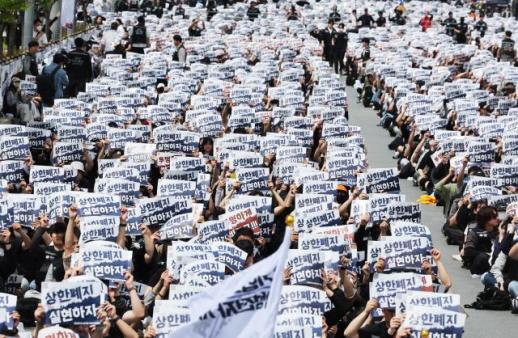 Samsung Electronics Labor-Shareholder Dispute Escalates Toward Street Protests Tensions surrounding Samsung Electronics are escalating in a way that is raising concern. A labor dispute that began with wage and bonus talks has moved to a threatened general strike, and the union has now said it will hold a rally outside the home of Executive Chairman Lee Jae-yong. Some shareholder groups have responded by filing for counterprotests. What was an internal effort to balance competing interests is increasingly spilling into street demonstrations and confrontation. According to reports, the Samsung Electronics union has warned it will begin an 18-day general strike starting on the 21st of next month. Its key demands include changes to the performance-bonus system, removal of a bonus cap and greater transparency in compensation. Workers have a legitimate right to press their claims, and pay and rewards should be settled through negotiation. But the approach matters. Targeting a private residence and seeking to pressure an executive personally crosses into different territory. A home is not a bargaining venue, and drawing a family’s living space into a labor fight can undermine the dispute’s legitimacy. Shareholder actions are also drawing scrutiny. Some shareholder groups have said they will stage protests across from union rallies and have also signaled counterdemonstrations near Lee’s home. Shareholders have rights as owners, but trying to overpower a union through street protests is not a constructive way to exercise those rights. Scenes of unions and shareholders facing off with loudspeakers are far from the norms of mature capital markets. The timing adds to the stakes. Samsung Electronics is facing major tests, including efforts to regain its lead in semiconductors, competition in AI memory and a reshaping of global supply chains. With U.S.-China technology rivalry intensifying, investment speed and research-and-development capacity are critical to corporate survival. If labor and shareholders become locked in an internal battle, the damage is likely to show up as weaker competitiveness. Any instability at Samsung can ripple beyond one company, affecting suppliers, local economies and the broader domestic stock market. Samsung is not free of responsibility. The dispute has reached this point in part because it failed to build a communication structure that employees trust. The company should examine whether bonus calculations were persuasive and whether management recognized employee frustration in time. It needs the capacity to treat the union as a negotiating partner while maintaining principled talks. For global companies, the ability to manage internal conflict through institutions is part of competitiveness. The union, too, faces choices. Escalation does not automatically produce better negotiations, and damage to corporate value can weaken the foundation for jobs and compensation. Shareholders should also avoid emotional responses focused only on short-term share prices. When labor, capital and management treat one another as enemies, all sides lose. With the dispute now extending to a planned rally outside Lee’s home, the conflict has moved beyond acceptable bounds. What is needed is not louder sound systems but a return to the negotiating table. Samsung should restore an orderly process for dialogue so that a dispute at a flagship Korean company does not end in street confrontation. 2026-04-27 09:01:06
 -
 Iran Offers Three-Stage Negotiation Plan, Says Talks Could Resume if U.S. Accepts Iran has presented mediators with a three-stage framework for negotiations and has indicated it could return to talks if the United States accepts the structure, according to a report. Lebanon-based pro-Hezbollah outlet Al Mayadeen reported on April 26 (local time) that Iran conveyed a phased proposal that begins with guarantees of a cease-fire, moves to maritime cooperation in the Strait of Hormuz, and then addresses Iran’s nuclear program. The report said Iran has signaled it would rejoin negotiations if Washington accepts the framework. The proposal divides issues by stage. In the first stage, Iran would seek a halt to U.S. and Israeli military actions and guarantees against renewed attacks on Iran and Lebanon, and it would not discuss other topics at that stage. If an agreement is reached in the first stage, talks would move to a second stage focused on management of the Strait of Hormuz. Iran is said to be considering a new legal regime to govern the strait in cooperation with Oman. In the third stage, Iran’s nuclear program would be placed on the agenda, but only if agreements are reached in the first two stages. Separately, Iranian Foreign Minister Abbas Araghchi returned to Islamabad on the same day and met with Pakistan’s army chief, Asim Munir, among others. Iran’s semi-official Tasnim news agency said the visit was intended to deliver Iran’s demands for ending the war through mediator Pakistan. Araghchi was reported to have presented Pakistan with key issues including a new legal regime for the Strait of Hormuz, compensation for war damage, guarantees against renewed aggression, and lifting a maritime blockade on Iran.* This article has been translated by AI. 2026-04-27 09:00:09
 -
 Audi Korea Reopens Renovated Gangbuk Showroom in Seoul Audi Korea said Sunday that its official dealer, Gojin Motors, has reopened the Audi Gangbuk showroom after renovations. The showroom in Mia-dong, Gangbuk-gu, Seoul, is a revamped version of the former Mia showroom. It offers 1,472 square meters (15,844 square feet) of display and consultation space, with customer flow designed to make it easier for visitors to experience Audi vehicles. The site is about a three-minute walk from Exit 1 of Mia Sageori Station on Seoul Subway Line 4. It sits along Dobong-ro, a major arterial road in northern Seoul, providing access from areas including Uijeongbu and Jongno. The Gangbuk showroom also includes a dedicated area for the recently launched The New Audi A6, the company’s flagship premium sedan. Through May 31, visitors who register via QR code after visiting the showroom will receive Audi lifestyle goods, and those who request a price quote will be offered additional benefits on a first-come, first-served basis.* This article has been translated by AI. 2026-04-27 08:57:14
 -
 iM Securities Raises Hyundai Steel Target to 50,000 Won on Expected Q2 Rebound iM Securities said Hyundai Steel's first-quarter results missed market expectations, but forecast a rebound in the second quarter with solid momentum likely to extend into the third quarter. The brokerage raised its target price to 50,000 won from 46,000 won and maintained its "buy" rating. Kim Yun-sang, an analyst at iM Securities, said first-quarter consolidated operating profit came to 15.7 billion won, down 63.7% from the previous quarter and below the market consensus of 44.3 billion won. Kim said the company’s headquarters operations swung to an operating loss of 72.5 billion won, citing lower prices for automotive steel sheet, higher raw material costs and rising scrap prices. Those factors narrowed roll margins in both the blast furnace and long steel businesses, he said. He added that subsidiaries performed steadily, supporting expectations for improved results in the second quarter. Kim said subsidiaries benefited from recognition of unrealized gains at overseas coil centers, improved business conditions and tariff refunds at Hyundai Steel Pipe, and the impact of stronger nickel prices at BNG Steel. He forecast second-quarter consolidated operating profit of 127.0 billion won, up 706.3% from the previous quarter. Kim attributed the improvement to higher hot-rolled steel prices and rising rebar distribution prices, which he said should widen roll margins in the blast furnace and long steel units and return headquarters operations to a profit of 80.0 billion won. Kim said macro factors such as energy costs and interest rates remain unfavorable for steel prices, but global steel prices have recently been firm. He said gains in rebar and hot-rolled prices are continuing, and an increase in automotive steel sheet prices is expected during the third quarter. He projected that these price increases would support solid performance at least through the third quarter. However, he said the recent price rise appears driven by supply factors and may not apply evenly across all products given differing demand conditions by end-use industry. * This article has been translated by AI. 2026-04-27 08:53:35