
Journalist

Seo Hye Seung
-
 Trump Signals Iran Deal Could Be Reached Within a Week Ahead of China Trip U.S. President Donald Trump suggested the United States could wrap up negotiations with Iran to end the war before his planned trip to China, as reports said the two sides are discussing a memorandum of understanding. Trump also warned he would intensify military pressure if no deal is reached. According to The Wall Street Journal and other outlets, Trump told reporters at a White House event on Tuesday local time that Iran “cannot have a nuclear weapon and will not,” adding that Iran had agreed on that point “along with many other things.” He said the two sides had “very good talks over the last 24 hours” and that “there’s a very good chance” of an agreement. CNN and Axios reported the U.S. and Iran are discussing a one-page MOU aimed at ending the war. The reports said it would include a temporary halt to Iran’s nuclear enrichment, U.S. sanctions relief, and a gradual lifting of Iran’s closure of the Strait of Hormuz and the U.S. maritime blockade of Iran. In an interview with PBS, Trump said a deal would include removing Iran’s stockpile of highly enriched uranium to the United States and shutting down Iran’s underground nuclear facilities. Trump also raised the possibility of a deal before his planned China visit on May 14-15. Asked by PBS whether it could be concluded before he leaves, he replied, “Possible.” Axios, citing officials, reported the White House hopes the talks will be finished before Trump’s China trip ends on May 15. Fox News anchor Bret Baier said Trump told him in a previous call that he expected about a week to finalize the process. Baier said Trump expressed “cautious optimism.” Even as he highlighted progress, Trump warned of renewed bombing if Iran does not agree. In a post on Truth Social, he wrote that if Iran does not consent, “the bombing will start,” and that it would be “at a much higher level and intensity than before.” U.S. keeps maritime blockade on Iran The United States has kept up pressure by maintaining its maritime blockade of Iran despite the reported diplomatic progress. U.S. Central Command said it “enforced the blockade” against the tanker Hasna as it traveled through international waters toward an Iranian port in the Gulf of Oman at about 9 a.m. Eastern time Tuesday. Central Command said the Hasna ignored repeated warnings, prompting U.S. forces to fire a 20mm machine gun and disable its rudder. It said the ship is no longer sailing to Iran and that the U.S. blockade on vessels seeking to enter or leave Iranian ports “remains fully in effect.” The United States began the maritime blockade at 10 a.m. on April 13, aiming to block ship movements through Iranian ports in what it described as a countermeasure to Iran’s closure of the Strait of Hormuz. The U.S. has said the blockade, intended to increase economic pressure, will remain until an agreement is finalized. Trump has repeatedly said the blockade will not be lifted until a signed deal to end the war is in place. Iran, meanwhile, has officially introduced new maritime rules requiring all ships passing through the Strait of Hormuz to obtain prior transit permission starting May 5, leaving unresolved friction over reopening the waterway.* This article has been translated by AI. 2026-05-07 11:24:15
 -
 Israel Strikes Lebanon Again During Ceasefire, Raising Stakes for U.S.-Iran Talks Israel carried out another large-scale airstrike on Lebanon during a ceasefire, resuming clashes that could complicate emerging U.S.-Iran talks on ending the war. On May 6 (local time), Reuters and Al Jazeera reported that Israeli Prime Minister Benjamin Netanyahu and Defense Minister Israel Katz said in a statement that Israel had struck Lebanon. The reports said Israel used fighter jets and armed drones to hit Hezbollah’s elite Radwan force in southern and eastern Lebanon, with at least 13 people reported killed. Hezbollah said it retaliated against Israeli forces using armed drones. The strike came during a ceasefire between Israel and Lebanon. Under U.S. and other mediation, the sides observed a 10-day truce from April 17 to 26 and then agreed to an additional three-week ceasefire from April 26 to May 17. Still, Israel carried out airstrikes on Lebanon on May 2 and May 5, and the violence has continued. The latest attack is also expected to affect U.S.-Iran negotiations that are now seen as within reach. Hezbollah is part of the Iran-aligned “Axis of Resistance,” and Iran’s conditions presented to the United States include an end to Israeli hostile actions against Lebanon. As clashes between Israel and Lebanon intensify, the prospects for a U.S.-Iran deal appear to diminish, and Netanyahu has voiced opposition to the talks. Reuters said, “As Iran and the United States were saying they were getting closer to end-of-war talks, the strike is threatening the ceasefire agreement that had halted Israel’s airstrikes on Lebanon.” Analysts also said the ceasefire-era speculation about a possible summit between Lebanese President Joseph Aoun and Netanyahu has become less likely. Atlantic Council researcher Nicholas Blanford told Al Jazeera, “The image of President Aoun shaking hands with Netanyahu would have a very negative impact in Lebanon.” Clashes between Israel and Lebanon began after Hezbollah resumed attacks on Israel on March 2, shortly after the outbreak of the Iran war. Lebanon’s Health Ministry says Israeli attacks have killed about 2,700 people in Lebanon and displaced 1.2 million. Israel has said 17 soldiers and two civilians have been killed.* This article has been translated by AI. 2026-05-07 11:21:07
 -
 Former PM's jail term reduced to 15 years on appeal over martial law involvement SEOUL, May 7 (AJP) - Former Prime Minister Han Duck-soo received a reduced sentence on appeal on Thursday for his involvement in disgraced former President Yoon Suk Yeol's botched martial law debacle in December 2024. In a nationally televised ruling, the Seoul High Court sentenced Han to 15 years in prison on insurrection charges related to Yoon's Dec. 3 declaration of martial law, which led to his ouster from office. Han was found guilty on most of the main charges including aiding or conspiring with Yoon in the short-lived, late-night martial law bid, as well as concealing or fabricating documents to make the move appear lawful. But Han's sentence was significantly reduced from the 23 years handed down by the lower court in January this year, as the appellate court, in a partial reversal, cleared him of some charges including perjury over his testimony at Yoon's impeachment trial in February last year. Even with the lighter sentence, Han's lawyers immediately vowed to appeal following the ruling. 2026-05-07 11:20:56
 -
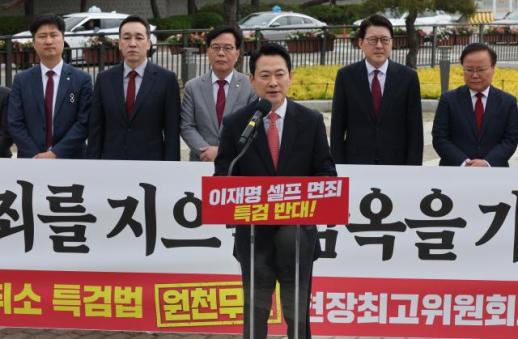 People Power Party slams special counsel bill allowing indictment cancellations in Lee Jae-myung cases The People Power Party held an on-site meeting of its 최고위원회 in front of Cheong Wa Dae on May 7 and criticized a special counsel bill that would allow the cancellation of indictments in cases involving President Lee Jae-myung. The party said indictment cancellations would go beyond “erasing Lee Jae-myung’s crimes” and amount to “the last tollgate on the road to dictatorship.” It also urged that five trials involving Lee be resumed. Party leaders, including Jang Dong-hyeok, spoke at the meeting held in front of the fountain at the Sarangchae near Cheong Wa Dae in Seoul. Jang said, “In Lee Jae-myung’s eyes inside Cheong Wa Dae, he can’t see the economy, people’s livelihoods, diplomacy or security — anything. Right now, Lee is thinking only about not going to prison.” Jang cited allegations including illegal remittances to North Korea, the Daejang-dong scandal, perjury, misuse of corporate card funds and election law violations, calling them “clear and shameless crimes” that he said Lee could not avoid facing. He claimed Lee was trying to “erase his crimes altogether by appointing a special counsel himself.” “In short, he wants to use a special counsel to take the indictment from the judge and have Lee Jae-myung tear it up with his own hands,” Jang said, adding, “He seems afraid of going to jail, but not afraid of the public at all.” Jang said, “The moment criminal Lee Jae-myung tears up the indictment with his own hands, an all-powerful dictatorship will begin in earnest,” and warned of harsher pressure on the opposition and the media. He also called the upcoming local elections a vote to stop what he described as “Lee Jae-myung’s dictatorship.” Jang also said he opposed a constitutional amendment proposal scheduled for a vote at the National Assembly plenary session that day, calling it a political maneuver to extend Lee’s rule. He said that if Lee wants a constitutional revision, Lee should first declare he will not seek another term. Jang urged the immediate withdrawal of the special counsel bill tied to indictment cancellations and called for the repeal of laws he described as unconstitutional. “They drafted a constitutional amendment to suit their tastes, introduced it first, and now say they want discussions — that itself is a dictatorial idea,” he said. Floor leader Song Eon-seok also criticized the special counsel measure, calling it an unprecedented “self-pardon bill” that would mobilize state power to erase Lee’s alleged criminal suspicions. “If he is truly confident, as he says, there is no reason to avoid trial,” Song said. Song added that five trials involving Lee — including cases tied to Daejang-dong, Baekhyeon-dong, Ssangbangwool-related remittances to North Korea, and violations of the Public Official Election Act — “should be resumed immediately.”* This article has been translated by AI. 2026-05-07 11:20:05
 -
 China Probes Hefei Party Chief Fei Gaoyun for Serious Discipline Violations A Chinese official born in the 1970s and once discussed as a potential next-generation leader has come under investigation, the latest in a string of falls among so-called “post-70s” cadres. The official is Fei Gaoyun, the Communist Party secretary of Hefei, the capital of Anhui province, which has recently emerged as a high-tech hub. China’s Central Commission for Discipline Inspection said on its website on the 6th that Fei is being investigated on suspicion of “serious discipline violations.” Fei has not appeared in public since April 19, when he presided over a Hefei party committee meeting. After the announcement, the Anhui provincial party committee and the Hefei party committee each held meetings to express support for the party center’s decision. The Hefei party committee said it would “strengthen management of family members, close associates and staff” and build “a clean and healthy relationship between government and businesses.” Fei, born in August 1971 and a native of Huai’an in Jiangsu province, spent about 30 years in public service in Jiangsu. He served as head of the organization department in Nantong, mayor and party secretary of Changzhou, and executive vice governor of Jiangsu. He moved to Anhui in 2023, served as executive vice governor there, and became Hefei party secretary in April last year. The article said Fei was known to have built ties in Jiangsu with senior leaders including Premier Li Qiang, United Front Work Department head Shi Taifeng and State Councilor Wu Zhenglong. It said Fei was promoted to Changzhou party secretary in 2017 when Li and Shi were serving as Jiangsu party secretary and governor, respectively, and later worked as a vice governor during Wu’s tenure as Jiangsu governor. Fei drew attention after being elected an alternate member of the Central Committee at the Communist Party’s 20th National Congress. Expectations had been high that he would enter the Central Committee and be tapped for a key central post at next year’s 21st Party Congress, joining a group of rising “post-70s” officials. He ultimately did not avoid the party’s disciplinary crackdown. On April 30, another “post-70s” official seen as a future leadership contender, Li Yunze, head of the National Financial Regulatory Administration at ministerial rank, was demoted over discipline violations, the report said. With the 21st Party Congress and a leadership reshuffle ahead next year, China’s anti-graft drive appears to be intensifying. The discipline commission said that, in addition to Fei, two other senior officials were also being investigated on suspicion of discipline violations: Zhandui, a vice mayor of Lhasa in the Tibet Autonomous Region, and Hu Chaowen, party secretary of Enshi Tujia and Miao Autonomous Prefecture in Hubei province.* This article has been translated by AI. 2026-05-07 11:19:04
 -
 South Korean Defense Stocks Slide on Hopes for U.S.-Iran War-End Talks South Korean defense stocks fell broadly Thursday as expectations grew for progress in U.S.-Iran talks aimed at ending the war, prompting profit-taking after a recent surge tied to rising Middle East tensions. As of 11:01 a.m., Hyundai Rotem was down 23,000 won, or 8.78%, at 239,000 won, according to the Korea Exchange. Hanwha Aerospace fell 5.23%, Korea Aerospace Industries dropped 3.57%, and LIG Defense & Aerospace declined 1.84%. The declines were widely attributed to reports that negotiations between the United States and Iran were gaining momentum, shrinking the geopolitical premium that had supported the sector as Middle East risks intensified. U.S. online outlet Axios reported on May 6 (local time), citing multiple sources, that the United States and Iran were close to signing a one-page memorandum of understanding laying out a basic framework to end the war and address the nuclear issue. While no final agreement has been reached, Axios said the talks were at their most advanced stage since the war began on Feb. 28. U.S. President Donald Trump, in an interview the same day with public broadcaster PBS, said he believed a deal with Iran was possible, adding that there was a “very high” chance of reaching an agreement. He also mentioned the possibility of a deal before his planned visit to China on May 14-15. In the market, concerns have grown that order momentum for defense companies could cool after shares jumped on expectations the war would be prolonged. Institutional and foreign investors were seen concentrating profit-taking in stocks that had posted the biggest recent gains. * This article has been translated by AI. 2026-05-07 11:18:17
 -
 South Korea’s KF-21 Fighter Cleared for Combat Use, Air Force Delivery Set for Second Half South Korea’s domestically developed KF-21 Boramae fighter has received a final determination that it is suitable for combat use, the Defense Acquisition Program Administration said Wednesday. DAPA said the decision marks completion of verification of all performance requirements for the KF-21 Block-I after about three years of follow-on testing and evaluation since a “provisional combat suitability” determination in May 2023. The KF-21 program formally entered full-scale system development in December 2015. Flight testing began in May 2021, and through February this year the program conducted about five years of ground tests to verify durability and structural integrity, DAPA said. DAPA said about 1,600 test flights validated flight performance and stability across about 13,000 test conditions, including aerial refueling and weapons-release tests. The agency said it expanded test airfields from Sacheon to Seosan and, for the first time in South Korea, introduced aerial refueling into flight testing, improving efficiency and scope. It said the development flight-test schedule was completed two months earlier than planned. DAPA said the KF-21 meets the Air Force’s required operational capabilities and has secured the technology level and stability needed to carry out missions in real battlefield conditions. The program is set to complete system development in June. The first mass-produced KF-21, rolled out in March, is scheduled to be delivered to the Air Force in the second half of this year, with subsequent aircraft to be deployed in sequence, DAPA said. No Ji-man, head of DAPA’s Korea Fighter Program Division, said the combat suitability determination was achieved through close cooperation among the Defense Ministry, the Joint Chiefs of Staff, the Air Force, Korea Aerospace Industries and the Agency for Defense Development. He called it a symbolic achievement showing South Korea has fully secured an independent fighter-development capability. No said the agency will push ahead with mass production and fielding without disruption to further strengthen the Air Force’s operational capability. DAPA said it plans to deliver 40 initial mass-produced KF-21s focused on air-to-air capability to the Air Force by 2028. It also plans to produce an additional 80 aircraft by 2032 with air-to-ground and air-to-ship capabilities, for a total of 120 deliveries. * This article has been translated by AI. 2026-05-07 11:14:57
 -
 South Korea finds 84 violations in monthlong inspection of seasonal migrant workers’ housing, rights Government inspections of farms and fishing households employing foreign seasonal workers found 84 violations over one month, including substandard housing and alleged rights abuses, the Justice Ministry said Thursday. The ministry said it inspected 849 workplaces in 15 cities and counties and interviewed 2,035 seasonal workers from April 1 to 30. It found 84 violations at 61 workplaces across eight cities and counties. Investigators from the Korea Immigration Service are conducting a three-month nationwide review through June 30 covering 3,445 workplaces in 27 cities and counties and 7,997 seasonal workers. The inspections focus on overall working and living conditions, including suspected involvement of illegal brokers, unpaid wages, contract violations and whether adequate housing is provided. In the interim results released Thursday, the ministry cited 34 cases involving inadequate housing, including 16 cases of providing container housing and 18 cases of missing fire-prevention equipment such as extinguishers. It also reported 25 labor contract violations, including failure to pay the minimum wage or overtime, failure to guarantee days off, and wage arrears. Another 25 cases involved alleged human rights abuses, including restricting phone use and verbal abuse. By region, Goryeong County in North Gyeongsang Province recorded the most violations with 29 cases, followed by Uiryeong County in South Gyeongsang (10). Changnyeong County in South Gyeongsang and Nonsan and Yesan in South Chungcheong each had six, Miryang in South Gyeongsang had two, and Gochang in North Jeolla and Damyang in South Jeolla had one each. The immigration policy bureau said it has demanded corrective action from workplaces and local governments where violations were found. Depending on the severity, it plans to impose penalty points and restrict the assignment of seasonal workers. For alleged rights abuses, the Migrant Rights Protection Task Force will begin detailed investigations and, if confirmed, start relief procedures through the Foreigners’ Human Rights Protection and Rights Promotion Council, the ministry said. If broker involvement is suspected, the ministry said it will immediately launch targeted investigations and seek punishment, including referring illegal brokers to prosecutors. A revised Immigration Control Act banning and penalizing broker activity took effect Jan. 23; violations are punishable by up to three years in prison or a fine of up to 30 million won. Justice Minister Jeong Seong-ho said, “Human rights violations against seasonal workers cannot be tolerated under any circumstances.” He said the ministry will strengthen on-site inspections through June 30 to ensure meaningful protection and, after the inspection period ends, improve the system so the 1345 immigration hotline can more actively receive reports through multilingual counselors. * This article has been translated by AI. 2026-05-07 11:13:59
 -
 Report warns South Korea’s industry is highly exposed to energy price swings South Korea’s industrial structure is vulnerable to swings in global energy prices, raising the risk that the country’s shift to cleaner production could be disrupted, a government-funded think tank said. It warned that higher energy costs can go beyond raising production expenses, eroding profitability and curbing investment — and ultimately weakening companies’ capacity to move to low-carbon operations. The Korea Institute for Industrial Economics and Trade said in a report released on the 7th, titled “In the era of energy security: Responding to green-transition risks for South Korean industry under a triple-exposure structure,” that the country faces a “triple exposure” of high dependence on imported energy, an economy centered on manufacturing, and heavy industrial energy use. Analyzing 2024 data from the International Energy Agency and the World Bank, the institute said South Korea’s energy import dependence stood at 84.2%, high among major economies. Manufacturing accounted for 26.6% of gross domestic product, while the industrial sector’s share of energy consumption was 26.4%, underscoring an energy-intensive industrial base. Under those conditions, the institute said, rising international energy prices are likely to feed directly into manufacturing costs and could squeeze spending on facilities and technology upgrades needed for the transition. Energy-intensive industries such as steel and petrochemicals saw profitability deteriorate during the 2022 surge in global energy prices, it said. The institute added that energy security has become a structural factor affecting industrial competitiveness and the pace of the green transition, not merely a cost issue. Major economies are already adjusting policies with energy-security risks in mind. The United States and Japan are strengthening measures that link energy security with industrial competitiveness, the report said. The United States is focusing on supply-chain restructuring and energy infrastructure investment, while Japan is pursuing its “GX (Green Transformation)” strategy alongside expanded investment in renewable energy and next-generation industries. The European Union, it said, kept policies to expand renewable energy during the energy crisis while also using fossil fuels and promoting demand-management measures to cushion the shock. In South Korea, calls are growing for policy steps to ease the burden on industry. The institute said near-term measures could include improving the industrial electricity pricing system to reduce cost volatility. Over the medium to long term, it said, transition finance and carbon contracts for difference, or CCfD, could help secure companies’ capacity to invest. “Green transition is an inevitable trend, but under the current industrial structure, external energy shocks can become a burden on the transition process,” Lee Sang-won, a research fellow at the institute, said. “Rather than a speed-focused approach, we need a transition strategy with the ability to respond to shocks.”* This article has been translated by AI. 2026-05-07 11:08:47
 -
 SK Launches Impact Booster Program to Help Social Ventures Scale Up SK said Wednesday it is launching “Impact Booster,” a program designed to help social ventures that have entered a growth stage scale up. Social ventures are startups that pursue profits while offering innovative solutions to social problems. The program targets social ventures that have moved beyond pre-A funding and entered Series A or B rounds, before an IPO. SK plans to select about 10 companies each year for intensive support. Selected companies will be offered opportunities to work with major SK affiliates including SK hynix, SK Innovation and SK Telecom, along with up to 70 million won in business support funding. SK will first provide 10 million won for growth, then offer up to 60 million won more for demonstration projects after companies identify tasks to pursue with SK affiliates. SK said it will link the new program with existing initiatives such as SK Pro Bono and SE Consultant to provide integrated support. For business-to-consumer companies, it will offer product consulting and help expand sales channels. For business-to-business companies, it will support pilot projects to help them build references and attract follow-on investment. SK also plans to strengthen support by working with outside organizations, including the Seoul Business Agency to back demonstration funding and the nonprofit OnYul to provide free legal advice. SK said the program is intended to address structural hurdles faced by social ventures, which it said can be undervalued in the market because of their focus on solving social problems and can struggle to secure opportunities to break through at the growth stage. The company cited its broader efforts to build an ecosystem for businesses focused on social problem-solving, including Impact MBA to develop social entrepreneurs, Impact Unicorn to help promising social ventures grow into unicorns valued at 100 billion won or more, and SOVAC (Social Value Connect) to promote connections and cooperation among companies working on social issues. SK said the push aligns with the group’s management philosophy. SK Group Chairman Chey Tae-won has emphasized the “Double Bottom Line,” arguing that companies should pursue social outcomes alongside financial performance to ensure sustainability. Under that approach, SK said it views social enterprises and social ventures as partners for shared growth, designing support to go beyond funding by providing business cooperation with affiliates and proof-of-concept opportunities aimed at generating sales and raising company value. “While the number of social ventures in Korea has increased, many are relatively undervalued as they carry out missions to solve social problems, and often fail to secure growth opportunities,” said Ji Dong-seop, SV committee chair of the SK Supex Council. “We will be a sponsor that provides integrated support so that no company fails to make a leap because it could not get an opportunity at the growth stage.”* This article has been translated by AI. 2026-05-07 11:07:33