
Journalist

Tom Stacey
-
 South Korea's prosecutorial overhaul enters uncharted territory SEOUL, April 17 (AJP) - The fall of prosecutor-turned-president Yoon Suk Yeol did not end an epic downfall for a leader, but also the institution he had once represented. The prosecution has already lost much of its once-mighty power to the police and the Corruption Investigation for High-ranking Officials, with another agency pending, leaving it a near-defunct institution. The dramatic downsizing is creating a severe bottleneck, turning what was once a sought-after post into a grind. At the Cheonan branch of the Daejeon District Prosecutors’ Office, the numbers tell the story. Each prosecutor is now responsible for more than 500 unresolved cases. "It's not something you can control with long hours anymore," one prosecutor said. "At 400 or 500 cases, the system is essentially in a state of panic." Nationwide, the average caseload per prosecutor rose from 73.4 at the end of 2024 to 135.7 by late 2025. Unresolved cases — defined as those not processed within three months — have surged. In Namyangju, caseload per prosecutor jumped from 169.6 to 295.2 within a year, with similar spikes in Jinju and elsewhere. As workloads mount, prosecutors are increasingly unable to process cases before statutes of limitations expire, forcing closures without prosecution — directly affecting victims and undermining confidence in the system. The Supreme Prosecutors' Office has urged prioritization of long-pending cases. Exodus of experience Driving the surge is a sharp reduction in manpower. Between last year and March, 233 prosecutors — more than 10 percent of the total — left the service, including 151 with more than 15 years of experience. A record number have taken leave, while dozens have been seconded to special investigations. At Cheonan, only 17 prosecutors remain out of an authorized 35, with roughly half in their second or third year. "Work overload is pushing people to their limits," said Cho Bae-sook, a lawmaker on the National Assembly's Legislation and Judiciary Committee. She warned that delays are leading to more expired prosecutions, calling the situation "a judicial bankruptcy" in which the state's ability to impose criminal punishment is eroding. The reform that changes everything In March, the National Assembly passed landmark legislation that will effectively dismantle the traditional prosecution service. A new entity — the Serious Crimes Investigation Agency — is to take over core functions, while prosecutors will, in principle, no longer conduct investigations. That authority will shift primarily to the police and the new agency. The reforms also eliminate prosecutors' authority to direct and supervise certain investigative bodies, marking a decisive break from past practice. The changes are scheduled to take effect later this year. Efforts to curb prosecutorial power are not new. Since the early 1990s, critics have questioned political neutrality and the concentration of authority. "Prosecutors' ability to both investigate and decide whether to indict creates efficiency," a senior incumbent prosecutor said. "But it also carries risk." Supporters argue separating investigative and prosecutorial functions is essential. "The belief that prosecutors investigate better than police is an illusion," said Kim Kee-Chang, a professor at Korea University Law School. "What prosecutors are good at is not investigation, but planning, building narratives and shaping cases." He also criticized pretrial disclosures. "In a system where prosecutors publicly declare someone guilty before trial, one has to ask what role remains for the judiciary," he said. Opponents argue the reforms are moving too quickly. Shin Dong-wook, a lawmaker on the same committee, described the overhaul as a "rough and ideological dismantling" of the prosecution service. He warned that without safeguards such as supplementary investigative authority, enforcement capacity could weaken. "If these systems are not properly designed," he said, "the result could be a country where criminals operate with greater impunity." At the heart of the reform is whether the police can absorb expanded investigative responsibilities. "That police conduct investigations is the standard model in modern states," Kim said, while acknowledging the need for stronger oversight and institutional safeguards. Inside the prosecution service, the mood is subdued. "People feel they have little room to speak," a senior prosecutor said. The system is now undergoing simultaneous shifts in structure, staffing and workload, placing it in a transitional phase where capacity and institutional design are being tested in parallel. 2026-04-17 17:50:57
 -
 Korean stocks slip as foreign investors offload $1.34 billion in shares SEOUL, April 17 (AJP) - Korean stocks closed lower Friday, retreating from recent highs as foreign investors led broad-based selling. Lingering geopolitical uncertainty continued to cap risk appetite despite signs of potential de-escalation in the Middle East. Other Asian markets also traded lower, with Japan’s Nikkei 225 falling 1.21 percent, Hong Kong’s Hang Seng Index dropping 1.2 percent, and China’s Shanghai Composite edging down 0.2 percent. The benchmark KOSPI fell 0.6 percent to close at 6,191.9, after trading between a high of 6,230.32 and a low of 6,159.88. Foreign investors drove the decline, offloading 1.99 trillion won ($1.34 billion) worth of shares. Retail investors bought 1.44 trillion won, while institutions added 150.1 billion won, indicating continued dip-buying against external outflows. The pullback came as investors reassessed the sustainability of the recent rally, with mixed signals emerging around U.S.-Iran negotiations and a temporary truce between Israel and Lebanon failing to fully stabilize sentiment. Large-cap stocks were broadly weaker, led by semiconductors. Samsung Electronics fell 0.7 percent to 216,000 won, while SK hynix dropped 2.3 percent to 1,128,000 won, reflecting cautious positioning despite overnight gains in the Philadelphia Semiconductor Index. Defense and industrial names also came under pressure. Hanwha Aerospace slid 6.3 percent, and Doosan Enerbility lost 2.1 percent, reflecting profit-taking following recent strength in defense-linked plays. Automakers, however, provided limited support. Hyundai Motor rose 0.8 percent, and Kia gained 0.8 percent. Among notable movers, Hanwha Engine surged 16.4 percent to 56,100 won on expectations of earnings growth tied to expanding orders and improving profitability in marine engine segments. The rally was further supported by optimism over the shipbuilding supercycle and strategic overseas acquisitions aimed at strengthening its position in eco-friendly vessel markets. STX Engine also hit its daily upper limit, driven by strong demand tied to defense exports and shipbuilding expansion. Sector-wise, gains were concentrated in selective themes. Venture investment firms jumped 7.7 percent, while electronics equipment and display panel stocks rose 4.1 percent and 3.9 percent, respectively, highlighting rotation into mid-cap growth plays. The KOSDAQ outperformed, rising 0.6 percent to close at 1,170.04, supported by heavy buying from foreign and institutional investors, who added 15.8 billion won and 9.1 billion won, respectively. Retail investors bought a modest 2.5 billion won. Biotech and secondary battery names showed mixed performance. Meanwhile, COVID-19-related stocks gained amid renewed concerns over the global spread of emerging variants, including BA.3.2, supporting selective strength in healthcare names. However, the move was largely thematic and had limited impact on broader market direction. The Korean won weakened against the dollar, trading at 1,483.1 won, down 0.2 percent from the previous session, reflecting sustained external pressure amid foreign outflows. Oil prices edged lower, with Brent crude falling 0.7 percent to $98.7 per barrel and WTI declining 1 percent to $93.7, as optimism over potential negotiations offset ongoing concerns over supply disruptions in the Strait of Hormuz. 2026-04-17 17:31:30
 -
 Hanwha Solutions trims capital raise to 1.8 trillion won after regulator pushback SEOUL, April 17 (AJP) - Hanwha Solutions announced it will scale back its planned rights offering to 1.8 trillion won ($1.21 billion) from an initial 2.4 trillion won, retreating from a contentious fundraising plan that drew a rare regulatory rebuke and sharp criticism from shareholders. The revised offering, approved by the company's board on Friday, comes just eight days after the Financial Supervisory Service ordered Hanwha Solutions to refile its securities registration, citing missing or unclear disclosures that could impair investor judgment. Under the amended plan disclosed through regulatory filing, funds earmarked for debt repayment will shrink to 907 billion won from 1.49 trillion won, while the roughly 908 billion won set aside for capital investment remains untouched. The issue size has been cut to 56 million new shares from 72 million, with the subscription price lowered to 32,400 won per share from 33,300 won. The allotment ratio for existing shareholders correspondingly drops to 0.2604 new shares per held share from 0.3348. The record date is May 14. The company has previously defended the move as a necessary measure against a credit-rating downgrade amid a prolonged downturn in the global solar and petrochemical sectors. "We sincerely reflect on and apologize for failing to adequately communicate the scale and rationale of the rights offering with shareholders and the market in its early stages," said Nam Jung-woon, head of the chemical division. The company said it will raise the remaining 600 billion won shortfall through asset monetization and capital-like financing, and pledged to refrain from additional equity offerings through 2030 while maintaining its shareholder return policy. 2026-04-17 17:01:59
 -
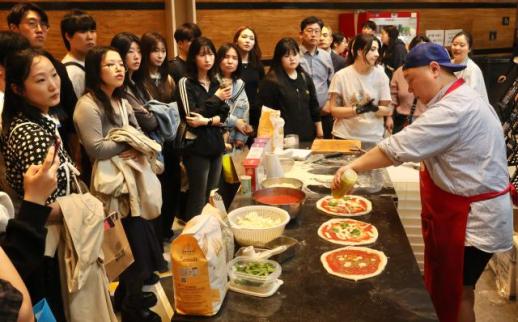 Bakery fair underway in southern Seoul SEOUL, April 17 (AJP) - A bakery fair is being held in southern Seoul, with around 300 booths from 100 bakeries and confectionery makers participating. Co-hosted by the Korea Confectionery Master Association and the Korea Bakery Association, the fair at COEX kicked off on Thursday and runs until Sunday under the theme of "Bake the World," showcasing bakery-related machinery, packaging solutions, and raw materials During the four-day run, a competition is also scheduled, featuring top-level pâtissiers showcasing their confectionery and baking skills. 2026-04-17 16:30:37
 -
 Annual coffee expo brings together industry professionals and coffee enthusiasts in Seoul SEOUL, April 17 (AJP) - A large-scale coffee expo is underway in southern Seoul this week, bringing together industry professionals, baristas, and coffee enthusiasts. Co-hosted by the Korea Coffee Association and COEX, the annual expo, now in its 15th year, kicked off its four-day run on Wednesday and runs until Saturday, showcasing coffee-related machines, equipment, beans, and other products. Under the slogan of "Blend the World," the expo features a special pavilion showcasing coffee brands and products from Viet Nam, selected as this year's guest country of honor. 2026-04-17 15:57:08
 -
 Wolf escaped from Daejeon zoo undergoes surgery to remove fishhook after capture SEOUL, April 17 (AJP) - "Neukgu," a wolf that escaped from a zoo in Daejeon last week and was caught after a nine-day search on Friday, is recovering at a veterinary clinic after undergoing surgery to remove a fishhook found in its stomach. According to Daejeon city officials, an X-ray revealed a 2.6-centimeter fishhook, along with leaves and fish bones. The fishhook, which posed a risk of perforation, was safely removed. The wolf was captured after rescue workers received a report at around 5:30 p.m. the previous day that it had been spotted near an expressway. After searching surrounding areas for several hours, they located the animal at around 11:45 p.m. and captured it with a tranquilizer gun after midnight. Officials said its pulse and body temperature were normal. A video clip released later shows Neukgu being captured after a 30-minute standoff. The two-year-old male wolf, born at Daejeon O-World, escaped last Wednesday after digging under a wire fence there. 2026-04-17 15:29:07
 -
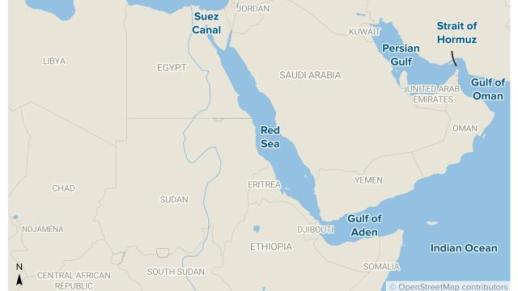 OPINION: Seoul navigates strategic reckoning as West Asia conflict rewrites energy calculus SEOUL, April 17 (AJP) -The West Asia conflict is forcing South Korea to confront a fundamental shift: energy security is no longer about efficiency, but resilience. For decades, Seoul optimized its energy system for cost and scale — routing roughly 70 percent of its crude imports through the Strait of Hormuz, refining heavier Middle Eastern oil into high-value fuels, and exporting them across global markets. It was a model built on efficiency. That model is now under strain. With the Hormuz corridor constrained and maritime risks spilling into the Red Sea, shipping costs are no longer just a function of distance. They now reflect geopolitical risk. Routes once considered optimal are vulnerable, while alternatives once dismissed as uneconomical are being reassessed through a different lens: safety. The recent transit of a South Korea-linked crude carrier through the Red Sea — the first confirmed Hormuz bypass shipment — captures this shift. It is not simply a logistical workaround, but a signal that Seoul is recalibrating priorities under pressure. Yet the challenge runs deeper than import diversification. South Korea is not just a major crude importer. It is also a critical exporter in the global energy system — a dual role that amplifies the stakes of disruption. Petrochemicals and refined oil products ranked as the country’s third- and fourth-largest export items last year, generating a combined $88.5 billion and accounting for 14 percent of total shipments. The country’s four major refiners — SK Energy, GS Caltex, S-Oil and HD Hyundai Oilbank — exported 86 million barrels of jet fuel in 2025, representing roughly 4 percent of global supply, the largest share worldwide. Despite being the world’s largest crude producer, the United States remains structurally dependent on Korean refining output. Korean shipments accounted for 71 percent of U.S. jet fuel imports last year — equivalent to about 7 percent of total supply. In western regions such as Washington and California, dependence rises to as high as 85 percent of imports. This reflects a structural imbalance. The U.S., buoyed by the shale revolution, produces predominantly light crude, which yields lower refining margins and is less suited for certain high-value fuels. South Korea, by contrast, has built its system around heavier Middle Eastern crude, particularly from Saudi Arabia, enabling it to produce premium products at scale. Washington has urged Seoul to pivot toward U.S. crude, framing it as both a commercial and strategic adjustment. But such a shift is not straightforward. It would require reconfiguring refining systems and could erode Korea’s competitiveness in high-value exports — a sector that has become a pillar of its trade balance. And here lies the contradiction. South Korea’s energy model is built on global integration — importing crude, refining it, and exporting higher-value products. But geopolitical fragmentation is beginning to challenge that model. Supply chains are no longer neutral. They are increasingly shaped by strategic alignments and conflict zones. The immediate risks are already visible. Some 26 South Korea-linked vessels remain stranded or delayed near the Persian Gulf. Shipping through Hormuz has dropped sharply, while insurance costs and security risks are rising. These pressures are feeding directly into domestic fuel prices and industrial margins. The government has responded with short-term stabilizers — emergency crude purchases and fiscal support — but these are stopgaps. The more consequential shift is strategic. Seoul is moving beyond simple diversification toward a broader rethinking of its energy architecture. This includes exploring new sourcing corridors and strengthening ties with alternative partners such as India, whose refining capacity and geographic position offer a potential buffer against Middle Eastern volatility. President Lee Jae Myung’s state visit to New Delhi, accompanied by a large business delegation, reflects this recalibration. Even if tensions ease, the old equilibrium is unlikely to return. U.S.-Iran negotiations may reopen parts of the Hormuz corridor, but under tighter controls and new conditions. The waterway may function again, but it will no longer be a frictionless artery of global trade. For South Korea, that changes the equation. Energy security can no longer be measured solely in cost per barrel. It must now account for route stability, geopolitical exposure and systemic resilience. In that sense, higher shipping costs are not an anomaly — they are the new premium for security. The shift from efficiency to safety will not be painless. It implies higher costs, more complex logistics and potential trade-offs in competitiveness. But the alternative — continued dependence on a single, volatile chokepoint — carries far greater risk. The West Asia conflict is not just disrupting supply. It is rewriting the logic of energy strategy. For Seoul, the task now is to adapt — not incrementally, but structurally — to a world where the cheapest route is no longer the safest one. *The author is the assistant editor of AJP 2026-04-17 15:29:05
 -
 Samsung Elec seeks court injunction to block union strike SEOUL, April 17 (AJP) - Samsung Electronics has moved to legally block a planned general strike by its labor unions, warning that disruptions to its semiconductor cleanrooms could trigger losses exceeding $20 billion and damage key client relationships. The South Korean tech giant filed for a provisional injunction with the Suwon District Court on Thursday to prevent what it described as “illegal” protest activities by a joint strike body formed by its three largest labor groups, including the National Samsung Electronics Union (NSEU). The legal action comes as tensions escalate ahead of an 18-day nationwide strike scheduled from May 21 to June 7, following a partial walkout next week amid impasse over performance-based bonuses. Samsung has offered to allocate 10 percent of operating profit to employee bonuses, while unions are demanding 15 percent, emboldened by the company’s record earnings. The company reported stunning first-quarter operating profit of around 57 trillion won. Union leaders dismissed the company’s concerns over potential damage to cleanroom facilities, arguing the strike would remain within legal boundaries. “We will proceed with a lawful strike based on legal review,” said Choi Seung-ho, head of the Samsung Electronics chapter of the Super-enterprise Union in a press briefing Friday, adding that 30,000 to 40,000 members are expected to join a mass rally on April 23. The chipmaker and industry watchers however warn even limited disruptions could have outsized consequences given the nature of semiconductor manufacturing. Chip production relies on uninterrupted, highly sensitive processes and any halt could render in-process wafers unusable, forcing large-scale scrapping and delaying deliveries. “If production lines stop, everything currently in the process must be scrapped,” said Lee Jong-hwan, a professor of system semiconductor engineering at Sangmyung University. “The damage could far exceed initial estimates.” Beyond immediate losses, analysts point to longer-term risks. Delays in supplying high-bandwidth memory (HBM) chips or foundry orders could prompt major clients such as Nvidia to shift orders to rivals including SK hynix or TSMC. “Once trust is broken, it takes years to recover,” Lee said, warning the disruption could widen Samsung’s gap in the fast-moving AI chip market. Union officials estimate that an 18-day strike could result in direct production losses of at least 12 trillion won, with total damages potentially reaching 20 trillion to 30 trillion won when factoring in recovery time. Stopping the strike however won't be easy, experts say. "Courts tend to prioritize constitutional labor rights unless the industry is deemed essential, such as healthcare or railways,” said Lee Byung-hoon, a professor emeritus of sociology at Chung-Ang University. The dispute also reflects deeper tensions rooted in Samsung’s long-standing non-union management culture, which has only recently begun to shift. Underscoring the conflict between the management and union, Samsung has filed a criminal complaint against an employee accused of illegally collecting personal data of around 20,000 workers, allegedly to pressure non-union members. With global tech clients closely watching, the court’s decision could prove pivotal—not only for Samsung’s labor relations but also for its ability to sustain momentum in the ongoing AI-driven semiconductor boom. 2026-04-17 15:16:26
 -
 Hanmi Launches Task Force to Commercialize Obesity Drug Efpeglenatide; Other Pharma-Bio Updates Hanmi launches companywide task force to commercialize obesity drug efpeglenatide this year "The development of Efe reflects Hanmi’s spirit of not being discouraged by failure and turning it into a bigger opportunity." Lim Ju-hyeon, vice chair of Hanmi Group, made the remarks April 13 at Hanmi C&C Square in Seoul as the company launched a cross-company consultative body, dubbed the “Efe Project–Seosa,” aimed at commercializing the obesity drug candidate efpeglenatide, known as Efe, within the year. The event included Lim and Hwang Sang-yeon, Hanmi Pharmaceutical’s new CEO and the company’s first chief executive hired from outside since its founding, along with key executives from new product development, marketing and R&D, the company said. The group plans to hold formal meetings monthly to align execution strategies across development, clinical work, marketing, production and distribution. Lim said Efe’s Phase 3 cardiovascular outcomes trial showed results indicating a reduced risk of major adverse cardiovascular events. She said the drug has strong protective effects for cardiovascular and kidney disease compared with other drugs in the same class currently on the market. Hwang said the company must now shift to detailed commercial preparation. “It feels like a torchbearer has just entered the main Olympic stadium,” he said, adding that Hanmi should create results “beyond sales.” He said he is confident the drug can be developed into a “premium, Korea-style obesity treatment” and pledged to grow Efe into a new engine of innovation-led growth. Daewoong Pharmaceutical wins Indonesian approval for GERD drug Fexuclu Daewoong Pharmaceutical said its self-developed gastroesophageal reflux disease treatment Fexuclu has received marketing authorization in Indonesia, as the company expands its push into Southeast Asia. The drug has now been approved in 16 countries, including South Korea, Indonesia, China, Mexico and India, and has been launched in six countries, the company said. Daewoong said April 17 that Fexuclu 40 mg, whose active ingredient is fexuprazan, was approved in Indonesia for the treatment of erosive GERD. The company also said it applied to South Korea’s Ministry of Food and Drug Safety on April 10 for an investigational new drug plan for a multinational Phase 3 trial jointly conducted in South Korea and Indonesia, seeking to expand the drug’s indication to treat gastric ulcers. Indonesia, with a population of 280 million, is the world’s fourth-most populous country and Southeast Asia’s largest economy, the company noted. A company official said a China launch is also approaching and that the Indonesian approval is expected to accelerate Fexuclu’s global expansion. Daewoong CEO Park Sung-soo said the approval in Indonesia, a key market in Southeast Asia, would be an important turning point for the company’s global push. GC Biopharma USA to present IVIG quality and safety data at U.S. conference GC Green Cross said its U.S. subsidiary, GC Biopharma USA, will present research evaluating the quality and safety of intravenous immunoglobulin products at an international conference in Denver, Colorado, running April 18-22 local time. The company said the study compared protein size and particle forms in commercially available IVIG products to assess the degree of aggregation. IVIG is widely used to treat immune disorders, and as use has increased, the importance of quality and safety has grown, it said. Protein aggregation can affect drug safety and adverse reactions during administration, making control of aggregation during manufacturing a key quality factor, the company said. The study compared five products, including GC Green Cross’ ALYGLO. The analysis found ALYGLO had lower levels of excessively aggregated proteins (multimers) and damaged protein fragments than competing products, while maintaining relatively higher levels of monomers and dimers, which are considered normal functional structures, the company said. A GC Green Cross official said the company will continue working to provide safer, more reliable treatment options for patients. Lunit to supply integrated breast cancer AI diagnostics to Lexington Clinic in the U.S. Medical AI company Lunit said it has supplied an integrated breast cancer AI diagnostic solution to Lexington Clinic in the United States, as it accelerates expansion in the Americas and aims to broaden its presence in the global breast screening market. Lunit said April 17 that Lexington Clinic adopted its mammography AI image analysis software, Lunit INSIGHT MMG, and its 3D mammography AI solution, Lunit INSIGHT DBT, to build an AI-based breast cancer diagnostic system. The clinic also introduced solutions from Lunit International, formerly Volpara, covering image quality optimization, breast density assessment and patient follow-up management. That will allow the full breast cancer diagnostic workflow to be operated on Lunit’s platform, the company said. Lunit said the deal means that about a year after integrating Lunit and Lunit International products, it has supplied the combined solution to more than 330 medical institutions across the Americas, supporting about 1 million mammography screenings annually. CEO Seo Beom-seok said supplying an end-to-end integrated solution to a large U.S. medical group and expanding to more than 330 sites reflects the combination of Lunit’s AI technology and Lunit International’s market capabilities. He said the company will continue to expand its influence beyond the Americas into the global breast cancer screening market.* This article has been translated by AI. 2026-04-17 14:51:00
 -
 Ferry service along Han River tops 100,000 riders since full resumption last month SEOUL, April 17 (AJP) - More than 100,000 people have taken ferries along the Han River in less than two months since the service resumed full operations early last month, the Seoul Metropolitan Government said on Friday. The water ferry service had been halted on some routes shortly after its bombastic launch in September last year due to a series of technical glitches and other problems, and then fully resumed on March 1 after being partially suspended for about 100 days. The number of riders is growing far faster than in the service's early days, when it took about six months to reach 100,000, bringing the cumulative total to more than 200,000. In a recent survey of passengers, which allowed multiple answers, about 96 percent said they were satisfied, according to the city government. About 94 percent said they would recommend the service to others, and 89 percent said they would ride again. "The quick rise in the number of passengers shows the possibility that the service can be used as one of the transportation options," said Park Jin-young, a city official. "We will keep improving the service and offer more connected services so that both residents and tourists can use it more conveniently," he added. 2026-04-17 14:41:05