


Latest by
-
 Korea charts clean Arctic course amid shadow fleet SEOUL, August 06 (AJP) - Russia's growing shadow fleet has exposed the environmental and regulatory risks lurking behind the rapidly opening Arctic shipping route, creating an unexpected opportunity for South Korea to market itself as a cleaner and more transparent alternative as it prepares its first container voyage through polar waters. Despite the war in Ukraine and sweeping Western sanctions, at least 100 ships legally transited Russia's Northern Sea Route last year—about one-third of all cargo vessels using the Arctic passage and a sharp increase from just 13 a year earlier. Many were aging vessels operating with inadequate insurance, questionable flags or disabled Automatic Identification System (AIS) tracking equipment, reinforcing the route's reputation among major global shipping companies as a high-risk corridor despite its commercial appeal. Moscow is simultaneously expanding a separate shadow fleet of liquefied natural gas carriers to keep Arctic energy exports flowing despite sanctions. Russia added eight secondhand LNG carriers over the past six months, bringing the fleet to 25 vessels as it seeks to sustain shipments from sanctioned projects such as Arctic LNG 2, one of the Kremlin's key sources of wartime revenue. The expansion also highlights the Arctic's long-term environmental challenge. As climate change makes northern waters increasingly navigable, more poorly regulated vessels are entering one of the world's most fragile marine environments, where accidents and oil spills are among the most difficult anywhere to contain. Sigurd Enge, a senior adviser at Norwegian environmental group Bellona, said conventional spill-response equipment is poorly suited to Arctic winter conditions, where darkness, sea ice, rough seas and powerful currents severely hamper containment efforts. "A number of the vessels in Russia's shadow fleet are grossly violating these regulations," Enge said. Since 2017, ships operating in polar waters have been subject to the International Maritime Organization's mandatory Polar Code, which establishes standards for ship design, equipment, crew training, operations and pollution prevention. The IMO also prohibited the use and carriage of heavy fuel oil in Arctic waters from July 2024, although exemptions and transitional waivers allow some vessels to continue operating until 2029. The widening gap between expanding Arctic traffic and uneven environmental compliance is precisely where South Korea believes it can differentiate itself. PanStar Group, a midsized Busan-based shipping company, is targeting Aug. 22 for South Korea's first trial container voyage through the Northern Sea Route. Rather than competing on sanctions avoidance or low-cost operations, Seoul hopes to demonstrate that Arctic shipping can be commercially viable while meeting the environmental, safety and transparency standards increasingly demanded by Western governments and cargo owners. PanStar plans to deploy the PanStar Acro, formerly HMM's 2,758-TEU container ship Mombasa, acquired from South Korea's largest container carrier. Although the purchase agreement has been completed, the vessel has yet to be delivered because HMM must first unload cargo from its final commercial voyage. The ship will then undergo modifications required for Arctic navigation before its scheduled departure later this month. Russia and China currently possess the greatest operational experience along the Northern Sea Route. Yet Jeong Ji-hoon, secretary-general of the Korea Arctic Research Consortium, said operating experience alone should not be mistaken for leadership in the environmental standards now emerging for Arctic shipping. The clearest evasive practices have been associated with Russia's shadow fleet. Some vessels have switched off AIS tracking systems, repeatedly changed names or operated through third-country shell companies, making it harder for authorities to monitor movements, verify compliance or respond quickly when accidents occur. That enforcement gap may also represent South Korea's greatest commercial opportunity. Jeong said sustainability now sits at the center of the government's Arctic strategy. "The basic idea is that the shorter distance can reduce fuel consumption as well as carbon dioxide, black carbon and other pollutants generated during a voyage," he said. The Northern Sea Route is roughly 30 percent shorter than the traditional passage through the Suez Canal. But Jeong stressed that distance alone does not make Arctic shipping environmentally sustainable. International maritime regulations are steadily moving toward cleaner fuels and stricter environmental and safety standards for polar operations, he said. "This direction is inevitable, not optional," Jeong said. "The question is whether Korea can move first and lead the market as those rules take shape." Korea's competitive advantage extends beyond shipbuilding itself. An OECD peer review published in April said alternative-fuel-capable vessels accounted for roughly 62 percent of South Korea’s shipbuilding orderbook. Building on its strength in LNG-powered ships, Korean yards are expanding into methanol-, ammonia- and hydrogen-based propulsion, supported by multibillion-dollar government programs for green-vessel development and clean-fuel bunkering infrastructure. Other countries can also build environmentally friendly ships. Korea's opportunity lies in combining advanced shipbuilding with transparent operations, reliable tracking and environmental compliance that can earn the confidence of Western regulators, insurers and cargo owners increasingly wary of opaque Arctic shipping. As the Northern Sea Route gradually shifts from a geopolitical experiment to a commercial trade corridor, the race may ultimately be decided not by who reaches the Arctic first, but by who convinces the world they can navigate it most safely, transparently and sustainably. AJP Takeaways △ South Korea's PanStar Group targets August 22, 2026, for the country's first trial container voyage through Russia's Northern Sea Route, using the PanStar Acro (formerly HMM's Mombasa). △ At least 100 ships transited the Northern Sea Route last year, up from 13 the year before, many linked to Russia's "shadow fleet." △ Russia's shadow LNG fleet has grown to 25 vessels, supporting exports from sanctioned projects like Arctic LNG 2. △ Heavy fuel oil was banned in Arctic waters from July 2024 under IMO rules, with exemptions until 2029. △ An OECD review (April 2026) found alternative-fuel-capable vessels make up about 62 percent of South Korea's shipbuilding orderbook. 2026-08-06 17:02:19
 -
 Fewer North Korean defectors arrive in South Korea in H1 SEOUL, August 6 (AJP) - Some 63 North Korean defectors arrived in South Korea in the first half of this year, down from 96 during the same period last year, the Unification Ministry said on Thursday. Of them, 59 were women and four were men. All entered South Korea through third countries including China, with no cases of direct entry from North Korea, according to the ministry. With their arrival, the cumulative number of North Korean defectors who have settled in South Korea reached 34,600. The ministry attributed the decline in the number of defectors to tighter border controls by North Korea, which have made it more difficult for them to pass through third countries, even after the isolated country gradually reopened its borders following the coronavirus pandemic. The number of North Korean defectors dropped sharply during the pandemic, falling from 229 in 2020 to 63 in 2021 and 67 in 2022. It later rose to 196 in 2023, 236 in 2024 and 223 in 2025. AJP Takeaways: - South Korea's Unification Ministry said on Thursday that 63 North Korean defectors arrived in South Korea in the first half of 2026, down from 96 during the same period in 2025. - Of the 63 North Korean defectors who arrived in South Korea in the first half of 2026, 59 were women and four were men. - All 63 North Korean defectors who arrived in South Korea in the first half of 2026 entered through third countries, including China, with no cases of direct entry from North Korea. - The arrival of 63 North Korean defectors in the first half of 2026 brought the cumulative number of North Korean defectors who have settled in South Korea to 34,600. - South Korea's Unification Ministry attributed the decline in defector numbers to tighter border controls by North Korea, which have made it more difficult for defectors to pass through third countries even as North Korea gradually reopened its borders following the coronavirus pandemic. 2026-08-06 16:58:05
 -
 Foreign ministry says NSC coordinates North Korea policy SEOUL, August 06 (AJP) - South Korea's Ministry of Foreign Affairs said Thursday that North Korea policy is set through coordination centered on the National Security Council, answering questions about whether it and the Unification Ministry are working from different positions. "The government has consistently pursued policy for the peace process on the Korean Peninsula under close coordination among relevant ministries centered on the National Security Council," spokesperson Park Doo-soon told a regular briefing. The questions followed two days of public exchange between the two ministers. After the foreign, unification, defense and veterans affairs ministries delivered their half-year reports to the president on Wednesday, Foreign Minister Cho Hyun described the Unification Ministry's plan for four-party talks toward a peace regime as idealistic and asked reporters to discount it. Chung Dong-young answered the next morning on his way into Government Complex Seoul in central Seoul: "Ideals are what change reality. I think it helps the government when we cooperate well with each other." Park was also asked about the Unification Ministry's proposal to open public debate on calling North Korea by its official name, the Democratic People's Republic of Korea. "As the president mentioned yesterday, we consider this a matter for careful review among the relevant ministries, taking account of such things as the formation of a national consensus," he said. Asked whether the proposal could affect relations with Washington, Park said security questions between ministries run through the same National Security Council channel. Chung put the naming proposal to President Lee Jae Myung at the presidential Blue House on Wednesday, arguing that calling the other side by its own name is the first step toward the trust that peaceful coexistence requires. Lee urged caution, saying the question was open to dispute and that he had doubts about whether it would help stability on the peninsula. Chung said the president had also encouraged the ministry to keep going. "He said that although it will be hard, like shouting without an echo, we should carry on with the peaceful coexistence policy with patience," Chung said. 2026-08-06 16:45:08
 -
 SK hynix plunge sinks KOSPI despite broader gains SEOUL, August 06 (AJP) -The KOSPI on Thursday reversed, weighed down by two heavyweights - SK and Samsung. The KOSPI, the main board of the Korea Exchange, closed at 6,296.4, down 4.6 percent, after SK hynix fell 10.4 percent to 1,495,000 won ($1,050) and Samsung Electronics dropped 6.3 percent to 230,500 won ($161.90). SK, the de facto holding company of the memory chipmaker, also lost 9.4 percent. The two chipmakers are worth roughly half the main board between them, and a weaker than expected quarterly outlook from U.S. storage maker SanDisk overnight was enough to move both. The index shed 301.9 points. Yet 490 main board stocks advanced against 381 decliners, and the junior KOSDAQ market closed up 0.3 percent at 801.7, reclaiming the 800 line it had lost in the morning. The concentration shows up in the large cap gauge. The KOSPI 200 fell 5.4 percent to 982.9, well ahead of the broader index. SanDisk beat on the quarter it had already finished, reporting revenue of $8.97 billion and adjusted earnings of $39.25 per share, then guided current quarter revenue below what analysts had modelled. The shares fell in extended trading. Investors read the outlook as a statement about memory pricing rather than about one company, and SK hynix, which is jointly developing a flash memory standard for AI servers with SanDisk, took the sharpest end of it. The Korea Exchange triggered a sell side sidecar at 10:18 a.m., a five minute suspension of program sell orders that activates when KOSPI 200 futures fall sharply. It was the 24th sell side sidecar of the year and the 46th of either direction, against a previous annual record of 26 set in 2008. SK hynix had signalled the session before it opened. In the pre market run by Nextrade, the alternative trading venue that starts at 8 a.m., the stock printed 1,168,000 won, down 29.98 percent and the daily limit, before the main board opened anywhere near that level. Foreign investors sold a net 3.33 trillion won ($2.34 billion) on the main board. Individuals absorbed almost all of it, buying a net 3.34 trillion won. Institutions were net sellers of 122 billion won. That pattern has repeated all week at extreme amplitude. On July 31 the KOSPI posted its largest single day gain on record, 17.9 percent, as foreign investors bought a record 7.24 trillion won. They sold close to 2.84 trillion won of it back the next session, and the index has swung between a 5.1 percent loss, a two day rebound of more than 5 percent, and Thursday's drop ever since. Money leaving the chip trade did not leave the market. The nonferrous metals sector rose 10.3 percent, the day's strongest, led by Korea Zinc, up 12.7 percent at 1,234,000 won ($866.75) on expectations for higher copper prices and after the smelter posted record first half earnings and announced a quarterly dividend. Precious metals names rose 7.1 percent as a group. Large caps outside memory held up. LG Energy Solution gained 2.8 percent to 345,000 won ($242.33) and Samsung Biologics rose 1.5 percent to 1,514,000 won ($1,063.43). Japan took a milder version of the same hit. The Nikkei 225 fell 0.9 percent, with Kioxia, SanDisk's NAND flash manufacturing partner, down 10.2 percent at 48,740 yen. SoftBank Group fell 4.4 percent and Advantest lost 2.3 percent. The composite index in Shanghai closed modestly higher, supported by energy and telecom names. The won traded at 1,423.70 per dollar, marginally weaker than Wednesday. For all the violence of the session, the KOSPI still finished above the 6,257.45 it closed at on Monday. 2026-08-06 16:24:03
 -
 South Korean animated feature invited to film fest in Toronto SEOUL, August 6 (AJP) - Director Youm Kyu-bock's animated film "Long Long Night" has been invited to this year's Toronto International Film Festival. The film will have its world premiere at the annual festival, which kicks off its 10-day run on Sept. 4, after being selected for the festival's Centrepiece programm, which showcases notable films from around the world, along with more than 50 other films. It marks the first South Korean feature-length animated film to receive an official invitation to the festival in about 13 years, since director Yeon Sang-ho's "The Fake" in 2013. Adapted from the bestselling South Korean children's book of the same name written by Ruri and released in 2021, which has sold about 800,000 copies, the film follows the journey of the last white rhino on Earth and a young penguin born from an abandoned egg as they travel to the sea. The film's domestic release date has not yet been decided, according to its distributor The Contents On. AJP Takeaways: - Director Youm Kyu-bock's animated film "Long Long Night" has been invited to the Toronto International Film Festival, with its world premiere set for the festival's 10-day run beginning Sept. 4, 2026. - "Long Long Night" was selected for the Toronto International Film Festival's Centrepiece programme, which showcases notable films from around the world alongside more than 50 other films. - "Long Long Night" is the first South Korean feature-length animated film to receive an official invitation to the Toronto International Film Festival in about 13 years, since director Yeon Sang-ho's "The Fake" screened at the festival in 2013. - "Long Long Night" is adapted from the bestselling South Korean children's book of the same name, written by Ruri and released in 2021, which has sold about 800,000 copies. - "Long Long Night" follows the journey of the last white rhino on Earth and a young penguin born from an abandoned egg as they travel to the sea. 2026-08-06 16:12:15
 -
 Police raid KFA as World Cup fiasco revives coach probe SEOUL, August 06 (AJP) - South Korea's football association was raided by police Thursday after its former president and former national team coach were grilled by lawmakers over the country's embarrassing exit from the latest FIFA World Cup. The Seoul Metropolitan Police Agency searched the Korea Football Association's headquarters in Cheonan and the KFA House in central Seoul under a warrant on suspicion of obstruction of business through deceptive means. Investigators seized records from the association's National Team Committee, national team division and World Cup support unit, along with forensic data from mobile phones and computers used by officials involved in the coaching selection. Police are investigating whether then-KFA President Chung Mong-gyu and then-technical director Lee Lim-saeng bypassed the association's rules and improperly influenced decisions reserved for the National Team Committee and the board. Former national team coach Hong Myung-bo was questioned as a suspect on Aug. 4 over how he became a candidate and whether he held prior discussions with senior KFA officials before the formal selection process. Police have consolidated nine complaints alleging offences including obstruction of business, coercion and breach of trust. The institution came under scrutiny and public outcry after South Korea failed to advance beyond the group stage of the 2026 World Cup, losing 1-0 to both Mexico and South Africa after opening with a 2-1 victory over the Czech Republic. Hong resigned on June 29 as criticism intensified over both the team's performance and the process that brought him to the job. The probe tracks down the five-month search launched after Jurgen Klinsmann was dismissed in February 2024. National Team Committee Chairman Chung Hae-sung resigned shortly before a final decision was made, leaving Lee to oversee the remainder of the search. A subsequent Sports Ministry audit found that Lee was neither a member nor the formally appointed chairman of the committee and had not been delegated authority to recommend a candidate. Nevertheless, he interviewed and ranked the three finalists before selecting Hong. According to the ministry, Lee conducted formal interviews in Europe with two foreign finalists, widely reported to have been Gus Poyet and David Wagner, but met Hong privately at about 11 p.m. on July 5, 2024, at a bakery near Hong's home without an observer, prepared questions or a separate tactical presentation. The ministry also found that Hong had been tied with a foreign candidate in committee recommendations, contrary to the KFA's public portrayal of him as the clear first choice. It further concluded that announcing Hong's appointment before obtaining written board approval effectively reduced the board's role to a formality. In November 2024, the Sports Ministry concluded that the appointment process contained serious procedural defects and sought disciplinary action against Chung, Lee and another senior KFA official, while stopping short of declaring Hong's contract invalid. The Seoul Administrative Court reinforced that finding in April, rejecting the KFA's attempt to overturn the ministry's disciplinary measures and ruling that the association had acted improperly in handling the coaching appointment and other governance matters. The KFA has appealed. Hong has denied receiving preferential treatment, telling a parliamentary hearing on July 30 that he believed the appointment process complied with the rules when he accepted the position. The KFA has likewise argued that its regulations did not prescribe a single interview format and that Lee was authorized to complete the search after the committee chairman resigned. The ministry's audit and the court ruling, however, do not by themselves establish criminal liability. Investigators must still prove that KFA officials intentionally used deception or improper influence to interfere with the National Team Committee's or the board's legitimate decision-making authority. The KFA said it would cooperate fully with the investigation, which remains at the evidence-gathering stage. 2026-08-06 15:23:59
 -
 Makeshift igloo draws 30,000 to sweltering Seoul SEOUL, August 6 (AJP) - More than 30,000 Seoul residents visited a makeshift shelter set up at Gwanghwamun Square in central Seoul to seek relief from the scorching heat that has gripped the country in recent weeks, the Seoul Metropolitan Government said on Thursday. According to the city government, 30,405 people visited the shelter between June 10 and July 31, averaging 596 visitors a day. The makeshift facility, called "Happyso," a name combining the meanings of "a place to escape the sun" and "a place that brings happiness," is equipped with five tables providing 26 seats, along with air conditioners and fans, allowing visitors to rest comfortably and find temporary relief from the heat. Measuring 8 meters by 8 meters and standing 4 meters tall, it operates daily from 11 a.m. to 8 p.m. After most of some 800 visitors surveyed said they were satisfied with the shelter, the city government decided to keep it open until the end of this month as the heatwave persists. "With nearly 600 people using it every day on average, we will make sure the facility remains safe and operates smoothly," said Choi Jin-seok, a city official. 2026-08-06 15:21:20
 -
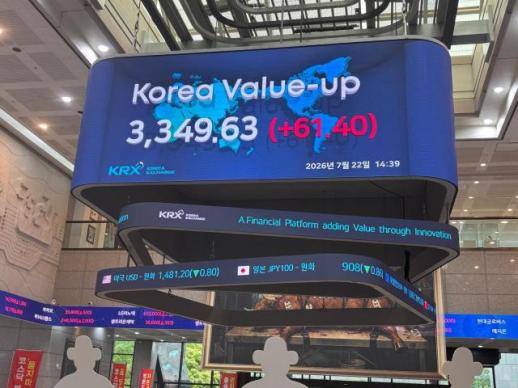 Korean Inc. doles out over $5 bn in July cash dividends SEOUL, August 06 (AJP) — South Korean companies doled out more than 7.4 trillion won ($5.3 billion) in cash dividends in July, led by Samsung Electronics and Hyundai Motor, as businesses stepped up shareholder returns under the government's drive to improve corporate value. According to the Korea Exchange (KRX) on Thursday, 90 listed companies, including 58 on the main KOSPI market and 32 on the junior KOSDAQ market, announced cash dividend payments totaling about 7.4 trillion won during the month. Samsung Electronics accounted for about 2.5 trillion won of the total, while Hyundai Motor approved dividends worth about 700 billion won. Major banking groups also expanded shareholder returns through share buybacks and share cancellations. Shinhan Financial Group and KB Financial Group each announced shareholder return measures worth 700 billion won, while Hana Financial Group and Woori Financial Group unveiled plans worth 250 billion won and 150 billion won, respectively. Separately, six companies disclosed new plans aimed at improving corporate value in July, bringing the cumulative total to 747 since May 2024. Of those, 348 are listed on the main KOSPI market and 399 on the junior market. Companies that have made such disclosures now account for 84.6 percent of the country's total stock market capitalization. On the KOSPI alone, the figure rises to 88.4 percent. Looking ahead, another seven companies notified the exchange that they intend to make similar disclosures, exceeding the typical monthly pace of one to three companies during the first half of the year. The trend has also drawn strong investor interest. The KRX Value-up Index closed at 3,162.13 at the end of July, up 75.9 percent from a year earlier and outperforming both the KOSPI and the KOSPI 200 over the same period. Assets under management for 13 ETFs tracking the index also climbed to 3.4 trillion won, nearly seven times their level at launch. Looking ahead, the KRX said it will hold regional briefing sessions in September to help high-dividend companies, low price-to-book (P/B) companies and specially listed firms prepare their value-improvement plans. The sessions will offer guidance on drafting the plans, improving P/B ratios, meeting disclosure requirements and strengthening communication with shareholders. AJP Takeaways • As of July 2026, 90 South Korean listed companies announced cash dividends totaling 7.4 trillion won ($5.3 billion), according to the Korea Exchange (KRX). • Samsung Electronics accounted for approximately 2.5 trillion won in dividends, while Hyundai Motor approved about 700 billion won in shareholder payouts. • Companies that have published Corporate Value Enhancement Plans now represent 84.6 percent of South Korea's total stock market capitalization and 88.4 percent of the KOSPI market capitalization. • The Korea Exchange Value-up Index rose 75.9 percent year over year to 3,162.13 at the end of July 2026, while assets under management in 13 related exchange-traded funds (ETFs) increased to 3.4 trillion won. • The Korea Exchange plans to hold regional briefing sessions in September 2026 to encourage more listed companies to adopt Corporate Value Enhancement Plans and strengthen shareholder communication. 2026-08-06 14:58:42
 -
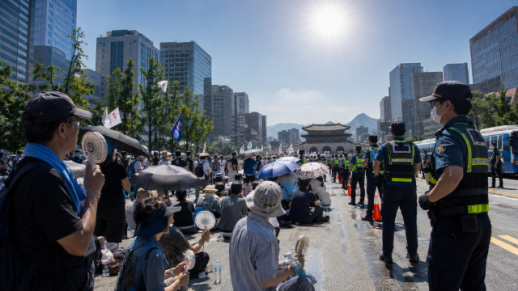 Seoul is boiling, but protests go on SEOUL, August 06 (AJP) - A prolonged and deadly heat wave is tightening its grip on South Korea, with 21 suspected heat-related deaths and 2,441 patients reported nationwide between May 15 and Aug. 4. Despite the escalating health risks, rallies, news conferences and demonstrations have continued across central Seoul, leaving participants and police officers responsible for managing the events exposed to intense sunlight and high temperatures. A total of 9,477 rallies and demonstrations were held in Seoul during the first six months of the year, according to police data. The monthly figure reached 1,774 in March and 1,757 in April, the two highest totals during the period. The tally for July has not yet been released. Several demonstrations have proceeded in recent days as daytime temperatures in the capital hovered around 38 C. Members of Solidarity Against Disability Discrimination held a subway-boarding protest at Hyehwa Station on Monday, while a coalition opposing proposed changes to local education funding held a news conference outside Cheong Wa Dae on Tuesday. The Korea Meteorological Administration announced the first “extreme heat warning” for Seoul and parts of Gyeonggi Province earlier this week. The new warning, introduced this summer, is designed for particularly dangerous conditions in which the daily maximum apparent temperature is expected to reach at least 38 C or the actual temperature is forecast to reach at least 39 C. The Seoul Metropolitan Police Agency has distributed hats, ice packs and handheld fans to police stations as officers are increasingly assigned to outdoor events during the heat wave. Police personnel deployed at major rally sites such as Gwanghwamun Square, where shade is limited, can remain outdoors for extended periods while controlling traffic and separating opposing groups. Organizations holding rallies have also introduced measures intended to reduce heat-related risks. Some have shortened events or advised participants to bring water, hats and parasols. The Korean Confederation of Trade Unions has circulated internal guidelines calling for rest areas, designated safety personnel and a limit of about one hour for outdoor rallies during periods of extreme heat. The continued demonstrations come as health authorities warn that prolonged exposure can be dangerous even for people who are not performing strenuous physical activity. Of the 2,441 heat-related patients recorded this season, 825, or 33.8 percent, were aged 65 or older. Thirteen of the country’s 21 suspected heat-related deaths involved people aged 80 or above, according to data from the Korea Disease Control and Prevention Agency cited by the Ministry of Health and Welfare. The KMA said the current extreme heat would probably reach its peak Friday, with afternoon temperatures ranging from 31 C to 39 C nationwide. Seoul is forecast to record a morning low of 27 C and an afternoon high of 39 C, while highs of 38 C are expected in Incheon and Gwangju. Temperatures are expected to decline slightly over the weekend as the atmospheric pressure pattern changes and clouds reduce the amount of direct sunlight. However, the heat wave is not expected to end, with daytime highs still likely to exceed seasonal averages and apparent temperatures potentially approaching 35 C again next week. 2026-08-06 14:54:51
 -
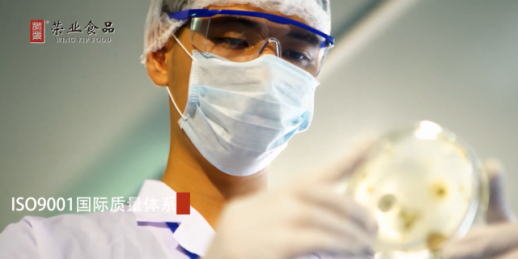 KOSDAQ-listed processed meat producer seeks capital boost SEOUL, August 6 (AJP) - KOSDAQ-listed processed meat producer Wing Yip Food said Thursday that its chairman and major shareholders will further increase their stakes by investing 20.8 billion won in newly issued shares to strengthen the company's capital base. According to a disclosure filed with the Financial Supervisory Service (FSS), its chairman, Wang Xiantao, purchased 18,355 shares the previous day at an average price of 1,148 won per share, spending about 21.1 million won entirely with his own funds. The purchase increased his holdings to 2.02 million shares or a 16.08 percent stake. Wang also reportedly plans to acquire an additional 237,533 shares next month, equivalent to about 1.89 percent of the company's outstanding shares. In addition to his planned purchases between Sept. 7 and Oct. 6, Wang Tingfeng, the largest shareholder of the Hong Kong-based Chinese company, also plans to invest 20.8 billion won in newly issued shares. At an extraordinary shareholders' meeting later in the day, the company is seeking approval for a 36.8 billion won fundraising plan to strengthen its capital base, meet South Korea’s stricter listing requirements and improve corporate and shareholder value. The new shares are scheduled to be issued on Sept. 7, which the company expects will help boost its market capitalization. Meanwhile, its shares opened 0.6 percent higher at 1,166 won and climbed as much as 2.5 percent to 1,188 won before paring gains to trade 0.9 percent lower at 1,149 won. Listed on the junior KOSDAQ market in 2018, Wing Yip Food manufactures Chinese-style processed meat products including lap cheong, bacon and ready-to-eat sausages. AJP Takeaways: • Wing Yip Food announced on Aug. 6, 2026 that chairman Wang Xiantao had increased his stake by purchasing 18,355 shares on the open market and plans to buy an additional 237,533 shares between Sept. 7 and Oct. 6, 2026. • Wing Yip Food's controlling shareholder, Wang Tingfeng, plans to invest 20.8 billion won by purchasing newly issued shares as part of the company's 36.8 billion won capital-raising plan. • The company said the combined insider investment and share issuance are intended to strengthen its capital base, comply with South Korea's tightened listing maintenance requirements, and enhance corporate and shareholder value. • Wing Yip Food, listed on the KOSDAQ since 2018, manufactures Chinese-style processed meat products, including lap cheong (Chinese sausage), bacon and ready-to-eat sausages. 2026-08-06 14:42:41