


Latest by
-
 Hyundai Steel Reaches Tentative Labor Agreement with 300% Bonus Hyundai Steel and its labor union have reached a tentative agreement in this year's wage and collective bargaining negotiations, which includes an 80,000 won increase in base salary and a 300% performance bonus. This marks the first tentative agreement reached among major affiliates of the Hyundai Motor Group this year.According to industry sources on July 31, Hyundai Steel and the union held negotiations and produced the tentative agreement.The agreement includes an 80,000 won monthly increase in base salary, which matches the company's previous proposal. The performance bonus will consist of 300% of the base salary, along with a cash payment of 5 million won and 300,000 won in gift certificates.Previously, the union had demanded an increase of 149,600 won in base salary and a performance bonus equivalent to 15% of last year's operating profit. The company had expressed difficulty in accepting the union's demands, citing the downturn in the steel industry and declining profitability.During negotiations on July 28, the two sides discussed the company's proposal but did not reach a final agreement. Following a request from the company, negotiations resumed in the afternoon, leading to the tentative agreement after further adjustments to the terms.The Hyundai Steel union had secured the right to strike after a decision by the Central Labor Relations Commission to suspend mediation and a successful vote among members on whether to engage in strike action. With this tentative agreement, concerns over production disruptions due to strikes have been alleviated for now.The union plans to present the tentative agreement to its members for a vote. If a majority supports the agreement, this year's wage negotiations will be finalized.* This article has been translated by AI. 2026-07-31 15:00:20
 -
Hyundai Steel Reaches Tentative Labor Agreement with 300% Bonus Hyundai Steel and its labor union have reached a tentative agreement in this year's wage and collective bargaining negotiations, which includes an 80,000 won increase in base salary and a 300% performance bonus. This marks the first tentative agreement reached among major affiliates of the Hyundai Motor Group this year.According to industry sources on July 31, Hyundai Steel and its labor union held negotiations that resulted in the tentative agreement.The agreement includes an 80,000 won monthly increase in base salary, which is consistent with the company's previous proposal. The performance bonus will consist of 300% of the base salary, along with a cash payment of 5 million won and 300,000 won in gift certificates.Previously, the union had demanded an increase of 149,600 won in base salary and a performance bonus equivalent to 15% of last year's operating profit. The company had expressed difficulty in fully accepting the union's demands due to the downturn in the steel industry and declining profitability.During negotiations on July 28, the two sides discussed the company's proposal but did not reach a final agreement. Following a request from the company, negotiations resumed in the afternoon, leading to the tentative agreement after further adjustments to the details.The Hyundai Steel union had secured the right to strike after a decision by the Central Labor Relations Commission to suspend mediation and a vote among members on whether to engage in strike action. With this tentative agreement, concerns over production disruptions due to a potential strike have been alleviated for now.The union plans to present the tentative agreement to its members for a vote. If a majority approves, this year's wage negotiations will be finalized. 2026-07-31 15:00:10
-
Semiconductor Stocks Surge as Power Sector Gains Amid AI Investment Recovery Investor sentiment in artificial intelligence (AI) has rebounded, leading to a surge in semiconductor stocks and a concurrent rise in power infrastructure-related shares.As of 2:33 PM on July 31, Hyosung Heavy Industries was trading at 2,947,000 won, up 510,000 won (21.08%) from the previous trading day. At the same time, HD Hyundai Electric rose by 93,000 won (15.95%) to 676,000 won, while LS ELECTRIC increased by 31,800 won (21.16%) to 182,100 won.With expectations for expanded AI infrastructure investment, buying interest has spread to companies involved in power equipment and power grid construction, which are essential for data center development. The power equipment sector is seen as a key beneficiary of the growing demand for electricity driven by the expansion of AI data centers and the need to replace aging power grids.In the U.S. stock market overnight, semiconductor stocks rebounded sharply, buoyed by strong performances from major tech companies and semiconductor equipment manufacturers. The Philadelphia Semiconductor Index (SOX) surged 8.2% on July 30, recovering from recent concerns over overheating AI investment. Microsoft shares jumped 15.51%, while Micron, SanDisk, and SK Hynix ADR also saw significant gains of 18.3%, 25.8%, and 17.5%, respectively.The recovery in investor sentiment is largely attributed to Microsoft's strong earnings report. The company reported quarterly revenue of $90 billion, exceeding market expectations of approximately $87.6 billion to $87.7 billion, driven by growth in its AI and cloud businesses. Earnings per share (EPS) also surpassed forecasts, coming in at $4.74 compared to the expected $4.24.Notably, capital expenditures (CAPEX) remained steady at $40 billion, alleviating concerns about a slowdown in AI investment. This has led to widespread optimism that the trend of expanding AI infrastructure investment will continue, benefiting both semiconductor and power infrastructure stocks.On the domestic market, bolstered by the recovery in AI investment sentiment, Samsung Electronics surged over 26%, while SK Hynix, SK Square, and Samsung Electro-Mechanics also hit their daily price limits, leading the rise in large-cap semiconductor stocks.* This article has been translated by AI. 2026-07-31 15:00:10
-
Yangsan Sets New Temperature Record at 41.4 Degrees Amid Ongoing Heat Wave The temperature in Yangsan, South Gyeongsang Province, soared to 41.4 degrees Celsius, setting a new record in South Korea's meteorological history. This extreme heat has persisted for three consecutive days, with temperatures exceeding 40 degrees at 97 climate observation points across the country.According to Yonhap News and the Korea Meteorological Administration, the temperature in Yangsan reached 41.4 degrees at approximately 1:40 PM on July 31. This marks the highest temperature recorded since weather observations began in Yangsan on December 26, 2008.Notably, this temperature is the highest ever recorded in South Korea based on the 97 official climate observation points. The previous record was 41.0 degrees, set in Hongcheon, Gangwon Province, on August 1, 2018, during what was dubbed the worst heat wave of the 21st century.Even when including data from Automatic Weather Stations (AWS), there have been few instances of higher temperatures than Yangsan's on this day. Since 1973, only three other locations have recorded higher temperatures: 41.9 degrees in Jiwol-ri, Gwangju, on August 1, 2018; 41.8 degrees in Gangbuk-gu, Seoul, on the same day; and 41.6 degrees in Geumsam-myeon, Yeoju, on August 4, 2024.Yangsan has already experienced an unusual heat wave, with temperatures exceeding 40 degrees for three consecutive days starting July 29. The maximum temperatures were 40.3 degrees on both July 29 and 30, leading to the rise to 41.4 degrees on July 31.The time at which temperatures first reached 40 degrees is also occurring earlier each day. On July 29, it was recorded at 3:30 PM, on July 30 at 1:10 PM, and on July 31 at 12:36 PM. This indicates that the extreme heat is intensifying, with higher temperatures occurring earlier in the day.This is only the third instance since 1973 of temperatures exceeding 40 degrees for three consecutive days in South Korea. Previously, Anseong, Gyeonggi Province, recorded three consecutive days above 40 degrees from August 1 to 3, 2018, and Yeongcheon, North Gyeongsang Province, recorded four consecutive days above 40 degrees from August 1 to 4, 2018.The extreme heat is not limited to Yangsan. As of 1 PM on the same day, AWS observations showed temperatures of 38.9 degrees in Geumjeong-gu, Busan, 38.7 degrees in Buk-gu, Busan, and 38.2 degrees in both Uiryeong and Gimhae, indicating record-breaking heat across the entire Gyeongnam region.The Korea Meteorological Administration forecasts that the heat wave will continue, with maximum perceived temperatures expected to reach around 35 degrees in most areas nationwide.* This article has been translated by AI. 2026-07-31 15:00:00
-
South Korea's Economic Diplomacy Focuses on Key Minerals and Defense in South America President Lee Jae-myung's visit to South America highlighted the direction South Korean diplomacy should take. The trip focused on securing supply chains for key minerals such as rare earth elements, lithium, and copper, while also expanding cooperation in defense, aerospace, and advanced manufacturing as part of economic security diplomacy. This strategic approach, centered on national interests, is noteworthy as the global economy undergoes a transformation driven by technological dominance and supply chain competition. Today, a nation's competitiveness hinges on its ability to secure key minerals reliably. Industries such as artificial intelligence (AI), semiconductors, batteries, electric vehicles, robotics, and defense cannot grow without strategic minerals like lithium, rare earth elements, and copper. Resource acquisition has evolved from a mere resource policy to an industrial and security policy. In Brazil, agreements were reached to collaborate on the supply chain for key minerals, including rare earth elements, establishing a cooperative framework that spans from mineral extraction to refining and product manufacturing. Discussions also included joint development of next-generation commercial aircraft and cooperation in the space industry. Korea Aerospace Industries (KAI) signed a strategic cooperation agreement with Brazilian aircraft manufacturer Embraer, while POSCO International entered into a supply chain agreement with a Brazilian rare earth development company. The fact that high-level diplomacy translated into tangible business cooperation is a significant achievement of this visit. In Chile, the scope of cooperation was further expanded. As one of the world's largest producers of lithium and copper, Chile is pursuing a mineral resource partnership with South Korea, proposing a cooperation model that connects the supply chain of key minerals to advanced manufacturing and defense. The decision to expand joint ventures between LS and Chile's state-owned copper company Codelco, along with strengthening defense cooperation, signifies a commitment to building a high-value industrial ecosystem beyond mere resource acquisition. The shift in trade strategy is also noteworthy. The Korea-Chile Free Trade Agreement, signed in 2004, was South Korea's first free trade agreement, primarily focused on expanding trade in agricultural and mineral products. However, the global economy is now being reshaped by AI, digital technology, clean technology, and supply chain competition. The modernization of the FTA and the resumption of trade negotiations with the Mercosur bloc are attempts to establish a new trade order that aligns with the changing industrial landscape. As cooperation with South America's largest economic bloc intensifies, new opportunities may arise not only in the automotive and steel sectors but also in defense and aerospace industries. This visit also demonstrated the collaborative nature of economic diplomacy, with key business leaders such as Chung Eui-sun, chairman of Hyundai Motor Group; Jeong In-hwa, chairman of POSCO Group; Cho Won-tae, chairman of Korean Air; and Koo Ja-eun, chairman of LS, accompanying the president to discuss cooperation with local companies. The government's role in opening diplomatic doors while businesses explore markets should continue to be actively expanded. The success of diplomacy cannot be measured solely by joint statements. It is only when investments and exports increase, supply chains stabilize, and companies expand overseas that citizens can truly feel the benefits. This South American visit illustrates where South Korea should seek new growth engines. Economic diplomacy that connects key minerals with defense, aerospace, and AI industries is expected to yield practical results that enhance national competitiveness, rather than being a one-time event.* This article has been translated by AI. 2026-07-31 14:48:20
-
Court Upholds Travel Ban on Moss Tan, Citing Risk of Flight Moss Tan, a Korean-American former professor at Liberty University, has had his request to cancel a travel ban by the Ministry of Justice denied. Tan is facing charges for allegedly spreading false information that defamed President Lee Jae-myung.On July 31, Judge Kim Tae-hwan of the Seoul Administrative Court ruled against Tan's lawsuit challenging the extension of his travel ban. The court found that the public interest in securing state punishment outweighed any disadvantages Tan might face from the travel restriction.Initially, Tan sought to cancel the second travel ban issued during the investigation phase. However, after he was indicted without detention, the prosecution issued a third travel ban, citing the need for ongoing criminal proceedings.The court determined that the second ban had already been lifted, rendering Tan's request for its cancellation legally moot. The Ministry of Justice lifted the second ban on July 16, the same day Tan was indicted, and imposed a third ban restricting his travel until August 15.The court viewed the second and third bans as separate administrative actions with different legal bases and purposes, rather than a continuous or combined legal effect.Regarding the third ban, the court found that the criteria for imposing a travel restriction were met and that the Ministry of Justice did not exceed its discretionary authority. The court noted that Tan, as a foreign national facing ongoing criminal proceedings, fell under this category.The court also pointed out that Tan had refused to comply with requests from investigative authorities and had not provided substantial explanations or statements regarding the allegations during questioning. Given this behavior and the progress of the criminal proceedings, the court concluded that it was difficult to rule out the possibility of Tan not returning after leaving the country.The court stated, "Considering the plaintiff's potential for fleeing abroad and other circumstances, it is hard to argue that the disadvantages he faces are more significant than the public interest in securing state punishment and uncovering the substantive truth through this measure."Tan's argument that the travel ban violates the presumption of innocence was also rejected. The court clarified that the travel restriction is an administrative measure limiting the freedom of a foreign national facing ongoing criminal proceedings, and it cannot be viewed as a punitive action based on a presumption of guilt.Tan's request for a temporary suspension of the third ban was also denied. While the court acknowledged the potential for irreparable harm due to the travel ban and the urgent need to prevent it, it determined that suspending the ban could significantly impact the public interest.As a result, Tan's travel ban will remain in effect until August 15. Following the ruling, Tan's legal team announced plans to appeal. A representative stated, "Preventing someone who has been indicted without detention from returning to their home country for about three months is an excessive restriction of fundamental rights. We plan to appeal as soon as possible and will also file a state compensation lawsuit regarding the wrongful travel ban."Tan faces allegations stemming from statements made during a press conference in Washington, D.C., last year, where he claimed that President Lee was involved in a murder case during his youth and was incarcerated in a juvenile facility, which prevented him from attending middle and high school.After Tan entered South Korea and failed to respond to a summons, the police requested a travel ban from the Ministry of Justice. Subsequently, he was investigated and sent to the prosecution without detention. The Seoul Central District Prosecutor's Office indicted him on July 16 for defamation under the Information and Communications Network Act and the Criminal Code. The first court hearing is scheduled for September 11.* This article has been translated by AI. 2026-07-31 14:44:00
-
Designer Brand Merryon Expands Offline Amid Sales Growth The domestic designer fashion brand Merryon is expanding its presence with a collection that blends classic moods and romantic sensibilities into modern styles.Merryon has focused on balanced silhouettes, materials, and color combinations rather than chasing rapidly changing trends, establishing its own brand identity. The brand has gained popularity among women in their 20s and 30s who prefer unique styles through products that can be worn comfortably in everyday life while embodying the brand's distinctive sensibility.According to the brand, sales this year have nearly doubled compared to last year. Sales have expanded on major fashion platforms such as its own online store, 29CM, and Musinsa, with steady orders coming from overseas markets including Japan, China, and Taiwan.The customer base secured online has positively influenced the expansion of its offline distribution network. After operating its first pop-up store at The Hyundai Seoul last year, the brand is now showcasing its products at Hyundai Department Store's Pangyo and KINTEX locations, broadening consumer touchpoints.In offline stores, customers can try on representative products such as blouses, dresses, skirts, and outerwear, allowing them to experience the texture and fit of materials that are difficult to assess online. This enhanced shopping experience emphasizes the quality of fabrics and silhouettes.Merryon focuses on reinterpreting classic designs to seamlessly blend with modern lifestyles rather than simply reproducing them. The seasonal collections maintain a direction that emphasizes refined design and material quality over excessive ornamentation.The brand director stated, "Creating designs that can be worn consistently over time is the brand's goal," adding, "We plan to continue presenting collections that capture a modern atmosphere based on classic sensibilities."Merryon aims to continuously expand its domestic online and offline distribution channels while accelerating its efforts in overseas markets. The brand plans to diversify its existing product range and consistently introduce collections that reflect its unique design philosophy, thereby broadening its connections with customers both domestically and internationally.* This article has been translated by AI. 2026-07-31 14:44:00
-
 Lee arrives in Argentina for final leg of South American trip SEOUL, July 31 (AJP) - President Lee Jae Myung on Thursday arrived in Buenos Aires for the final leg of his South American trip, after visiting Brazil and Chile earlier this week. It marks the first visit to Argentina by a South Korean president since former President Roh Moo-hyun visited the country in 2004. Lee, who arrived at Ezeiza International Airport late Thursday night with first lady Kim Hea Kyung, is scheduled to hold a summit with Argentine President Javier Milei the following day to discuss ways to deepen bilateral ties and expand practical cooperation in various sectors. Argentina, the world's fourth-largest holder of lithium reserves, possesses abundant energy and other resources including shale gas and agricultural and livestock products. The South Korean government seeks to combine Argentina's abundant resources with South Korea's strengths in battery production and advanced manufacturing to establish a supply chain for critical minerals. Resuming trade negotiations with Mercosur countries is also expected to be one of key topics of their talks. Argentina is a member of the South American trade bloc along with Brazil, Paraguay and Uruguay. Established in 1991, it is similar to a free trade agreement (FTA) but covers a broader range of areas. After the summit with Milei, Lee will meet with Buenos Aires mayor Jorge Macri to ask for the city government's continued attention and support for the roughly 23,000 South Koreans living there, the second-largest South Korean community in South America after São Paulo, Brazil. Lee will then attend a dinner meeting with them to hear about their concerns. After wrapping up his three-day stay in Argentina, Lee will travel to Frankfurt, Germany on Saturday, for a brief stopover to meet with South Korean nationals there before returning home. 2026-07-31 14:41:52
 -
Fire Breaks Out at Factory in Yeongcheon, South Korea A fire broke out at a factory in Sinnyoung-myeon, Yeongcheon, Gyeongbuk.According to Yonhap News and local fire authorities, the blaze started around 1:51 p.m. on July 31, and firefighting efforts are currently underway.So far, there have been no reported injuries.Fire officials suspect that the fire was triggered by an explosion at an oil tank in the factory.They stated, "We received reports of a loud noise from the oil tank followed by smoke rising. We will work to extinguish the fire as quickly as possible."* This article has been translated by AI. 2026-07-31 14:40:00
-
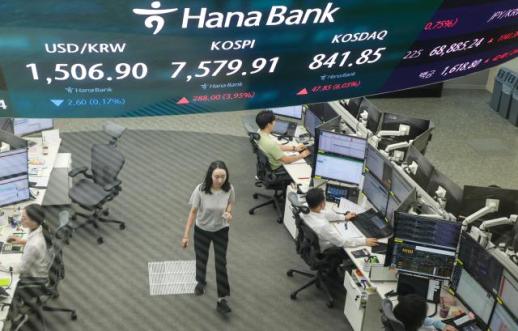 Foreign ownership in Korean shares rises despite record selloff SEOUL, July 31 (AJP) -Foreign investors sold nearly 50 trillion won ($31.2 billion) worth of South Korean equities in June, yet their ownership of the market climbed to 36.4 percent — the highest in months — suggesting the six-month selling streak has been more a portfolio reshuffle than a broad retreat as soaring share prices boosted the value of remaining holdings. Foreign investors recorded a net withdrawal of 44.86 trillion won from South Korea's listed securities in June, as heavy stock sales outweighed continued buying of government bonds, according to data released Friday by the Financial Supervisory Service (FSS). They sold a net 49.34 trillion won of listed equities, extending their selling streak to a sixth consecutive month. Net sales reached 50.98 trillion won on the benchmark Kospi, partly offset by net purchases of 1.64 trillion won on the Kosdaq market. Combined equity sales reached 163.56 trillion won during the first six months of the year, while total net outflows from stocks and bonds amounted to 149.78 trillion won, widening from 38.23 trillion won in May to 44.86 trillion won in June. Despite the persistent selling, the market value of foreign investors' Korean equity holdings rose by 56.33 trillion won from a month earlier to 2,908.64 trillion won, lifting their ownership share to 36.4 percent of the market from 35.3 percent in May and sharply from 30.8 percent at the end of December. European investors led the June selling, unloading a net 30.76 trillion won of shares, followed by investors from the Americas with net sales of 26.96 trillion won. By country, British investors sold a net 32.20 trillion won, while U.S. investors disposed of 23.18 trillion won and Luxembourg-based investors sold 4.27 trillion won. Buying was concentrated among Cayman Islands-based investors, who purchased a net 7.27 trillion won of shares, followed by investors from France with 6.11 trillion won and Hong Kong with 5.27 trillion won. U.S. investors remained the largest foreign shareholders, holding Korean stocks worth 1,222.34 trillion won, equivalent to 42 percent of all foreign-owned equities. The bond market told a different story. Overseas investors remained net buyers for a third straight month, recording net investment of 4.48 trillion won after purchasing 13.90 trillion won of listed bonds and receiving 9.42 trillion won through maturities and repayments. Government bonds attracted net inflows of 4.73 trillion won, while special-purpose and monetary stabilization bonds posted modest outflows. Foreign investors favored longer-dated debt, buying a net 7.86 trillion won of bonds with one to five years remaining to maturity and 6.52 trillion won of bonds maturing in more than five years, while reducing holdings of debt maturing within one year by 9.90 trillion won. Foreign holdings of listed bonds edged up by 1.21 trillion won from May to 334.79 trillion won, equivalent to 11.8 percent of the outstanding listed bond market. Combined foreign holdings of Korean listed stocks and bonds stood at 3,243.43 trillion won at the end of June. The FSS added its figures are compiled on a settlement basis, unlike Korea Exchange data, which are based on trade execution dates. 2026-07-31 14:38:49