


Latest by
-
 Doosan Shares Surge 28% on SK Siltron Acquisition Hopes and Strong Electronics Performance Doosan's shares have surged, driven by expectations of acquiring SK Siltron and strong performance in its electronics division.As of 2:09 PM on July 31, Doosan's stock was trading at 1,154,000 won, up 255,000 won (28.33%) from the previous trading day. The company even hit the upper limit early in the session.Investor sentiment was boosted by reports that SK would hold a board meeting to discuss the potential sale of its stake in SK Siltron, a company that produces silicon wafers for semiconductors.Doosan was selected as the preferred bidder for the acquisition of SK Siltron in December 2022 and has been negotiating the purchase price and transaction terms with SK. The sale involves a total of 70.6% of shares, which includes SK's 51% stake and a 19.6% stake from a total return swap (TRS) agreement. However, the board's approval and the finalization of the sales contract have yet to be confirmed.The company's strong second-quarter performance also contributed to the stock price increase. Doosan reported a consolidated revenue of 5.6 trillion won for the second quarter, a 5% increase compared to the same period last year, while operating profit rose 38% to 488.4 billion won. Revenue and operating profit from its core business reached record highs of 765.2 billion won and 212.1 billion won, respectively.Notably, the electronics division's revenue grew by 42% year-on-year to 676 billion won, driving the overall performance growth.* This article has been translated by AI. 2026-07-31 14:16:10
 -
Crisis in the Petrochemical Industry Deepens Amid Outsourcing Challenges The petrochemical industry is facing a structural crisis exacerbated by global oversupply and pressure for carbon neutrality, leading to concerns over a deepening phenomenon of 'outsourcing in crisis' that disproportionately impacts subcontractors and temporary workers. Experts emphasize the need for region-specific industrial and employment transition roadmaps, as the impacts vary across major petrochemical complexes such as Yeosu and Ulsan.On July 31, the Korea Employment Information Service released a report titled 'Job Monitoring and Policy Tasks for the Petrochemical Industry in Yeosu and Ulsan,' diagnosing that the capital and equipment-intensive petrochemical sector has low employment elasticity and a dual labor market structure divided between primary and subcontracted workers. During economic downturns, subcontractors and temporary workers are likely to bear the brunt of employment shocks more than primary companies.While the domestic petrochemical industry is a key sector, it is undergoing restructuring due to increasing uncertainties both domestically and internationally. Factors contributing to this include rising self-sufficiency rates in China, global oversupply, weakened competitiveness of generic products, and pressures for low-carbon transitions.The regional impacts of this crisis are not uniform. The Yeosu industrial complex, which has the largest ethylene production capacity in the country, accounts for 49.5% of the national total, with a capacity of 6.415 million tons. The refining and chemical sectors dominate the complex, making up 98.4% of total production and 98.3% of exports.Employment in the Yeosu industrial complex and related petrochemical sectors had been on the rise since 2017 but began to decline in 2023. By 2025, total employment in the complex had decreased by 3,900 from the previous year, with related sector employment dropping by 5,000.In contrast, Ulsan has not experienced a sharp decline in employment. The presence of major industries such as automotive and shipbuilding, along with a well-established vertical integration structure among refining, petrochemical, and upstream industries, has provided a buffer against job losses. However, employment in the petrochemical sector peaked at 21,300 in 2022 and is projected to fall to 20,600 by 2025.Governance structures also differ significantly between the two regions. Yeosu has established a collaborative framework involving the city government, the Chamber of Commerce, the industrial complex construction council, and major labor unions. It also operates re-employment and transition training programs through a convergence center. However, the response has primarily focused on emergency support, lacking a long-term industrial and employment transition strategy.Ulsan, on the other hand, has a public institution-led response system through the Ulsan Human Resource Development Committee and the Job Promotion Agency, but participation from private companies and labor groups is limited. The Employment Information Service warns that the likelihood of a prolonged structural downturn is high, necessitating an early warning system to detect rising unemployment patterns and the establishment of proactive employment safety nets.Both regions face a common challenge of shock transmission due to the dual structure of primary and subcontracted labor. Factory shutdowns by primary companies, changes in subcontractors, and lowest-bid contracting practices are leading to hiring freezes, job reallocations, and conflicts over employment succession among subcontractors. The issue of skilled labor is also complex, as new hiring is stifled by the industrial crisis while existing workers are leaving, resulting in a shortage of skilled labor on the ground.The Employment Information Service emphasizes that the employment crisis in the petrochemical industry should be viewed not merely as a reduction in jobs but as a multifaceted crisis involving outsourcing challenges, skill mismatches, and increased demand for specific job roles. It calls for the establishment of differentiated industrial and employment transition roadmaps for each region, along with a redesign of job roles and skills based on industrial complexes and the strengthening of region-centered employment safety nets.Park Ga-yeol, a deputy researcher at the Employment Information Service, stated, 'We need to build a region-based governance for a just transition that involves companies, labor, local governments, and training institutions. A regional committee for a just transition should be established to manage industrial, employment, and skill transitions in an integrated manner to proactively respond to the employment crisis.'* This article has been translated by AI. 2026-07-31 14:16:00
-
 Hanwha Aerospace posts record Q2 operating profit near $1 billion SEOUL, July 31 (AJP) - Hanwha Aerospace said Friday its second-quarter operating profit reached a record 1.37 trillion won ($951 million), nearing the $1 billion mark, driven by steady defense deliveries at home and abroad and strong earnings from Hanwha Ocean and Hanwha Systems. The company posted 9.29 trillion won ($6.5 billion) in consolidated sales for the April-June period, up 47 percent from a year earlier. Operating profit rose 59 percent on-year to 1.37 trillion won. By business, the land systems division reported 2.11 trillion won in sales and 533 billion won in operating profit, up 19 percent and 2 percent, respectively, from a year earlier. Domestic sales were supported by increased production of major programs, including the Chunho wheeled anti-aircraft gun system and the Chungum anti-tank guided missile. Overseas deliveries to Poland, Egypt and the Middle East also proceeded as scheduled and were reflected in earnings. The company’s order backlog stood at about 38.3 trillion won, supported by additional export orders including a K9 self-propelled howitzer deal with Finland worth about 940 billion won in April and an additional Chunmoo multiple rocket launcher supply contract with Estonia in May. The aerospace division posted 760 billion won in sales and 37 billion won in operating profit. Sales rose 17 percent from a year earlier on increased military volume, while the division swung to an operating profit. Hanwha Ocean reported 5.44 trillion won in sales and 736.1 billion won in operating profit, marking its strongest quarterly performance since being acquired by Hanwha Aerospace. Sales rose 65 percent on-year and operating profit increased 98 percent, helped by a higher share of revenue from profitable commercial ship projects, including liquefied natural gas carriers. Hanwha Systems posted 1.12 trillion won in sales and a record operating profit of 103.7 billion won, supported by increased exports of key products such as multifunction radar systems. “Hanwha Aerospace expects to maintain solid earnings in the second half, supported by mass production under Poland’s second K9 execution contract and deliveries of K9 howitzers to Egypt and Australia,” a company official said. “Based on the aircraft engine development capabilities demonstrated through our recently unveiled unmanned aerial vehicle engine prototype, we will also actively participate in the government’s advanced aircraft engine development program to strengthen Korea’s aviation industry self-reliance and export competitiveness,” the official added. 2026-07-31 14:11:56
 -
Jeonbuk Education Office Awards Scholarships to 100 Student Athletes The Jeonbuk Special Self-Governing Provincial Office of Education has selected 100 student athletes from elementary, middle, and high schools who have demonstrated outstanding performance and potential in sports to receive scholarships.According to the Jeonbuk Education Office on July 31, the scholarship program aims to provide a stable training environment for young athletes, allowing them to focus on their sports without financial burdens.The recipients were chosen through a selection process among student athletes affiliated with school sports teams and professional sports clubs.The education office evaluated applicants based on their competition results, self-development plans, and mentoring plans from coaches, ultimately selecting 100 student athletes from 44 schools across 28 sports.Among the selected students, there are 22 elementary school students, 39 middle school students, and 39 high school students.Notably, additional points were awarded to socially disadvantaged individuals (such as those receiving basic living assistance or from low-income families) to prioritize their selection.Starting in September, each selected student will receive a monthly scholarship of 200,000 won for six months, totaling 1.2 million won.Jeonbuk Education Superintendent Cheon Ho-seong expressed pride in the student athletes who strive to shine in Jeonbuk sports despite challenging circumstances. He stated, “I hope this scholarship support serves as a solid foundation for our young athletes to advance to larger stages, and we will continue to provide unwavering support for their growth and development.”Recruitment for 2026 Native Speaker Online English Talking ClassThe Jeonbuk Special Self-Governing Provincial Office of Education announced on July 31 that it is recruiting students for the '2026 Native Speaker Online English Talking Class 3rd Session.'The third session will run from August 24 to October 22, with applications accepted online from August 4 at 6 PM until August 18 at 8 PM.Eligible participants include students from the 3rd grade of elementary school to the 3rd year of high school, as well as out-of-school youth, with classes conducted in a 1:3 ratio with native speakers.Classes will be held twice a week, with each session lasting 30 minutes.This year's Native Speaker Online English Talking Class consists of four sessions, each lasting nine weeks.The program, part of the Jeonbuk Education Office's English education initiative, aims to enhance students' self-directed learning capabilities and reduce private education costs through online classes with native speakers.Last year, from April to December, a total of 16,104 students participated, and the satisfaction rate among students surveyed was 88.2%.* This article has been translated by AI. 2026-07-31 14:08:00
-
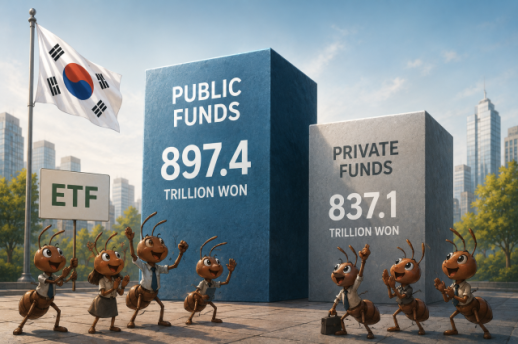 ETF boom pushes public funds to overtake private funds for 1st time SEOUL, July 31 (AJP) - South Korea's public investment funds overtook private funds in total assets for the first time in the first half of this year, driven by surging demand for exchange-traded funds (ETFs) as retail investors poured money into the stock market. According to the Korea Financial Investment Association (KOFIA) on Friday, public funds jumped 47.3 percent from the end of last year to 897.4 trillion won (US$646 billion), while private funds grew 9.2 percent to 837.1 trillion won. As a result, public funds accounted for 51.7 percent of the overall fund market, up from 44.3 percent six months earlier, overtaking private funds for the first time. The broader fund market also expanded rapidly. Total assets under management in domestic public and private funds reached 1,735 trillion won ($1.25 trillion) at the end of June, up 26 percent from the end of last year. The increase more than doubled the 11.4 percent growth recorded in the previous six months. The turnaround was driven largely by ETFs, which are publicly traded investment funds that track stocks, bonds or other assets and can be bought and sold like shares. ETF assets surged 72.4 percent to 512.4 trillion won during the six-month period, far outpacing the 23.3 percent growth recorded by public funds excluding ETFs. ETFs accounted for 57.1 percent of public fund assets at the end of June, up from 48.8 percent six months earlier. Equity ETFs led the expansion, with assets more than doubling to 326.3 trillion won, while derivative ETFs increased 52.4 percent to 104.8 trillion won. The ETF boom also reinforced investors' preference for domestic assets. Assets invested in South Korea rose 30.4 percent to 1,137 trillion won at the end of June, lifting their share of total fund assets to 65.6 percent from 63.4 percent six months earlier. South Korean equity funds more than doubled to 282.9 trillion won, rising 125.2 percent. Overseas investment funds also expanded, though at a slower pace, growing 18.5 percent to 597.1 trillion won. The trend was equally evident in fresh money entering the market. Net inflows totaled 126.3 trillion won during the first half, including 96.9 trillion won into public funds and 29.3 trillion won into private funds. Equity funds attracted the largest inflows at 50.9 trillion won, followed by money market funds (MMFs) with 28.4 trillion won, derivative funds with 12.2 trillion won and balanced funds with 10.6 trillion won. Bond funds were the only category to post net outflows, with about 3 trillion won leaving the sector. 2026-07-31 14:07:33
 -
Interview: Seo Su-min on Working with So Ji-sub in 'Kim Manager' SBS's weekend drama 'Kim Manager' concluded with a viewership rating of 23%. Among the seasoned veteran actors, a fresh face captured the audience's attention: Seo Su-min, who played the role of 'Min-ji,' the only driving force that pushed the protagonist, played by So Ji-sub, back into the fray. Despite being a debut performance, Seo skillfully navigated the emotional landscape, enhancing the show's immersion. We explored Seo Su-min's solid start at the center of this grand narrative."I still can’t quite believe it. Everyone around me has been congratulating me, but with OTT platforms dominating, I thought it was impossible to achieve over 20% viewership. Now that it has become a reality, I’m not sure if this is a dream. Of course, it’s thanks to the viewers enjoying the show, but every staff member, director, and senior actor on set kept saying that 'Kim Manager' would do well. I believe it’s the result of our collective effort," Seo said.Seo's parents experienced a unique level of immersion while watching their child’s debut performance. They felt a mix of pride, affection, and concern as they witnessed their daughter portray a character facing intense challenges and bullying."My father’s friends really liked me, and I think he felt proud hearing them say, 'You raised your daughter well.' However, we couldn’t watch the drama together. My father reacted so intensely every time I appeared that my mother and I would sometimes go to another room to watch it. My mother even said she was too upset to continue watching the first episode and asked if I could quit acting. My father was fully immersed, feeling sad, jealous, and asking what would happen next, even requesting autographs," Seo shared.Having been a long-time fan of the original webtoon, Seo expressed his excitement about joining the 'Kim Manager' world. "I was really passionate about it in middle school. The story was engaging, and the action was thrilling, so I continued to follow it into high school. Then I got cast. It was one of my favorite webtoons, and being cast as So Ji-sub's daughter was hard to believe at first," he said.Given his deep affection for the source material, the pressure on Seo as a newcomer to hold a key role in the narrative was significant. However, he alleviated his fears through a rigorous audition process that confirmed the director's strong trust in him."The pressure was immense. I often wondered if I was fit for this role. With original fans and viewers of the drama, I worried that having a newcomer play a pivotal character might make them uncomfortable. The casting process wasn’t straightforward; it took several auditions, and I learned that the director had confidence in me after reviewing other footage. I believe the process took about a month. Seeing how much the director valued Min-ji and trusted me helped me set aside my worries and focus on the present," Seo explained.The most significant support came from So Ji-sub, who played the role of 'Dad.' Although meeting such a senior actor was nerve-wracking, Seo quickly found comfort in So's kindness."I remember my first meeting with So Ji-sub clearly. During the first shoot, we didn’t have a scene together, but we met at the same location while getting on separate buses. I was surprised by the number of people and cameras, feeling overwhelmed. But he asked, 'Min-ji, aren’t you cold?' and offered me something to eat, saying he was looking forward to working with me. His kindness from the start made it easier for me to feel comfortable during filming," Seo recalled.The bond between the two continued off-camera, contributing significantly to the emotional depth of their father-daughter relationship as the story progressed. Their connection was not forced but rather a natural result of their shared experiences."In the early stages, we talked a lot and joked around. I think that helped reduce any awkwardness during our father-daughter scenes. Even when we weren’t filming, he treated me like a daughter, which was fascinating since I have a real dad. It was surprising to feel that way towards someone who wasn’t my father. I knew it was all part of the production, but I still felt that emotion. That’s why I think I could perform better in the emotional scenes in episodes 7 and 10. I wasn’t acting; I was genuinely sad, as if it were the last time I would see my dad, which led to some NGs. I spent time preparing to let go of my emotions rather than trying to force them out," he said.Seo also appreciated the support from fellow cast members, including Choi Dae-hoon, who played 'Uncle Han-soo,' and Yoon Kyung-ho, who portrayed 'Jin-cheol.' Their camaraderie helped him feel secure in the unfamiliar environment."Uncle Han-soo (played by Choi Dae-hoon) approached me when I was struggling with my performance, asking, 'Is Min-ji having a hard time?' and offered practical advice on how to approach the scenes. Thanks to him, I could find direction in my acting. Jin-cheol (played by Yoon Kyung-ho) praised me loudly when I felt intimidated, creating a supportive atmosphere. One helped me find my way, another created a positive environment, and my dad quietly watched over me. Each of them provided different energy, but it felt like a harmonious triangle. I’m really grateful for that," Seo said.Even after filming wrapped, the friendly atmosphere continued. Seo mentioned that he and So Ji-sub, Yoon Kyung-ho, and Choi Dae-hoon often joked around and took playful photos together, creating a family-like atmosphere."We took a lot of MZ or Gen Z-style photos together. Yoon Kyung-ho would ask, 'What should we take today? Who should we target?' and we would brainstorm poses. Especially towards the end of the filming, So Ji-sub suggested we do a 'devil heart' pose, which surprised me. When I asked, 'Dad, what’s a devil heart?' he showed me the pose himself. It was cute and funny to think that my dad secretly studied Gen Z poses. I’m thankful that everyone was so engaged," he said.Born in 2007, Seo Su-min was a high school student during the filming of 'Kim Manager.' He utilized his real-life high school experiences to add authenticity to his character."I think my high school experiences were reflected a lot. Since I filmed while still in high school, those memories are fresher than my experiences as an adult. Scenes like studying or looking at my phone, and how I interact with my dad, were influenced by my real life. For instance, when my dad says, 'Kim Min-ji, wake up,' and tells me to get ready, there’s a scene where Min-ji doesn’t go to the bathroom but instead goes to the sofa to sleep again. That’s a bit of my own life added in. I think those details helped a lot," he said.With such a significant achievement from the start, expectations for Seo's next steps have naturally grown. He is preparing to turn the page on his acting career with a sense of pleasant pressure."I do worry about whether I can capture the same level of performance next time. However, I’m looking for projects where I can leave a mark as a different character, not just Min-ji. I haven’t decided on my next project yet. While becoming famous is nice, I want to be an actor who is remembered for a long time," he concluded.* This article has been translated by AI. 2026-07-31 14:04:00
-
Bloomberg Highlights KOSPI's Record 17% Surge Amid AI Investment Optimism Bloomberg reported on July 31 that the KOSPI experienced a remarkable rebound. The recent forced selling of leveraged investments, which had contributed to the market's decline, has subsided, and optimism is returning regarding the growth of semiconductor companies driven by increased artificial intelligence (AI) investments.According to Bloomberg, the KOSPI surged as much as 17% during trading, marking its largest single-day increase ever. This followed a 17% drop over three trading days, driven by concerns over rising AI investment costs and competition from Chinese semiconductor firms.The rebound was led by semiconductor stocks. SK Hynix nearly reached a daily maximum increase of 30%, while Samsung Electronics saw a peak rise of 26% during the session.Bloomberg analyzed that the rebound in U.S. tech stocks and expectations for expanded AI investments have revitalized investor sentiment in the South Korean market. Major U.S. tech companies, including Microsoft, have announced plans to increase their AI investments, and Amazon reported strong cloud revenue along with additional AI investment plans.Expectations are also growing that the forced selling, which had exacerbated the recent decline, will stabilize. Reports indicated that the U.S. hedge fund Situational Awareness, which suffered significant losses from the drop in AI-related stocks, sold a substantial portion of its holdings to Citadel, leading to hopes that the wave of large sell-offs is coming to an end. This fund has also invested in Asian companies, including SK Hynix.Foreign investors have also engaged in significant buying. According to the Korea Exchange, foreign investors purchased a net 7 trillion won worth of KOSPI stocks on this day, while individual investors sold a net 6.8 trillion won.Chey Tae-won, chairman of SK Group, also contributed to investor sentiment by purchasing 3,620 shares of SK Hynix for approximately 4.8 billion won. Bloomberg noted that this direct purchase by Chairman Chey was interpreted as a sign of confidence in SK Hynix's long-term growth potential.The government has also implemented market stabilization measures, including requiring more collateral for leveraged exchange-traded funds (ETFs) that track Samsung Electronics and SK Hynix, which has been cited as a factor in the market's rebound.Yoon Jung-in, CEO of Fibonacci Asset Management Global, told Bloomberg, "While today's rebound has the character of a relief rally, it is not simply due to stocks being undervalued. I see it as an early recovery signal following extreme volatility, supported by corporate earnings."* This article has been translated by AI. 2026-07-31 14:00:00
-
Adeka Korea Expands Production Facility in Wanju Techno Valley Adeka Korea Co., Ltd. (CEO Park Jong-seok) will invest 61.3 billion won to expand its production facility for resin additives at its existing site in the Wanju Techno Valley 2nd General Industrial Complex.On July 31, Adeka Korea signed an investment agreement worth 61.3 billion won with North Jeolla Province and Wanju County, marking a significant step in fostering the advanced chemical materials industry and revitalizing the local economy.This agreement is notable as it is the first foreign investment agreement since the inauguration of the 9th elected government.Adeka Korea is a foreign-invested company fully funded by Japan's Adeka, which has been established in Wanju since 1991 and has grown alongside the local community for 35 years.The company currently operates its headquarters and three production facilities in Wanju, producing resin additives and semiconductor materials while solidifying its presence in both domestic and international markets.Adeka, the parent company, holds the second-largest market share globally in the resin additives sector and is recognized for its proprietary technologies in advanced semiconductor materials, including materials for semiconductor memory and hafnium precursors, making it a key player in the global supply chain.Adeka Korea plans to invest 61.3 billion won to expand its resin additive production facility at the existing site in the Wanju Techno Valley 2nd General Industrial Complex.The new resin additives will be high-value materials that enhance the functionality and transparency of plastic products. The company’s self-developed functional additive, 'Transparex,' has even been listed in the Guinness World Records.Construction of the production facility is set to begin within the year, with a target completion date of September 2027.The province and Wanju County are committed to providing administrative and financial support in accordance with relevant laws and regulations to ensure the investment plan is executed smoothly.This expansion is expected to strengthen the advanced chemical materials cluster centered in Wanju and North Jeolla Province.North Jeolla Province Governor Lee Won-taek and Wanju County Mayor Yoo Hee-tae stated, “Adeka Korea has consistently reinvested in the region since establishing its roots in North Jeolla, invigorating the local economy. We will do our utmost to create a favorable environment for businesses, believing that the success of companies leads to the happiness of our residents.”The Wanju Techno Valley 2nd General Industrial Complex spans 2.113 million square meters and can accommodate a total of 130 companies, consisting of 1.717 million square meters of industrial facility zones and 396,000 square meters of support facility zones (mini-complex town).Building Smart Senior Center Infrastructure in 10 LocationsWanju County announced on July 31 that it will invest an additional 91 million won in the second half of this year to establish smart senior center infrastructure in 10 locations to address the digital information gap among seniors and expand non-face-to-face leisure, health, care, and welfare services.Smart senior centers integrate information and communication technology (ICT) into existing centers, creating 'digital welfare spaces' where seniors can more easily access non-face-to-face communication, education, health management, and welfare services in familiar environments.This project is set to be completed by November, increasing the number of smart senior centers in Wanju County from 100 to 110.Since February, the county has been operating various programs, including singing classes, health exercises, laughter therapy, recreation, and guest lectures, in real-time interactions at the existing 100 smart senior centers over 14 sessions.In the second half of the year, a strength training class, which has received positive feedback from seniors, will be filmed in a studio and broadcast to smart senior centers starting in August. Additionally, over 24 more programs will be offered to help improve the health and alleviate depression among seniors in rural areas.The county plans to continue expanding smart senior centers next year and will focus on securing relevant budgets and developing new programs that reflect the needs of seniors.* This article has been translated by AI. 2026-07-31 13:56:00
-
Coupang to Compensate Victims of Data Breach with 100,000 Won Each The Consumer Dispute Mediation Committee has ordered Coupang to compensate victims of a data breach 100,000 won each. This marks the first instance where Coupang has been held liable for damages related to a data leak.On July 31, the committee announced that Coupang must pay 100,000 won per person in cash or Coupang cash, following a collective dispute resolution involving 50 consumers.The committee cited the breach of personal information, including members' names, emails, addresses, shared entrance codes, and order histories, as a significant factor in their decision. They noted that hackers had accessed personal data over an extended period and had sent emails to some customers regarding the breach, indicating a real risk of misuse.While Coupang claimed to have retrieved the devices used in the breach to prevent further damage, the committee concluded that it could not definitively rule out the possibility of additional leaks. They also recognized the mental distress experienced by consumers due to the data breach, affirming the need for compensation.The compensation amount was set at 100,000 won, considering the typical damages awarded in large-scale data breach cases and the sensitivity of the leaked information. The committee also took into account that Coupang did not provide actual usage data for its proposed compensation plan.To increase acceptance of the mediation, the committee agreed to allow applicants to receive their compensation in Coupang cash instead of cash if they preferred.Coupang must notify the committee of its acceptance of the mediation proposal within 15 days of receiving the decision. If there is no separate indication, it will be considered accepted, and if both parties agree to the mediation, it will have the same effect as a court settlement.If Coupang accepts the decision, the committee will proceed with a compensation plan to ensure that victims who did not participate in the mediation receive the same compensation.In November of last year, Coupang experienced a security incident in which approximately 37.56 million personal records were leaked. Last month, the government imposed a record fine of 624.68 billion won and an additional penalty of 1.68 million won on Coupang.* This article has been translated by AI. 2026-07-31 13:52:00
-
Hyundai Engineering & Construction Reports Record Earnings and Backlog Hyundai Engineering & Construction has surpassed 100 trillion won in backlog for the first half of the year, laying the groundwork for long-term growth. The company also reported a recovery in operating profit, aided by improved cost ratios in the housing sector. On July 31, Hyundai Engineering & Construction announced its preliminary consolidated results for the first half of the year, reporting sales of 13.1236 trillion won and an operating profit of 442.7 billion won. The company achieved an order intake of 22.823 trillion won, a 36.4% increase from the same period last year, driven by large-scale overseas projects and high-value contracts. Notable projects contributing to this growth include the construction of an electric arc furnace steel mill in the United States and the mixed-use development project at Bokjeong Station. As a result, the backlog for the first half reached 103.9831 trillion won, marking a 9.4% increase from the previous year and surpassing the 100 trillion won milestone for the first time in the company's history. This amount corresponds to approximately 3.8 years' worth of work. Sales decreased by 13.5% compared to the previous year (15.1763 trillion won), totaling 13.1236 trillion won. However, operating profit increased by 2.8% from the previous year (430.7 billion won) to 442.7 billion won, reflecting improvements in cost ratios and a greater focus on projects with adequate profitability, achieving 55.3% of the annual operating profit target. Financial health indicators also showed improvement. The company reported cash and cash equivalents (including short-term financial products) of 3.8646 trillion won. Through asset revaluation, the debt ratio decreased by 19.6 percentage points to 155.2%. The current ratio increased by 0.3 percentage points to 148.2%, and the credit rating remained at the industry’s highest level of AA-. Hyundai Engineering & Construction plans to continue securing strategic and profitability-focused projects in the second half of the year while concentrating on discovering new growth engines based on its 'H-Road' initiative. A representative from Hyundai Engineering & Construction stated, “Our differentiated technological competitiveness and global execution capabilities are leading to visible results in diversifying our business portfolio. We aim to solidify our competitive edge in sustainable energy sectors, including large nuclear power plants, small modular reactors (SMRs), and solar energy, while expanding business opportunities in new growth areas such as data centers and offshore wind power.” Kim Do-yeop, a researcher at Yuanta Securities, noted, “Large projects such as the electric arc furnace steel mill in the U.S., the Bokjeong Station mixed-use development, and the gas processing facility in Kazakhstan have driven the first-half results. The second half also has projects like Papua New Guinea LNG, Wando Geumil offshore wind, data centers, and urban redevelopment in the pipeline, making it likely that the annual order target will be met.”* This article has been translated by AI. 2026-07-31 13:52:00