


Latest by
-
 U.S. Faces Increased Military Burden with Houthi Threat Amid Iran Tensions Concerns have been raised that the United States may face increased military burdens if it has to confront the Iran-aligned Houthi armed group in Yemen.According to Reuters on July 22, current and former U.S. officials warned that if the Houthis implement their announced maritime blockade against Saudi Arabia and the U.S. is compelled to respond, the burden on U.S. military resources and munitions could significantly increase.The U.S. military is already deploying substantial forces in a potential conflict with Iran. Currently, more than 20 U.S. Navy vessels and hundreds of military aircraft are stationed in the Middle East, with additional troops and equipment being moved into the region.Analysts suggest that if a front opens against the Houthis, it is likely that some U.S. military assets concentrated in the Gulf region will need to be redirected to the Red Sea and near Yemen.Jason Campbell, a former senior U.S. Defense Department official, noted, "To intercept Houthi missile and drone attacks and strike targets within Yemen, it may be necessary to reposition some U.S. Navy vessels currently deployed in the Gulf region."Additional intelligence and reconnaissance resources will also be required to assess the Houthis' weapon deployments and military capabilities.The depletion of missiles and air defense interceptors is another concern. If U.S. Navy vessels and aircraft continuously intercept missiles and drones launched by the Houthis, the already dwindling stock of U.S. missiles and interceptors could be exhausted more rapidly.The need for significant military resources for operations against the Houthis has been confirmed by previous instances. Last year, the U.S. conducted airstrikes against the Houthis for about two months, deploying two aircraft carriers, fighter jets, and B-2 strategic bombers, yet failed to completely eliminate the Houthis' maritime attack capabilities.Prolonged overseas operations also pose a burden. Some U.S. Navy vessels have been engaged in high-intensity operations in the Middle East for extended periods following missions in the Caribbean. Reuters reported, "As operations extend, the fatigue among service members accumulates, and the maintenance burden on vessels inevitably increases."Meanwhile, the Houthis declared on July 20 that they would block the loading and unloading of cargo ships at Saudi ports. U.S. President Donald Trump indicated on July 21 that the U.S. would respond if the Houthis interfere with shipping operations in the Red Sea.* This article has been translated by AI. 2026-07-22 14:44:00
-
LG Display CEO Jeong Cheol-dong: Excluding One-Time Costs, We Achieved Profit in Q2 LG Display CEO Jeong Cheol-dong stated that the company achieved a real profit in the second quarter when excluding one-time costs related to voluntary retirement. He expressed strong confidence that performance will significantly improve in the second half of the year, which is typically a peak season.Speaking to reporters on July 22 after the 2026 Korea Display Industry Exhibition in Seoul, Jeong acknowledged that some may have been disappointed with the Q2 results, but emphasized that the one-time costs from workforce efficiency measures, including voluntary retirement, were reflected in the figures. He noted, "Even considering this, we are maintaining a profit trend for the first half of the year," indicating that the proactive costs for business improvement have led to solid results.LG Display reported a consolidated revenue of 5.6121 trillion won and an operating loss of 107.7 billion won for the second quarter. Revenue remained similar to the same period last year, while the operating loss decreased by about 7% compared to the previous year, narrowing the deficit.For the first half of the year, the company recorded a revenue of 11.1461 trillion won and an operating profit of 39 billion won, marking a return to profitability compared to the same period last year.Jeong stated, "Even when looking at the entire first half, we are clearly on a path of recovery in performance," confirming that the efforts to strengthen the business are yielding results.Regarding the outlook for the second half, he conveyed an even more positive message. Jeong said, "Due to the seasonal characteristics of the display industry, we expect the second half's performance to be significantly better than the first half," and pledged to focus the company's capabilities to meet market expectations with excellent results.He also addressed the increased external uncertainties due to rising memory semiconductor prices, which have raised cost pressures for finished product manufacturers and led to downward pressure on panel prices.Jeong acknowledged, "It is true that there are some effects from the surge in memory prices on the display market," but he expressed confidence, stating, "We have been continuously engaged in cost improvement activities based on technology, so we can sufficiently endure and overcome the current level of external variables."He also discussed advancements in next-generation technologies and new business plans, stating, "We are fully prepared to expand tandem OLED technology, which significantly improves the lifespan and power efficiency of organic light-emitting diodes (OLED), beyond existing IT and automotive products into the mobile sector, including smartphones."Additionally, he mentioned ongoing reviews of investments in 8.6-generation OLED and research and development of advanced technologies such as glass interposers, reinforcing the company's technological differentiation. Jeong emphasized, "In the future, we will continue to provide differentiated value to customers based on a transition to a high-value-added business structure and our unique technological capabilities."* This article has been translated by AI. 2026-07-22 14:44:00
-
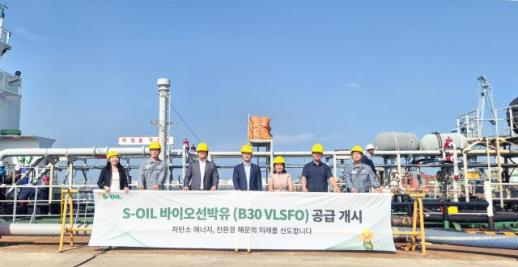 S-Oil launches biofuel-blended marine fuel for shipping SEOUL, July 22 (AJP) - S-Oil, South Korea's fourth-largest oil refiner, announced it had begun supplying a biofuel-blended marine fuel as it moves to capture growing demand for cleaner-burning fuels in the global shipping industry. The new product, known as B30 VLSFO, combines conventional very low-sulphur fuel oil with about 30 percent sustainable biofuel. Because it can be used without any modification to a vessel's engines, the refiner said, it offers shipowners an immediate and practical way to meet tightening emissions rules imposed by the International Maritime Organization and the European Union. The company produces VLSFO at its Onsan plant and links it to nearby biofuel production and storage facilities, a setup it said minimizes logistics and sharpens operational efficiency. The Ulsan port draws heavy demand for biofuel-blended marine fuel, driven largely by car-carrier vessels, positioning the refiner to serve major customers quickly and reliably. "In the biofuel-blended marine fuel market, competitiveness rests not only on product quality but on securing a stable feedstock supply and an efficient delivery system," a company official said. "Building on our existing bunkering business and the strong supply infrastructure in the Onsan area, we plan to provide customers with stable and competitive low-carbon fuel." 2026-07-22 14:41:48
-
Samsung Discusses Investment in French AI Startup Mistral Samsung Electronics is in discussions to invest in Mistral, a French artificial intelligence (AI) startup often referred to as the "European OpenAI," according to a report by the Financial Times on July 22, citing sources. If the investment materializes, Mistral is expected to strengthen its position as a viable alternative to major U.S. AI tech companies.Reports indicate that Samsung is considering participating in a new funding round initiated by Mistral. One source mentioned that Samsung could invest around €1 billion (approximately 1.7 trillion won) in this round. Upon completion of the funding round, Mistral's valuation is projected to reach about €20 billion (approximately 33.8 trillion won).According to the Financial Times, Samsung has already invested in Mistral through its venture capital division, and the two companies discussed collaboration opportunities during French President Emmanuel Macron's visit to South Korea in April.Founded three years ago, Mistral is currently the highest-valued AI startup in Europe. CEO Arthur Mench has stated that the company expects to surpass $1 billion in annual recurring revenue (ARR) by the end of this year. Mistral aims to leverage its strengths to attract European and Asian companies and governments seeking alternatives to U.S. AI models.Demand for such alternatives has surged, especially after the Trump administration restricted access to the latest AI models, "Mitos" and "Fable," for overseas users. Additionally, as China tightens control over its own AI models, Mistral has become increasingly appealing to clients looking for AI solutions outside the U.S. and China.However, the Financial Times notes that Mistral faces stiff competition from recently launched Chinese AI models, including Kimi.This funding round comes less than a year after Mistral raised €1.7 billion in an investment led by Dutch semiconductor equipment maker ASML, which valued the company at €12 billion. The European Commission is reportedly supporting this investment, and discussions are ongoing with the ScaleUp Europe fund managed by Swedish asset management firm EQT. Sources indicate that negotiations are still in progress, and investment terms may change, with no final decision made yet.Furthermore, the negotiations reflect a broader trend in the AI industry to strengthen collaborations with semiconductor suppliers. As demand for computing power in the AI sector surges, competition for securing semiconductors is intensifying, leading to increased partnerships between AI companies and semiconductor firms.In fact, just the day before, Mistral announced an expansion of its collaboration with Microsoft, one of its early investors, and last month, Anthropic announced a partnership with U.S. memory company Micron, which includes long-term memory and storage supply agreements. 2026-07-22 14:40:00
-
Samsung Heavy Industries Accelerates Development of Floating SMR with U.S. Firm Samsung Heavy Industries is accelerating the commercialization of floating small modular reactors (FSMR) by partnering with a leading U.S. nuclear design and engineering firm.On July 22, Samsung Heavy Industries announced that it has signed a mutual priority cooperation memorandum of understanding (MOU) with Sargent & Lundy (S&L) to develop a universal FSMR standard platform.Founded in 1891, S&L has led global nuclear project design and engineering for over 70 years and was recognized as a leading firm in the nuclear plant sector in the 2026 Top Design Firms Sourcebook published by ENR.This agreement targets the global market, including the U.S., and is expected to be a key step in advancing the FSMR project from conceptual design to actual commercial deployment.Through this partnership, the two companies will jointly develop a universal FSMR standard platform that is not limited to specific reactor types. This strategy aims to broaden customer options and enhance their approach to the global market.Additionally, the companies plan to collaborate on key stages of FSMR commercialization, including development, regulatory support, construction planning, and deployment strategies. They also intend to improve the technical completeness of FSMR to comply with evolving international and U.S. regulatory standards.Kim Kyung-hee, Vice President and Head of Samsung Heavy Industries' Future Business Division, stated, "Collaboration with S&L, a leader in global nuclear design and engineering, will be a milestone in enhancing our FSMR technology. We will accelerate the advancement of FSMR technology, which is a next-generation growth driver, to lead the global offshore nuclear power market."FSMR is a next-generation offshore nuclear power platform that generates electricity by deploying small modular reactors (SMR) on floating structures. With the recent surge in power demand across all industries due to the expansion of artificial intelligence (AI) data centers, FSMR is gaining attention as an effective energy infrastructure for coastal and island areas where securing land for production is challenging or where power grid connections are limited.* This article has been translated by AI. 2026-07-22 14:36:00
-
Musinsa Establishes ESG Committee to Strengthen Sustainable Management Musinsa announced the establishment of an ESG (Environmental, Social, Governance) committee under its board of directors and the publication of the '2026 Musinsa Impact Report,' which details its sustainable management achievements from the previous year.The ESG committee was launched following a board resolution in April, with operational regulations established in May. Composed of five board members, the committee reviews and approves key ESG policies and statuses, including major risk management, climate change response, health and safety, supply chain management, and co-prosperity initiatives.The Impact Report, now in its fourth edition, highlights significant achievements across environmental, social, and governance areas. In the environmental section, it showcases accomplishments in greenhouse gas management, eco-friendly packaging, and re-commerce initiatives. The social section includes details on co-prosperity with partner brands, customer safety transaction infrastructure, community contributions, and employee rights and welfare. The governance section addresses board operations, enterprise risk management, ethical and compliant management, and enhanced information security.Notably, this year, the scope of greenhouse gas emissions management has been expanded to include major subsidiaries such as Musinsa Japan and Musinsa Logistics. This initiative has led to the establishment of a greenhouse gas inventory, known as Scope 1 and 2, at the Team Musinsa level, with related emissions disclosed. The report has also undergone independent third-party verification by the Korea Management Certification Institute.Musinsa CEO Jo Nam-seong stated, "We will achieve customer satisfaction through products and services that consider the environment and people, and continuously enhance our ESG standards in a changing environment."Additionally, last month, Musinsa signed a business agreement with eco-friendly bio-material company GRICO to promote the introduction of sustainable packaging using bio-materials.* This article has been translated by AI. 2026-07-22 14:36:00
-
 S&P lifts Samsung outlook as AI memory boom gathers pace SEOUL, July 22 (AJP) — Global ratings agency S&P Global Ratings has made its call on Samsung Electronics, betting that an AI-driven memory supercycle will drive at least two more years of strong earnings growth. The agency revised its outlook on the chipmaker to positive from stable, saying favorable industry conditions, including strong demand for high-bandwidth memory (HBM) and a prolonged supply shortage, are likely to support memory prices through 2027. "The positive outlook reflects our expectation that Samsung will strengthen its technological competitiveness, expand its market share in HBM and foundry businesses, and deliver solid operating performance over at least the next two years as the memory industry continues its structural growth," S&P said. The stock rose 3.86 percent to 269,000 won in Wednesday afternoon trading following the outlook. The optimism rests on a widening gap between AI demand and chip supply. The ratings agency expects Samsung to be among the biggest beneficiaries of the AI-driven memory supercycle, as investment in hyperscale data centers continues to outpace new semiconductor capacity. Some DDR5 chip prices have already risen three- to fourfold from a year earlier. It also sees memory shortages persisting for at least two more years as AI infrastructure spending continues to accelerate. The world's four largest hyperscale cloud operators are projected to quadruple capital spending from 2024 levels to around $1 trillion by 2028, with much of the money directed toward AI infrastructure, while meaningful supply growth is not expected before then. Reflecting that outlook, the agency forecasts Samsung's annual revenue will reach a record 683 trillion won ($495 billion) in 2026 before climbing to 821 trillion won in 2027. EBITDA, a widely used measure of operating earnings, is expected to surge from around 91 trillion won in 2025 to 393 trillion won in 2026 and 502 trillion won in 2027. The agency also expects this cycle to be less volatile than previous memory booms. As shortages persist, customers are increasingly seeking long-term supply agreements lasting three to five years. The growing use of customized memory products should also give chipmakers clearer order visibility and help protect earnings when the market eventually turns. Samsung's advances in HBM technology further reinforce that outlook. According to S&P, Samsung has advanced its HBM technology by pairing its latest 1c DRAM with a 4-nanometer base die in next-generation HBM4 chips, while largely fixing the production yield issues that affected its earlier HBM3E products. The agency also sees improving prospects for Samsung's foundry business. It said yields on its most advanced manufacturing processes are beginning to stabilize. At the same time, capacity constraints at Taiwan Semiconductor Manufacturing Co. could give Samsung an opportunity to win more orders as an alternative supplier. Backing that expansion, Samsung's annual capital expenditure is projected to rise from 52 trillion won in 2025 to between 81 trillion won and 84 trillion won over the next two years. Even so, S&P expects the balance sheet to remain resilient. Strong cash generation is forecast to lift free cash flow from 33 trillion won last year to 201 trillion won this year and 288 trillion won in 2027. 2026-07-22 14:34:48
-
When is the Next World Cup? 100th Anniversary Tournament Across Three Continents The next North America World Cup will take place in 2030, marking the 100th anniversary of the FIFA World Cup, which began in Uruguay in 1930.The 2030 World Cup will feature a unique hosting format. Morocco, Portugal, and Spain will serve as the main host countries, while Uruguay, Argentina, and Paraguay will host one commemorative match each. This will be the first time in World Cup history that matches are held across six countries on three continents: Europe, Africa, and South America.According to the schedule released by FIFA, the tournament will kick off in South America on June 8 or 9, 2030. The opening ceremony and Uruguay's first match will take place in the capital, Montevideo, along with the first matches for Argentina and Paraguay. These matches will be official group stage games, not friendly matches or separate pre-events.Following this, the official opening ceremony and inaugural match will occur in the main host countries of Morocco, Portugal, and Spain on June 13 or 14. The final is scheduled for July 21. However, this is a preliminary schedule from FIFA, and specific matchups, venues, and kickoff times will be confirmed later.Morocco, Portugal, and Spain were officially selected as the host countries for the 2030 World Cup during a FIFA extraordinary congress held via video conference on December 11, 2024. The proposal was approved by acclamation from the 211 FIFA member associations. Uruguay, Argentina, and Paraguay were named as hosts for the commemorative matches.The inclusion of the three South American countries is rooted in the history of the first World Cup. The inaugural tournament in 1930 featured 13 countries, with Uruguay defeating Argentina 4-2 in the final held at Estadio Centenario in Montevideo.FIFA has decided to hold the commemorative ceremony and matches in Uruguay, the host and champion of the inaugural tournament. Argentina, as the runner-up in 1930, is also included, while Paraguay is recognized for being home to the South American Football Confederation (CONMEBOL). It is noteworthy that CONMEBOL was the only continental football federation in existence at that time.Teams playing their first matches in South America will then travel across the Atlantic to continue the group stage in Europe and Africa. FIFA has designed the schedule to allow the six teams playing in South America to have approximately 11 to 12 days for travel and rest before their second match. The remaining six teams in the same group and other participating countries will have about 5 to 6 days between their first and second matches.The current hosting plan is based on a system of 48 countries, similar to the 2026 tournament. Out of a total of 104 matches, three will be held in South America, while the remaining 101 will take place in Morocco, Portugal, and Spain.There is also a possibility of expanding the number of participating countries to 64. FIFA President Gianni Infantino has stated that after the 2026 World Cup, the relevant committee will review and discuss the proposal to increase the number of teams by 16 from the initial 48. However, FIFA has not yet officially approved this expansion.CONMEBOL President Alejandro Dominguez publicly urged on July 20 for the 2030 World Cup, marking its centenary, to be held with 64 teams. If the expansion is adopted, the current number of matches, tournament schedule, and hosting format in South America may also be adjusted.Morocco, Portugal, Spain, Uruguay, Argentina, and Paraguay will automatically qualify for the tournament as host nations. Their spots will be deducted from the allocation of slots for their respective continents.The 2030 World Cup will commemorate the first tournament held in South America before moving to Europe and Africa for the competition. The next World Cup in 2034 has been confirmed to take place in Saudi Arabia.* This article has been translated by AI. 2026-07-22 14:32:00
-
LE SSERAFIM's Hong Eun-chae to Throw First Pitch at Chiba Lotte Marines Game Group LE SSERAFIM's Hong Eun-chae will make a special appearance at a Chiba Lotte Marines home game in Japan.Hong Eun-chae is set to attend the game between the Chiba Lotte Marines and the Saitama Seibu Lions on August 5 at Chiba's Zozo Marine Stadium. This event is part of the Chiba Lotte Marines' annual summer festival, 'BLACK SUMMER WEEK.'According to the team, Hong Eun-chae will participate in the first pitch and engage with fans during various events throughout the game.In a statement through her agency, Source Music, Hong Eun-chae expressed her excitement, saying, "I am very honored to throw the first pitch in Japan for the first time. I hope to bring bright energy and joy to those who come to the stadium despite the hot weather."This invitation highlights LE SSERAFIM's growing popularity in Japan. The group topped the Oricon weekly single chart and the weekly combined single chart with their debut single 'FEARLESS' in 2023, marking the first time in over five years that a foreign female artist achieved this feat with a debut album.Since then, LE SSERAFIM has made history by receiving the Special International Music Award at the Japan Record Awards, becoming the first K-pop girl group to do so. Last year, they also performed at Tokyo Dome as part of their first world tour encore.For Hong Eun-chae, this first pitch holds special significance. She has previously revealed her passion for baseball through various content and interviews. In March of last year, she threw the first pitch at a KBO League game for the Doosan Bears, earning the nickname 'Victory Fairy' after the team won.Meanwhile, LE SSERAFIM is currently on their second world tour, '2026 LE SSERAFIM TOUR 'PUREFLOW,' having recently completed performances at the Inspire Arena in Incheon on July 11-12, and will continue their tour in Japan starting July 25 in Osaka.* This article has been translated by AI. 2026-07-22 14:32:00
-
 Seoul denies receiving US Hormuz warship request SEOUL, July 22 (AJP) - No request has come from Washington for South Korea to send any specific military asset to the Strait of Hormuz, South Korea's presidential Blue House said Wednesday, pushing back against reports that a formal demand for a naval deployment was close. The denial is narrow, and the wording matters. The presidential office said the government has not been asked recently to dispatch a particular asset in connection with the safety of international sea lanes and freedom of navigation. It did not say that talks about a South Korean contribution have stopped. "We have continued to discuss related cooperation measures with the United States side," the office said, adding that Seoul is weighing practical ways to contribute to freedom of passage through the strait while taking into account readiness on the Korean Peninsula, domestic legal procedures and other factors. It declined to go further. Specific details of military and security communications between South Korea and the United States cannot be disclosed publicly, the office said. The strait carries about 20 percent of the world's oil and liquefied natural gas, and its effective closure since fighting between the United States and Iran began in March has driven up energy prices worldwide. South Korea, which imports almost all of its crude and buys much of it from Gulf producers, has more exposure to the waterway than most of the countries being asked to help police it. The pressure has been building since March 14, when President Donald Trump named South Korea, China, Japan, France and Britain in a post on Truth Social and demanded they send warships to secure the passage. Trump has since accused allies who declined of ingratitude. The domestic legal procedures the presidential office referred to are the central obstacle. Defense Minister Ahn Gyu-back told a parliamentary hearing in March that sending a warship or troops to the Strait of Hormuz would require approval from the National Assembly, a step that would turn a military decision into a political one. Any deployment would most likely involve the Cheonghae Unit, the antipiracy task force South Korea has maintained near the Gulf of Aden since 2009. The unit rotates a destroyer to the region roughly every six months with about 260 personnel and an attack helicopter aboard. There is precedent for expanding its remit. In January 2020, the government widened the unit's area of operations to include the Strait of Hormuz while stopping short of joining the US-led maritime coalition then operating there. Foreign Minister Cho Hyun has repeatedly declined to say in public whether Washington has made a request. Pressed at a parliamentary committee in March, he said only that responding to an ally's demand was an important question and that the government would act in accordance with the constitution and the law. Japan and Australia have both said they do not plan to send ships to escort vessels through the strait. 2026-07-22 14:29:58