


Latest by
-
 Commercial Real Estate Auctions Surge Despite Market Challenges Commercial real estate, including retail spaces and officetels, is facing a downturn due to high interest rates and vacancy pressures. This trend is reflected in the auction market, which has seen a record number of listings. However, prime commercial properties in Seoul, driven by expectations of redevelopment, are still fetching premium prices.According to the June 2026 Auction Trends Report from Jiji Auction, the number of commercial property auctions nationwide reached 8,268 last month, marking a nearly 9% increase from 7,579 in the previous month, the highest monthly total on record. Retail spaces and officetels accounted for the largest share of these auctions.Despite the increase in auction listings, the success rate has been disappointing. The nationwide auction success rate for commercial properties stood at 20.0%, down 0.3 percentage points from the previous month. The average winning bid rate was 51.3%, a decrease of 1.9 percentage points from 53.2% the prior month, indicating that properties were selling for about half of their appraised values. The average number of bidders per auction was just 2.8.This decline in the commercial real estate market is reflected in the auction metrics. Retail spaces are sensitive to the performance of small businesses, rental income, and vacancy rates. With high interest burdens and slow consumer recovery, expectations for rising rents are low. Officetels are also losing investment appeal as they straddle the line between residential and income-generating properties, contributing to the increase in auction listings.The situation is even more challenging in regional markets. In Sejong, the auction success rate for commercial properties was only 29%, while it was 38.7% in Gangwon, 42.3% in Jeonbuk, and 42.4% in Gyeongnam.In contrast, Seoul's commercial property auction success rate was 71.7%, up 3.8 percentage points from 67.9% the previous month. This figure is over 20 percentage points higher than the national average of 51.3%, indicating strong demand for prime properties in the capital.Notably, commercial properties in redevelopment areas showed robust performance. Retail spaces within a redevelopment apartment complex in Dohwa-dong, Mapo-gu, and those in the redevelopment promotion zone around Cheonho-dong, Gangdong-gu, were sold for an average of 1.5 times their appraised values. Additionally, five small officetels in Gwangjin-gu were all auctioned at around 100% of their appraised values.Looking ahead, the disparity in auction performance across regions is expected to widen. Particularly, commercial properties in transit-oriented developments, redevelopment areas, and large-scale surrounding commercial districts are likely to see increased selective demand.However, potential buyers of commercial properties in redevelopment areas must consider various factors, including the association's regulations, membership status, recognition of sale rights, compensation for business operations, and legal relationships. Delays in redevelopment projects or unfavorable changes in property placement and sale conditions could diminish anticipated development profits.An industry insider noted, "The record number of commercial property auctions indicates that assets unable to withstand current conditions are entering the market. The commercial properties in Seoul's redevelopment zones are being evaluated differently due to development expectations and surrounding demand."He added, "The profitability of commercial property auctions varies significantly based on location and legal relationships. Rather than simply following properties that sold for higher than their appraised values, it is essential to assess the stage of redevelopment projects, membership status in property associations, and future rental demand."* This article has been translated by AI. 2026-07-15 16:04:00
-
Interest Rate Hike Looms as Household Funds Shift from Stocks to Savings As the Bank of Korea prepares to resume its interest rate hike cycle, there is growing interest in whether some household funds that had flowed into the stock market will shift back to bank deposits. Although rising deposit rates may enhance the appeal of safe assets, expectations for stock market gains remain high, and the current low interest rate levels suggest that a rapid reversal in money movement is unlikely.According to the financial sector on July 15, the Bank of Korea's Monetary Policy Committee will decide on adjustments to the current benchmark interest rate of 2.50% on July 16. Given the recent consumer price inflation rate in the 3% range, fluctuations in the won-dollar exchange rate, and steady economic growth, the market widely anticipates a 25 basis point (1 basis point = 0.01 percentage points) increase in the benchmark rate during this meeting. There is also a prevailing outlook that an additional hike may occur later this year, depending on inflation and financial stability conditions.If the benchmark rate rises, it is likely that deposit rates at commercial banks will follow suit. Currently, the highest interest rate for 12-month fixed deposits at the four major banks (KB Kookmin, Shinhan, Hana, and Woori) is around 2.90%. Following the anticipated rate hike, some products are expected to exceed 3%, which could attract funds seeking relatively stable returns.This year, household funds have shown a preference for investment assets over deposits. According to the Bank of Korea's '2026 Q1 Financial Flow' statistics, the scale of household fund management increased from 84.3 trillion won in the fourth quarter of last year to 96.3 trillion won in the first quarter of this year. During the same period, the scale of fund procurement slightly decreased from 17.3 trillion won to 17.1 trillion won. While the proportion of savings deposits has decreased, the share of equity securities and investment funds has increased, indicating a flow of funds into the stock market.Market analysts believe that a single interest rate hike will not drastically change the flow of funds. Household funds tend to respond more sensitively to the expected returns of risk assets like stocks and market outlooks than to deposit rates themselves. As long as expectations for stock market gains remain, the likelihood of a large-scale shift to deposits is limited. However, funds waiting for investment opportunities or those with short-term management strategies may respond more sensitively to rising deposit rates, suggesting that movements will vary based on the nature of the funds.Experts suggest that a significant money movement will only occur when the relative attractiveness of deposits and stocks changes together. Even if deposit rates rise due to the benchmark rate hike, the current levels may not be sufficient to reverse the preference for risk assets, and the investment appeal of other safe assets like bonds may become more pronounced.Kim Sang-bong, a professor of economics at Hansung University, stated, "The current benchmark rate is still low, so even a 25 to 50 basis point increase is unlikely to lead to a massive shift in funds. Interest rates need to rise to levels similar to those in the United States for deposits to become more attractive, and at present, bonds may be a better investment option than deposits."* This article has been translated by AI. 2026-07-15 16:04:00
-
Household Funds Shift from Savings to Stock Market Amid Bullish Trends As the stock market strengthens, household funds are moving from bank deposits to the stock market. In the first quarter of this year, funds exited savings accounts, while the scale of investments in stocks and investment funds nearly doubled. With the central bank signaling potential interest rate hikes, attention is turning to the future direction of household funds.According to the Bank of Korea on July 15, the total deposits held by households and non-profit organizations at financial institutions in the first quarter amounted to 29.4 trillion won, a 42.01% decrease from 50.7 trillion won in the same period last year. In contrast, the scale of equity securities and investment funds increased from 30.4 trillion won to 61.4 trillion won, nearly doubling compared to the previous year.The total deposits at financial institutions increased compared to the previous quarter (12.8 trillion won). Analysts suggest that much of this increase is due to the expansion of securities deposits.This trend is also reflected in detailed financial transaction data. The scale of short-term savings deposits held by households and non-profit organizations decreased by 7.628 trillion won in the first quarter. Long-term savings deposits also fell by 12.192 trillion won. Conversely, the issuance of resident stocks and equity interests increased by 18.329 trillion won in the first quarter, indicating a shift of funds from savings to riskier assets like stocks.Such fund movements appear to have continued into the second quarter. In April, the turnover rate of demand deposits was recorded at 23.1 times. This turnover rate was 23.6 times in December last year, reflecting heightened enthusiasm for stock investments, the highest level in a decade since December 2015 (24.6 times).Additionally, the turnover rate for savings deposits, including time deposits and regular savings, was 1.7 times per month, matching the highest level recorded in December last year. This increase is attributed to the growing enthusiasm for stock investments, leading to active fund transfers from bank savings to investment opportunities like stocks.The movement of household funds into stocks is largely attributed to the bullish stock market. The KOSPI index recorded a return of 19.71% in the first quarter. In contrast, the interest rate on one-year time deposits at commercial banks remained in the upper 2% range. As expectations for capital gains from rising stock prices grew, investors shifted their funds toward the stock market.However, there are concerns that increased volatility in the domestic stock market since the second quarter and growing uncertainties surrounding the semiconductor industry may weaken investors' appetite for riskier assets. Additionally, the likelihood of the central bank raising interest rates could also impact household fund management. If the central bank raises the benchmark interest rate, market interest rates will likely rise first, leading banks to increase their deposit rates to attract funds.Experts suggest that if the preference for riskier assets continues, the inflow of funds into the stock market may persist. Kim Yu-mi, a researcher at Kiwoom Securities, stated, "As households and businesses continue to accumulate financial assets, if the preference for riskier assets persists, the potential for idle funds to flow into the stock market could increase. The expansion of equity securities and investment funds confirmed in this fund circulation statistics signals that this movement of funds is already underway."* This article has been translated by AI. 2026-07-15 16:04:00
-
Criticisms Arise Over Labor Minister's Comments on Excess Profit Distribution Writer and broadcaster Heo Ji-woong has sharply criticized the government's discussions on excess profit distribution in the semiconductor industry and comments made by the Labor Minister. His remarks have quickly gained traction online, sparking criticism even within progressive circles.On July 15, Heo Ji-woong posted a lengthy message on his Instagram account. He questioned the discussions on excess profit distribution, stating, "This is not about additional state revenue. Shouldn't we first define what excess profit is? Why is it that we only discuss sharing profits and not losses?"He emphasized, "Even when the government helps struggling companies, it does not take responsibility for their bankruptcy. In capitalism, the entity that takes the risk reaps the profits."Heo further criticized the notion of distributing excess profits, saying, "It is uncertain whether reinvesting all operating profits into facilities and technology will lead to stagnation or advancement. The speed of capital input is crucial. Yet, to say we will share excess profits just because current results are good? That is unacceptable."He also pointed out that competitors are rapidly growing, stating, "They only need to distribute with the Communist Party. If we allow this kind of discussion to shake our foundations, we will be overtaken by Chinese companies like Changxin in a year or two." He directly referenced the Labor Minister's comments, questioning, "Is the Labor Minister believing in some kind of cult religion when he says, 'Transcending the binary thinking of investment versus distribution is the first step to opening the door to a new society'?"He concluded his post by stating, "It is a total mess from start to finish. I don't even know where to begin."This controversy follows a discussion forum held the previous day titled 'A New Path for Social Innovation in Line with AI Technology Innovation.' During the forum, the main agenda was how to share excess profits from the semiconductor industry with workers, partner companies, and society. A representative from the Korean Confederation of Trade Unions sparked controversy by stating, "I don't think shareholders have ownership rights over corporate profits. Dividends are merely a procedurally defined right."As Heo Ji-woong's post spread, over 400 critical comments emerged from progressive women in their 20s and 30s. Many expressed their discontent, with comments such as, "I used to vote for the Democratic Party thinking it was the lesser evil, but I can't do that anymore. After ruining the market, they talk about excess profits," and "Is this North Korea?"One commenter reflected on their changing perspective, stating, "I used to not understand why older generations talked about communism. Now that I am paying taxes, buying a house, and thinking about the future, I understand. I still dislike the Taegukgi Brigade, but I feel like the '개딸' and the Taegukgi Brigade are the same. There are no absolute lines in politics; they are all just different kinds of trash we keep recycling. This time, the trash failed to be reused, and I don't think I will vote for the Democratic Party again." 2026-07-15 16:04:00
-
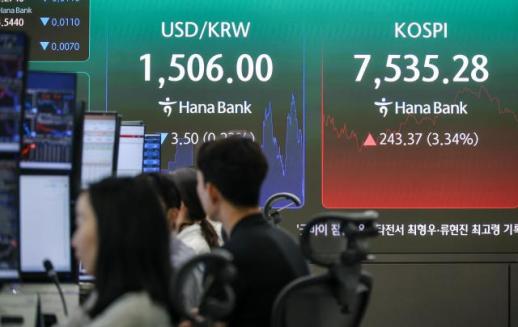
Foreign Investors Boost KOSPI by 8% Amid Rate Cut Expectations On July 15, the KOSPI index rebounded dramatically, regaining the 7,000-point mark, driven by expectations of interest rate cuts due to easing inflation in the U.S. and a recovery in global semiconductor investment sentiment. After plummeting to the 6,400 range the previous day, the market surged over 8% during the day, fueled by more than 2 trillion won in net purchases by foreign investors and a spike in semiconductor stocks.According to the Korea Exchange, the KOSPI closed at 7,284.41, up 427.58 points (6.24%) from the previous trading day. The index opened at 7,082.91, up 226.08 points (3.30%), and quickly reclaimed the 7,000 mark. It even reached a high of 7,424.18 during the day, marking an increase of over 8%.The rebound was led by foreign investors, who net purchased 23.227 trillion won in the stock market, while institutions also net bought 1.827 trillion won. In contrast, individual investors sold off 24.680 trillion won in profit-taking.Foreign buying was particularly concentrated in semiconductor stocks. Major companies such as SK Hynix, Samsung Electronics, Hanmi Semiconductor, SK Square, and LG Innotek were among the top net purchases by foreign investors. Domestic semiconductor stocks also showed strong performance, with Samsung Electronics rising 6.27% and SK Hynix climbing 8.83%. Notably, Hanmi Semiconductor surged 29.88% after reporting strong earnings the previous day, with second-quarter consolidated revenue reaching 251.1 billion won, a 39.5% increase year-on-year, marking a record high for the quarter. Operating profit rose 51.0% to 130.3 billion won, with an operating margin of 51.9%, the highest ever recorded.Lee Kyung-min, a researcher at Daishin Securities, noted, "The recent sharp decline in the semiconductor sector in the U.S. has attracted bargain hunters, leading to a bullish market. In particular, the 27% surge in SK Hynix's ADR has stimulated investment sentiment in the domestic semiconductor sector."Expectations for an improvement in the global semiconductor market also supported investor sentiment. On the same day at 2 p.m. (Korean time), ASML reported second-quarter revenue of 9.33 billion euros and a gross margin of 54%, exceeding market expectations. The company also raised its annual revenue guidance from 36-40 billion euros to 43-45 billion euros.The rebound in the stock market was further bolstered by lower-than-expected U.S. consumer price index (CPI) figures. The June CPI rose 3.5% year-on-year, below the market forecast of 3.8%, while the core CPI was at 2.6%, also below the consensus of 2.8%.Lee Eun-taek, a researcher at KB Securities, commented, "The CPI report was generally positive, with a significant slowdown in sticky core inflation excluding housing costs. This, combined with heightened fear sentiment and an oversold market, led to the surge in semiconductor stocks." 2026-07-15 15:56:00
-
HP Unveils AI-Driven Solutions for Corporate Security, Real Madrid Leads the Way HP has introduced a next-generation workplace solution that uses artificial intelligence (AI) to predict IT failures and security threats for businesses. The company showcased a real-world application of this technology, currently utilized by the renowned Spanish football club Real Madrid, as part of its strategy to penetrate the AI-driven workplace market.At the 'HP Future of Work Summit' held on July 15 in Seoul, HP Korea CEO Gang Yong-nam stated, "The future of work that HP envisions is an environment where AI supports people to work more productively. This change is not a distant future; it will become a reality within the next year."The highlight of the event was the debut of the 'HP Workforce Experience Platform (WXP).' This platform integrates management of IT assets such as PCs, workstations, and printers, regardless of operating system or manufacturer. AI analyzes system status, network conditions, security programs, and application usage to score potential failure risks and alert administrators before issues arise.Unlike traditional methods that respond to failures after they occur, the core of this technology is its proactive approach, analyzing anomalies to take preemptive action. It also automatically recommends scripts needed for problem resolution and can apply BIOS and driver updates according to policy. HP claims that it can help reduce IT operational costs by analyzing AI application usage and license utilization.HP reported that Real Madrid uses WXP to manage numerous devices in real-time across its stadium, training facilities, and headquarters. This unified platform allows the club to predict failures and minimize disruptions in the IT environments used by players, analysts, media production teams, and operational staff.Real Madrid's Chief Information Officer (CIO) Enrique Uriel remarked, "The weakest link in cybersecurity is ultimately the human factor. We have established an environment where employees can work safely by implementing HP's security portfolio."The club employs HP Wolf Security to block malware and hacking attempts, utilizes 'HP Protect and Trace' to remotely delete data from lost laptops, implements 'HP Sure View' to prevent screen snooping, and uses 'HP Secure Print' to ensure documents are printed only after user authentication.Both companies also unveiled an AI-based collaboration environment. HP introduced its on-device AI platform 'HP IQ,' which processes document summaries, meeting notes, and Q&A directly on PCs. The AI meeting solution 'Poly' enhances collaboration productivity with features like speaker tracking, noise cancellation, and real-time translation.CEO Gang emphasized, "AI is becoming the most powerful tool for enhancing individual productivity. Companies must create work environments that allow employees to freely utilize AI while maintaining security."CIO Uriel added, "We operate a dedicated organization to manage employee experience in collaboration with HP. Through WXP, we continuously analyze the performance of employees' PCs and proactively replace or enhance performance before issues arise. Good security should not hinder employees' work but rather enhance safety and productivity."* This article has been translated by AI. 2026-07-15 15:56:00
-
Yoon Suk Yeol Appeals Two-Year Sentence for Receiving Polls from Myung Tae-kyun Former President Yoon Suk Yeol, who was sentenced to two years in prison for receiving polls for free from political broker Myung Tae-kyun, has filed an appeal. According to legal sources on July 15, Yoon submitted his appeal to the 33rd Criminal Division of the Seoul Central District Court the previous day. Myung, who was sentenced to 18 months in prison and taken into custody during the first trial, also filed an appeal on the same day. Yoon's legal team stated that the appeal will argue that the first trial court misinterpreted the facts and misunderstood the law, leading to an unjust sentence. Yoon is accused of receiving 58 polls from Myung for free between June 2021 and March 2022, in collusion with his spouse, Kim Kun-hee. On July 13, the first trial court determined that Yoon received 14 polls for free and sentenced him to two years in prison along with a fine of 13.96 million won. The court found that there was an implicit agreement between Yoon and Myung regarding the conduct and provision of the polls. It concluded that even without a prior agreement, Yoon exerted influence in favor of former People Power Party lawmaker Kim Young-sun as a form of compensation. However, the court ruled that the remaining 44 polls could not be definitively linked to an agreement between Yoon and Myung, as they were not directly delivered by Myung. This ruling contrasts with the separate acquittal of Kim on similar charges in both the first and second trials. Those courts determined that Myung provided the polls unilaterally, without prior requests or consultations, as part of his business activities at the Future Korea Research Institute, which he operated.* This article has been translated by AI. 2026-07-15 15:56:00
-
U.S. Begins Maritime Blockade Against Iran; Trump Threatens Strikes on Infrastructure The United States has initiated a maritime blockade aimed at intercepting vessels traveling to and from Iranian ports. This move is accompanied by additional airstrikes in key southern regions of Iran and new sanctions targeting oil and shipping networks. President Donald Trump has warned that if Iran does not engage in negotiations, the U.S. will begin attacking power plants and bridges starting next week.U.S. Central Command announced on July 14 that the blockade of vessels traveling to and from Iranian ports resumed at 4 p.m. EDT (5 a.m. KST on July 15). More than 20 U.S. Navy warships and hundreds of military aircraft have been deployed across the Middle East.The blockade specifically targets vessels entering or leaving Iranian ports, while commercial ships from other countries can still transit the Strait of Hormuz. The U.S. military reported that during the first blockade from April to June, over 140 vessels were turned back, and nine non-compliant ships were neutralized. More than 50 vessels carrying humanitarian aid were allowed to pass.In conjunction with the blockade, the U.S. has conducted additional airstrikes against Iran. Recent attacks lasted for seven hours, targeting dozens of military objectives near the Strait of Hormuz and along the Iranian coastline. Iranian authorities reported that southern regions, including Bushehr, Bandar Abbas, Qeshm Island, and Abadan, were hit.The U.S. has also intensified its economic pressure. The Treasury Department imposed new sanctions on individuals, companies, and over 50 vessels linked to Mohammad Hosein Shamakani, identified as a key figure in Iran's oil export network. To date, the U.S. has sanctioned more than 200 entities associated with this network.In a Fox News interview, President Trump revealed that U.S. and Iranian delegations have been in contact. He stated, “If they do not come to the negotiating table, we will take down their power plants and bridges,” adding that “the situation will get very bad next week.”While Trump did not set an official deadline for a final agreement, his warning indicates that if Iran does not return to negotiations, the U.S. may expand its targets to include critical infrastructure. He also noted that the ongoing airstrikes against Iran would continue “until I say stop.”Following a memorandum of understanding (MOU) on cessation of hostilities last month, the U.S. and Iran had been working to lift the maritime blockade and engage in follow-up negotiations. However, renewed attacks on commercial vessels in the Strait of Hormuz and U.S. retaliatory strikes have effectively undermined the agreement. The U.S. has reported that Iran attacked seven commercial vessels in the past week.Iran is also escalating its response. The Islamic Revolutionary Guard Corps (IRGC) warned that “regional energy exports will be enjoyed by all or none,” threatening to block other export routes that benefit the U.S. and its allies. Iran has stated it will continue to close the Strait of Hormuz.Iran claims to have attacked facilities related to the U.S. Fifth Fleet in Bahrain, logistics facilities in Kuwait, and U.S. military sites in Jordan. Jordan reported intercepting three ballistic missiles launched from Iran.If Iran's threats materialize, the conflict could extend beyond the Strait of Hormuz to the Bab el-Mandeb Strait, which connects to the Red Sea. The Houthi armed group in Yemen, which is allied with Iran, has been mentioned as a potential actor in blocking this strait. Prior to the conflict, approximately one-fifth of the world's oil and gas shipments passed through the Strait of Hormuz, so disruptions in both major routes could significantly impact global energy and logistics markets.* This article has been translated by AI. 2026-07-15 15:56:00
-
 Lee orders swift measures for single-stock leveraged ETFs amid market volatility SEOUL, July 15 (AJP) - President Lee Jae Myung on Wednesday ordered financial authorities and the Korea Exchange to swiftly draw up measures for leveraged exchange-traded funds (ETFs) linked to Samsung Electronics and SK hynix amid concerns over heightened stock-market volatility. The matter is expected to be discussed Thursday at a meeting of South Korea's four main economic and financial authorities, commonly known as the F4, as regulators consider stronger protection for investors. The F4 brings together the Ministry of Economy and Finance, the Bank of Korea, the Financial Services Commission and the Financial Supervisory Service. Lee raised the issue during a joint government policy briefing at Cheong Wa Dae, asking Financial Supervisory Service governor Lee Chan-jin about the controversy involving single-stock leveraged ETFs. The governor admitted the regulator's responsibility as a market supervisor. Lee then turned to Korea Exchange chairman Jeong Eun-bo and asked officials to prepare supplementary measures without delay. "Please swiftly draw up the necessary measures," Lee said, stressing that normalizing and strengthening the capital market remains his key policy priority. Single-stock leveraged ETFs, launched in the domestic market on May 27, amplified the daily price swings of individual stocks including those of the country's two biggest chipmakers. Their launch has sparked debate over whether heavy trading in these funds could make swings in the underlying stocks, related derivatives, and the broader market even bigger. Buy and sell sidecars have been triggered 36 times on the benchmark KOSPI so far this year, with 17 of those activations occurring since the leveraged ETFs were launched, according to news outlet Newsis. Five of the 13 circuit breakers activated across the KOSPI and junior KOSDAQ since 2000 have also occurred since May 27. The figures show that the launch of these products coincided with a period of unusually sharp market moves, but do not by themselves establish that the ETFs directly caused the trading halts. Authorities are expected to examine the funds' trading structure, liquidity management, their interaction with spot and derivatives markets and the risk of losses among individual investors. Kim Yong-beom, Lee's chief policy secretary, said last week that the government would closely review the products' market impact at the next F4 meeting and decide whether additional measures were needed. The FSS chief has previously expressed regret over the products' introduction, saying last month that the regulator should perhaps have taken stronger action before accepting their securities registration statements. The Financial Services Commission also held a closed-door meeting Tuesday with major brokerages and asset management companies to discuss potential safeguards. Financial firms, meanwhile, agreed this week to strengthen risk warnings tailored to investors' ages and portfolios, improve mandatory education for leveraged-product trading and consider raising minimum deposit requirements to curb excessive investment. The government's measures are likely to focus on tighter entry requirements, clearer risk disclosures and stronger liquidity and operational controls, with the broad direction expected to emerge after Thursday's F4 meeting. 2026-07-15 15:52:58
-
 2026 Korea Drone Expo hosts thrilling match INCHEON, July 15 (AJP) - A drone soccer match takes place during the Drone Soccer Grand Prix at the 2026 Korea Drone & UAM Expo at Songdo Convensia in Yeonsu District, Incheon, on July 15, 2026. 2026-07-15 15:50:43