


Latest by
-
 SK Hynix ADR Debuts with 84,000 Domestic Investors on First Day Domestic individual investors purchased over 300 billion won worth of SK Hynix American Depositary Receipts (ADRs) on the first day of trading.According to the financial investment industry on July 15, approximately 84,000 individual investors bought SK Hynix ADRs through nine major domestic securities firms, including Mirae Asset Securities, on July 10 (local time).ADRs are certificates issued by foreign companies that allow their shares to be traded on U.S. stock exchanges while maintaining their home country listings.On the first day, domestic investors acquired a total of 1.36 million shares of SK Hynix ADRs, representing about 0.76% of the public offering amount of 177.9 million shares. The estimated value of these purchases was around 338.9 billion won.Industry estimates suggest that if purchases through other securities firms are included, the number of investors could approach 100,000, with total holdings exceeding 400 billion won.In the domestic stock market, individual buying continued. According to the Korea Exchange, individual investors net bought 788,510 shares of SK Hynix on the same day, amounting to approximately 1.7 trillion won.This surge in buying is interpreted as investors anticipating further stock price increases for SK Hynix following the ADR listing, prompting simultaneous purchases in both the U.S. and domestic markets.However, the stock experienced significant volatility immediately after its listing. SK Hynix ADRs began trading at $170, above the offering price of $149, and peaked at $177 during the day, but later retraced to close at $168.01. This reflects a 12.76% increase compared to the offering price, but is lower than the initial trading price.On the second trading day, July 13, the stock closed down 9.32% from the previous day, but rebounded with a 27.29% increase on July 14.Meanwhile, the SK Hynix ADR listing was conducted with a total scale of $26.5 billion (approximately 40 trillion won). Industry experts regard it as the second-largest listing in the U.S. market this year, following SpaceX's $85.7 billion IPO last month.* This article has been translated by AI. 2026-07-15 08:52:00
-
Gaon Cable Supplies Power Distribution Cables to SK Hynix's Yongin Semiconductor Cluster Gaon Cable has begun supplying power distribution cables to SK Hynix's Yongin semiconductor cluster, marking an expansion in its semiconductor power infrastructure business.On July 15, Gaon Cable announced it has supplied hundreds of millions of won worth of power distribution cables to the Yongin semiconductor cluster.This supply extends Gaon Cable's reach to the Yongin cluster, following its existing operations in Icheon and Cheongju. The company plans to actively target the demand for new semiconductor fab construction, expansion of existing production facilities, and replacement of aging equipment.Power distribution cables are essential equipment that reliably supply electricity to production lines and process facilities. Semiconductor plants require large amounts of power 24/7, creating consistent demand not only for new factory construction but also for expansions and maintenance.Gaon Cable is currently negotiating additional supplies worth hundreds of millions of won for the second half of the year and is also pursuing participation in a power infrastructure project for semiconductor production facilities being developed by a U.S. company.Industry experts anticipate that as investments in AI semiconductors increase, the demand for power cables and transformers will grow alongside the establishment and expansion of semiconductor factories both domestically and internationally.Jung Hyun, CEO of Gaon Cable, stated, "Semiconductor production facilities are massive power infrastructure sites. Based on our domestic supply experience, we will expand our business into the global semiconductor power infrastructure market, including the United States."* This article has been translated by AI. 2026-07-15 08:48:00
-
Na Hong-jin's 'Hope' Premieres Today Amid Audience Reactions Na Hong-jin's new film 'Hope' premiered today, drawing attention to a review from an audience member who attended a director's Q&A session.On July 14, a post titled 'Hope Lee Chang-dong Director's Q&A Review' appeared on an online community.The reviewer noted that Director Lee Chang-dong described the film as "the pinnacle of pure entertainment," adding, "I resonate with that description."He praised the film for its "exhilarating action, speed, tension, and thrills, showcasing a sensory experience rarely seen in Korean cinema," and remarked that the quality of the cinematography was exceptional.However, he expressed some disappointment with the CGI, stating, "While it doesn't break immersion, viewers familiar with creature films might find certain scenes somewhat jarring," and predicted that the depth of the story and its conclusion would elicit mixed reactions among audiences.Additionally, Na Hong-jin mentioned during the Q&A that he wanted to create a film that was "completely different from 'Gokseong,'" and the reviewer felt that this intention was successfully realized, advising viewers not to expect 'Gokseong.'Further insights into the atmosphere of the Q&A session were shared.The reviewer noted, "Director Lee Chang-dong humorously remarked at the start, 'Na Hong-jin makes great films but isn't great at speaking, so I'll moderate the discussion,' which had the audience laughing," and added that the unexpectedly humorous moderation was impressive.He also shared in the comments, "The dialogue is clear. It's not a dialogue-heavy film to begin with," and suggested that Director Lee seemed to have a favorable view of 'Hope.'Film critic Lee Dong-jin had previously expressed high expectations for the film in his Q&A event announcement.Lee described 'Hope' as "an astonishing sci-fi film in both the quantity and quality of action, with a story that uniquely delves into various layers," and characterized the film as feeling like a massive crescendo as it boldly races through a bizarre chaos.He emphasized that it is not merely a spectacle-driven commercial film, but one that impresses with its narrative, direction, and rhythm, stating, "You probably haven't seen Na Hong-jin tell a story this long and deep before."Fans of the film have been buzzing about Lee's every expression.In particular, his comment that the "quantity and quality of action are astonishing" has been interpreted as a nod to the film's large-scale action sequences, while the phrase "a story that uniquely delves into various layers" suggests a narrative that goes beyond simple entertainment, allowing for diverse interpretations.Moreover, the description of the film as racing "like a massive crescendo" has been seen as an indication of the escalating tension and immersion as the film progresses.Commenters have expressed their excitement, stating, "The most anticipated Korean film of the year," "I always watch Na Hong-jin's films in theaters," "Just reading Lee Dong-jin's review raises my expectations," and "The casting alone is incredible."'Hope' marks Na Hong-jin's first feature film in nearly a decade since 'Gokseong.' It is known for its global cast and unique worldview, combining action, mystery, thriller, and human drama, and is considered one of the most anticipated films of the summer.* This article has been translated by AI. 2026-07-15 08:48:00
-
Naver's AI Tab Reaches 10 Million Users, Integrates Chat Feature Naver announced that its AI Tab, an agent-based search service, reached 10 million users on July 14. The company is enhancing its competitiveness by integrating AI technology with its search, shopping, local, and content services.The AI Tab expands Naver's existing search experience by combining it with its own services. Unlike other conversational AI services, it connects information searches with actual actions like purchases and reservations, reflecting the context of domestic users and differentiating itself from global AI models.Based on user trends, Naver evaluated that the AI Tab shows potential to evolve from conversational search to an actionable AI agent. This is supported by over 20 years of accumulated search technology and infrastructure, along with a vast content ecosystem including blogs and cafes.Since the official launch of the AI Tab on June 26, user search behavior has changed. The average daily queries for the AI Tab increased sevenfold compared to the beta service, and the number of queries per user rose by 1.7 times. The proportion of multi-turn conversations, where users continue with follow-up questions, has also expanded.Additionally, the time taken from search to decision-making has been reduced by up to 60-70%. This improvement is attributed to the use of actual purchase data, shopping reviews, and various user-generated content (UGC) to provide personalized recommendations in everyday searches for electronics, household items, and fashion.Naver plans to continue enhancing the actionable AI agent features of the AI Tab to enable more users to incorporate it into their daily lives.Starting today, a chat window linking to the AI Tab will be added below the AI Briefing. The AI Briefing service has over 30 million monthly users, allowing users to check key summaries and then continue with follow-up questions and in-depth exploration in the AI Tab.This month, Naver will also strengthen the integration between Smart Lens, AI Briefing, and AI Tab to enhance the image-based search experience. Users can take pictures of products or upload images with Smart Lens, check key information in the AI Briefing, and then proceed to follow-up questions and product purchases in the AI Tab.Next month, Naver will unveil a property-finding agent linked to its real estate service and an AI agent specialized for the Whale browser. The real estate agent will utilize Naver Pay real estate data, user-linked asset information, and UGC to recommend tailored listings, along with providing real-life reviews and property analysis information. The Whale browser will support web navigation by executing agents in the sidebar for webpage summaries and visit history inquiries.By the end of the year, Naver plans to introduce a health agent that provides personalized health information based on verified sources. This agent will offer reliable answers based on authoritative medical information and will be linked to actual experience information from Naver Cafe, as well as searches for hospitals and supplements, to provide a customized health management experience.Kim Kwang-hyun, Naver's Chief Data and Content Officer (CDO), stated, "Through the AI Tab, we will provide a search experience tailored to domestic users that is distinct from various conversational AI services both domestically and internationally. We aim to enhance the service to be the most reliable in terms of trustworthiness, making it an indispensable AI service in users' daily lives."Meanwhile, Naver officially launched the AI Tab on June 26, revamping the user interface (UI) to center around the AI Tab, replacing the search button known as the 'Green Dot' that symbolized its mobile app. The beta service, conducted for Naver Plus members, attracted 4 million users in about two months. Following the official launch for all users, the number of users reached 10 million within 18 days, indicating that Naver's integrated AI agent strategy is successfully attracting users through this search service.* This article has been translated by AI. 2026-07-15 08:44:00
-
Low-Interest Loan Scams Top Phishing Attacks in Q2 2026 AhnLab reported that the most prevalent type of phishing text attack in the second quarter of 2026 was 'loan scams.' The analysis indicates that rather than new attack techniques emerging, existing phishing methods have become more sophisticated, leading to a rapid increase in loan scams and messenger lure attacks.According to AhnLab's 'Q2 2026 Phishing Text Trend Report,' loan scams accounted for 62.68% of all phishing attacks. This was followed by: Telegram impersonations (17.38%), financial institution impersonations (8.97%), government and public institution impersonations (6.60%), job scams (2.22%), delivery service impersonations (1.37%), family impersonations (0.51%), disguised public offering subscriptions (0.27%), and wedding invitation scams (0%).Notably, loan scams and Telegram impersonations saw significant increases of 162% and 71%, respectively, compared to the previous quarter. In contrast, family impersonations and wedding invitation scams decreased by 31% and 96%, respectively.Loan scams rose from second place in the previous quarter to first place this quarter. Attackers attract users' attention with phrases like 'emergency support,' 'low interest,' and 'high limit,' then insert a messenger ID in the text to lure them into one-on-one consultation rooms. They subsequently request personal information or demand advance payments or fees under the pretext of processing loans.The most frequently impersonated sector was financial institutions, which made up 52.92% of the total. This was followed by government and public institutions (38.96%) and logistics companies (8.12%).AhnLab explained that many cases involved impersonating banks, credit card companies, and securities firms, creating scenarios that required immediate action, such as loan approvals, withdrawal notifications, card usage, or reports of unusual transactions, thereby clouding users' judgment.In terms of phishing attempt methods, mobile messenger lures accounted for the largest share at 43.89%. This was followed by URL insertion (40.33%), phone inducement (14.86%), and text reply inducement (0.92%).This represents a shift from URL insertion-based attacks, which comprised 98.99% in Q4 of last year and 81.36% in Q1 of this year, indicating a diversification of attack methods utilizing various channels such as messengers and phone calls. AhnLab analyzed that attackers are using multiple channels to evade detection and increase their success rates.* This article has been translated by AI. 2026-07-15 08:44:00
-
Samsung Unveils 'Flex Titanium' Display for Next-Gen Galaxy Foldable Phones Samsung Electronics introduced its new 'Flex Titanium' display technology on July 15, designed for the next generation of Galaxy foldable devices.The Flex Titanium display is the culmination of Samsung's expertise in foldable technology, now in its seventh generation. The redesigned display structure enhances durability while improving the visual experience by reducing screen creases.To achieve this, Samsung has developed a unique dual structure that combines an upgraded 'titanium plate' with a 'titanium alloy film' that features high elasticity and strength, replacing the traditional plastic film.The 'titanium alloy film,' positioned beneath the organic light-emitting diode (OLED) panel, is crafted to be one-third the thickness of a human hair. This innovation allows the device to be thinner than its predecessors while providing approximately 20 times greater strength compared to conventional polymer films, thus enhancing both crease reduction and durability.The 'titanium plate' located beneath it has been precisely engineered to minimize the size of micro-holes at the folding point, ensuring both support and flexibility.Additionally, the display's power efficiency has been significantly improved through high-resolution design and the use of next-generation organic materials.The new Galaxy foldable smartphone, featuring the Flex Titanium technology, is set to be officially unveiled at the 'Galaxy Unpacked' event in London on July 22 (local time).Moon Sung-hoon, Vice President of Hardware at Samsung Electronics' MX Division, stated, "The next-generation Galaxy foldable, born from years of accumulated display technology expertise, will offer an unprecedented viewing experience."Yoo Kyung-jin, Vice President of the Product Development Team at Samsung Display, also noted, "By processing the micro-holes at the folding section, we have achieved both flexibility and durability while maximizing power efficiency to enhance competitiveness." 2026-07-15 08:44:00
-
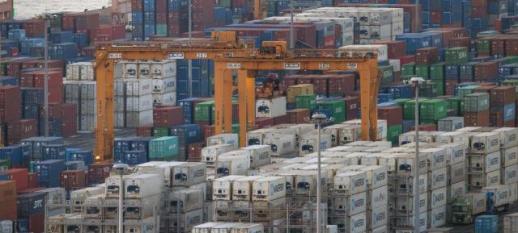 Korea's import prices fall steepest in 3 years, chip exports still firm SEOUL, July 15 (AJP) - South Korea's import prices posted their steepest monthly decline since late 2022 in June as lower oil prices reduced import costs, while semiconductor exports remained resilient, Bank of Korea data showed Wednesday. The won-denominated import price index fell 4.4 percent from May, reversing a 0.2 percent increase a month earlier, according to preliminary export-import price data released by the central bank. It was the sharpest monthly decline since December 2022, when import prices fell 6.5 percent. The reversal followed a volatile second quarter. Import prices surged 18.0 percent in March after the U.S.-Iran conflict pushed crude prices sharply higher, before falling 2.1 percent in April and edging up 0.2 percent in May. The Bank of Korea said the June decline reflected lower prices for mining products, coal and petroleum products as international crude prices retreated. Dubai crude, the benchmark used in Korea's import price calculations, averaged $79.45 a barrel in June, down sharply from $103.15 in May. The monthly decline would have been even steeper without the weaker won. Import prices measured in contract currencies fell 6.4 percent from May, compared with a 4.4 percent decline in won terms, as the average won-dollar exchange rate weakened to 1,527.30 in June from 1,490.11 a month earlier. Compared with a year earlier, import prices were still up 20.6 percent, although the pace slowed from 25.4 percent in May. Raw material prices fell 10.3 percent from May, led by an 11.3 percent decline in mining products. Intermediate goods prices dropped 3.2 percent as coal and petroleum products and chemical products became cheaper. Capital goods and consumer goods each rose 1.6 percent, reflecting the weaker won and firmer non-energy import prices. Energy-related prices nevertheless remained well above year-earlier levels. Import prices for mining products rose 25.2 percent from a year earlier, while coal and petroleum products increased 38.9 percent. Export prices, meanwhile, were unchanged from May as higher semiconductor prices offset weaker petroleum products. The flat monthly reading was the weakest since June 2025, when export prices fell 1.2 percent. On an annual basis, however, export prices surged 48.9 percent, the fastest increase since March 1998. Contract-currency export prices fell 2.2 percent from May, indicating that the weaker won helped prevent the headline export price index from declining. The contrast between energy and technology became more pronounced during the month. Export prices for coal and petroleum products fell 13.9 percent from May, led by declines in diesel and jet fuel. By contrast, prices for computer, electronic and optical products rose 4.5 percent from the previous month and jumped 117.4 percent from a year earlier. Memory chips continued to drive the gains. DRAM export prices rose 3.1 percent from May and soared 277.9 percent from a year earlier, while flash memory prices gained 11.7 percent during the month and climbed 268.1 percent on the year. The strength extended beyond prices into export volumes. Export volumes increased 29.8 percent from a year earlier in June, marking the eighth consecutive month of growth and the fastest expansion since January 2010. The Bank of Korea attributed much of the increase to continued global investment in artificial intelligence infrastructure, which boosted shipments of computer, electronic and optical products. Export volume growth in the sector accelerated to 40.0 percent from 25.9 percent in May. Outside the semiconductor sector, export performance remained mixed. Chemical product export volumes slipped 0.7 percent from a year earlier, while transport equipment and electrical equipment posted single-digit growth. Primary metals and machinery performed better, with export volumes rising 20.5 percent and 11.5 percent, respectively. Export value climbed 74.8 percent from a year earlier, accelerating from a 57.0 percent increase in May. Import volumes rose 12.0 percent, supported by computer, electronic and optical products as well as machinery and equipment, while import value increased 30.5 percent. Korea's net barter terms of trade improved for a 36th consecutive month, rising 15.6 percent from a year earlier in June, although the pace slowed from 18.6 percent in May as import prices continued to reflect earlier spikes in oil costs. The income terms of trade index climbed 50.0 percent on stronger export volumes. Looking ahead, easing oil prices could provide further relief after the June 18 U.S.-Iran framework agreement helped calm energy markets. However, uncertainty surrounding shipping through the Strait of Hormuz and continued volatility in global crude prices remain key risks. Lower oil prices are easing pressure on import costs, but the weaker won is limiting the benefit. At the same time, Korea's external sector remains increasingly dependent on semiconductors, with AI-driven demand continuing to offset softer momentum across much of the rest of manufacturing. 2026-07-15 08:42:18
-
SM Vexel Establishes Battery Pack Solutions Team to Target Drone and Robot Markets SM Vexel, a subsidiary of SM Group focused on manufacturing and services, is taking significant steps to become a "mobility power solution company" by advancing next-generation battery packs and battery management systems (BMS) for drones and robots.On July 15, SM Vexel's battery division announced the establishment of a new Battery Pack Solutions Team within its technology research institute, launching a long-term project aimed at penetrating the advanced battery market. The company plans to enhance research and development (R&D) investments in high-performance battery packs, from industrial drones to humanoid robots, to respond to changes in the global market.The newly formed team will include experts overseeing product design, manufacturing, evaluation, analysis, and domestic and international sales. Personnel responsible for BMS circuits, firmware, and mechanical design will also join the team in phases.Future R&D efforts will be tailored to the specific characteristics of various industries and products. Mobility batteries will require precise design from the outset to achieve high energy density, thermal runaway prevention, lightweight construction, rapid charging, long lifespan, and real-time status diagnostics.For instance, drones will utilize high-density, lightweight battery packs to enhance flight time and stability, while humanoid products will require high-output battery packs capable of ultra-fast charging for multi-joint actuation.The key to each product's performance lies in the "smart BMS." SM Vexel's battery division is preparing to integrate thermal management and high-stability design into a BMS that analyzes voltage, temperature, charging, and lifespan in real-time to control output and detect anomalies early. This aims to maximize battery lifespan and stability while introducing battery packs optimized for various usage environments.Additionally, SM Vexel's battery division is concurrently working on high-density lithium-ion battery research projects and developing battery packs for industrial and defense drones. The company plans to solidify product mass production and supply through strategic partnerships in areas such as robotic vacuum cleaners, serving robots, and humanoid applications.Choi Se-hwan, head of SM Vexel's battery division, stated, "We plan to grow the newly established Battery Pack Solutions Team into a pivotal organization leading future mobility power systems based on our accumulated expertise in the battery field. We will quickly commercialize high-performance battery packs that meet market and customer needs."Meanwhile, the demand for battery packs is rising as the drone and humanoid robot markets experience rapid growth. In particular, industrial and defense drones prioritize long flight times and stability, while humanoid robots emphasize high output, ultra-fast charging, and lightweight design as key competitive advantages.* This article has been translated by AI. 2026-07-15 08:40:00
-
KB Securities Maintains Buy Rating on SK Hynix Amid Ongoing Memory Supply Shortage KB Securities maintained a target price of 4.2 million won and a 'buy' rating on SK Hynix on July 15, forecasting that the memory supply shortage will persist at least until 2028 due to faster-than-expected investments in AI data centers.Kim Dong-won, a researcher at KB Securities, stated, "In 2027, investment will focus on HBM, effectively limiting the expansion of new production capacity for general memory. Once long-term supply agreements (LTAs) between big tech companies and memory manufacturers are fully established, the memory supply felt by general customers will approach 'zero.'"Regarding recent concerns over Meta's reduced AI investments, he assessed them as merely temporary noise. Meta plans to build a 7GW AI data center this year and add another 7GW next year, aiming for a total of 14GW in AI computing infrastructure. The investment in the Hyperion data center is also expected to increase from an initial $10 billion to over $50 billion in the future.Additionally, the U.S. Federal Energy Regulatory Commission's (FERC) streamlining of power grid connection procedures is expected to significantly shorten the construction period for AI data centers, accelerating big tech's AI investment pace.Kim noted, "Recently, SK Hynix's stock price fell 36% from its previous peak over concerns about a slowdown in AI investment. However, the long-term growth trajectory of the AI industry and the memory supply environment remain unchanged. The recent stock price adjustment is due to a decline in investor sentiment, and excessive concerns may actually present a buying opportunity."* This article has been translated by AI. 2026-07-15 08:40:00
-
Trump Warns Iran of Attacks on Infrastructure if Negotiations Fail President Donald Trump has warned that if Iran does not engage in negotiations by next week, the U.S. will target its power plants and bridges.In an interview with Fox News on July 14, Trump stated, "Iran's situation will get really bad by next week," adding, "If they do not come to the negotiating table, we will destroy their power plants and bridges," according to reports from Reuters and AFP.Trump mentioned that U.S. and Iranian delegations had contact on the same day, but he did not disclose specific details about the discussions or any progress in negotiations.Previously, Trump had repeatedly warned of potential attacks on Iran's power and transportation infrastructure, but no such actions have been taken so far.U.S. airstrikes against Iran have been ongoing for four days. Trump indicated that the strikes would continue "until I say enough."* This article has been translated by AI. 2026-07-15 08:40:00