


Latest by
-
 U.S. Inflation Falls Short of Expectations, Dollar Weakens Against Won The won-dollar exchange rate is trading in the upper 1480s.As of 10:37 a.m. in the Seoul foreign exchange market, the exchange rate is 1,489.9 won per U.S. dollar. This marks a decrease of 12.9 won from the previous day's closing price of 1,490.5 won, recorded at 6 a.m.The decline in the exchange rate appears to be linked to U.S. inflation indicators falling below expectations.In June, the U.S. consumer price index (CPI) rose 3.5% compared to the same month last year. This increase is slower than May's rate of 4.2% and below the Dow Jones estimate of 3.8%. Month-over-month, it decreased by 0.4%.On Wall Street, stocks rose overnight as inflation concerns eased. The Dow Jones Industrial Average closed up 9.63 points (0.02%) at 52,508.27.The S&P 500 index increased by 28.25 points (0.38%) to finish at 7,543.59, while the Nasdaq Composite rose by 233.83 points (0.90%) to close at 26,107.01.The dollar index, which measures the value of the dollar against six major currencies, fell 0.34% to 100.93.International oil prices rose amid ongoing tensions between the U.S. and Iran over control of the Strait of Hormuz. September futures for Brent crude increased by 1.72% to $84.73 per barrel.August futures for West Texas Intermediate (WTI) crude closed up 1.54% at $79.34 per barrel.Analysts expect the exchange rate to decline due to the influx of real demand for the won. Min Kyung-won, an economist at Woori Bank, stated, "The weaker dollar triggered by U.S. inflation data falling short of expectations, along with a recovery in risk appetite for tech stocks and the influx of export company negotiations, is expected to lead to a decline. We anticipate that significant negotiation volumes, likely from semiconductor companies following heavy industry, will drive the rate below 1,500 won."* This article has been translated by AI. 2026-07-15 10:52:00
-
Sejong Law Firm Concludes Seminar on Evolving Tax Environment and Corporate Strategies Sejong Law Firm announced on July 15 that it successfully concluded a seminar titled 'Evolving Tax Environment and Corporate Strategies' on the 24th floor of the Sejong Grand Seoul on July 14.The seminar was attended by over 80 corporate representatives and featured in-depth discussions on the latest trends and key issues in tax audits, tax disputes, international taxation, and customs.In the first session, attorney Kim Min, who has served as the head of the Investigation Bureau and Litigation Bureau at the Seoul Regional Tax Office, and certified public accountant Yoon Geun-hee, who has worked at the Tax Tribunal, presented on 'Trends in Tax Audits and Tax Disputes.'Kim emphasized, 'As the National Tax Service focuses its investigative capabilities on sophisticated offshore tax evasion and asset concealment, proactive risk management regarding residency determinations and transactions with overseas local corporations is crucial.' Yoon added, 'The tax dispute environment is rapidly changing, as seen in the announcement of reform measures for the Tax Tribunal. It is essential to meticulously review procedural defects at each stage of the disposition and establish appropriate appeal strategies.'The second session featured attorney Yoon Jun-seok, who has handled numerous tax cases at the Seoul Administrative Court and holds a Ph.D. in tax law from Seoul National University, and attorney Baek Hye-young, who has served as a foreign exchange inspector at the Seoul Customs and as deputy director of the WCO RILO AP. They discussed 'The Landscape of International Taxation and Trump Tariffs.'Yoon stated, 'With the global minimum tax already becoming a reality, it is necessary to conduct proactive checks on jurisdictions with effective tax rates below 15%.' Baek noted, 'While comprehensive tariffs based on the IEEPA have faced some setbacks, item-specific tariffs and investigation-based tariffs are trending towards long-term implementation. Risk management in anticipation of changes in customs administration, such as strengthened monitoring of circumvention of origin exports, is necessary.'The subsequent panel discussion was moderated by Lee Chang-hee, an honorary professor at Seoul National University's Law School and a renowned expert in tax law. The panel included Professor No Mi-ri from Dong-A University Law School, former Seoul Regional Tax Office Commissioner Lim Seong-bin, former Ministry of Economy and Finance Tax Policy Director Kim Byeong-kyu, and senior foreign attorney Oh Hyuk, who has provided various cross-border tax advisory services at Deloitte and Sejong Law Firm.Professor No emphasized, 'Since a tax investigation delineates the boundary between the subject of investigation and the accused, it is crucial to ensure the protection of rights equivalent to criminal procedures when a general tax audit transitions into a tax investigation.' Lim advised, 'As cases transitioning to tax investigations are increasing, it is important to receive assistance from experienced professional representatives at the Tax Investigation Review Committee stage to fully exercise defense rights.'Kim noted, 'At the tax tribunal stage, procedural justice is as important as substantive justice, and with the enforcement of customs administration expected to strengthen, companies need to proactively review their export and import compliance systems.' Oh highlighted, 'While the first global minimum tax report in Korea was completed in June, the key is not just the domestic report but also global data management at the group level, and companies should prepare proactively for the upcoming National Tax Service report checks scheduled for August.'In concluding the discussion, moderator Lee Chang-hee remarked, 'The tax environment faced by companies is undergoing comprehensive changes, including tax audits, tax disputes, international taxation, and customs. It is crucial to secure procedural legitimacy at each stage and proactively manage risks, necessitating integrated support from experts across legislation, administration, and judiciary.'Baek Je-heum, the representative attorney, stated, 'The tax environment that companies face today is truly one of upheaval. Proactive management of tax risks and strategic responses are core tasks that directly impact corporate competitiveness and sustainable growth, beyond mere cost reduction.' He added, 'Sejong will continue to be a reliable partner providing optimal solutions for companies to effectively address tax issues based on our accumulated experience and expertise.'Meanwhile, the Sejong Tax Group offers one-stop legal services covering domestic and international taxation, supported by experts across legislation, administration, and judiciary.This year, the firm has further strengthened its expertise by recruiting former chief judge Yoon Jun-seok, attorney Lee Ji-sung, senior foreign attorney Oh Hyuk, and certified public accountant Yoon Geun-hee, and was recognized as 'Band 1' in the tax sector in the Chambers Asia-Pacific Guide 2026 published by the global law firm rating agency Chambers and Partners.Founded in 1983, Sejong Law Firm is one of South Korea's leading large law firms, providing optimized legal services to corporate and individual clients across various fields, including M&A, finance, litigation, tax, intellectual property, and labor, with approximately 700 experts.* This article has been translated by AI. 2026-07-15 10:52:00
-
Special Prosecutor Reinvestigates Allegations Against Cho Sung-hyun The Special Prosecutor's Office, led by Kwon Chang-young, has summoned Cho Sung-hyun, the former head of the Army's 1st Guard Brigade, for further questioning.On the morning of July 15, starting at 10 a.m., the special prosecutor's office in Gwacheon, Gyeonggi Province, is conducting an investigation into Cho, who is a suspect in insurrection-related duties. This marks Cho's second appearance before the special prosecutor, following his initial appearance on July 10.Arriving at 9:40 a.m., Cho denied allegations that he did not issue orders to avoid crossing Seogang Bridge during the state of emergency, stating, "It is correct that I instructed not to cross Seogang Bridge." He added, "I will provide detailed explanations once I enter."Cho is accused of being involved in insurrection by relaying orders from former Commander Lee Jin-woo to the 2nd Special Operations Battalion and the 35th Special Operations Battalion on December 3, 2024, regarding their deployment to the National Assembly.The special prosecutor's office is focusing on Cho's reported instruction to troops waiting at Seogang Bridge to leave their firearms and rubber bullets in their vehicles and to take riot shields instead, with the mission to remove individuals from inside the National Assembly, following Lee's directive to pull out lawmakers.The special prosecutor believes that relaying Lee's order to subordinate units constitutes participation in insurrection.Deputy Special Prosecutor Kim Ji-mi stated during a regular briefing on July 14, "We have secured significant evidence, including details of the orders given by Cho and notes taken at the time."She explained that Cho generally responded to questions unfavorable to him by claiming he did not remember or that he learned about his subordinates' movements afterward.Previously, the insurrection special prosecutor's team, led by Jo Eun-seok, had decided not to charge Cho, believing he had initially responded passively to Lee's orders and ultimately rejected them as unconstitutional and illegal.* This article has been translated by AI. 2026-07-15 10:52:00
-
Surge in Stock Loans Amid Market Boom Prompts Regulatory Action As stock loans in the online investment-linked finance sector surge due to a booming stock market, financial authorities are stepping up risk management measures. The aim is to limit the scale of new stock loans and set individual borrower limits to prevent a decline in financial soundness due to concentration in specific products.On July 15, financial authorities announced that they will implement administrative guidance starting July 16 as part of their 'Risk Management Measures for Stock Loans in the Online Investment-Linked Finance Sector.' Stock loans allow investors to borrow additional funds using their owned stocks as collateral for further stock investments.According to the new measures, online investment-linked finance companies must manage the amount of new stock loans issued each month to within 30% of the previous month's new linked loan amount (excluding stock loans). However, if the stock loan balance at the end of each month after July remains below the level recorded at the end of June, this limit will not apply.Additionally, the balance of stock loans for each borrower will be capped at 1 billion won to prevent excessive concentration on specific borrowers or stock loan products.The move by financial authorities comes in response to a sharp increase in stock loans within the online investment-linked finance sector. As of the end of June this year, the balance of stock loans in this sector reached 898.3 billion won, a 71.5% increase (374.5 billion won) from the end of last year, which was 523.7 billion won.Through this administrative guidance, financial authorities aim to prevent excessive expansion of stock loans in the online investment-linked finance sector and maintain financial soundness.The authorities stated, 'We plan to closely monitor the implementation status of the risk management measures for stock loans by each online investment-linked finance company and, if necessary, guide the strengthening of risk management through meetings with management.'* This article has been translated by AI. 2026-07-15 10:48:00
-
Minimum Wage Set at 10,700 Won Amid Ongoing Labor Disputes The minimum wage for next year has been set at 10,700 won per hour, a 3.7% increase from this year. Labor representatives argue that considering rising prices and the cost of living, this effectively amounts to a freeze, while business groups contend it will impose further burdens on small business owners and self-employed individuals already at their limits. Ultimately, no agreement was reached between labor and management, and after a vote, the employer's proposal was adopted.More attention should be paid to the structural limitations of the minimum wage system, which repeats itself annually. This year, labor and management started from vastly different positions, with labor demanding 12,000 won and management advocating for a freeze. Although the gap narrowed through several revisions, they failed to reach an agreement by the end. The Minimum Wage Commission ultimately resorted to the familiar conclusion of a vote.The minimum wage is a crucial policy variable that affects workers' livelihoods, business costs, and the overall economy. Yet, the current decision-making process remains largely trapped in a cycle of labor-management struggles and political conflicts. After decisions are made, labor often expresses dissatisfaction, while management claims the wage is excessive, creating a pattern where no one is satisfied. This unsatisfactory decision-making structure has persisted for decades.The difficulty of this decision is compounded by the challenging economic realities faced by both sides. Workers are feeling the impact of rising prices, which diminish their real purchasing power. There is a valid argument that the minimum wage should ensure a basic standard of living. Conversely, small business owners and self-employed individuals are grappling with economic downturns, weak consumer demand, and rising rents and raw material costs. Concerns that increased labor costs could lead to business closures and job cuts cannot be dismissed lightly.Particularly in sectors like hospitality and food service, some businesses struggle to bear the same wage burdens as large corporations or high-profit industries. While the intent of the minimum wage is to provide basic protection for similar work, the growing disparities in profit structures and productivity across industries cannot be ignored. Discussions about applying different minimum wages by sector took place this year, but no conclusions were reached. However, it is now imperative to address the need for systemic improvements.In fact, public members of the Minimum Wage Commission recommended establishing a task force to explore issues such as the application of the minimum wage to subcontracted workers and the possibility of differentiated rates by industry during this deliberation process. This should not be seen as a mere supplementary measure but as an essential task for the sustainability of the minimum wage system.A higher minimum wage is not inherently better, nor is a lower one necessarily preferable. A balance must be struck among various factors, including workers' living stability, businesses' ability to pay, productivity growth, and job retention. This is why decisions cannot be made based solely on one side's logic.It is time to move beyond the unproductive debate focused solely on percentage increases. We need to establish institutional mechanisms that can more accurately reflect industry characteristics, productivity, regional economic conditions, and business sizes. The structure for determining the minimum wage must evolve from a labor-management confrontation to a system based on objective economic indicators and data.The minimum wage of 10,700 won has already been decided. The important thing is to avoid repeating the same conflicts at this time next year. Reforms are needed now to reduce the social costs of conflicts surrounding the minimum wage while achieving the dual goals of protecting workers and maintaining jobs. Creating sustainable standards is more important than merely fighting over numbers. 2026-07-15 10:48:00
-
President Lee: Remaining 3 Years and 11 Months Are Crucial for Long-Term Policies President Lee Jae-myung stated on July 15 that the remaining 3 years and 11 months of his term are crucial for implementing long-term policies, following the second departmental report since his administration began. He acknowledged the achievements made in the past year, saying, "You have delivered many results and done well so far. Now, the remaining period is more important." During the morning meeting at the Blue House, which included reports from the Ministry of Finance and Economy (National Tax Service, Customs Service, Public Procurement Service), National Data Agency, Financial Services Commission, and Budget Planning Office, President Lee emphasized the need for both reform and innovation. He expressed confidence that progress is being made in these areas.He urged the need to align with national planning goals and prepare effectively for long-term policy execution while addressing existing issues within the government.The departmental reports, themed "An Irreplaceable South Korea Felt in Life," will take place over nine sessions starting today. To enhance public engagement, a Public Participation Group of over 200 citizens has been selected to participate in the reports.According to the Blue House, from July 1 to July 6, 1,259 individuals applied to join the Public Participation Group through the President's social media platforms, resulting in a competition ratio of approximately 6.3 to 1 after excluding duplicate applications. About 20 participants will be selected for each report session. Today's group includes four individuals in their 20s, one in their 30s, six in their 40s, ten in their 50s, and one in their 60s.In terms of applications, the Ministry of Education had the highest number of applicants at 209, accounting for 16.1% of the total. This was followed by the Ministry of Land, Infrastructure and Transport with 108 applicants and the Ministry of Health and Welfare with 107. The largest age group was individuals in their 40s, totaling 340, followed by those in their 30s (307), 50s (291), 60s (175), 20s (159), and 70s (23). The applicants came from diverse professions, including office workers, self-employed individuals, freelancers, students, and homemakers.A Blue House official explained, "In line with the philosophy of a government of the people, the Public Participation Group will receive direct reports from the President and departments and will have the opportunity to ask questions or make suggestions from the perspective of the public."* This article has been translated by AI. 2026-07-15 10:40:00
-
Woori Financial Foundation Supports Breakfast for Elementary Students with Local Businesses 우리금융그룹 우리금융미래재단이 인천광역시교육청, 월드비전과 '우리아이 든든아침' 업무협약을 체결했다고 15일 밝혔다. 이번 협약은 성장기 어린이들에게 균형 잡힌 식사를 제공하기 위해 마련됐다. 이번 지원은 인천지역 아침돌봄 운영 초등학교 10개교의 결식 우려 아동 약 200명에게 오는 2학기부터 이뤄질 예정이다. 학교 인근 소상공인이 조리한 식사는 학교로 배송되며 학생들은 등교 후 교내에서 아침 식사를 하게 된다. 특히 이번 활동에는 지역 소상공인이 아침식사 조리에 참여하며 지역경제 활성화를 함께 추진한다. 우리금융미래재단은 사업 기획과 재원 지원을 통해 안정적인 사업 운영 기반을 마련할 계획이다. 인천광역시교육청은 참여 학교 모집과 행정지원 및 모니터링을 담당한다. 월드비전은 지역 소상공인 발굴과 학교 연계하여 위생관리 등 사업 운영을 맡는다. 우리금융미래재단은 교육기관·비영리단체와 협력을 통해 아동 식사 지원을 이어갈 계획이다. 장광익 우리금융미래재단 사무국장은 "아이들이 든든한 아침 식사로 하루를 시작할 수 있도록 지원하는 것은 건강한 성장과 안정적인 학교생활을 돕는 중요한 일"이라며 "인천광역시교육청, 월드비전과 긴밀히 협력해 안전한 아침 식사를 제공하고 지역 소상공인과의 상생에도 기여하겠다"고 말했다.* This article has been translated by AI. 2026-07-15 10:40:00
-
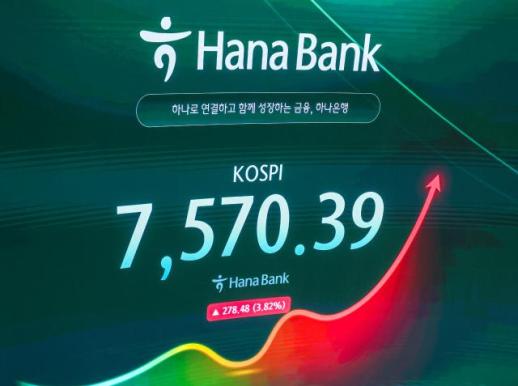 Seoul stocks soar as cooling U.S. inflation, chip optimism fuel broad rally SEOUL, July 15 (AJP) — South Korean stocks staged a powerful rebound Wednesday as softer-than-expected U.S. inflation and renewed optimism over the artificial intelligence semiconductor cycle triggered a broad-based buying spree led by SK hynix and Samsung Electronics. As of 9:57 a.m., the benchmark KOSPI surged 6.81 percent to 7,323.60, while the tech-heavy KOSDAQ jumped 5.39 percent to 826.24, recovering sharply after recent market volatility. The rally tracked overnight gains on Wall Street after U.S. inflation eased more than expected, tempering fears of further Federal Reserve rate hikes and reviving appetite for technology stocks. The Nasdaq Composite rose 0.90 percent and the S&P 500 gained 0.38 percent after the U.S. Consumer Price Index increased 3.5 percent in June from a year earlier, slowing from May's 4.2 percent and coming in below economists' expectations of 3.8 percent. Lower Treasury yields boosted risk appetite, particularly for semiconductor shares that continue to benefit from strong artificial intelligence investment. Leading the advance was SK hynix, whose U.S.-listed ADRs soared 27.29 percent overnight. Sentiment received an additional boost after Barclays initiated coverage with an Overweight rating and a $330 price target, arguing investors continue to underestimate the company's earnings potential as high-bandwidth memory prices strengthen and its leadership in AI memory widens. The upbeat outlook lifted semiconductor stocks globally. Nvidia climbed 4.06 percent, Micron Technology gained 4.92 percent, Sandisk advanced 5.01 percent and the Philadelphia Semiconductor Index rose 2.54 percent. The momentum quickly spilled into Seoul. SK hynix jumped 11.19 percent to 2,127,000 won, while Samsung Electronics gained 6.18 percent to 279,250 won. The rally extended throughout the broader SK and Samsung groups. SK Square, SK hynix's largest shareholder, surged 16.72 percent to 1,389,000 won. Samsung Electro-Mechanics climbed 9.37 percent, Samsung Electronics preferred shares rose 6.75 percent, Samsung Life Insurance gained 7.89 percent, Samsung C&T added 4.94 percent and Samsung Biologics advanced 2.92 percent. Cyclical sectors also joined the rally. Hyundai Motor rose 2.47 percent and Kia added 3.22 percent, while LG Energy Solution gained 4.50 percent. HD Hyundai Heavy Industries advanced 2.84 percent and Doosan Enerbility climbed 4.37 percent. Financial stocks posted comparatively modest gains, with KB Financial Group rising 1.00 percent and Shinhan Financial Group adding 2.21 percent. Investor sentiment also improved after U.S. President Donald Trump withdrew a proposal to impose transit fees on commercial vessels passing through the Strait of Hormuz, easing concerns over another escalation in Middle East shipping risks and raising hopes for renewed diplomatic negotiations. Attention is now turning to earnings from Dutch chip equipment maker ASML later Wednesday and Taiwan Semiconductor Manufacturing Co. on Thursday, with investors looking for fresh signals on the sustainability of AI-driven semiconductor demand. Elsewhere in Asia, Japan's Nikkei 225 gained 0.45 percent while Shanghai's Composite Index rose 1.4 percent. The Korean won strengthened sharply to 1,488.6 per U.S. dollar 2026-07-15 10:39:43
-
 South Korean action-packed thriller stays atop Netflix's global non-English TV chart SEOUL, July 15 (AJP) - SBS' latest drama series, "Agent Kim Reactivated," which is also available on Netflix, remained the global streaming giant's most-watched non-English TV show for the second consecutive week. According to the latest chart released by Netflix's rankings website Tudum on Wednesday, the action-packed revenge thriller garnered 9.1 million views for the week ending Sunday, staying at the top of the chart after its first episode aired late last month. "Agent Kim Reactivated," whose first episode aired on June 26, also ranked as the No. 1 show in some 22 countries this week and made the top 10 in 72 countries around the world. The 10-episode series stars So Ji-sub as a seemingly ordinary father who is forced to return to his life as a secret agent after his daughter goes missing, with two special episodes added after it became an instant hit shortly after its release. Another hit South Korean drama, "Teach You a Lesson," remained at No. 2 with 3.6 million views after relinquishing the top spot, which it had held for several weeks. The school-themed drama was followed by the South African telenovela "The Polygamist," the Polish hostage thriller "Human Vapor," and the Mexican mystery thriller "I'm Not Afraid." 2026-07-15 10:39:19
-
Economic Sector Warns 3.7% Minimum Wage Increase in 2027 Could Hurt Youth Jobs and Small Businesses The economic sector has expressed concerns over the final decision to set the minimum wage for 2027 at 10,700 won per hour.On July 15, the Korea Economic Association stated, "Given the dual challenges of sluggish sales and rising costs faced by small businesses and self-employed individuals due to high exchange rates and inflation, we are disappointed by the decision to set next year's minimum wage at 10,700 won." They added, "It is particularly unfortunate that the differentiated application of minimum wage for sectors like hospitality and food service, which have reached their payment capacity limits, was not realized."The Minimum Wage Commission held its 14th plenary meeting the previous day and decided to raise the minimum wage by 3.7% (380 won) from this year, surpassing last year's increase rate of 2.9%.The Korea Economic Association warned, "This decision is expected to exacerbate the difficulties faced by small businesses and self-employed individuals, and it will negatively impact job opportunities for vulnerable groups such as youth and low-income workers who are directly affected by the minimum wage."They further expressed hope for a more rational minimum wage determination process in the future, advocating for the institutionalization of differentiated applications by industry and prioritizing employers' payment capacity and productivity in the decision-making process.The Korea Employers Federation also pointed out immediately after the minimum wage decision that, considering the challenging management realities and payment capacity limits of small and medium-sized enterprises and small businesses, the wage should have been frozen.They added, "Despite the accumulated minimum wage increases leading to over 30% of certain sectors paying below the minimum wage, we express deep regret that a single minimum wage will be applied across all sectors again next year, given the significantly low acceptance in the field."* This article has been translated by AI. 2026-07-15 10:36:00