


Latest by
-
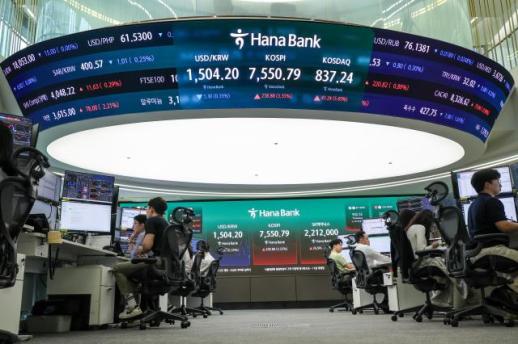 Tycoons' stock wealth falls 6 trln won without Samsung, SK chiefs SEOUL, July 14 (AJP) - The combined stock wealth of South Korea’s major business group chiefs jumped by more than 29 trillion won ($19.6 billion) in the second quarter, but the headline increase masked losses across most of the group as gains were overwhelmingly concentrated in Samsung Electronics Chairman Lee Jae-yong and SK Group Chairman Chey Tae-won. Excluding Lee and Chey, the value of shares held by the remaining 44 group leaders fell by 5.97 trillion won, or 8.6 percent, between the end of March and the end of June, according to corporate tracker Korea CXO Institute. Twenty-eight of the 46 business leaders surveyed, or 60.9 percent, saw their stock wealth decline during the quarter. Including Lee and Chey, the group’s combined stock holdings rose 28 percent to 133.62 trillion won at the end of June from 104.43 trillion won three months earlier. The two chairmen recorded a combined increase of 35.16 trillion won, more than offsetting the losses posted by the other group chiefs. Lee accounted for most of the overall gain, with the value of his stock holdings surging by 28.25 trillion won to 59.19 trillion won from 30.94 trillion won. His stock wealth alone represented more than 44 percent of the combined holdings of all 46 business leaders at the end of June. The value of Lee’s Samsung Electronics shares nearly doubled to 32.54 trillion won from 16.29 trillion won, while his Samsung C&T holdings rose to 16.72 trillion won from 9.05 trillion won. His total stock wealth crossed 60 trillion won for the first time in early June and reached 64.33 trillion won on June 25 before retreating by the end of the month. Chey posted the fastest growth rate, with his holdings soaring 176.9 percent to 10.83 trillion won from 3.91 trillion won. Chey does not directly hold shares in chipmaker SK hynix but owns about 12.98 million common shares in SK Inc., the group’s holding company. SK Inc. shares climbed to 834,000 won at the end of June from 301,000 won at the end of March, driving the sharp increase in Chey’s stock wealth. Other group leaders posted comparatively modest gains. Hyosung Group Chairman Cho Hyun-joon saw his holdings increase by 971.3 billion won, followed by LG Group Chairman Koo Kwang-mo with a gain of 386.2 billion won and Doosan Group Chairman Park Jeong-won with 279.9 billion won. Hyundai Department Store Group Chairman Chung Ji-sun and Hyundai Motor Group Executive Chair Euisun Chung recorded increases of 260.1 billion won and 235 billion won, respectively. By contrast, Celltrion Group Chairman Seo Jung-jin suffered the largest decline in absolute terms, with the value of his holdings falling by 1.64 trillion won. HYBE Chairman Bang Si-hyuk recorded the steepest percentage drop, losing 35.8 percent of his stock wealth as the value of his holdings declined to 2.53 trillion won from 3.93 trillion won. Kakao founder Kim Beom-su’s holdings also fell by 1.19 trillion won to 3.64 trillion won. As of the end of June, 16 group leaders held shares valued at more than 1 trillion won. Lee topped the ranking with 59.19 trillion won, followed by Seo with 11.89 trillion won, Chey with 10.83 trillion won and Euisun Chung with 7.76 trillion won. The survey covered leaders of large business groups designated by the Fair Trade Commission whose stock holdings were worth at least 100 billion won as of the end of June. The valuations were based on closing prices on March 31 and June 30 and included both directly owned listed shares and indirect stakes held through majority-owned unlisted companies. Korea CXO Institute said roughly two-thirds of about 150 stocks held by the business leaders declined during the second quarter, underscoring the narrow concentration behind the increase in their combined wealth. The institute warned that volatility could intensify in the third quarter as investors take profits from stocks that have risen faster than their earnings, while interest rates, exchange rates and geopolitical developments remain key risks. 2026-07-14 16:18:42
-
 Korea's dog meat restaurants face their final summer before ban SEOUL, July 14 (AJP) - The alley of dog meat restaurants in Jongno-gu, Seoul, was quiet on Tuesday lunchtime, one day before Chobok — the first of the three hottest days in the traditional Korean lunar calendar. A few years ago, the street would have been packed with diners around this time of year. This is the last summer South Koreans can legally eat dog meat. Under the Act on the Ending of Dog Meat Consumption, the breeding, distribution, and sale of dogs for food will be fully prohibited from February 7 next year. More than 80 percent of dog farms have already closed, causing wholesale prices to spike and pushing the price of a single bowl up by roughly double in just six months, according to restaurant owners. Some establishments are converting to black goat restaurants or other alternatives, but many remaining traders say the impending ban poses a serious threat to their livelihoods. The summer dish, once sought out by some as a seasonal health tonic, is on course to disappear from Korean tables for good. 2026-07-14 16:17:30
-
 2025 Education Budget Report: Local Leaders Choose 'Anchor' While Education Ministry Defines 'Glocal' As student enrollment continues to decline, the education budget is paradoxically increasing, raising concerns. In this context, where is South Korea's education finance headed? The National Assembly Budget Office's report on the '2025 Fiscal Year Settlement Analysis by Committee (Education and Culture, Sports and Tourism)' reveals the contradictions in the current education finance structure. The structural limitations of local education finance grants, which expand in line with domestic tax revenue despite a decrease in the school-age population, and the disarray in the budget for free high school education, along with the misalignment in higher education innovation financing represented by the Anchor (formerly RISE) and Glocal universities, create a complex web of issues. Aju Business Daily aims to diagnose the crisis in early childhood, primary, secondary, and higher education finance through a three-part series and seek reasonable alternatives for sustainable future education. <Editor’s Note>Regional universities' key funding has undergone a significant change in just one year, with the 'Regional Innovation Center University Support System (RISE)' being completely transformed into the 'Regional Growth Talent Development System (ANCHOR)' starting in 2026. This shift aims to resolve the misalignment in higher education finance caused by conflicts between central and local authorities.2025 Higher Education Budget Structure 'Deformed'Beginning in 2025, the RISE program will be fully implemented across 17 cities and provinces, linking local development strategies with the delegation of financial authority for university support to local governments. The Ministry of Education plans to execute 99.6% of the 1.941 trillion won budget, amounting to 1.933 trillion won, through grants to local governments. Each city and province will have a joint committee led by the local governor and the president of regional universities to select supported universities through a bottom-up model. A total of 327 universities will receive support under this system.In contrast, the Glocal university program is a top-down initiative where the Minister of Education directly designates universities that aim to innovate by breaking down barriers both inside and outside the institution, providing up to 100 billion won in support over five years. Designations began in 2023, with a total of 27 universities selected by 2025. The fundamental differences in purpose and authority between the two programs are evident.The issue arose when the Ministry of Education abolished the Regional Innovation System (RIS) project and forced the Glocal university budget into the RISE program starting in the 2025 fiscal year. A new provision was added to the RISE program's grant conditions stating, 'The amount received by the designated Glocal university must be fully granted.' This effectively turned a significant portion of the 1.6396 trillion won in local government grants into a channel for transferring funds to specific universities designated by the central government.Budget Office Calls It 'Structurally Inappropriate'... Education Ministry's Conflicting Explanations and Policy Reversal After One YearThe National Assembly Budget Office criticized this structure, stating, 'While the RISE program's beneficiaries are selected by local governors, the Glocal universities are designated by the Ministry of Education, making the inclusion of the Glocal university program within RISE structurally inappropriate.' The analysis suggests that centralizing decision-making authority while routing budget distribution through local governments undermines the original intent of 'local-led university innovation' in the RISE program.In response to the Budget Office's review process, the Ministry of Education explained, 'Glocal universities refer to an innovation model rather than specific institutions, and they are obligated to generate results as models leading regional and university innovation within the RISE framework.' The Ministry also claimed that local governments included Glocal university content in the RISE basic plan, asserting that there is no systematic contradiction.However, the Ministry's explanation was overturned just one year later. In the 2026 budget proposal, funding for Glocal universities among national universities was once again separated into the 'National University Development Project.' This marks a return to the previous method of direct funding from the Korea Research Foundation (NRF), bypassing local governments, as was done in the 2023 and 2024 fiscal years.The Ministry of Education acknowledged some of the Budget Office's criticisms. In its response to the settlement analysis, the Ministry stated, 'The Glocal university program is a centrally led initiative where the Ministry directly designates and manages performance, so the local government grant method is not suitable, and we are in discussions to change it to a direct funding model,' effectively accepting the Budget Office's critique.Launch of the 'Anchor' System in 2026... Legal Framework to Untangle the Complex Web of Local AuthorityTo rectify the confusion in financial execution, the government has renamed the existing 'RISE' to 'ANCHOR' and established a legal foundation. The amendments to the 'Higher Education Act Enforcement Decree' and the 'Local University Development Act Enforcement Decree' passed in the Cabinet meeting on July 14 are central to this change.The new Anchor system focuses on overcoming the inherent limitations of the previous RISE program. First, the authority to establish local university support plans has been completely shifted from the Minister of Education to local governors. The establishment of a 'Regional Innovation University Support Committee' in each province and the legal procedures for forming a 'Super-Regional Collaboration Support Committee' for projects crossing provincial boundaries have also been enacted.Notably, the revised enforcement decree clearly defines a feedback system to prevent the 'blanket budget allocation' controversy that arose under the 2025 RISE framework. The amended decree establishes a cyclical structure leading to 'evaluation-results disclosure-budget differential allocation' for Anchor projects pursued by universities and local governments.The central government’s share of Glocal university funding (for national universities) has been separated to enhance efficiency, while the Anchor budget allocated to local governments will be strictly distributed under the evaluation and responsibility of local governors.After the Cabinet meeting, Minister of Education Lee Kyo-jin stated, 'With this amendment to the enforcement decree, we will begin to operate a collaborative system where universities, local governments, and the central government jointly design the future of the region.'Education finance officials pointed out that behind this legal restructuring lies the reality of a hasty financial design that has partially reverted to the past in just one year. The Budget Office criticized, 'Ultimately, since the project was launched in 2023, the 2025 fiscal year was the only time the entire Glocal university project budget was included within the RISE program, overlooking the structural differences between the two initiatives.'* This article has been translated by AI. 2026-07-14 16:16:00
-
Financial Supervisory Service Strengthens Investigative Capabilities with New Hires The Financial Supervisory Service (FSS) is enhancing its capabilities to combat unfair trading in capital markets by hiring experienced investigators for the first time since acquiring cognitive investigative authority. Starting in the second half of the year, personnel with investigative experience from the prosecution and police will be assigned to frontline departments, strengthening the link between investigation and prosecution.According to the FSS, the recruitment of specialized and experienced personnel for levels 4 and 5, which concludes at the end of this month, includes positions focused on investigating unfair trading and financial crimes. The recruitment will include six general investigators and positions in digital forensics. Successful candidates are expected to be assigned to departments handling investigations and prosecutions of unfair trading as early as November.The general investigation roles will involve tasks related to investigating and collecting evidence for unfair trading and financial crimes, interviewing suspects, applying for warrants, and transferring cases to the prosecution. Applicants must have at least three years of experience in public, economic, financial, or capital market-related investigations. The digital forensics positions will focus on collecting and analyzing digital evidence from computers, servers, and mobile phones, requiring a minimum of three years of relevant investigative experience.While the FSS has previously focused on hiring legal and accounting professionals, this is the first time it has recruited personnel with direct investigative experience from the prosecution or police as a separate category. This move aligns with the FSS's goal to strengthen its practical capabilities following the acquisition of cognitive investigative authority by its Special Judicial Police for Capital Markets in April.Previously, cases investigated by the FSS had to go through a process of referral to the prosecution via the Securities and Futures Commission before being assigned to the Special Judicial Police. However, with the new cognitive investigative authority, all cases handled by the FSS can now be transitioned to Special Judicial Police investigations following a decision by the investigation review committee.It is reported that many of the experienced applicants have previously dealt with capital market crimes at the Southern District Prosecutor's Office in Seoul, raising expectations for the FSS's enhanced capabilities in responding to market manipulation and insider trading cases.Notably, this recruitment of investigative personnel by the FSS has garnered significant interest from investigators as the government and ruling party are working to reduce the direct investigative functions of the prosecution and are planning to establish a new Serious Crimes Investigation Agency in October, indicating a major overhaul of the investigative system and changes in operations.An FSS official stated, "Even with cognitive investigative authority, if there are not enough personnel to conduct actual investigations, the effectiveness of the system will be limited. Deploying experienced investigators in the field will significantly enhance our capabilities to respond to unfair trading in capital markets, from investigation to enforcement."* This article has been translated by AI. 2026-07-14 16:12:00
-
Expert Calls for Easing Loan and Building Regulations to Boost Non-Apartment Housing Supply To normalize the supply of non-apartment housing, improvements in loan regulations and building standards are necessary, experts say.Kim Deok-rye, a senior researcher at the Korea Housing Industry Institute, stated at a forum on expanding housing supply for public stability that "to normalize non-apartment projects, much of the uncertainty for the future needs to be removed."Kim emphasized that non-apartment housing is closely linked to the rental market, private rental housing, and multiple homeowners, and thus related systems must be designed together. He noted, "Even the projects that are currently built or those that were prepared to be built have come to a standstill."The primary reason for project delays is identified as the loan-to-value (LTV) regulations. The government restricted housing loans for buyers and rental businesses in the metropolitan area and regulated zones through supply measures last year, making it difficult for non-apartment developers to secure funding.Kim explained, "The reason projects have stalled is that the LTV has been significantly reduced, leading to strict lending constraints. Although the government promised to create funds and guarantee products for non-apartments, they are still not available, so they need to be established promptly."He also pointed out that building standards need to be updated to reflect current realities. Currently, multi-family and row houses are subject to standards established in 1999, which limit them to four stories or fewer. This restriction makes it challenging to secure project viability and limits the supply of quality non-apartment housing.Kim stated, "The restrictions on the number of stories for multi-family and row houses are excessive," adding that there needs to be a significant change in residential area and story limits. He continued, "If that happens, citizens who feel housing insecurity regarding non-apartments will be able to live in quality, safe homes."There were also calls to extend the exemption for counting housing units for non-apartments to stimulate transactions. Non-apartments have played a crucial role in providing rental housing for low-income individuals, youth, and the elderly, but the combined effects of financial and tax regulations, along with rental fraud, have led to a simultaneous contraction in supply and transactions.Representatives from the construction industry attending the forum also urged for the easing of loan regulations to expand non-apartment supply. Kang Kyung-hoon, CEO of Jinkyung Construction, remarked, "It is a very difficult process to use banks while regulating the LTV for sales and rental businesses," and requested a relaxation of these rules.Kang also noted that the special exemption from acquisition tax, comprehensive real estate tax, and capital gains tax for non-apartments priced under 60 million won and 60 square meters will only last for one year and four months, urging for a three-year extension until 2030.Addressing the supply of non-apartments requires a comprehensive approach that goes beyond simple permit relaxations, focusing on financial support for developers, updating building standards, and recovering demand for purchases and rentals to lead to actual construction and supply.Kim Yoon-deok, Minister of Land, Infrastructure and Transport, expressed at the forum that he would reflect the opinions from the field in future real estate policies. The market is watching closely to see if the government will include easing LTV regulations for non-apartments, establishing funds and guarantee products, and extending the exemption for counting small non-apartment housing units in its supply measures.* This article has been translated by AI. 2026-07-14 16:08:00
-
Specialized Online Retailers Gain Ground Over General Marketplaces In South Korea's e-commerce market, specialized retailers are becoming more prominent than general marketplaces. While the growth of comprehensive malls has slowed, specialized platforms focusing on fashion, beauty, and household goods are rapidly expanding. As consumer interests become more segmented and inflation drives demand for value, vertical commerce is emerging as a new growth driver.According to the National Data Agency, the online shopping transaction growth rate was 8.6% in January and 5.3% in February, followed by 13.4% in March, 10.0% in April, and 10.3% in May, maintaining a double-digit growth for three consecutive months. In May, the transaction volume for comprehensive malls reached 13.38 trillion won, a 7.8% increase, while specialized malls saw a 13.3% increase to 11.63 trillion won.The annual transaction volume for specialized malls, which was 100.64 trillion won in 2023, is projected to grow to 114.15 trillion won in 2024 and 124.67 trillion won in 2025. As of May this year, the cumulative transaction volume reached 55.87 trillion won, marking a 13.7% increase compared to the same period last year.Changes are also evident in app user numbers. According to Wise App and Retail, the specialized mall app with the highest monthly average users (MAU) in April was Abley, with 9.98 million users, surpassing AliExpress (8.57 million) and Temu (8 million) for the first quarter of this year. Other notable performers include Olive Young, Daiso, and Musinsa, collectively known as 'Oldamu.' Olive Young's users increased from 7.73 million in April last year to 8.83 million this April, while Daiso Mall grew from 3.8 million to 5.13 million. Musinsa also saw an increase from 7.28 million to 7.4 million during the same period.In contrast, comprehensive malls and Chinese e-commerce apps are experiencing a slowdown. 11th Street's MAU dropped from 8.93 million in April last year to 7.7 million this year. AliExpress fell from 8.81 million to 8.57 million, and Temu decreased from 8.48 million to 8 million. Gmarket also saw a decline, dropping from the 7 million range last year to 6.9 million in the first quarter of this year.Industry experts suggest that consumers are increasingly favoring specialized malls that offer curated product selections and recommendations over general marketplaces that simply aggregate a wide range of products. This trend is particularly pronounced in categories like fashion and beauty, where personal preferences play a significant role. Additionally, rising inflation has heightened price sensitivity, driving demand for relatively cheaper products in specific categories, further supporting the growth of specialized malls.The targeted strategies of specialized malls have also proven effective. Abley, the leading company in MAU, utilizes data accumulated from 150 billion transactions annually to provide optimized recommendation services that reflect consumer preferences in real-time.An e-commerce industry insider stated, "Recent consumers are seeking more specialized product assortments and information in their areas of interest, and specialized malls appear to be quickly absorbing this demand."* This article has been translated by AI. 2026-07-14 16:04:00
-
South Korea Eases Regulations for Biosimilar Development The Korea Food and Drug Administration (KFDA) has relaxed requirements for submitting clinical trial data and certain animal testing materials during the development of biosimilars. This move aims to reduce the burden on domestic pharmaceutical and biotech companies and enhance their global competitiveness. On July 14, the KFDA announced the implementation of revised regulations for the approval and review of biological products. Biosimilars are biological medicines that have demonstrated quality and non-clinical and clinical comparability to existing approved drugs. According to the revisions, if quality, non-clinical, and pharmacokinetic comparability are established, the submission of clinical trial data from Phase 3 can be waived. Previously, both Phase 1 and Phase 3 clinical trial data were required for biosimilar approval. The requirements for animal testing have also been eased. If quality and pharmacological comparability are confirmed, the submission of repeated-dose toxicity test data can be omitted. This change aligns with international regulatory trends aimed at reducing unnecessary animal testing. This revision follows a bio-innovation strategy meeting chaired by the President in September of last year. The KFDA stated that it revised the regulations based on feedback from industry stakeholders through public-private consultations. Earlier this year, the KFDA published guidelines on the criteria for determining the necessity of Phase 3 clinical trials for biosimilars and established a system for pre-reviewing clinical trial plans in the early stages of development. The KFDA expressed optimism that the revisions will reduce development time and costs, thereby enhancing the global competitiveness of domestic companies. It also emphasized its commitment to ongoing regulatory innovation based on scientific evidence and safety. Meanwhile, the growth of the biosimilar and contract development and manufacturing organization (CDMO) sectors has driven record production and exports of pharmaceuticals. According to KFDA data, pharmaceutical production reached 33.8466 trillion won last year, a 3.0% increase from the previous year. For the first time, domestic pharmaceutical exports surpassed $10 billion (approximately 15.5 trillion won), marking the highest production figures since related statistics began in 1998.* This article has been translated by AI. 2026-07-14 16:04:00
-
Mandatory Electronic Shareholder Meetings for Companies with Over 2 Trillion Won in Assets Starting January Companies listed on the stock exchange with total assets exceeding 2 trillion won will be required to hold electronic shareholder meetings starting in January, making it easier for shareholders to exercise their voting rights.According to the Ministry of Justice on July 14, an amendment to the commercial law to introduce electronic shareholder meetings was approved at a Cabinet meeting chaired by President Lee Jae-myung.The amendment aims to address the difficulties shareholders have faced in exercising their rights due to the concentration of shareholder meetings at specific times and locations, often referred to as 'Super Shareholder Meeting Day.'As a result, the amendment mandates that companies with total assets exceeding 2 trillion won must hold electronic shareholder meetings, allowing domestic and international shareholders to participate and exercise their rights from anywhere. As of the end of last year, there were 210 companies with total assets exceeding 2 trillion won, including 201 on the KOSPI and 9 on the KOSDAQ.The Ministry of Justice plans to conduct a mock electronic shareholder meeting in collaboration with the Korea Securities Depository in the second half of this year to help companies and shareholders understand and utilize the electronic meeting system. They aim to ensure a smooth implementation of the electronic shareholder meeting system starting January 1, 2027.Minister Jeong Seong-ho stated, "The introduction of electronic shareholder meetings has created an environment where domestic and international shareholders can exercise their rights without barriers of distance and time. The Ministry of Justice will continue to work to enhance shareholder participation and facilitate closer communication between companies and shareholders."* This article has been translated by AI. 2026-07-14 16:04:00
-
Despite Increase in Foreign Visitors, Duty-Free Spending Declines Despite a noticeable increase in foreign visitors to South Korea, the mood in the duty-free industry is not entirely positive. While the number of visitors to duty-free shops has risen, the average spending per person has actually decreased. In response, the industry is focusing on enhancing price competitiveness, expanding premium brands, and offering experiential content and VIP services to boost spending. According to the Korea Duty Free Association, sales at domestic duty-free shops reached 1.1117 trillion won in May, a 5.6% increase compared to the same period last year. The number of buyers rose by 1.8% to 2.62 million. However, the trend among foreign consumers was different. In May, the number of foreign buyers increased by 3.0% to 1,229,264, but foreign sales fell by 2.5% to 857 billion won. Consequently, the average spending per foreign customer dropped from approximately 737,000 won in April to about 697,000 won in May, a decrease of 5.3%. This indicates that while tourist numbers are up, actual spending has contracted. Industry experts attribute this decline to changes in foreign consumer behavior. There is a growing trend for foreign visitors to shop directly in areas like Myeongdong, Seongsu, and Hannam-dong, with stores like Olive Young, Daiso, and Musinsa becoming essential shopping destinations for foreigners, leading to a reduced focus on duty-free shops. In response, the duty-free industry is working hard to secure price competitiveness. Lotte, Shilla, Shinsegae, and Hyundai Duty Free have recently raised their internal exchange rate for domestic brand products from 1,450 won to 1,500 won. This adjustment is seen as a necessary measure to maintain the price competitiveness of domestic brands amid prolonged high exchange rates. As the exchange rate increases, the dollar-based selling price decreases, which could result in a perceived price reduction of about 3-4% for foreign customers. VIP customer services are also being enhanced. Shinsegae Duty Free officially launched its premium pickup service, the 'Airport Mobility Service,' on July 13. Customers traveling abroad can book a vehicle to transport them comfortably between their homes and the airport at their preferred time and location, with professional drivers providing the service. Lotte Duty Free has partnered with the luxury travel concierge platform 'Paris Class' since May to offer one-on-one premium travel concierge services for VIP customers. Shinsegae Duty Free is also targeting young international tourists with experiential content, such as a pop-up featuring AI wearable products at its Myeongdong store. An industry representative stated, "The previous structure where some customers purchased high-priced items in bulk is gradually weakening. Strategies that enhance price competitiveness, premium brands, experiential content, and VIP services will become increasingly important for increasing customer dwell time and conversion rates in the future."* This article has been translated by AI. 2026-07-14 16:00:00
-
Final Negotiations on Minimum Wage Set at 690 Won: Labor Demands Bold Increase, Business Claims Limits Reached As final negotiations for next year's minimum wage begin, labor and management continue to engage in last-minute tensions. Public members have indicated that system improvements are necessary for progress in minimum wage discussions.On July 14, the Minimum Wage Commission held its 14th full meeting at the Government Sejong Center to continue discussions on the minimum wage level for the upcoming year. During the 13th full meeting on July 9, labor representatives proposed a wage of 11,220 won per hour, while management suggested 10,530 won. The gap between the two sides has narrowed from an initial 1,680 won to 690 won.Management has urged for minimal increases, citing the financial limits of small businesses. Ryu Gi-jeong, Executive Vice President of the Korea Employers Federation, stated, "The minimum wage has already reached a high level, and the payment capacity of businesses is at its limit. A conclusion must be reached that allows small business owners and SMEs to maintain employment levels."He also noted that the rate of workers earning below the minimum wage has reached 12.4%, exceeding 30% in businesses with fewer than five employees and in the accommodation and food service sectors. He emphasized the need for a single minimum wage that applies universally, arguing that the realities of vulnerable sectors should guide the decision-making process.Yang Ok-seok, head of the Human Resources Policy Department at the Korea Federation of Small and Medium Businesses, added, "Even a 2% increase can pose a significant threat to the survival of small businesses and self-employed individuals. With the outstanding loans of self-employed individuals reaching 1,055.5 trillion won and overdue amounts increasing to 22.3 trillion won, policies to alleviate the burden on SMEs and small business owners are necessary."Conversely, labor representatives argue that increasing the minimum wage is essential not only for the survival of low-wage workers but also as an economic policy to stimulate domestic demand. Ryu Gi-seop, Secretary General of the Korean Confederation of Trade Unions, stated, "This year's minimum wage increase should go beyond merely covering living costs and serve as a practical catalyst for reviving the stagnant domestic market. What is needed now is not gradual adjustment but a proactive and bold decision."He further emphasized the urgency of including workers in vulnerable positions and addressing the low-wage structure, stating, "Expanding the application of the minimum wage is crucial for restoring fairness across the labor market."Lee Mi-sun remarked, "While incomes remain stagnant, the cost of living has skyrocketed, making it difficult for workers to afford three meals a day on the current minimum wage. The minimum wage for 2027 should be determined based on actual living costs and income distribution indicators to alleviate polarization."Seong Jae-min, a public member and deputy director of the Korea Labor Institute, noted, "This is a critical moment for labor, management, and public members to work together to reach a meaningful conclusion. I urge everyone to make a responsible decision that considers each other's circumstances in accordance with the Minimum Wage Act."If labor and management fail to find common ground in further negotiations, it is likely that public members will propose a range with upper and lower limits to facilitate agreement or voting. The Minister of Employment and Labor must finalize and announce next year's minimum wage by August 5. Considering administrative procedures, a decision is expected by mid-July, prompting the Minimum Wage Commission to engage in marathon negotiations to reach a conclusion.Meanwhile, public members of the Minimum Wage Commission have expressed the need for system improvements to advance discussions on the minimum wage. They stated in a recommendation that, "In an era of rapid changes in the economy and society, including the spread of artificial intelligence (AI) and the growth of platform-based businesses, discussions on minimum wage have been repetitive and stagnant each year. Improvements to the system are necessary to address this situation and facilitate progress in discussions."They also recommended that the Ministry of Employment and Labor establish a task force for system improvements in the second half of this year to comprehensively review and study the current minimum wage system, including its application targets and decision-making criteria, and prepare comprehensive improvement plans for future minimum wage discussions.* This article has been translated by AI. 2026-07-14 16:00:00