


Latest by
-
 Surge in Auction Activity in Semiconductor Belt Amid Land Transaction Restrictions The government has designated Dongtan in Hwaseong, Giheung in Yongin, and Guri as land transaction permit areas due to soaring housing prices driven by the semiconductor industry. This has made the auction market in these regions a focal point. While the general sales market has seen increased barriers to transactions due to permit procedures and residency requirements, the auction market has experienced bids exceeding appraised values and heightened competition, suggesting a potential increase in future demand.According to Gigi Auction on July 13, the auction sale rate for apartments in Dongtan, Hwaseong, rose from 95.01% in April to 98.03% in May, reaching 107.02% in June. The sale rate reflects the ratio of the final bid amount to the appraised value. The average number of bidders also increased during this period, from 6.20 to 7.56, and then to 10.45, indicating intensified competition.High bid amounts have been recorded for individual properties as well. In an auction last month for a 102-square-meter unit at the 'Dongtan Station Lotte Castle Albatross' in Cheonggye-dong, 18 bidders participated, and it sold for approximately 1.1 billion won, about 120% of the appraised value. On July 3, just before the land transaction permit designation, a 104-square-meter unit at 'Lake Bandou Yubora Ivy Park' in Jangji-dong, Dongtan, was sold for 714 million won, exceeding its appraised value of 650 million won.A similar trend is observed in Guri. In June, the average auction sale rate for apartments in Guri reached 103.72%, with a bid rate of 100%. The SK-Shinil Apartments in Topyeong-dong sold for 104% of the appraised value after 14 bidders competed. In Yongin's Sanggal-dong, a 60-square-meter unit at 'Geumhwa Village Jugong Greenville' also attracted 13 bidders, selling for 117% of its appraised value.On July 5, the government designated Dongtan, Giheung, and Guri as land transaction permit areas. This measure aims to curb speculative transactions following a rapid increase in housing prices driven by the development of semiconductor industrial complexes and transportation improvements. After the implementation of the land transaction permit system, buyers of properties above a certain size must meet permit requirements for actual residency, which is expected to limit some investment demand in the general sales market.In contrast, auctions are conducted under civil enforcement law, allowing purchases to proceed without needing a separate land transaction permit. This makes auctions an attractive alternative with lower entry barriers compared to general sales. As the auction sale rates and number of bidders have already increased, if some investment demand shifts from the general sales market to auctions, competition could intensify further.The housing prices in the semiconductor belt region continue to rise. According to the Korea Real Estate Agency's report on apartment price trends for the first week of July, apartment prices in Dongtan, Hwaseong, increased by 1.29% compared to the previous week. Although the rate of increase has slowed, it remains above 1% on a weekly basis.Experts believe that while the land transaction permit system may effectively suppress speculative demand, it will be challenging to weaken actual demand based on industrial complexes and transportation improvements in the short term. In areas like Dongtan, Giheung, and Guri, where proximity to workplaces is highly anticipated, some demand may shift to the auction market.Kang Eun-hyun, head of the Law Firm Myungdo Auction Research Institute, stated, "Since auctions proceed without needing a separate land transaction permit, they have relatively lower entry barriers compared to general sales. Dongtan's market sentiment is already heated due to expectations surrounding Samsung Electronics' investments. If general sales are restricted by the land transaction permit system, there is a significant possibility that some investment and actual demand will turn their attention to the auction market."* This article has been translated by AI. 2026-07-13 16:00:00
-
US-Iran Tensions Escalate Over Control of Hormuz Strait, Shipping at Lowest in 5 Weeks The conflict between the United States and Iran over control of the Hormuz Strait has escalated into armed clashes for a second consecutive day. Following Iran's attack on a commercial vessel transiting the strait and its declaration to close the waterway, the U.S. launched a series of airstrikes against Iranian military facilities. Iran retaliated by firing missiles and drones at U.S. military bases and allied nations in the Gulf region.According to reports from AP and Reuters, the clashes began when the Islamic Revolutionary Guard Corps (IRGC) attacked the container ship 'GFS Galaxy,' registered in Cyprus, on July 11. The vessel suffered significant damage to its engine room and caught fire, forcing it to halt operations. Authorities in Oman rescued 23 crew members, but one Indian national remains missing.The IRGC claimed that the ship ignored warnings and used a route not approved by Iran, asserting, "We will close the Hormuz Strait until U.S. military intervention ends."The core of the conflict lies in who sets the navigation rules for the strait. The U.S. maintains that civilian vessels should be able to pass freely without Iranian approval, while Iran insists it has the authority to designate and manage the routes.Clash Triggered on Omani Route; US Strikes 300 Iranian TargetsThe U.S. has been supporting vessels to use the southern route along Oman to avoid Iranian territorial waters. Iran views this as an attempt to undermine its authority and has issued warnings to ships using that route. The attacked container ship was also navigating this path.Following the attack on the commercial vessel, the U.S. launched extensive airstrikes targeting key Iranian military facilities from July 11 to 12. The strikes focused on missile and drone facilities, air defense systems, communication equipment, coastal radar, and IRGC vessels. The U.S. Central Command stated that the operation aimed to weaken Iran's capability to attack commercial vessels.In response, Iran fired missiles and drones toward Bahrain, Kuwait, Qatar, Jordan, and Oman, where U.S. military bases and allied facilities are located.In Qatar, debris from interception efforts injured three people, including a child. In Kuwait, a border post and offshore oil drilling facility were damaged, injuring one worker. Some facilities in Jordan were also reported damaged. Oman summoned the Iranian ambassador to protest the attacks on its territory.The exchanges continued through July 13, with the IRGC claiming to have disabled the systems of two vessels in the Hormuz Strait, halting their operations. However, the names, nationalities, and details of the affected vessels were not disclosed.The U.S. and Iran have conflicting claims regarding whether the strait is actually closed. The U.S. asserts that shipping operations are ongoing, indicating the strait remains open, while Iran insists it will prevent vessels from passing without its permission.Strait Remains Open, but Shipping Volume Plummets; Peace Talks at RiskIn reality, shipping activity has significantly decreased. According to shipping data provider Kpler, only six vessels transited the strait on July 12, the lowest number in five weeks. Most oil tankers were reported to have turned off their Automatic Identification Systems (AIS), and no liquefied natural gas (LNG) carriers were confirmed to have passed over the weekend.While some vessels may have moved without AIS, the overall traffic is clearly down compared to the pre-conflict average of about 140 vessels per day.The Hormuz Strait is a critical shipping route, accounting for approximately 20% of global oil and natural gas trade before the conflict. Concerns over escalating clashes and supply disruptions led to a more than 4% increase in Brent crude prices in Asian markets on July 13.Oman recently proposed reopening both routes through its territorial waters during negotiations with Iran, including allowing the southern route to be used without prior approval as before the conflict. However, the Iranian delegation decided not to reach an agreement on-site and opted to review the proposal in Tehran. With attacks on commercial vessels occurring in the southern route and ongoing exchanges between the two nations, mediation discussions are now at risk of being halted.This escalation raises the likelihood of derailing the memorandum of understanding (MOU) signed last month between the U.S. and Iran, which aimed to normalize shipping operations in the strait within 60 days. However, both sides have been unable to reconcile their differences over management authority and vessel safety guarantees.Mediation efforts by countries such as Qatar, Pakistan, and Egypt are ongoing, but the cycle of commercial vessel attacks, U.S. airstrikes, and Iranian retaliation raises fears of a return to full-scale conflict. 2026-07-13 16:00:00
-
Bambulab: The 'iPhone of 3D Printers' Captivating China's Youth Consumer 3D printers are becoming the most popular "new toy" among China's younger generation. The so-called "digital kids," who have been familiar with digital devices since childhood, are enjoying the hobby of creating their own items using generative artificial intelligence (AI), leading to rapid growth in the related market.Shiao, a 1990s-born office worker living in Shanghai, has recently taken up the hobby of making stress-relief toys using a 3D printer from Chinese company Bambulab (Chinese name: 拓竹科技). She utilizes design files downloaded from the internet to print everything from animated figures to movie merchandise and Gundam robot models.According to Xiaohongshu, often referred to as China's version of Instagram, 3D printing emerged as one of the rapidly rising interests in China last year. The platform saw a 238% increase in searches related to 3D printing compared to the previous year, with cumulative views of related posts exceeding 1.64 billion.In the past, users needed to know how to operate specialized design software, but advancements in AI now allow users to easily create 3D models by simply typing in desired shapes or making simple sketches, significantly lowering the entry barrier for general consumers.At the center of the consumer 3D printer craze in China is the startup Bambulab, founded in 2020 by engineers from the drone company DJI. They applied stabilization technology, originally developed to reduce camera shake in drones, to achieve fast and precise printing performance in 3D printers.Notably, Bambulab's 'X1 Carbon' series, launched in 2022, has gained the nickname "the iPhone of 3D printers" due to its high output quality and user-friendly design, earning a spot on Time magazine's list of the best inventions of 2022.According to Chinese media, Bambulab's revenue surpassed 10 billion yuan (approximately $2.2 billion) last year, with cumulative shipments exceeding 1 million units.Industry experts note that Bambulab's competitiveness lies not only in its hardware performance but also in its software and user ecosystem development.The design-sharing platform operated by Bambulab, MakerWorld, currently hosts over 2.6 million 3D design model files. Users can download their desired designs via smartphone and send them to the printer, allowing them to create everyday items like smartphone stands or toys in about an hour. Creators who upload designs receive points based on download counts, which can be exchanged for various products.A Bambulab representative told the Nihon Keizai Shimbun, "While competitors can quickly catch up in hardware, building an ecosystem is challenging in the short term. Our core competitiveness lies in nurturing software and the user community together."The company is expanding beyond online sales into the offline market. Since September of last year, it has opened stores in Shenzhen, Shanghai, and Nanjing, where it offers free 3D printing experience classes for children twice a day. Family consumers are a key target audience.Experts analyze that China's strong emphasis on science and engineering education, along with the growth of the AI industry, is supporting the expansion of the consumer 3D printer market. As generative AI and humanoid robots rapidly spread into daily life, the experience of designing and creating items is becoming a new form of play and education.The market outlook is also promising. British IT market research firm Context predicts that this year, Chinese companies will account for about 90% of the global consumer 3D printer market, with Bambulab expected to hold a 37% share. Context stated, "China has reached a status in the consumer 3D printing sector similar to that of Japan in the consumer electronics market in the 1980s."Global market research firm QY Research forecasts that the global consumer 3D printer market will grow to $2.1 billion this year, a 16% increase from the previous year, and is expected to expand to $4.7 billion by 2031. 2026-07-13 16:00:00
-
Changsin-dong Toy Market Transforms into a Hotspot for Adults On July 10, the Changsin-dong stationery and toy market in Jongno-gu, Seoul, was bustling with young adults and 'kidults' despite the rainy weather. Once primarily a wholesale hub for stationery store owners, this market has transformed into a trendy destination for the MZ generation due to changing consumer trends.The short market alley, approximately 150 to 200 meters long, is home to over 100 discount stores. The hottest selling item at the Changsin-dong toy market is undoubtedly 'Malang-i'. This unique product, which returns to its original shape when squeezed or stretched, has gained popularity among the 2030 generation.Word of mouth on social media has spread the news that Malang-i is effective for stress relief and mental stability, making it a must-have item among adults. Prices range from 2,000 to 6,000 won, depending on the design and features. Another trending item is the 'Wakpu Ball', which has a wax-coated surface that creates a satisfying crunch when pressed.A market vendor stated, "Since we started selling Malang-i last year, the number of customers has increased, with adults showing more interest than children." On the day of the reporter's visit, the market was filled with not only children but also young couples, seniors shopping for grandchildren, and foreign tourists, showcasing a diverse mix of ages and nationalities. A Korean woman in her 40s, residing in Boston, shared, "I came to Korea for vacation with my family and heard about the popularity of Malang-i on social media. I brought my father and child to the market. The prices are cheaper and the variety is greater than what we find in the U.S., and my son loves it here."The toy and stationery market, which had been losing its place due to declining birth rates and the rise of online retail, is now revitalizing. The Changsin-dong toy market has its roots in the 1960s when merchants began selling stationery near Dongdaemun. Although the market faced challenges due to a decrease in school-age children, the merchants' proactive efforts to adapt have helped it survive. The Changsin-dong stationery and toy market association recognized that waiting for wholesale demand to recover was not feasible and decided to expand their target audience to include 'adult consumers'.Lee Eun-hee, a professor of consumer studies at Inha University, noted, "The Changsin-dong stationery and toy market offers a treasure-hunting experience that differs from typical stores, which likely contributes to the increase in visits from the 2030 generation."In particular, the rise in toy consumption among the 2030 generation has signaled a revival for the toy market. According to an analysis of payment data from NH Nonghyup Bank, spending on toys by the 2030 generation surged by 224% in the first half of this year compared to the previous year.The vibrant market atmosphere and rising sales have encouraged the merchants' association. Since Malang-i gained fame on social media, the average daily visitors have doubled since March compared to last year, according to market vendors. Song Dong-ho, president of the Changsin-dong toy market association, who has operated a toy store in the alley for over 40 years, estimated that on weekdays, 3,000 to 5,000 people visit, while weekends can see up to 15,000 visitors.With the influx of visitors, the merchants' association is focusing on ensuring safe shopping for customers. Song stated, "On busy weekends, we designate the area as a car-free zone and will improve outdated facilities to enhance the market's vibrancy for our customers." 2026-07-13 15:56:00
-
Deepnoid Launches Commercialization of Generative Medical AI Deepnoid is embarking on the commercialization of generative medical artificial intelligence (AI) with the recent approval of its chest X-ray interpretation solution, 'M4CXR.' CEO Choi Woo-sik announced this initiative during the '2026 Deepnoid Media Day' held at the Westin Chosun Hotel in Seoul.Choi stated, "The approval of 'M4CXR' marks the starting point for generative medical AI to provide tangible benefits in hospital settings, transforming us into a 'medical AI service company' that encompasses solutions, infrastructure, and agents." He emphasized that Deepnoid will no longer define itself solely as a medical device company, but will expand its modalities to include chest CT and MRI.'M4CXR' is the first generative AI medical device to receive designation as an innovative medical device and has now obtained product approval from the Ministry of Food and Drug Safety.According to the company, 'M4CXR' has been trained on over 10 million chest X-ray images and reports, enabling it to interpret more than 41 abnormal findings and automatically generate preliminary reports in an average of 2.3 seconds. Deepnoid aims to address structural issues in the medical field, such as the shortage of radiologists, the concentration of interpretation infrastructure in large hospitals, and the workload from repetitive chest imaging.Additionally, the company is leveraging its accumulated experience in chest and brain imaging products, along with a nationwide hospital network and partnerships with Picture Archiving and Communication Systems (PACS), to establish a foothold in the market.Starting with 'M4CXR,' Deepnoid plans to expand its modalities. The roadmap includes extending chest imaging from X-ray to CT and MRI, and broadening brain imaging from MRA to CTA and MRI, referred to as a 'dual-axis expansion' strategy. Choi expressed his vision to evolve beyond simple diagnostic assistance to an agent-based AI service that aids in generating preliminary reports and executing workflows in medical settings.The event also featured a medical session that validated the clinical utility of 'M4CXR.' Kim Sung-hyun, director of the Human Imaging Center, explained that 'M4CXR' automatically generates preliminary reports, allowing specialists to focus on identifying abnormal findings. He described it as a "smart assistant role, not a replacement." In the clinical efficacy evaluation presented at the briefing, 'M4CXR' demonstrated a suitability rate of 96.6%, closely matching the 97.6% suitability rate of a radiologist with over ten years of experience, confirming its high-quality interpretation capabilities.On the infrastructure front, the collaboration with FuriosaAI is noteworthy. The two companies are conducting a demonstration combining 'M4CXR' with FuriosaAI's Renegade (RNGD) chip through the National IT Industry Promotion Agency's (NIPA) 'AI Semiconductor Application Demonstration Support Project,' achieving over double the performance per watt compared to NVIDIA's H100.A Deepnoid representative stated, "We believe that true commercialization is only possible with a stable operational infrastructure and will accelerate the expansion of a domestic technology-based medical AI ecosystem."* This article has been translated by AI. 2026-07-13 15:52:00
-
Hanyuwon Begins Accepting Applications for Third Performance Certification Program The Korea Small and Medium Enterprises and Startups Agency announced on July 13 that it has begun accepting applications for the third round of the Performance Certification (EPC) program.The Performance Certification program is designed to support small and medium enterprises (SMEs) with technological capabilities in entering the public procurement market. It aims to objectively verify and certify the performance of technology development products created by SMEs, enabling public institutions to trust and purchase these products.Products certified for quality through this program can be eligible for direct contracts with public institutions and are prioritized for purchase, providing benefits for entering the public procurement market.The application period runs from July 13 to July 24, and interested SMEs can apply online through the Comprehensive Public Procurement Information Network (SMPP). Detailed eligibility requirements and procedures can be found on the Ministry of SMEs and Startups website and the SMPP.Earlier, Hanyuwon announced in March that it would implement the 'Public Institution Verification Support Project for Technology Development Products' to assist companies seeking to enter the public procurement market.Lee Tae-sik, CEO of Hanyuwon, stated, “The Performance Certification program is a system that supports capable SMEs in securely entering the public procurement market. We hope for significant interest and active participation from SMEs with excellent technology development products.”* This article has been translated by AI. 2026-07-13 15:52:00
-
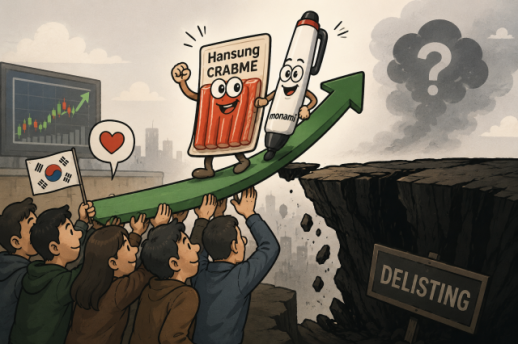 Patriotic retail investors on buying spree to rescue beloved brands from delisting SEOUL, July 13 (AJP) - In a market usually driven by earnings, valuations and future prospects, some South Korean retail investors are making room for something more sentimental: trying to save the companies they grew up with. From a beloved penmaker to a well-known seafood brand, individual investors have rushed to buy shares of struggling companies facing possible delisting. Their buying spree has sent stock prices sharply higher as they try to save familiar brands from disappearing from the market. But the buying spree has also raised a broader question: Is it an act of loyalty to iconic South Korean companies or simply shareholders trying to avoid losses? Experts say it may be a mix of both, exposing an unintended effect of the Korea Exchange's tougher delisting rules. "Many investors are likely buying shares not only to support the company but also to protect their own investment from losses," said Lee Jeong-hwan, a professor of economics and finance at Hanyang University. The phenomenon emerged after the Korea Exchange earlier this month introduced tougher listing guidelines, under which companies listed on the main KOSPI market with shares trading below 1,000 won or a market capitalization under 30 billion won (US$21.7 million) can face delisting reviews. Rather than abandoning struggling companies, however, many individual investors have done the opposite - buying shares to push their market values above the threshold. The clearest example was Hansung Enterprise, a seafood processor best known for Crabme, one of South Korea's best-selling crab-flavored seafood products. Its shares surged 100 percent last week, making it the top-performing stock in the market. The stock climbed from 4,635 won to 8,460 won in just about a week, hitting the daily 30 percent price limit in two consecutive sessions on Thursday and Friday. The rally showed little sign of slowing on Monday. As of 2:40 p.m., shares were up 26.83 percent at 10,730 won after earlier touching the daily limit of 10,990 won. Hansung had been struggling with rising raw-material costs and weakening profitability, leaving the company at risk of delisting after its market capitalization slipped to 28.7 billion won, below the Korea Exchange's new requirement. The turnaround began not with an earnings surprise or a restructuring announcement, but with posts on online investor forums. Users shared stories about the company's long-running charitable activities, including hosting annual concerts for Korean War veterans for roughly 25 years, prompting some retail investors to buy its shares to support a company they believed deserved another chance. Within days, buying accelerated. Hansung's market capitalization climbed to 52.5 billion won, lifting the company back above the delisting threshold. A similar story unfolded at Monami, one of the country's best-known stationery brands, whose inexpensive ballpoint pens have been a fixture in classrooms, offices and homes for decades. The stock climbed 62 percent during the week, rising from 1,318 won on July 6 to 2,145 won after nearly hitting the daily trading limit on two consecutive sessions. The rally extended into Monday, with the shares up another 17.02 percent at 2,510 won as of 2:41 p.m., after touching an intraday high of 2,780 won, just below the daily price limit of 2,785 won. The rally also lifted its market capitalization from 24.9 billion won to 40.5 billion won, helping the company avoid the immediate risk of delisting. For many investors, it was about preserving a familiar brand. "I hardly ever go to stationery stores anymore, but I still bought a Monami three-color pen online not long ago," said Lee K.M., a South Korean IT professional in his 30s who studied in the U.S. "It's cheap, writes well and is one of those reliable Korean products that has always been around. I even carried Monami pens with me when I lived in the U.S." His sentiment appeared to resonate with many retail investors, several of whom described Monami as one of those familiar brands that had quietly endured for decades. Hansung thanked the unexpected support. "We sincerely appreciate the encouragement and support we have received through online communities and social media," the retailer said in a statement posted on its website, pledging to continue producing "quality food products" as it has since its founding in 1963. Song Jae-hwa, the CEO of Monami, also posted a handwritten message on the company's official Instagram account on July 10. "Your trust and support have given us tremendous strength during a time when Monami faced the possibility of delisting." The rallies quickly evolved into a broader debate across online investing communities over whether investors were preserving Korean brands or simply fueling another speculative trade. On Naver's stock message board, one investor wrote, "Monami is a patriotic company. Let's send it to 10,000 won by Liberation Day," while another described it as "a good company that even pays dividends." Others were far more skeptical. "There are limits to using patriotism to manipulate a stock," one investor wrote. Another investor wrote: "Delisting doesn't mean the company disappears — just buy its products instead," arguing that consumers should support the companies through purchases rather than by driving up their share prices. One investor summed up the debate: "Patriotism or not, I have to survive first." The episode revived memories of South Korea's 2019 boycott of Japanese products, when patriotic consumption spilled into the stock market. On July 4, 2019, Monami's shares surged 29.88 percent to close at 3,325 won, hitting the daily trading limit as investors bet consumers would shift away from Japanese stationery brands. The following day, Shinsung Tongsang, operator of homegrown casualwear brand Topten, jumped as much as 26.6 percent intraday on expectations that the boycott would also benefit domestic apparel makers at the expense of Japanese rivals such as Uniqlo. Unlike those gains, however, the latest rallies have been driven not by expectations of stronger sales but by investors' attempts to keep companies above the Korea Exchange's minimum market-capitalization requirement. Lee of Hanyang University, said the buying was a predictable response from shareholders facing potential losses, but he said the episode also raised questions about the exchange's new delisting rules. "If a brief rise in the share price is enough to lift a company back above the 30 billion won threshold, similar episodes could continue," he said. "That suggests the listing standards need to be refined." Yang Jun-sok, a professor of economics at the Catholic University of Korea, offered a more market-driven explanation. He said distressed companies often attract speculative buying from investors hoping for a last-minute rescue through an acquisition, government support or another turnaround. "In many cases, investors buy because they believe someone else will eventually rescue the company through an acquisition or financial support," Yang said. "Even if that doesn't happen, they may think the shares have already fallen so much that the downside is limited." He compared the episode to the 2021 GameStop frenzy in the U.S., when retail investors on Reddit's WallStreetBets forum piled into shares of the struggling video-game retailer. The buying was driven less by confidence in the company's business than by a desire to inflict losses on hedge funds that had heavily shorted the stock. The stock soared from $17.25 at the start of January to as high as $483 on Jan. 28, forcing many short sellers to buy back shares to limit their losses and driving prices even higher. "That wasn't a normal investment either," Yang said. "Many participants were motivated to punish short sellers for betting against the company." Whether the recent rallies reflect genuine support for familiar Korean brands or simply another speculative trade remains open to debate. One widely shared online post captured that skepticism with a sarcastic remark: "This is what the Korean stock market has come to — we're talking about pen stocks and imitation-crab-stick stocks while the rest of the world is talking about artificial intelligence." Regardless of investors' motives, however, the episode has already exposed an unexpected consequence of the country's tougher delisting regime. Rules intended to weed out weak companies instead encouraged some shareholders to rally around them. For now, the buying spree has bought both companies more time. Whether it represents a new form of patriotic investing or simply shareholders trying to protect themselves from losses remains open to debate. The bigger question is whether the momentum can continue once the initial excitement fades. 2026-07-13 15:51:30
-
Seoul's Dominance in Housing Market Intensifies as Demand Shifts This year, the trend of concentration in the housing application market has become more pronounced in Seoul. While nearly half of the nationwide applicants flocked to the general supply in Seoul, which accounts for less than 4% of the total supply, Gyeonggi Province, despite being part of the metropolitan area, saw an average competition rate below 2:1. Analysts suggest that the risk of applications for housing projects in the outskirts of Gyeonggi may increase in the second half of the year.According to the Korea Real Estate Agency's application home data released on July 13, the number of first-choice applicants nationwide in the first half of the year totaled 283,619. Among them, 128,137 applicants were from Seoul, making up 45.2% of the total.The supply volume was limited. The general supply in Seoul was only 2,016 units, which is just 3.8% of the nationwide general supply of 52,963 units. This means that nearly half of the nationwide applicants concentrated on less than 4% of the available units. The average competition rate for first-choice applications in Seoul during the first half of the year was 63.56:1, nearly 12 times the national average of 5.36:1.In contrast, Gyeonggi Province had 29,335 applicants for 15,626 units, resulting in an average competition rate of just 1.88:1. Although the supply volume was more than seven times greater than that of Seoul, the number of applicants remained at only a quarter of Seoul's figures. Incheon, also part of the metropolitan area, had 3,978 applicants for 4,436 units, achieving an average competition rate of 8.11:1.This shift indicates that the housing application market is no longer simply divided between the metropolitan area and the provinces. Demand has concentrated in Seoul due to the scarcity of new constructions and expectations of price gains in areas subject to price cap regulations. However, projects in the outskirts of Gyeonggi are increasingly failing to attract buyers, despite being located in the metropolitan area.The challenges facing the outskirts of Gyeonggi include an imbalance between pricing and location. In the past, lower prices compared to Seoul were seen as an advantage, but recent increases in construction and land costs have diminished this appeal. Developments lacking clear accessibility to Seoul, proximity to workplaces, or essential infrastructure are losing their status as 'alternatives to Seoul.'A representative from a construction company stated, "Projects in the outskirts of Gyeonggi are expected to have high land costs and pricing due to their location in the metropolitan area, but they do not automatically attract application demand like those in Seoul. The burden of marketing and financing costs is increasing, while they also face the risk of under-subscription, similar to provincial projects."In the provinces, the trend of under-subscription has become more evident. In Gangwon, the average competition rate was 0.30:1, in Busan it was 0.33:1, in Jeju it was 0.46:1, and in Jeollanam-do it was 0.58:1, all failing to reach an average of 1:1 for first-choice applications.Industry insiders noted, "While development prospects, such as semiconductor clusters in the Honam region, have improved application demand in some areas, the overall average competition rate in the provinces remains low. The gap between Seoul, preferred areas in the metropolitan region, and smaller cities in the provinces is widening further."* This article has been translated by AI. 2026-07-13 15:48:00
-
SEVENTEEN Members Renew Contracts with Pledis Entertainment Group SEVENTEEN will continue their journey with their current agency, Pledis Entertainment. Pledis Entertainment announced on July 13 that "SEVENTEEN has agreed to renew their contracts for a second time." The agency added, "All members, except those currently serving in the military, have completed their contract signing, and the members on active duty will sign their contracts sequentially based on their service conditions." SEVENTEEN expressed their happiness through their agency, stating, "We are glad to share this exciting news with our Carats. We believe that there is nothing we cannot achieve together, and we have decided to continue as a group of 13 with a shared vision of wanting to go further together." They also urged fans to join them in their commitment to challenge eternity as part of 'TEAM SVT.' Pledis Entertainment stated, "We will continue to provide systematic and comprehensive support for SEVENTEEN's group, unit, and individual activities, and we look forward to the day when all 13 members stand before you again, laying the groundwork for a successful return as a complete group." SEVENTEEN debuted in 2015 and signed their first contract renewal early in 2021. Despite being a large group, they have once again united to renew their contracts without any member departures. Starting as a self-producing group, SEVENTEEN has expanded their activities based on their music, performance, and content creation skills. They have set records for 'highest sales of a single K-pop album' and 'first K-pop group to surpass 5 million copies in first-week sales,' while also engaging in unit and individual activities. Recently, the unit V8, consisting of The8 and Vernon, released their first mini-album and held the '2026 Vernon The 8 Live' concert on July 11-12. Dino is set to release a solo album under the character name Pichorin on August 3.* This article has been translated by AI. 2026-07-13 15:48:00
-
 South Korea to steer record tax revenue into AI, physical AI push SEOUL, July 13 (AJP) - South Korea will channel its largest-ever projected tax revenue into a new future-response fund, pouring resources into three mega-projects led by artificial intelligence. Deputy Prime Minister Bae Kyung-hoon, who also serves as science and ICT minister, positioned physical AI as the country's next growth engine, pledging to "export Korea's factories to the world" on the back of a homegrown, full-stack platform. Speaking at the 2026 national fiscal strategy meeting chaired by President Lee Jae Myung at the Cheong Wa Dae in Seoul on Monday, Bae called the current race to secure a general-purpose physical AI platform "the golden time to marshal national capabilities." The government expects 2027 national tax revenue to top 500 trillion won ($332.6 billion), far above the earlier forecast of 412 trillion won. The windfall will seed a fund targeting youth, growth engines, regional development and talent, with semiconductors, AI data centers and physical AI taking top priority. Bae described AI data centers as the core infrastructure that mints the "production tokens" powering AI services, and said the ministry aims to secure 8.4 gigawatts of capacity by 2029 and 18.4 GW by 2035. Projects are already confirmed in Sejong, Donghae and Ulsan, with three to four more sites under review. Citing Morgan Stanley, Bae said physical AI represents a potential market of $60 trillion, about half of current global gross domestic product, and would spread beyond factory robots into defense, logistics, agriculture, caregiving and household chores. "The nation that seizes the general-purpose platform will lead future industrial competitiveness," Bae said, adding that the government would run three public-private bodies as "one team" to keep the mega-projects on track. 2026-07-13 15:45:00