


Latest by
-
 Artists Unaware of Proposed Overhaul of Arts Promotion Law “This is essentially creating a new legal framework, yet many are unaware of it. No one knows about this amendment.” The proposed overhaul of the Arts Promotion Law by the government has sparked significant backlash from the cultural and arts community. Despite its potential to greatly impact the sector, the initiative has proceeded without discussions with artists. Critics argue that the policy direction, which treats art as an 'industry,' could stifle basic arts. Hajang-ho, a policy committee member of the Cultural Solidarity, pointed out at a recent emergency forum titled 'We Must Open the Path for Art' held in Seoul, “Given the importance of the issue, the proposed amendment to the Arts Promotion Law has not been sufficiently publicized.” He acknowledged that the need for reform has long been raised within the arts community but emphasized, “It is crucial to understand what this amendment is for and who is following what procedures to implement it, as this is a significant issue in the new cultural policy paradigm.” Participants at the forum highlighted the government's lack of communication. Writer Jeong Yoon-hee stated, “When I asked artists involved in arts policy governance about this amendment, they all said they were unaware of it. Even institutions under the Ministry of Culture were not informed. They said they would have to wait until directives come from above.” She added, “Policies are being developed unilaterally and we are left in the dark.” Kim Dae-hyun, a literary critic and member of the Korea Arts Council, noted, “There has been no public consultation or hearings. No one on the ground is aware of this.” He expressed concern about whether institutions directly governed by the law have been adequately consulted, stating, “A major policy shift should proceed based on consensus from the field. Even if this law passes, who will support it?” Another contentious issue is the focus on the 'arts industry.' The arts community fears that arts policy may be restructured around marketability and industrial competitiveness. Lee Hoon-gyeong, vice president of the Korea Theater Association, warned, “We must not evaluate culture and arts solely through the lens of efficiency and market logic. Policies should not funnel budgets only into high-market content and distribution. The amendment must not lead to a regression of basic arts disguised as industrial promotion.” Yeom Sin-kyu, director of the Korea Cultural Policy Institute, stated, “Market formation and overseas expansion should not be led by the public. The public sector should focus on building the infrastructure that the private sector cannot manage, such as data collection.” The restructuring of institutions under the amendment is also a point of contention. Kim Dae-hyun mentioned proposals to rename the Korea Arts Council to the 'Korea Arts Commission' and to convert the Arts Management Support Center into a statutory body called the 'Korea Arts Industry Promotion Agency.' He noted that the amendment includes provisions to establish new uses for the Arts Promotion Fund, such as enhancing the competitiveness of the arts industry and providing loans. “Serious matters requiring separate policy review are being addressed within a single amendment to the promotion law,” he said. He specifically expressed concern over the potential weakening of the Korea Arts Council's status. “The role of the committee, which is a consensus-based body involving the arts community, will clearly be diminished through this amendment,” he said. If the committee handles creation support while the new agency takes charge of distribution and international exchange, it could disrupt the continuity of policies from creation to distribution and overseas expansion. He concluded, “The value chain of creation, distribution, and international exchange cannot be artificially separated. If the committee's research functions are also separated, it will have to rely on the promotion agency, which operates under industrial logic, to support the policies it designs.” 2026-09-18 09:44:00
 -
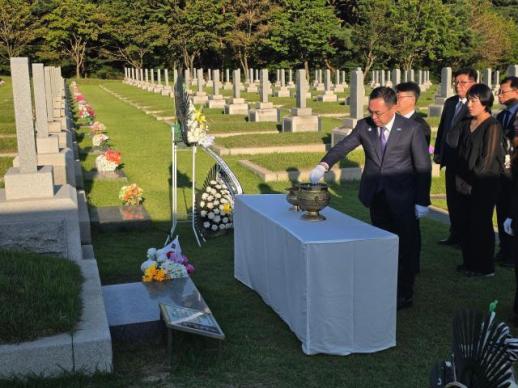 OPINION: Korea's Eurasian pivot needs substance beyond summit rhetoric Kazakhstan's culture minister burned incense Wednesday at the grave of Hong Beom-do, the Korean independence commander who spent his final years in exile in Kazakhstan. The gesture came a day after Arman Kyrykbayev signed an agreement with South Korea to preserve sites associated with Korea's independence movement, witnessed by Presidents Lee Jae Myung and Kassym-Jomart Tokayev. Hong's remains were returned to Korea in 2021 after nearly eight decades in Kazakhstan, a homecoming Tokayev helped commemorate. Amid all the talk in Seoul this week about uranium, oil, critical minerals, artificial intelligence and infrastructure, that quiet scene at Daejeon National Cemetery may have captured something equally important about South Korea's belated Eurasian turn. Central Asia is suddenly crowded with suitors. China gathered the five Central Asian leaders in Astana in June last year for the second China-Central Asia Summit, where President Xi Jinping signed a treaty on permanent good-neighborliness and pushed deeper cooperation in trade, energy, mining, transport and technology. The China-Kyrgyzstan-Uzbekistan railway, after decades of discussion, has moved into implementation. Russia followed with the second Central Asia-Russia Summit in Dushanbe in October. President Vladimir Putin, whose country retains deep economic, linguistic, security and migration links to the former Soviet republics, called for greater trade with the region. A month later, U.S. President Donald Trump brought all five leaders to the White House in the C5+1 format, with critical minerals, investment, energy and supply chains high on the agenda. President Joe Biden had held the first U.S.-Central Asia presidential gathering in New York in 2023. Now South Korea has joined the summit circuit. Lee hosted the first Korea-Central Asia Summit in Seoul on Wednesday after bilateral meetings with each of the five leaders. More than 70 agreements and memorandums were reached across energy, mining, infrastructure, technology and investment, while the leaders agreed to institutionalize their summit on a biennial basis, with Kazakhstan to host the next gathering in 2028. The sudden attention is hardly mysterious. For much of the post-Soviet era, Central Asia appeared distant from the centers of global capital: enormous in land mass, rich beneath the ground, but landlocked and constrained by Russia to the north, China to the east and difficult transport links to markets elsewhere. Those supposed disadvantages are being reassessed as assets. Kazakhstan alone produced about 40 percent of the world's uranium last year and holds substantial oil, gas and mineral resources. Turkmenistan sits on some of the world's largest natural-gas reserves. Uzbekistan combines gold, uranium and copper resources with the region's largest population. Kyrgyzstan and Tajikistan bring hydropower and mineral potential. For an energy-importing country such as South Korea, the attraction has become sharper as geopolitical shocks repeatedly expose the vulnerability of concentrating supplies in a handful of regions and maritime routes. Central Asia cannot simply replace the Middle East. It is landlocked, and moving oil, gas and minerals to East Asia still requires pipelines, railways and corridors crossing other countries. The rise of the Trans-Caspian or Middle Corridor reflects precisely the effort to create routes linking Central Asia with Europe without depending entirely on Russia, but geography remains stubborn. Its importance therefore lies in diversification rather than substitution. And increasingly, the prize is not simply what can be dug out of the ground. Central Asia has begun trying to convert cheap land, electricity and energy resources into computing power. Kazakhstan is considering an AI data-center campus in Ekibastuz that could eventually reach 1 gigawatt. Uzbekistan has introduced incentives for AI data centers in Karakalpakstan and this year discussed a proposed 125-megawatt facility expandable to 250 MW with Nvidia and Firebird representatives. That changes the conventional image of the region. Oil fields, uranium mines and pipelines could increasingly sit alongside server farms, smart cities, renewable-energy complexes and AI infrastructure. Demography adds another dimension. While South Korea, Japan and much of Europe are aging rapidly, Central Asia remains young. People under 25 account for roughly 30 percent of the region's population, and UN projections suggest another 20 million people could enter working age by 2050. That means Central Asia is potentially not only a source of energy and minerals but also a growing consumer market, industrial base and pool of workers, engineers and entrepreneurs. Its governments are also heavily involved in determining the direction of that growth. The Seoul business summit itself reflected that reality: ministers, sovereign wealth funds, state companies and national investment bodies sat alongside private businesses. For Korea, that is a familiar economic language. Its own rise from poverty was built in large part through state-coordinated infrastructure, industrial policy, export manufacturing, education and technology acquisition before the economy and political system evolved into their present forms. Central Asian governments now speak frequently of industrial diversification, technological upgrading, special economic zones, smart cities and moving from raw-material exports into higher-value production. Korea therefore enters the region differently from the three great powers already entrenched there. It cannot match China's financial scale or geographic proximity. It cannot replicate Russia's Soviet-era networks, security ties and migration links. Nor does it possess the strategic reach or financial system of the United States. The Seoul summit instead points toward another possible model: pairing Central Asian resources and young markets with Korean manufacturing, engineering, digital technology and industrial know-how. Lee's government explicitly framed cooperation around moving beyond the simple purchase of raw materials toward joint value chains in which exploration, processing, technology and manufacturing are connected. But technology and money alone will not distinguish Korea for long. Every major power arriving in Astana or Tashkent now comes carrying offers involving minerals, AI, digital infrastructure and logistics. Korea possesses another asset that is harder to reproduce: living history. Around 310,000 Koryo-saram, descendants of Koreans who settled across the former Soviet Union, live in Central Asia and Russia. Next year marks 90 years since Stalin's forced relocation of ethnic Koreans from the Russian Far East to Central Asia. South Korea and its Central Asian partners are already planning commemorative projects, including a Koryo-saram history museum in Uzbekistan. About 150,000 Central Asian students and workers are also now in South Korea. Hong Beom-do embodies that connection particularly vividly. Stalin's government deported him with other ethnic Koreans to Kazakhstan in 1937. Koryo-saram in Kyzylorda tended his grave for decades; Kazakhstan later agreed to return his remains to Korea, and a memorial park now stands where he was once buried. There is no need to exaggerate this into claims of some ancient ethnic sameness between Koreans and the peoples of the Eurasian steppe. The genuine history is powerful enough. The Silk Road moved people, religions, goods and ideas between East and West long before modern national borders appeared. The Koryo-saram later created a very human bridge between Korea and Central Asia. Today students, migrant workers, businesses and popular culture are adding a contemporary layer to those ties. The Korean presidential office chose precisely that imagery at this week's summit, describing the old Silk Road as evolving into a "digital Silk Road" connecting people, culture, technology and the future. Heritage cooperation should go beyond museums and ceremonies. Archives, archaeological projects, restoration, cultural-property conservation, Koryo-saram heritage, universities, tourism and digital preservation can create networks that survive commodity cycles and changes of government. Industrial partnerships built on top of such human connections may prove more durable than memorandums built around the mineral price of the day. Central Asia itself is seeking room to maneuver. Its governments continue to work with Russia, deepen economic links with China, welcome American investment and cultivate ties with Europe, Turkey, Japan, Korea and others. The rush of summits is evidence not merely of great-power competition but of Central Asian governments exercising their own multi-vector diplomacy. Korea's Eurasian engagement does not have to become another contest to "win" Central Asia from somebody else. The more durable question is whether Korea can become useful to a region that wants more partners, more routes and more choices. * The author is the managing editor of AJP. 2026-09-18 09:43:32
 -
Barun and H&H Lawyers Host Seminar on Australian Market Entry and Investment Strategies Barun Law LLC, led by attorneys Lee Dong-hoon, Lee Young-hee, and Kim Do-hyung, announced on September 18 that it co-hosted a seminar with the Australian law firm H&H Lawyers on September 17 at the Barun Building. The seminar focused on 'Entering Australia: Investment and Global Asset Transfer Strategies.'As Korean companies and investors increasingly enter the Australian market, issues such as local corporate establishment, investment structures, foreign investment regulations, real estate investment, and tax and foreign exchange reporting have become more complex. This seminar aimed to address the legal and tax differences between Korea and Australia and to present an integrated strategy covering asset transfer and succession from the contract stage.Hong Kyung-il, managing partner at H&H Lawyers, discussed 'Trends in Australian Market Entry and Foreign Investment Regulations.' He noted that the number of Korean companies operating in Australia has surpassed 80, expanding from large corporations to medium and small enterprises, particularly in the defense and infrastructure sectors over the past five years. He emphasized that the choice of initial structure—whether to establish a local entity, engage in mergers and acquisitions, invest in real estate projects, or enter through branches or direct contracts—can impact tax, employment, and exit strategies.He explained that the Foreign Investment Review Board (FIRB) assesses foreign status based on ownership and control structure rather than nationality, indicating that a local entity controlled by a Korean parent company could be classified as foreign. Regarding real estate regulations, he pointed out that from April 2025 to June 2029, foreign acquisition of existing homes will generally be prohibited, limiting eligible purchases to new homes, off-the-plan properties, and vacant land. He advised that investors should consider after-tax real returns rather than just nominal rental income, highlighting that many medium and small enterprises often sign contracts before seeking legal advice. He stressed the necessity of confirming regulations before contracts, as FIRB approvals and surcharges cannot be reversed post-contract. He recommended integrating visa and immigration planning from the outset of business, including corporate establishment, sponsorship, work visas, and permanent residency.Jo Ok-ah, an attorney at H&H Lawyers, presented on 'Australia's Tax Environment and Investment and Asset Holding Structures.' She compared tax differences with Korea, noting that while Australia does not impose inheritance or gift taxes, transfer taxes and capital gains taxes (CGT) apply during asset transfers. She highlighted that there is no additional comprehensive property tax for multiple property owners. Regarding CGT, she explained that the main residence is fully exempt from tax regardless of the amount or holding period, while investment properties are eligible for a 50% reduction if held for over 12 months. If a primary residence is converted to an investment property, selling it within six years can also result in full exemption.She also noted that starting in July 2027, negative gearing will only apply to new properties, not existing ones, following a May 2026 announcement. Jo emphasized that the tax residency status and investment objectives differ based on the three asset holding structures: individual, corporate, and trust, advising that decisions regarding holding structures and residency status should be made after consulting with professionals.Barun partner attorney Jo Woong-kyu addressed 'Global Asset Management and Succession Strategies,' discussing the complexities of 'cross-border inheritance' where the governing law and outcomes vary based on nationality and residency. He explained that, according to Article 77 of the Private International Law, inheritance generally follows the law of the deceased's home country, but real estate is governed by the law of its location, which can lead to a single inheritance being subject to multiple legal systems based on the type of property and the nationality or residency of the deceased. He compared methods of asset succession using inheritance division, wills, and trusts, outlining the advantages and disadvantages of each approach.He also covered citizenship and permanent residency acquisition and the 'cross-border estate planning' for overseas Koreans. He noted that changes in governing law due to citizenship acquisition can alter inheritance outcomes, and that obtaining permanent residency does not automatically change tax status. He stressed the importance of integrating asset transfer and succession planning before changing nationality or residency.In the final session, Barun partner attorney Choi Jin-hyuk presented on 'Domestic Regulations Related to Overseas Investment and Asset Transfer.' He explained the differing definitions of residents and non-residents under the Foreign Exchange Transaction Act and tax law, warning that if individuals plan to return to Korea while maintaining family and assets there, they may be considered tax residents even during long stays abroad, subjecting their worldwide income to taxation.He outlined methods for transferring funds abroad, including foreign direct investment (reporting to designated foreign exchange banks for acquiring over 10% equity or establishing new entities), offshore financial institution reporting (to the Bank of Korea), acquiring overseas real estate (pre-reporting and post-reporting), and procedures for paying relocation expenses. He highlighted the 'exit tax' on domestic stocks deemed sold upon relocation, noting that starting in 2027, this will also apply to overseas stocks exceeding 500 million won, and that individuals must report if their overseas financial accounts exceed 500 million won at any point during the year.All presenters emphasized that FIRB approvals and foreign surcharges cannot be reversed after contracts are signed, urging that visa, tax, asset structure, and family planning should be integrated from the initial stages of market entry. They advised caution regarding unverified information and recommended consulting with professionals on residency status, holding structure choices, and fund transfer methods. 2026-09-18 09:40:20
-
Lotte Card Issues $300 Million in Overseas ABS, Demonstrating Funding Capability Lotte Card has diversified its funding channels by issuing overseas asset-backed securities (ABS). The company announced on September 18 that it has issued $300 million (approximately 404.1 billion won) in overseas ABS. This ABS is backed by credit card receivables. Mitsubishi UFJ Financial Group (MUFG) and Société Générale participated as investors, with an average maturity of 3.5 years. Lotte Card explained that it issued the ABS at competitive interest rates compared to domestic corporate bonds, thereby reducing its funding costs. It also entered into currency and interest rate swap agreements to mitigate risks associated with exchange rate and interest rate fluctuations. A Lotte Card official stated, "We successfully issued overseas ABS by securing investor confidence based on stable underlying assets and financial management capabilities. We will continue to diversify our funding channels and improve our medium- to long-term profitability and financial structure through proactive risk management."* This article has been translated by AI. 2026-09-18 09:32:10
-
President Yoon Meets UAE's Khaldoon Al Mubarak to Discuss AI and Defense Cooperation President Yoon Suk Yeol is set to meet Khaldoon Khalifa Al Mubarak, the Chief Executive Officer of the Abu Dhabi Executive Office, on September 18 to discuss ways to enhance practical cooperation between South Korea and the United Arab Emirates (UAE).According to the Blue House, President Yoon will receive Al Mubarak at 2 p.m. at the Blue House. The two leaders will evaluate ongoing collaborations in defense, artificial intelligence (AI), culture, nuclear energy, and space, and discuss future directions for these partnerships.During the meeting, President Yoon is also expected to convey his regards to UAE President Mohammed bin Zayed Al Nahyan.Al Mubarak is the UAE's designated official overseeing cooperation with South Korea. Prior to the meeting with President Yoon, he will hold a separate discussion and lunch with Kang Hoon-sik, the Chief of Staff to the President.Kang and Al Mubarak are expected to exchange views on expanding high-level exchanges between the two countries, as well as cooperation in defense, AI, culture, nuclear energy, and space.Last November, during President Yoon's state visit to the UAE, the two nations agreed to broaden their existing cooperation in energy, nuclear power, and defense to include AI, advanced technology, and culture. A joint declaration was adopted at that time, outlining a vision for a 'century-long partnership' between the two countries.This meeting marks the first encounter between President Yoon and Al Mubarak since their last meeting at the Blue House on January 15, approximately eight months ago. At that time, President Yoon emphasized the need for tangible results in their cooperative projects, referencing the 'century-long partnership' concept. Following that meeting, the UAE committed to prioritizing the supply of 24 million barrels of crude oil to South Korea amid regional instability in the Middle East.* This article has been translated by AI. 2026-09-18 09:32:00
-
Korean Won Declines Slightly Amid Falling International Oil Prices The won-dollar exchange rate is showing a slight decline.As of 9:22 a.m. on September 18, the exchange rate in the Seoul foreign exchange market is 1380.3 won against the U.S. dollar. The rate at 6 a.m. today was 1381.5 won, down 0.7 won from the previous day's reference rate at 3:30 p.m.This decline is attributed to reduced uncertainty in the financial markets following the Federal Reserve's interest rate hike.The dollar also showed a slight weakening. The dollar index (DXY), which reflects the value of the dollar against six major currencies, fell by 0.04% to 100.215.The U.S. stock market also rebounded. The Dow Jones Industrial Average closed up 316.14 points (0.61%) at 51,778.04.The Standard & Poor's (S&P) 500 index rose by 85.95 points (1.14%) to 7,637.76, while the tech-heavy Nasdaq Composite Index increased by 439.87 points (1.69%) to 26,418.30.U.S. Treasury yields and international oil prices also fell. The yield on the 10-year U.S. Treasury note decreased by 5.7 basis points (1 basis point = 0.01 percentage point) to 4.946%. The yield on the 2-year Treasury note, which is sensitive to monetary policy, also dropped by 3.8 basis points to 4.688%.International oil prices fell as concerns over supply disruptions from Saudi Arabia eased. The November futures for Brent crude oil closed down 0.95% at $104.82 per barrel, while the October futures for West Texas Intermediate (WTI) crude oil fell 0.51% to $101.91.In the early trading session, foreign investors are in a buying position in the domestic stock market. In the securities market, foreign investors have net purchased 29.6 billion won.The exchange rate is expected to decline further. Min Kyung-won, an economist at Woori Bank, stated, "We are paying attention to the volatility of the yen ahead of the Bank of Japan's interest rate decision, but the overall trend is expected to reflect stability in international oil prices and decline." He added, "Recent low-priced buying from both domestic and foreign markets has led to a rebound in the exchange rate, but considering the upcoming Chuseok holiday and the steady demand for currency exchange from semiconductor companies, it is likely to stabilize slightly downward rather than rise further before the holiday." * This article has been translated by AI. 2026-09-18 09:32:00
-
Trump Middle East Advisor: President Decides to End Iran War Soon Donald Trump, the President of the United States, has resolved to end the ongoing Iran war, which has lasted for seven months, according to his senior advisor for Middle East affairs. Amid recent statements from Trump indicating that the end of the Iran war is near, a key White House official has officially confirmed the intention to seek peace, drawing attention to future negotiations with Iran and the situation in the Middle East.Masaad Bulos, the senior advisor for Arab and Middle East affairs, stated in an interview with European media outlet Euronews on September 17, "President Trump believes the war will soon come to an end. He has made up his mind to conclude the war and is working towards that goal." He added, "He is a man of his word. We have all seen President Trump fulfill his promises, whether they are campaign pledges or other commitments. There has not been a promise he has not kept." However, when asked about the specific timing of the end of the war, Bulos replied that it depends on Trump’s decision, and he only mentioned that the manner of concluding the war is also up to the President.Bulos, who is also related to Trump, identified Iran's nuclear issue as a prerequisite for ending the war, emphasizing that Iran must not possess nuclear weapons. He remarked, "Someone had to step in to resolve this nuclear issue. As President Trump has repeatedly stated, we cannot allow Iran to have nuclear weapons." He added, "Consider what the region and the world would be like if Iran possessed nuclear weapons." Bulos noted that Trump is providing Iran with opportunities for negotiation, stating, "President Trump has shown great patience thus far. We ultimately hope for peace to prevail." He referred to Trump as the "President of Peace," explaining that Trump has already worked to end conflicts in various parts of the world and is currently striving to conclude two wars. However, he did not specify which conflicts Trump has resolved, according to Euronews.These comments come as Trump has repeatedly mentioned that the Iran war will conclude around the time of the U.S. midterm elections on November 3. During a press conference with midterm election reporters the previous day, Trump said, "We hope the Iran war is coming to an end. Iran is very eager for an agreement. We will know soon how it will unfold." He also stated on social media platform Truth Social on September 14 that oil prices would plummet once military conflicts with Iran cease, asserting, "That (the end of the war) is not far off." Trump is scheduled to meet with leaders of the six Gulf Cooperation Council (GCC) countries on September 22 during the United Nations General Assembly. He indicated in an interview with Axios that he would decide on his policy toward Iran after hearing opinions from the leaders of key Gulf nations regarding the future of the Iran war.Meanwhile, Bulos stated that the Abraham Accords, which aim to normalize relations between Israel and Arab nations under U.S. mediation, were halted due to Trump's loss in the 2020 election, but will be pursued again once the Iran war concludes. He noted that key Gulf countries, including Qatar, have raised concerns that existing security agreements are insufficient for their security due to the ongoing Iran war, suggesting the possibility of expanding the Abraham Accords to other Middle Eastern nations. 2026-09-18 09:28:10
-
Heavy Rain Expected in Jeju, Strong Winds Advisory On September 18, rain is falling in Jeju, the southern coast of Jeollanam-do, the eastern coast of Gyeongbuk, the northeastern mountains, and in Busan, Ulsan, and Gyeongnam due to easterly winds.According to Yonhap News, Jeju, located at the boundary of cold and warm air, is expected to receive rain at a rate of 20 to 30 mm per hour until the afternoon.The rain is expected to mostly stop by the afternoon.The anticipated rainfall amounts are as follows: 10 to 50 mm in Jeju (excluding the northern and western regions), over 80 mm in some areas; 5 to 30 mm in northern and western Jeju; 5 to 20 mm in the southern coast of Jeollanam-do, Busan, Ulsan, and Gyeongnam; 5 to 10 mm in the mountainous areas of Gangwon; around 5 mm in the eastern coast of Gyeongbuk, northeastern mountains of Gyeongbuk, and inland Gyeongnam; and less than 5 mm in the eastern coast of Gangwon, southeastern Jeollabuk-do, Gwangju, and northern Jeollanam-do.Strong winds exceeding 7 km/h (90 km/h in the Jeju mountains) are expected to continue until the 19th in Jeju, the southern coast of Jeollanam-do, and the western coast of Gyeongnam. Additionally, some inland areas may experience gusts of around 55 km/h (70 km/h in mountainous regions).The daytime high temperature is expected to range from 23 to 29 degrees Celsius.* This article has been translated by AI. 2026-09-18 09:28:00
-
KOSPI Rises Over 2% Amid U.S. Semiconductor Surge with Foreign and Institutional Buying The KOSPI is showing a rise of over 2% thanks to simultaneous net buying by foreign and institutional investors. Following a strong performance in the U.S. stock market, particularly in semiconductor and artificial intelligence (AI) stocks, major semiconductor companies like Samsung Electronics and SK Hynix are leading the index's gains. The KOSDAQ index is also experiencing an increase of around 1%.According to the Korea Exchange, as of 9:10 a.m., the KOSPI has risen by 151.88 points (2.26%) to 6,867.29. The index started the day at 6,885.70, up 170.29 points (2.54%), before giving back some of its gains.In the securities market, foreign and institutional investors have net bought 148.4 billion won and 196.1 billion won, respectively, while individual investors have net sold 405.4 billion won.All major stocks by market capitalization are on the rise. Samsung Electronics is up 3.17%, SK Hynix by 3.67%, SK Square by 3.57%, Samsung Electro-Mechanics by 5.26%, LG Energy Solution by 1.10%, Hyundai Motor by 2.20%, Samsung Biologics by 1.29%, KB Financial by 0.73%, and Samsung C&T by 2.11%.The KOSDAQ index is also continuing its upward trend. At the same time, the KOSDAQ index is trading at 829.66, up 7.48 points (0.91%) from the previous trading day. The index started at 832.72, up 10.54 points (1.28%), before slightly reducing its gains.In the KOSDAQ market, foreign and institutional investors have net sold 64.7 billion won and 4.4 billion won, respectively, while individual investors have net bought 70.2 billion won, contributing to the index's rise.Most major stocks in the KOSDAQ are rising, except for Alteogen, which is down 0.30%. EcoPro is up 0.24%, EcoPro BM by 2.14%, JUSUNG Engineering by 2.94%, Rainbow Robotics by 1.75%, Wonik IPS by 1.19%, IOTech by 0.76%, and Rino Technology by 2.71%.On the previous night, all three major indices on the New York Stock Exchange rose. The Dow Jones Industrial Average increased by 0.61%, while the S&P 500 and Nasdaq Composite rose by 1.14% and 1.69%, respectively.Semiconductor and AI stocks led the gains. Micron surged by 5.50%, and SK Hynix's American Depositary Receipts (ADRs) rose by 4.64%. Nvidia also increased by 2.54%, contributing to a 3.14% rise in the Philadelphia Semiconductor Index.U.S. Treasury yields remained stable. Following the Bank of England's decision to hold its benchmark interest rate at 3.75%, European bond yields fell, leading to a decline in U.S. Treasury yields. The yield on the 10-year U.S. Treasury note, which briefly exceeded 5% during the previous trading day, has dropped to the 4.9% range.Seo Sang-young, a researcher at Mirae Asset Securities, stated, "The U.S. stock market rose as it absorbed the hawkish results from the recent FOMC meeting, with declines in international oil prices and Treasury yields. In particular, semiconductor and AI stocks, which had been sluggish due to recent calls for a slowdown in AI development, are leading the gains."Today, the Bank of Japan (BOJ) is expected to announce a monetary policy decision that may include a rate hike. However, the market believes that the possibility of a hike has already been largely priced in, so attention will focus more on the future path of additional rate increases and comments from BOJ Governor Kazuo Ueda, as well as movements in the yen.Han Ji-young, a researcher at Kiwoom Securities, analyzed, "The domestic stock market is expected to show an upward trend as it digests the BOJ meeting while benefiting from the rebound in the U.S. stock market, particularly in semiconductors, amid stable U.S. 10-year Treasury yields following the September FOMC meeting."* This article has been translated by AI. 2026-09-18 09:24:10
-
President Lee Declares Special Disaster Zone in Yeonggwang County Due to Heavy Rain Damage President Lee Jae-myung has declared Baeksu-eup in Yeonggwang County, South Jeolla Province, a special disaster zone following significant damage from record heavy rainfall.Kang Yu-jeong, the chief spokesperson for the Blue House, announced on the 18th that President Lee made the declaration around 9 p.m. the previous day after a central joint investigation.The Yeonggwang area experienced heavy rainfall from August 28 to September 1, with a particularly severe downpour of 344 mm on August 31, leading to total precipitation exceeding 500 mm over three days. This resulted in flooding of homes, businesses, agricultural land, and facilities.According to preliminary estimates from Yeonggwang County, the total damage amounts to approximately 4.7 billion won, with Baeksu-eup suffering the most significant losses at around 2.746 billion won. Other affected areas include Beopseong-myeon, Hongnong-eup, Nakwol-myeon, and Yeomsan-myeon.Declaring a special disaster zone allows for some recovery costs, which local governments would typically bear, to be covered by national funds, thereby reducing the financial burden. Affected residents will also receive indirect support, including deferrals on national and local tax payments and reductions in public utility fees.Kang stated, "The government will finalize a recovery plan as soon as possible to help residents in the affected areas return to their daily lives swiftly."* This article has been translated by AI. 2026-09-18 09:20:00