


Latest by
-
 Honda and Nissan to Jointly Develop Next-Gen Automotive Software Honda and Nissan, which abandoned plans for a management integration last year, have agreed to jointly develop the "brain" of next-generation vehicles. This marks the first concrete outcome after 2.5 years of discussions that began in 2024. With competitors like Tesla and Chinese electric vehicle manufacturers advancing in enhancing vehicle performance through software, both companies felt a sense of urgency to compromise rather than risk falling further behind by sticking to independent paths.According to the Nihon Keizai Shimbun (Nikkei), Honda and Nissan announced on August 31 that they have signed a contract for the joint development of key components and basic software for software-defined vehicles (SDVs). The collaboration will include the development of a core electronic control unit (ECU) that integrates control of the entire vehicle, as well as the vehicle operating system (OS) and control software. The developed components and software are planned to be incorporated into new vehicles released by both companies after 2029.SDVs are vehicles that can receive software updates via communication after delivery, improving driving assistance features or adding entertainment functionalities. In traditional vehicles, separate ECUs control functions like the engine, brakes, and transmission, but SDVs will integrate these functions under a core ECU and vehicle OS. This shift means that software will play as crucial a role as hardware in determining vehicle performance and marketability.Despite the growing importance of SDVs in the automotive competition, it took 2.5 years for the two companies to reach an agreement. They began discussions in March 2024 and agreed in August of the same year to collaborate in five areas, including SDVs and battery supply. In December, they entered negotiations for management integration, but Honda's proposal to make Nissan a subsidiary led to Nissan's objections, resulting in the breakdown of talks in February of last year. Subsequently, both companies shifted their focus from management integration to sector-specific collaboration.The late decision to pursue joint development stems from the need to prevent widening the gap with leading companies in the rapidly growing SDV market. According to the Japan Electronics and Information Technology Industries Association (JEITA), SDVs are expected to account for 67% of global vehicle production by 2035. As Tesla and emerging Chinese automakers lead development, Toyota also launched its first full-fledged SDV model, the new RAV4, last year.High development costs have made it difficult to maintain independent paths. Last year, Honda and Nissan sold 3.52 million and 3.2 million vehicles globally, respectively, nearly ranking them third in the world combined. Mitsubishi Motors, in which Nissan holds a stake, is also considering joining the joint development. The Asahi Shimbun noted that a coalition of Honda, Nissan, and Mitsubishi is emerging as a counterforce against the Toyota-led alliance that includes Suzuki. The combined sales of the three companies, including Mitsubishi, are expected to reach about 7.3 million units in the 2025 fiscal year. The more vehicles that incorporate jointly developed components, the lower the development costs per vehicle, and the greater the variety and volume of data collected from the vehicles.However, the two companies are still at odds over the leadership of SDV technology. According to the Asahi Shimbun, Honda envisioned an OS that integrates control of the entire vehicle, while Nissan proposed a limited-functionality specification. Honda has been developing its own OS, "Asimo OS," while Nissan has been working on an SDV platform that includes data infrastructure and development environment for its vehicle OS. Nissan plans to commercialize this platform by 2026. Adopting one company's technology would require the other to abandon its ongoing independent development.Ultimately, Honda's revision of its vehicle OS strategy opened the door for negotiations. Honda announced it would reconsider its strategy of broadly applying Asimo OS. The core ECU and vehicle OS will be developed jointly, utilizing some of the technology already developed by Nissan while incorporating Honda's technology.However, technologies directly linked to vehicle individuality and market competitiveness, such as autonomous driving, will continue to be developed separately for the time being. Honda will continue its independent development, while Nissan will utilize technology from the UK startup Wave Technologies. Mapping and entertainment applications will also be developed independently by each company. While they have joined forces on a common foundation to reduce costs, they have not merged the technologies that determine the distinctiveness of their finished vehicles.Differences Between the Two Companies RemainConflicts still linger. The two companies initially aimed to announce their agreement in July, but negotiations were prolonged over the usage fees for Nissan's developed technology and intellectual property rights ownership. A Nissan executive expressed to the Yomiuri Shimbun, "It is difficult to handle intellectual property rights in a cooperation without capital ties." Despite announcing a significant agreement, they did not hold a joint press conference. Of the five areas of cooperation proposed in 2024, only the SDV has led to an actual contract so far.While the two companies spent 2.5 years negotiating, American and Chinese firms have widened the technological gap. An analyst expressed skepticism to the Asahi Shimbun, stating that even starting joint development now would make it difficult to catch up. Conversely, Takaki Nakaniishi, a representative analyst at Nakaniishi Automotive Industry Research, told the Yomiuri Shimbun, "To secure competitiveness in SDVs, scaling up is essential, so it is a wise decision for Japan's major manufacturers to join forces."What is clear is that merely reducing costs will not allow them to catch up with the leaders. The success of this collaboration will hinge on how smoothly they can integrate independently developed technologies, such as autonomous driving, onto a common foundation to create vehicles that consumers will choose.* This article has been translated by AI. 2026-09-01 13:12:00
 -
Elementary School Closed 20 Years Ago Transformed into Café Gallery 20 years after closing, an elementary school in Naju has transformed into a cultural tourism site. The former Namgyeongbuk Elementary School in Namgyeong-eup, Naju, has been renamed 'Namgyeong507' as a multi-cultural space. Namgyeongbuk Elementary School closed in 2007 and had been left unused for a long time. Naju City invested 2.45 billion won to remodel the site, aiming to revitalize tourism in the Namgyeong area, and opened 'Namgyeong507' in March. This project is part of the Namgyeong Station Theme Park development. The main appeal of Namgyeong507 lies in its ability to preserve the memories and essence of the old school while adding new cultural functions. The trees on the school grounds and the unique atmosphere of the school have been maintained, while the existing buildings have been reconfigured into a café, gallery, experiential learning room, and seminar room. It offers nostalgic memories for older generations and a unique cultural experience for children. The former cafeteria has been transformed into the 'Namgyeong Gallery,' hosting various exhibitions and special shows featuring local artists and works by young artists with developmental disabilities, creating an open cultural space accessible to everyone. It serves as a space for families to enjoy experiences and relaxation together. The experiential learning room offers art programs for children, while the spacious lawn and outdoor areas serve as a playground for kids. Parents can relax in the café and appreciate the artwork in the gallery, enjoying culture, art, experiences, and leisure all in one place. Since its opening, visitor traffic has continued even on weekdays. It has become a new outing destination for families from nearby areas, including Gwangju and the Bitgaram Innovation City in Naju. Naju City plans to use the opening of 'Namgyeong507' as a catalyst to boost tourism in the Namgyeong area. The city aims to connect historical, cultural, and natural resources around Namgyeong Station and Jiseokcheon with 'Namgyeong507' to develop a tourism zone focused on 'seeing, resting, experiencing, and staying.' Local residents have responded positively. During a community meeting on the 'Namgyeong Station Theme Park Development Project' held on August 31, residents expressed their delight, stating, "The closed school has been beautifully renovated into a cultural tourism space that attracts many users and visitors, revitalizing the area." They also hoped that Naju City would promote the site widely and support the sale of local agricultural products to increase residents' income.* This article has been translated by AI. 2026-09-01 13:08:00
-
South Korea Allocates 700 Billion Won for Long-Term Debt Relief for Small Businesses Government plans to invest 700 billion won to specially adjust long-term debts for small businesses affected by COVID-19. A new loan program, 'K-Living Support Loan,' will provide up to 1 million won to individuals with low credit scores.On September 1, the government approved the '2027 budget' during a Cabinet meeting. According to the budget proposal, the support for small businesses, farmers, and vulnerable workers will increase from 10 trillion won this year to 15.4 trillion won next year, an increase of 5.4 trillion won. Of this, support for small businesses will rise from 2 trillion won to 3.5 trillion won.To alleviate the debt repayment burden on small businesses affected by COVID-19, the government will allocate 700 billion won for special adjustments of long-term debts. Additionally, small businesses not covered by employment insurance will receive 500,000 won per month for three months as childcare support, and a health care program will provide up to 100,000 won for substitute labor costs during health check-ups.Support will also be expanded to enhance the competitiveness and revenue base of small businesses. The government will issue 24 million coupons offering a 5,000 won discount for using cooperative delivery apps. Eight hundred companies developing essential products in sectors like food and beauty will receive 100 million won each for product development and commercialization.Support for artificial intelligence (AI) and digital transformation will be strengthened. A new initiative will allow trained individuals to visit small businesses to consult on AI and digital transformation, with a total of 8,000 consultations planned. The follow-up promotion and branding support for the TOPS program, aimed at online sales channels, will expand from 30 to 60 companies.The support for local and innovative companies to enhance their ideas and provide funding for promotion and commercialization will increase from 534 to 900 companies. The program matching private investment up to three times, with a limit of 200 million won, will also expand from 300 to 450 companies.To stimulate consumption and expand revenue bases, the issuance of local love gift certificates and Onnuri gift certificates will increase from 29.5 trillion won this year to 30.1 trillion won next year. The government will select 139 new markets and commercial districts based on characteristics and themes, providing up to 5 billion won in support.The consumer environment in traditional markets will also be improved. The discount rate for digital Onnuri gift certificates in traditional markets will increase from 7% to 10%, and the number of locations receiving safety management packages, including cooling equipment for heat waves, will expand from 80 to 340.A new 'K-Living Support Loan' will be introduced to prevent low and mid-credit individuals from resorting to illegal moneylending. Eligible individuals, classified in the bottom 50% of credit scores, can borrow up to 1 million won at an annual interest rate of 4.5%. The loan term is 10 years, with early repayment options available.The total supply will amount to 600 billion won, combining 300 billion won from government finances and 300 billion won from private funds. The government aims to support low and mid-credit individuals in recovering their credit without resorting to illegal moneylending.Support for farmers and vulnerable workers will also be enhanced. The basic income project for rural areas will expand from 17 counties and 200 billion won this year to 35 counties and 1.2 trillion won next year. The scope of social insurance premium support for labor providers will extend from employment insurance and national pension to include industrial accident insurance and health insurance, with 20% of premiums for these new categories being supported.The income safety net for low-income households will be strengthened. The government plans to increase the median income standard for next year by a record 6.7%. Consequently, the monthly living allowance for a family of four will rise from 2.08 million won to 2.22 million won, an increase of 140,000 won. The budget for the four major benefits related to basic living security will also expand from 22.4 trillion won to 27.1 trillion won.The eligibility for disability pensions will be broadened. Starting in July next year, the support target will expand from individuals with severe disabilities (grades 1-3) to include those with grade 3 disabilities. This change will increase the number of beneficiaries from 345,000 to 612,000, with the related budget rising from 907.1 billion won to 1.1194 trillion won.A new system will be established to provide emergency living support of 300,000 won to crisis households. The related budget for this initiative is 5.3 billion won. The government will also strengthen the system for identifying and supporting crisis households through the provision of essential goods packages.Through these measures, the government aims to mitigate the 'K-shaped polarization' that has emerged during the growth process and to distribute the benefits of growth to small businesses, farmers, and vulnerable workers.Park Hong-geun, Minister of the Ministry of Economy and Finance, stated, "We will support growth led by local governments so that small businesses, farmers, and vulnerable workers can equally benefit from growth."* This article has been translated by AI. 2026-09-01 13:04:00
-
South Korean Government Allocates 850 Billion Won to Korea Electric Power Corporation The South Korean government will provide a total of 850 billion won to the Korea Electric Power Corporation (KEPCO) next year. This includes a cash injection of 500 billion won to alleviate the interest burden from accumulated deficits, as well as 350 billion won in government support for electricity discounts for vulnerable groups and educational facilities that KEPCO has been covering.The Ministry of Climate, Energy and Environment announced on September 1 that the total expenditure for the 2027 budget and funds will increase by 18.3% (3.9737 trillion won) from this year, reaching a record 25.7319 trillion won. This is the largest budget in history, including projects under the Future Response Fund managed by the Ministry of Strategy and Finance.The budget proposal for next year includes a new allocation of 500 billion won to improve KEPCO's financial structure. While there have been some past cash injections, such measures have not been taken recently.Since 2021, KEPCO has faced a cumulative deficit of 34 trillion won due to soaring international energy prices and insufficient adjustments to electricity rates. The annual interest cost related to this deficit amounts to approximately 1 trillion won. The government plans to reduce KEPCO's financial burden by providing an amount equivalent to half of the annual interest cost.The government will also support the 350 billion won in electricity welfare and special discount costs that KEPCO has been shouldering. This includes 197 billion won for welfare discounts for vulnerable groups and 153 billion won for heating and cooling costs for elementary, middle, and high schools, as well as support for damages from free trade agreements (FTAs).A ministry official, during a briefing, confirmed that the total investment of 850 billion won can be viewed as a combination of the cash injection and electricity discount support, adding that additional costs for transmission network-related projects will also be covered.The budget for financial support for renewable energy will more than double from 648 billion won this year to 1.5108 trillion won next year. The budget for solar loans for factory rooftops will increase from 122.9 billion won to 544 billion won, a 4.4-fold increase, and the number of households eligible for residential solar support will rise from 100,000 to 200,000.Additionally, the government will enhance investments in the green transition of the economy and daily life. The budget for electric vehicle distribution will increase by 32.8% from 1.6114 trillion won to a record 2.1403 trillion won. The number of subsidized electric vehicles will expand from 300,000 this year to 430,000 next year, with electric trucks increasing from 35,000 to 61,000 and electric vans from 3,800 to 4,700.Conversely, the budget for charging infrastructure will be slightly reduced. With approximately two electric vehicles per charging station already established, the government has determined that the previous year's budget execution rate was only about 60%. Instead of increasing the number of chargers, the focus will shift to enhancing rapid charging and services like V1G and V2G.Furthermore, the budget for electrifying thermal energy, including heat pumps, will increase from 15.7 billion won to 85.9 billion won, a 5.5-fold rise. However, as the program only began full-scale distribution in August, sufficient verification of government-level results has not yet been completed. The targets for next year's joint housing demonstration and installation methods are still being discussed with the Korea Land and Housing Corporation (LH) and private construction companies.No separate budget has been allocated in anticipation of new nuclear power plant construction as part of the 12th Basic Plan for Power Supply and Demand, due to the energy mix still being undecided. The budget for small modular reactor (SMR) manufacturing will increase from 18.8 billion won to 23.5 billion won.The Ministry of Climate has restructured expenditures by approximately 2.7 trillion won through the termination and reduction of support for the Sunshine Income Village program, assistance for old diesel vehicles rated at level 5, and the installation of Internet of Things (IoT) systems at air pollution emission sites.This budget proposal will be submitted to the National Assembly on September 2 and is expected to be finalized in December after review and approval by the Assembly.Ministry of Climate Planning and Coordination Director Ahn Se-chang stated, "We have structured the budget to support the infrastructure needed for advanced industries, as well as the green transition through the distribution of renewable energy, electric vehicles, and heat pumps. We will work to ensure that this is reflected without issues during the National Assembly review process."* This article has been translated by AI. 2026-09-01 13:04:00
-
 Moreno named temporary Korean national football team manager SEOUL, September 01 (AJP) - Former Spain head coach Robert Moreno was named temporary manager of South Korea's men's national football team Tuesday, taking over a side still dealing with the fallout from its early World Cup exit and a long-running scandal over the appointment of his predecessor. The Korea Football Association (KFA) approved Moreno's appointment during a board meeting at Korea Football Park in Cheonan, about 90 kilometers south of Seoul. Moreno, 48, will take charge of South Korea's next six international matches. The Taegeuk Warriors will host Ecuador on Sept. 24, Uruguay on Sept. 28, Venezuela on Oct. 2 and Uzbekistan on Oct. 6. The KFA is also seeking to arrange two more matches during the Nov. 9-17 FIFA international window. Moreno's contract runs through Nov. 27, but the KFA said he could be considered for the full-time job for the Asian Football Confederation Asian Cup in Saudi Arabia in January depending on the team's performance this fall. The national team has been without a permanent coach since Hong Myung-bo resigned June 28 after South Korea failed to advance from the group stage of the 2026 FIFA World Cup. South Korea opened the tournament with a 2-1 win over Czechia before suffering successive 1-0 defeats to co-host Mexico and South Africa. Hong stepped down after the team failed to qualify for the round of 32 as one of the best third-place finishers, saying he took full responsibility for the result. His departure, however, revived a controversy that had followed him virtually throughout his two-year tenure. Hong was appointed in July 2024 after a five-month KFA search for a successor to Jurgen Klinsmann. The association interviewed several foreign candidates before technical director Lee Lim-saeng approached Hong, then coach of K League club Ulsan HD, during a brief meeting near Hong's home. The manner of his appointment immediately drew accusations of favoritism and a lack of transparency. Critics questioned why foreign candidates underwent formal interviews while Hong was offered the position through a markedly different process. Hong denied receiving preferential treatment. A subsequent Culture Ministry audit found the KFA had violated its own rules and procedures in appointing both Hong and Klinsmann. It concluded that Lee did not have the proper authority to make the final recommendation and that the board approval of Hong came only after his selection had effectively been decided and announced. The ministry's final audit identified 27 cases of improper or unlawful practices at the KFA and called for disciplinary action against senior officials, including then-President Chung Mong-gyu. The controversy has continued well beyond Hong's resignation. Hong and Chung, who has since stepped down as KFA president, were summoned to a National Assembly hearing on July 30 as lawmakers examined the association's management, Hong's appointment and South Korea's World Cup failure. Police then raided KFA offices in Cheonan and Seoul on Aug. 6 as part of an investigation into allegations that senior officials improperly intervened in Hong's appointment. Hong had been questioned as a suspect two days earlier. Against that backdrop, the KFA has opted against rushing into another permanent appointment, giving Moreno a six-match audition before deciding who will lead the team into the Asian Cup. Moreno has experience with precisely that kind of temporary assignment. He coached Spain for nine matches in 2019 after Luis Enrique stepped away from the national team for personal reasons. Moreno later managed AS Monaco in France, Granada in Spain and FC Sochi in Russia, where he remained through last year. Earlier in his career, he worked as a scout for FC Barcelona and served as an assistant to Enrique at AS Roma, Celta Vigo and Barcelona. AJP Takeaways Robert Moreno takes temporary charge: The former Spain coach will lead South Korea through six friendlies from September to November, with a possible full-time appointment for the Asian Cup at stake. Hong scandal still hangs over KFA: A government audit found procedural violations in Hong Myung-bo's controversial 2024 appointment, which triggered parliamentary scrutiny and an ongoing police investigation. KFA avoids another rushed permanent hire: After Hong resigned following South Korea's 2026 World Cup group-stage exit, the association is giving Moreno a six-match trial before choosing its next long-term coach. 2026-09-01 12:52:42
 -
 Seven in 10 Koreans back age limits on children's social media SEOUL, September 01 (AJP) -More than seven in 10 South Koreans favor age-based limits on minors' access to social media, showed a poll that may influence whether Seoul joins governments around the world in tightening restrictions on children's use of social media. According to a report by the Korea Press Foundation's Media Research Center, 70.7 percent of respondents supported restricting social media use based on age, while 29.3 percent opposed such a policy. Of the total, 28.7 percent said they strongly supported restrictions and 42 percent said they somewhat supported them. The report, titled Public Perceptions of Creating a Safe Social Media Environment for Youth, was published Tuesday. The survey found a sharp generational divide. Among teenagers aged 14 to 18, only 41 percent supported age-based restrictions, compared with 59 percent who opposed them. By contrast, 77.5 percent of adults with children aged 5 to 18 and 78.3 percent of adults without children in that age group supported the restrictions. The online survey was conducted from Aug. 14 to 19 among 1,000 people aged 14 to 58. The findings come as countries step up efforts to protect minors online. Australia has required major social media platforms since Dec. 10, 2025, to take reasonable steps to prevent users under 16 from creating or maintaining accounts, with platforms facing penalties of up to 54.6 million dollars for noncompliance. Britain announced in June that it would also bar social media companies from providing services to children under 16, with the rules expected to take effect in spring 2027. The government also plans default restrictions on personalized feeds, autoplay and overnight use for 16- and 17-year-olds. The European Union, rather than imposing a bloc-wide age ban, has issued guidelines under the Digital Services Act calling for minors' accounts to be private by default, safer recommendation systems and the disabling of features such as autoplay and push notifications that can encourage excessive use. The Korean survey, however, suggested that respondents did not see age restrictions as the only solution. When asked whether greater emphasis should be placed on limiting access or making platforms themselves safer, 59.8 percent chose stronger platform responsibility, compared with 40.2 percent who prioritized age-based access restrictions. Among teenagers, 72 percent favored making platform features and environments safer. More than nine in 10 respondents also said social media companies were responsible for safely managing minors' privacy settings, preventing exposure to harmful content and examining how recommendation algorithms affect young users. “The Democratic Party has introduced a bill aimed at regulating teenagers’ use of social media and is discussing additional legislation,” said Rep. Kim Hyun of the Democratic Party, a member of the National Assembly’s Science, ICT, Broadcasting and Communications Committee. AJP Takeaways More than 70% of South Koreans support age-based social media restrictions for minors, but teenagers are far less supportive. A Korea Press Foundation survey found 70.7 percent of respondents favored age limits on children's social media use, while only 41 percent of teenagers aged 14 to 18 supported such restrictions. South Koreans favor making social media platforms safer over simply banning minors from accessing them. Nearly 60 percent of respondents said stronger platform responsibility should take priority over age-based restrictions, with 72 percent of teenagers supporting safer social media features and environments. South Korea is considering tighter social media rules for teenagers as Australia, Britain and the European Union strengthen online child-safety policies. Democratic Party lawmakers are discussing legislation on minors' social media use, while governments overseas are imposing age limits and restrictions on algorithms, autoplay, personalized feeds and other potentially addictive features. 2026-09-01 12:47:02
 -
 AI expert advises Korea against copying US, China on physical AI SEOUL, September 01 (AJP) - South Korea should not chase the United States and China in the race to build humanoid robots but instead exploit its manufacturing strength to carve out a distinct path in physical AI, a leading roboticist said. Dennis Hong, a professor of mechanical and aerospace engineering at the University of California, Los Angeles, and director of its Robotics & Mechanisms Laboratory, told Aju Business Daily on Aug. 29 that Korea would lose if it mimicked the two powers. "Going forward, it will become harder to neatly divide this into American AI and Chinese hardware," Hong said. He argued that success in physical AI hinges on the speed at which companies build robots, deploy them, gather data and train the next, better generation. Korea's edge lies in its industrial base spanning semiconductors, automobiles, batteries, electronics and precision manufacturing, Hong said, warning against a numbers race to churn out the same humanoids as rivals. The country should instead link physical AI to industries where it already leads. The professor pointed to the field data held by conglomerates such as Samsung Electronics, Hyundai Motor Company and LG Electronics, arguing that the decisive resource in the physical AI era sits on factory floors rather than on the internet that fed the generative AI boom. Firms with products, plants and supply chains, he said, should deploy robots where work is needed and build a cycle of gathering, learning and refining. Fusing that data with physical AI will demand social trust, Hong cautioned, citing workers' fears of losing jobs after teaching their skills to machines and looming disputes over who owns the data. Rules on consent and on sharing the value the data creates are needed, he said. Hong, sometimes called robotics' Leonardo da Vinci, dismissed inflated hype around the technology and said a robot's worth lies not in working cheaper than a person but in taking on danger. "What must be warm is not the robot's chest but the heart of the person who builds it," he said. AJP Takeaways • Dennis Hong, a UCLA professor and director of its Robotics and Mechanisms Laboratory, urged South Korea in an Aug. 29 interview with Aju Business Daily to avoid imitating the United States and China in physical AI and to build a strategy around its own manufacturing strengths. • Hong identified South Korea's base in semiconductors, automobiles, batteries, electronics and precision manufacturing, along with the factory-floor data held by conglomerates such as Samsung, Hyundai Motor and LG, as the country's decisive advantage over rivals racing to mass-produce humanoids. • Hong warned that combining industrial data with physical AI will require resolving workers' job-loss fears and data-ownership disputes, and cautioned that hype obscures the gap between one-off demonstrations and reliable, daily deployment. 2026-09-01 12:41:31
 -
 Korea exceeds $90 billion in export SEOUL, September 01 (AJP) - South Korea's exports topped $90 billion for a third straight month in August, as record semiconductor shipments offset weaker sales of cars and ships, the trade ministry said Tuesday. Exports rose 68.7 percent from a year earlier to $98.25 billion, while imports climbed 22.5 percent to $63.51 billion, leaving a trade surplus of $34.75 billion, the Ministry of Trade, Industry and Resources said. The surplus stayed above $30 billion for a third consecutive month. Semiconductor exports surged 209 percent to a record $46.65 billion on continued demand for AI infrastructure. Chip exports have now topped $40 billion for three straight months. Computer exports also hit a monthly record, jumping 419.5 percent to $6.24 billion on rising NAND prices. Wireless device exports rose 21.2 percent to $1.88 billion, extending gains for a 10th straight month on strong sales of Samsung's Galaxy S26 lineup. Cars and ships were the main drags. Auto exports fell 29.8 percent to $3.85 billion as summer shutdowns at major automakers shifted into early August and partial strikes disrupted output. Ship exports slid 45.9 percent to $1.69 billion on fewer deliveries. Petroleum product exports rose 65.3 percent to $6.84 billion, lifted by higher crude prices amid instability around the Strait of Hormuz. Rechargeable battery exports gained 24 percent to $600 million, staying positive for a fourth month on electric vehicle and energy storage demand. By destination, shipments to China more than doubled to $24.1 billion, up 119.3 percent, on strong semiconductor and machinery sales. Exports to the United States climbed 89.3 percent to $16.5 billion, while shipments to Southeast Asian countries jumped 75.4 percent to $19.09 billion, the best August figure on record. AJP Takeaways · Korea's August exports rose 68.7 percent to $98.25 billion. · Monthly exports topped $90 billion for a third straight month. · Semiconductor exports hit a record $46.65 billion. 2026-09-01 12:39:18
 -
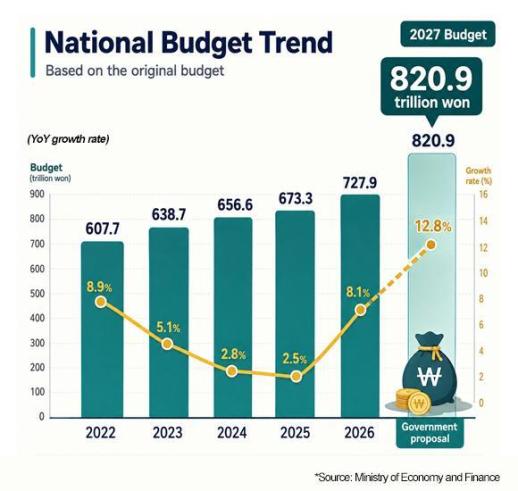 Chip windfall bankrolls Korea's record $600 bn budget for '27 SEOUL, September 01 (AJP) -Seoul has proposed a record 820.9 trillion won ($599 billion) budget outline through its biggest-ever increase of nearly 13 percent, riding on the chip windfall to invest in future growth instead of increasing immediate spending that can go counter to tightening monetary policy. Total spending for 2027 will rise 93 trillion won, or 12.8 percent, from this year's original budget, crossing the 800 trillion won threshold for the first time and exceeding the 10.6 percent increase recorded in 2009 during the global financial crisis. The expansion differs from past emergency periods because it is being financed by excess tax revenue generated by red-hot chip exports, corporate earnings and the stock-market rally, rather than resorting to national reserves or debt. Total government revenue is projected to surge 30.4 percent to 880.8 trillion won next year. National tax revenue alone is expected to jump 49.8 percent to 584.4 trillion won. The spending targets also differ from past periods of fiscal expansion. At the center of the plan is a new 162.3 trillion won Future Response Fund designed to prevent the extraordinary tax windfall from simply flowing into ordinary government expenditure. The fund will be financed primarily with tax revenue exceeding the 10-year trend in domestic tax collections, effectively setting aside much of the upside from the current revenue boom for longer-term investment and a fiscal buffer. Of the amount accumulated next year, 45.4 trillion won will be deployed across four priority areas: 14.2 trillion won for future growth engines, 13.3 trillion won for younger generations, 10.3 trillion won for regional development and 7.6 trillion won for education and talent. New projects include 4.7 trillion won for frontier-level artificial intelligence development and 1.4 trillion won for universal public rental housing. Projects will be selected under what the government calls its "NEXT" principle, standing for New-capital, Enterprising investment, flexible execution and Timely deployment. Another 12.5 trillion won will be used to reduce new government bond issuance. The government argues against using the entire windfall for large-scale debt repayment, saying an abrupt reduction in government bond issuance could disrupt the government bond market. That leaves 104.4 trillion won in reserve, which will be supplemented by any additional excess tax revenue identified when the government revises its revenue estimate later this month. Government officials have raised the possibility that the fund could ultimately approach 200 trillion won in its first year. The unprecedented fiscal expansion nevertheless jolted the bond market. The three-year government bond yield rose 4.5 basis points to 3.883 percent by midday Tuesday, while the benchmark 10-year yield climbed 6.5 basis points to 4.378 percent. The selloff was sharper at the longer end of the curve, reflecting concerns over the longer-term debt outlook. The 20-year yield surged 8.6 basis points to 4.576 percent and the 30-year yield jumped 9.5 basis points to 4.622 percent. Other financial markets also weakened. The won fell to 1,370.7 against the U.S. dollar, while the KOSPI reversed earlier gains to trade 0.37 percent lower. Planning and Budget Minister Park Hong-keun described the fund as "a strategic investment platform for using large-scale tax revenue for productive spending and a fiscal stabilization mechanism that improves the efficiency of fiscal management." President Lee Jae Myung acknowledged that tension Tuesday as the Cabinet approved the spending plan. "Higher interest rates are unavoidable now," Lee said. "Fiscal policy must play a finely calibrated role in minimizing the pain for vulnerable groups caused by higher rates and ensuring that growth potential is not damaged." The BOK last week raised its benchmark interest rate for a second consecutive meeting to 3 percent, maintaining a hawkish stance as stronger economic growth and persistent inflation reduced the case for monetary easing. Budget Minister Park argued that the record spending increase therefore should not be viewed as conventional fiscal stimulus aimed primarily at boosting consumption. "The budget was not designed to scatter cash in populist handouts or concentrate on simple consumption spending," Park said. Support for younger people and vulnerable households will inevitably stimulate some demand, he said, but the greater emphasis has been placed on infrastructure, research and development and other investment intended to raise Korea's potential growth rate and productive capacity. Such spending should ultimately be compatible with the BOK's longer-term goal of price stability, Park said. "We need a productive virtuous-cycle fiscal strategy that uses increased future resources to enlarge the economic pie and upgrade industrial capabilities, which in turn expands fiscal capacity again," Lee said. The government expects the spending to help reverse a prolonged decline in Korea's potential growth rate while spreading the gains from the current economic upswing more broadly. "We should look at Korea's economic situation not on a single-year basis but as a long-term structural trend," Park said. "What deserves greater attention is the continued decline in growth potential and the potential growth rate." He said active fiscal investment was needed to make the current V-shaped economic recovery more durable. The revenue boom gives Seoul unusual room to pursue that strategy. South Korea's economy is expected to round above 3 percent this year thanks to the extraordinary chip exports, strongest since the post-pandemic rebound from recession-hit 2021. National tax revenue reached 274 trillion won through July, up 41.4 trillion won, or 17.8 percent, from a year earlier. Corporate tax receipts increased 4.4 trillion won to 51.8 trillion won, while securities transaction tax revenue more than quadrupled to 8.2 trillion won as trading activity surged. Income tax collections rose 12.2 trillion won to 89.3 trillion won, helped by stronger wages, performance bonuses and property transactions. The government had collected 66 percent of its revised full-year tax target by the end of July, compared with 60.8 percent a year earlier. Much of the fiscal expansion will be directed toward industries and infrastructure Seoul believes can extend the current growth cycle. The government will spend 21.3 trillion won, up 97.2 percent from this year, on three mega projects aimed at maintaining Korea's semiconductor advantage, establishing leadership in physical AI and expanding the power, water and industrial infrastructure needed to support them. Another 62.8 trillion won, up 22.7 percent, will go toward future growth engines including advanced strategic industries and the energy transition. Programs for younger Koreans will receive 43.3 trillion won, an increase of 53.5 percent. The largest allocation, 117.1 trillion won, will go toward what the government calls "growth for all," covering regional development and support for small businesses, farmers, fishermen and vulnerable workers. Another 38.3 trillion won will be spent on national security, supply-chain diversification, disaster preparedness and equipment needed for the planned transition of wartime operational control. The government will simultaneously pursue 107.6 trillion won in expenditure restructuring to make room for its priorities. Of that amount, 38.6 trillion won will come from discretionary spending cuts targeting small, habitual, unnecessary, low-performing and overlapping programs. Another 69 trillion won will come from mandatory expenditure changes, including reforms to tax-linked transfers to local governments and education authorities. Despite the record spending increase, the government's fiscal indicators are projected to improve sharply because revenue is rising even faster. The managed fiscal deficit is forecast at just 0.1 percent of gross domestic product next year, compared with 3.9 percent under this year's original budget. Park described the plan as a historic attempt to catch "two rabbits" at once: economic growth and fiscal soundness. The government plans to gradually moderate expenditure growth after next year, to 9 percent in 2028, 7 percent in 2029 and 5 percent in 2030. It aims to bring the managed fiscal deficit below 3 percent of GDP during Lee's term and lower the national debt ratio to around 48 to 49 percent. Seoul fears a reversal in the chip cycle could quickly weaken corporate tax receipts and argues the Future Response Fund is designed partly as protection against that risk, separating a large portion of above-trend revenue from ordinary spending and keeping more than 100 trillion won available to absorb future fiscal shocks. The government is seeking to amend the National Finance Act to allow spending under major categories of the fund to be changed by as much as 30 percent by presidential decree without prior parliamentary approval. The 2027 budget will be submitted to the National Assembly by Sept. 3. Parliament has until Dec. 2 to approve it. AJP Takeaways ○ South Korea proposed a record 820.9 trillion won budget for 2027, raising spending 12.8 percent as a semiconductor- and stock-market-driven tax windfall sharply expands government revenue. ○ A new 162.3 trillion won Future Response Fund will channel above-trend tax receipts into AI, future growth engines, youth and regional development while retaining more than 100 trillion won as a fiscal buffer. ○ President Lee Jae Myung and Planning and Budget Minister Park Hong-keun argue the spending surge does not conflict with BOK tightening because the budget emphasizes productive investment and targeted support rather than broad consumption stimulus. 2026-09-01 12:38:58
 -
South Korea Allocates 1.4 Trillion Won for Disease Prevention and Pandemic Preparedness The Korea Centers for Disease Control and Prevention (KCDC) has announced a budget exceeding 1.4 trillion won for the upcoming year. This budget focuses on advanced vaccine research and development to prepare for the next potential pandemic and aims to enhance the quality of vaccines provided for free to youth and seniors.On September 1, KCDC revealed its 2027 budget plan of 1.4347 trillion won, an increase of 988 billion won (7.4%) from this year's budget of 1.3359 trillion won. The budget emphasizes strengthening the national crisis management system to address infectious diseases and chronic illnesses that threaten daily life.Quality of Free Vaccines for Youth and Seniors to ImproveA significant change will be the upgrade of the 'national vaccination program' for youth and seniors. The human papillomavirus (HPV) vaccine will be replaced with the '9-valent vaccine,' which can prevent nine types of viruses, doubling the previous four types and significantly enhancing cancer prevention effectiveness. Additionally, the age for male youth eligible for the free vaccine will be expanded from 12 to 13 years.The vaccine for pneumococcus, which poses a threat to seniors, will also be upgraded to a 'conjugate vaccine (PCV)' that offers broader protection and longer-lasting defense compared to the previous polysaccharide vaccine. Furthermore, the age limit for free influenza vaccinations for school-aged children will be raised from 14 to 15 years.Preparing for the Next Pandemic with Antiviral Stockpiles and AI Vaccine DevelopmentKCDC is also establishing a robust defense against potential new infectious diseases similar to the COVID-19 pandemic. The agency plans to invest 25.5 billion won to proactively purchase and stockpile antiviral medications to treat patients and prevent the spread of new influenza and other domestic infectious diseases. Additionally, KCDC will acquire personal protective equipment worth 5 billion won to protect healthcare workers fighting against viruses.Investment in research and development (R&D) for future medical technologies will also see a significant increase. KCDC will allocate 8 billion won to establish the 'Korean Pandemic Preparedness Engine (K-AI PPX),' which utilizes artificial intelligence (AI) to analyze new viral pathogens and rapidly design vaccines.Moreover, 40.5 billion won will be designated for the development of next-generation mRNA vaccine platforms, and for the first time, 1.5 billion won will be allocated for the development of domestically produced mRNA antibody treatments.Enhanced Surveillance for Disease-Carrying Mosquitoes and Ticks Amid Climate ChangeAs climate change leads to an increase in disease-carrying mosquitoes and ticks, KCDC will expand its real-time surveillance network from seven to over ten locations. A new specialized monitoring center will focus on analyzing vectors entering the country to prevent the early introduction of unfamiliar infectious diseases.In addition, KCDC will support monitoring efforts at approximately 530 emergency rooms for heat-related and cold-related illnesses, enhancing real-time monitoring systems, including the development of predictive models for heat-related illnesses. An investment of 400 million won is planned to conduct in-depth monitoring of heatwave impacts and accurately assess their characteristics.Im Seung-kwan, head of KCDC, stated, “We are focusing on strengthening our core functions, including the transition to next-generation vaccines, enhancing the coverage of national vaccination programs, and improving the crisis management system for new infectious diseases. We will ensure the safety and health of the public against various health threats, including the next pandemic.”* This article has been translated by AI. 2026-09-01 12:36:00