


Latest by
-
 Trump Warns of 50% Tariff Increase on Canadian Cars, Impacting U.S. Auto Industry Donald Trump, the President of the United States, has announced plans to increase tariffs on Canadian-made cars, auto parts, and steel to 50% starting next year, prompting a strong backlash from the Canadian auto industry. Canadian officials argue that the close integration of the U.S. and Canadian auto supply chains means that such tariffs would not only harm Canadian companies but also impact the production and competitiveness of U.S. automakers. There are also concerns that competitors from South Korea, Japan, and Germany could gain a relative advantage.On August 24, Trump stated on his social media platform, Truth Social, "Canada has been exploiting the U.S. for a long time," and announced that starting January 1, 2027, tariffs on all cars, light and heavy trucks, auto parts, and steel would rise to 50%. He added, "If produced in the U.S., there will be no tariffs," pressuring companies with production facilities in Canada to relocate to the U.S. This announcement follows the U.S. imposing a 50% tariff on approximately $20 billion worth of Canadian products, including wine, hockey sticks, and cement, starting August 22. The proposed increase in auto tariffs would double the current 25% rate.In response to the news, shares of Stellantis fell 4.8% on the New York Stock Exchange, while Ford and General Motors (GM) saw declines of 3.3% and 1.1%, respectively. Many vehicles produced in Canadian factories are exported to the U.S., so the implementation of these auto tariffs would inevitably harm the Canadian auto sector.While some in the Canadian auto industry express caution about whether Trump's statements will translate into actual policy, there is growing concern that if the tariffs are enacted, they could deliver a significant shock to the entire North American auto industry.Lucas Malinowski, president of the Canadian Global Automotive Manufacturers Association, told Canadian broadcaster CBC that there have been instances in the past where Trump's similar statements did not lead to actual changes in tariffs or trade policy, saying, "We are watching to see if this will actually happen." His organization represents major non-U.S. automakers with production facilities in Canada, including Hyundai, Toyota, Volkswagen, BMW, Honda, and Nissan.However, Malinowski also noted that if the 50% tariff is implemented, it would be "very concerning for the Canadian auto industry, but it would also have adverse effects on the U.S. auto industry, leading to destructive outcomes."U.S. Auto Industry Also Faces Potential ImpactCanadian auto industry representatives emphasize that the U.S. and Canadian auto supply chains cannot be easily separated along the border. A significant portion of vehicles and parts produced in Canada are exported to the U.S., while parts made in the U.S. are sent to Canadian factories. If the U.S. imposes high tariffs on Canadian parts, it would not only increase costs for Canadian companies but also raise production costs for U.S. automakers importing those parts. Canada has also imposed a 25% tariff on certain U.S. products, including some steel and aluminum, in response to U.S. auto tariffs last year, citing violations of the United States-Mexico-Canada Agreement (USMCA).Flavio Volpe, president of the Automotive Parts Manufacturers' Association (APMA), argued that the U.S. tariffs would be borne by American "importers" rather than Canadian companies, asserting that tariffs on Canadian auto parts would lead to increased costs for U.S. automakers.Additionally, there are reports that automakers from South Korea, Japan, and Germany could find themselves in a relatively advantageous position. In the past, Canadian auto industry associations have raised concerns that U.S. tariffs on Canadian-made cars and steel have placed U.S. automakers at a disadvantage compared to their South Korean, Japanese, and German counterparts, who have been able to procure Canadian products under more favorable tariff conditions for sale in the U.S. market.Ultimately, if Trump's proposed tariffs on Canadian cars and parts are implemented, one of the world's most closely integrated auto supply chains could face significant disruption, according to Reuters.Meanwhile, some speculate that the timing of Trump's proposed tariffs, set for next January, after the November midterm elections, could lead to a postponement or withdrawal of the tariffs depending on the situation. Local auto industry executives, speaking on condition of anonymity, expressed skepticism to Reuters about the likelihood of the tariffs being enacted, noting that Trump has previously scaled back or postponed tariffs after announcing them.* This article has been translated by AI. 2026-08-25 15:12:00
 -
KakaoPay Receives Compensation After 2022 Data Center Fire KakaoPay has confirmed it received compensation related to the fire at the SK AX data center in Pangyo in 2022. This settlement comes after nearly four years of negotiations between Kakao and SK AX over losses incurred due to the disruption of key services such as payments, remittances, and loan brokerage.On August 25, financial industry sources reported that the KakaoPay board recently approved a compensation agreement regarding the damages from the SK AX data center fire.SK AX has made a lump-sum payment to Kakao, which has since distributed the funds among affected subsidiaries, including KakaoPay. The total amount of the settlement and the specific allocation to KakaoPay have not been disclosed.The fire at the SK AX data center in Pangyo in October 2022 led to significant service interruptions for major Kakao services, including KakaoPay, KakaoT, KakaoMap, and Daum. KakaoPay experienced disruptions in its core services, including payments, remittances, loan brokerage, and transportation card services, resulting in user inconvenience and business losses.In response, KakaoPay extended the validity of point coupons and implemented other customer compensation measures, while other subsidiaries also offered service extensions and additional coupons and points.The total compensation provided by the Kakao community to users and business partners is estimated at approximately 27.5 billion won. Of this, 50 million won was distributed to 205 small business cases that met the compensation criteria. Additionally, around 900 small business owners received 45 million won worth of KakaoTalk channel cash.When accounting for revenue losses due to service interruptions and costs associated with recovery efforts, the total losses incurred by the Kakao community likely exceeded the 27.5 billion won allocated for user compensation.The lengthy negotiations over the compensation agreement were attributed to significant disagreements regarding the total amount of damages and the extent of responsibility for both parties. Kakao and SK AX clashed over whether the facts surrounding the fire and the power shutdown plan were adequately communicated, as well as who was responsible for the prolonged service disruptions.Kakao maintained that the delay in server and service recovery was due to inadequate initial communication and notification regarding the power shutdown. Conversely, SK AX argued that the power shutdown was unavoidable due to requests from fire authorities and that Kakao's lack of server redundancy and disaster recovery systems contributed to the prolonged disruptions. The key issues in the compensation negotiations revolved around the responsibilities for power and facility management at the data center and the backup and recovery responsibilities of the tenant companies.There were concerns that Kakao might seek reimbursement from SK AX after compensating users and small business owners, which could lead to litigation. However, both companies ultimately chose to settle to avoid the costs and uncertainties associated with prolonged legal battles.A financial industry source stated, "The prolonged service disruptions and the complex issues surrounding the amount of damages and responsibility contributed to the lengthy negotiations. Both parties aimed to reduce the burden of litigation and ensure stable management, leading to the final agreement."* This article has been translated by AI. 2026-08-25 15:08:00
-
Long-Term Interest Rates Rise Amid Increased Bond Supply Pressure As long-term bond rates rise sharply, the South Korean government's 8·13 comprehensive real estate measures are emerging as a factor for increased supply of high-quality bonds, including corporate and bank bonds. Analysts warn that the combination of rising global long-term interest rates and domestic government bond supply pressures could exacerbate the burden on the bond market, especially with increased funding needs for housing supply.According to the financial sector on the 25th, the Korea Land and Housing Corporation (LH) has issued bonds worth 11.2 trillion won this year, surpassing last year's total issuance of 9 trillion won. The net issuance, excluding maturities, is expected to exceed 10 trillion won in the near future.The increase in LH bond issuance is driven by rising project costs for the construction of third-phase new towns and public housing. Additionally, the government's commitment to start construction on 1.35 million housing units by 2030, including over 230,000 units in the metropolitan area, is expected to further increase funding demands.The Housing Finance Corporation (HUG) is also likely to increase its bond issuance. HUG's bond issuance this year is projected to reach 8.6 trillion won, exceeding last year's total of 6.2 trillion won. Under the 8·13 measures, HUG's guarantee supply for normal real estate project financing is set to expand from 3.7 trillion won last year to between 9 trillion and 13 trillion won annually over the next three years. This expansion, along with support for reconstruction, redevelopment, relocation loans, and policy products for young and actual homebuyers, is expected to increase HUG's external funding needs.Bank bonds are also contributing to the supply pressure. The government has raised its target for household debt growth from 1.5% to 3% this year, creating an additional loan capacity of about 30 trillion won in the financial sector. If a significant portion of this is allocated to relocation and interim payments, the demand for bank funding will increase, leading to greater pressure for bank bond issuance.Bonds issued by public institutions like LH and HUG, as well as bank bonds, are classified as high-quality securities. With the burden of government bond issuance increasing, a simultaneous rise in these bonds could lead to competition among limited institutional investors, driving up bond rates. If rates on high-quality bonds rise, the issuance rates for general corporate bonds may also increase, potentially raising corporate funding costs.The key question is how much of the increased supply can be absorbed by investment demand. With the risk-weighted asset ratio for housing mortgage loans increasing this year, banks are expected to continue favoring low-risk assets like government bonds and certain public bonds. However, if government, public, and bank bond issuances all increase simultaneously, it may be challenging to absorb the entire volume with existing demand.Kim Sang-in, a researcher at Shinhan Investment Corp., stated, “With the 8·13 measures, the roles of LH, HUG, KAMCO, and other public institutions are expected to expand, leading to increased bond issuance from these entities. The relaxation of household debt total management regulations will also exert pressure on the issuance of bank bonds, making it difficult to alleviate the burden of high-quality bond supply.”* This article has been translated by AI. 2026-08-25 15:04:00
-
Book Your International Flights in August to Save on Fuel Surcharges If you are planning to travel abroad, the timing of your flight ticket purchase can significantly affect the burden of fuel surcharges. Korean Air's international fuel surcharges for September are set to rise sharply compared to August.According to Korean Air, the one-way fuel surcharge for flights from Incheon to Tokyo and Osaka will increase from 49,600 won in August to 66,000 won in September, a rise of 16,400 won. For destinations like Bangkok, Singapore, and Guam, the surcharge will jump from 99,200 won to 153,000 won, an increase of 53,800 won.The increases are even more pronounced for long-haul routes. The one-way surcharge for flights from Incheon to Los Angeles, London, and Paris will rise from 225,600 won to 325,500 won, an increase of 99,900 won. For flights to New York, Chicago, and Boston, the surcharge will go up from 259,200 won to 354,000 won, a rise of 94,800 won.Travelers should note that fuel surcharges are based on the ticket purchase date, not the departure date. If you book your ticket in August, the August surcharge will apply even if you depart in September. Conversely, if you book in September, the September surcharge will apply regardless of your departure date. After purchase, any changes in fuel surcharges before your flight will not result in additional charges or refunds.However, the amounts announced by Korean Air are based on one-way flights departing from Korea. The fuel surcharge for the return leg may vary depending on the country of departure, so travelers should check the total cost during the booking and payment process.The increase in September fuel surcharges is attributed to rising jet fuel prices. The average price of jet fuel during the calculation period for September is $149.29 per barrel, which is 25.4% higher than the $119.06 per barrel during the calculation for August. Consequently, the number of levels for international fuel surcharges has increased from 14 to 21.* This article has been translated by AI. 2026-08-25 14:56:00
-
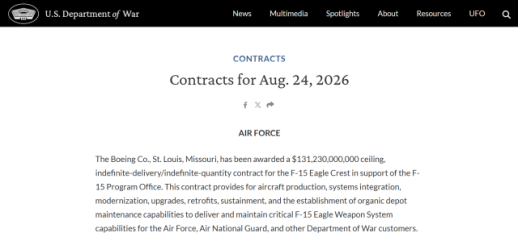 Boeing secures $131B F-15 contract covering South Korea SEOUL, August 25 (AJP) - Boeing has secured a U.S. Air Force contract with a ceiling of $131.23 billion for production, upgrades and long-term support of the F-15 fighter family, with South Korea included among seven countries covered by potential Foreign Military Sales. The U.S. Department of War said Monday that Boeing had been awarded an indefinite-delivery, indefinite-quantity, or IDIQ, contract for the F-15 Eagle Crest program, which supports the Air Force's broader F-15 fleet. The contract covers what the department described as "aircraft production, systems integration, modernization, upgrades, retrofits, sustainment," as well as the establishment of depot maintenance capabilities. Work will be carried out in St. Louis, Missouri, and is expected to continue through August 2037. The initial ordering period runs through Aug. 24, 2031, with an option to extend it for another five years through August 2036. "This contract involves Foreign Military Sales to Japan, Israel, Saudi Arabia, South Korea, Singapore, Indonesia, and Poland," the department said. The deal was awarded to Boeing on a sole-source basis. The $131.23 billion figure represents the maximum potential value of the IDIQ contract rather than money immediately committed to Boeing. Such contracts establish an overall framework under which individual orders can be placed over time without guaranteeing that the full ceiling will ultimately be spent. Only $343,740 in fiscal 2026 research, development, test and evaluation funding was obligated at the time of the award, according to the department. The announcement also does not specify how much of the potential contract value is associated with South Korea or indicate that Seoul is purchasing additional F-15 aircraft. South Korea operates the F-15K Slam Eagle, a customized version of the F-15E that has served as one of the Republic of Korea Air Force's principal long-range strike aircraft since its introduction in 2005. Seoul is already undertaking a major modernization of its F-15K fleet. In January, the U.S. government awarded Boeing a separate contract worth up to $2.81 billion to design and develop an integrated package of upgrades for South Korea's F-15Ks. The department said that contract would support modifications for the Republic of Korea Air Force and the Defense Acquisition Program Administration and would run through the end of 2037. The latest Eagle Crest contract therefore provides a much larger long-term contracting framework covering the U.S. F-15 fleet and several overseas operators, including South Korea, rather than representing a new $131.23 billion aircraft purchase by Seoul. AJP Takeaways · Boeing secured a $131.23 billion ceiling contract for the F-15 Eagle Crest program, covering aircraft production, modernization, upgrades and long-term sustainment. · South Korea is among seven countries included in potential Foreign Military Sales under the contract, alongside Japan, Israel, Saudi Arabia, Singapore, Indonesia and Poland. · The $131.23 billion figure is a maximum contract ceiling, not a confirmed purchase by South Korea, which is separately modernizing its F-15K fleet through a Boeing upgrade program. 2026-08-25 14:53:10
 -
Korean Sports Association Wins OCA Asia Sports Science Award After 27 Years The Korean Sports Association announced on August 25 that it has been selected as the recipient of the 8th OCA Asia Sports Science Award, presented by the Olympic Council of Asia (OCA). This marks the first time in 27 years that a Korean organization has received this honor since the late Dr. Ha Kwon-ik was the inaugural awardee in 1999.The OCA, established in 1982 in New Delhi, India, comprises National Olympic Committees (NOCs) from 45 Asian countries. The Korean Sports Association Medical Center earned this award for its clinical and research capabilities, as well as its achievements in international cooperation, particularly in providing medical support to national athletes, researching sports injuries, and engaging in international exchanges in sports science.The Medical Center is responsible for injury prevention, diagnosis, treatment, rehabilitation, and health management for national athletes. It also conducts research on the epidemiology and prevalence of sports injuries. The center has published its research findings in international journals, establishing a sports science system that links clinical practice and research. Additionally, it has consistently participated in international cooperation activities, including field training and medical supplies support for developing countries.Yoo Seung-min, president of the Korean Sports Association, stated, "This award is a recognition of the efforts and expertise of the Medical Center's team, who have long been dedicated to improving the health and performance of our national athletes. Sports science is a key area that supports not only injury treatment but also prevention, rehabilitation, and overall health management throughout an athlete's career."He added, "The Korean Sports Association is enhancing the professionalism and independence of the Medical Center by upgrading its existing medical science department. We are continuously advancing the medical support system for national athletes and plan to expand our advanced medical equipment, such as MRI and CT machines, to further strengthen the competitiveness of sports science in South Korea."Furthermore, he emphasized the commitment to support the Medical Center in becoming a leading institution in sports science research and international cooperation, aiming to develop into a hub for sports science in Asia.In light of this award, the Korean Sports Association plans to strengthen its medical support system for national athletes and expand its research and international cooperation in sports science.Kim Hyun-cheol, head of the Medical Center, remarked, "This award reflects the long-term accumulation of clinical and research efforts in athlete health management and sports injury fields. We will continue to develop standardized protocols for injury prevention and athlete health management, linking our clinical experiences and research outcomes to an internationally applicable level."* This article has been translated by AI. 2026-08-25 14:52:00
-
 More than half of pensioners get less than 500,000 won per month SEOUL, August 25 (AJP) - Pensioners received an average of 737,000 won (US$534) per month in 2024, up 6 percent from a year earlier, but more than half or 53 percent received less than 500,000 won per month, according to data released by the Ministry of Data and Statistics on Tuesday. The ministry said some 9.12 million people aged 65 and older received at least one of about a dozen types of public and private pensions. But despite more than 90 percent of the elderly population being covered by these pensions, up 0.3 percentage points from a year earlier, 878,000 people or 8.8 percent had no such income. The average monthly payment remained only about half of the 1.34 million won minimum cost of living for a single-person household in 2024, though it rose by 42,000 won from a year earlier. The median monthly pension payment was even lower at 497,000 won, with those receiving between 250,000 won and 500,000 won accounting for the largest share at 46.7 percent, followed by those receiving between 500,000 won and 1 million won at 33.8 percent. Some 9.5 percent received between 1 million won and 2 million won, while 6.3 percent received 2 million won or more. Those receiving less than 250,000 won accounted for 3.6 percent, meaning that 50.3 percent of elderly pensioners received less than 500,000 won per month. By pension type, state-funded pensions for financially vulnerable people and those with disabilities had the largest number of recipients at 6.76 million or 74.1 percent of all recipients. They were followed by another state-run pension for ordinary salaried workers with 5.21 million recipients, similar pensions for civil servants, military personnel and private school employees with 595,000, individual private pensions with 496,000 and others. Some 3.93 million people received pensions from two or more programs, accounting for 39.3 percent of those aged 65 and older. And homeowners generally received more pension income than those without homes, while men received considerably more than women, with male recipients receiving an average of 957,000 won per month, compared with 546,000 won for female recipients, reflecting differences in how much and how long they paid into pension programs during their working years. "As men are more likely to participate in economic activity and remain employed longer, they tend to have higher pension coverage," a ministry spokesperson said. AJP Takeaways • South Korean pensioners aged 65 and older received an average of 737,000 won ($534) per month in 2024, up 6 percent from 2023, according to the Ministry of Data and Statistics. • More than half of elderly pensioners received less than 500,000 won per month in 2024, with 50.3 percent falling below that amount and the median monthly pension payment standing at 497,000 won. • Pension coverage among South Koreans aged 65 and older reached 91.2 percent in 2024, but 878,000 people, or 8.8 percent, had no pension income. 2026-08-25 14:50:25
 -
Controversy Erupts Over Compensation for Descendants of Donghak Peasant Revolution Participants The Jeonbuk Special Self-Governing Province has decided to provide an annual allowance of 1.2 million won to 723 descendants of participants in the Donghak Peasant Revolution, sparking a heated debate on online communities. Some netizens have raised concerns about equity, arguing that support should prioritize descendants of other historical contributors, such as independence activists and Korean War veterans.On August 25, Jeonbuk announced that, under the "Ordinance on Supporting Commemoration Projects for the Donghak Peasant Revolution," it would grant the allowance to descendants of participants who have resided in the province for over a year. This amount has been doubled from the initially planned 600,000 won, with a total budget of 868 million won allocated for this year.Eligible recipients include children, grandchildren, and great-grandchildren of registered descendants as defined by the "Special Act on Restoring Honor for Participants of the Donghak Peasant Revolution." They must have been registered residents of Jeonbuk for at least one year as of January 1 of this year. Applications will be accepted from September 4 to 22 at local administrative offices, with payments scheduled for November and December.As news of the allowance spread, male online communities saw a surge in comments, with 900 responses within an hour, while female communities received over 500 comments in the same timeframe. Many users expressed concerns about fairness, suggesting that support should be directed towards descendants of those who fought in the Korean War or independence movements.One user remarked, "It seems more appropriate to clarify the identities of the descendants of Korean War veterans or independence activists and support them instead." Another added, "Now that Jeonbuk has set a precedent, will we also demand compensation for the March 1st Movement, April 19th Movement, and the Busan-Masan Uprising?"Criticism has also been directed at local financial management and welfare policies. Comments included, "Despite having one of the lowest financial independence rates, Jeonbuk is leading the way in various giveaway policies," and "What does logic matter? When has this country ever been governed by reason?"Jeonbuk views the allowance as a step towards enhancing national recognition for participants and their descendants of the Donghak Peasant Revolution. Governor Lee Won-taek stated, "The payment of the allowance is a meaningful start to honor the legacy of the participants and to pass on their spirit to future generations," emphasizing the need for expanded national recognition.The Donghak Peasant Revolution, which took place in 1894, was a popular uprising led by Donghak leaders and farmers against corruption and foreign influence in the feudal society. Jeonbuk considers it a significant historical event in modern history. 2026-08-25 14:48:10
-
Insurance Fraud Incentives: The Dual Faces of Claims Adjusters In June, before the peak of summer heat, a young man in his early thirties filled a quiet bar in Dapsimni-dong, Dongdaemun-gu, with his voice. He spoke with the pride typical of young professionals discussing their jobs.His story was intriguing. He boasted about catching an 'insurance fraudster' and receiving a reward from his company. Although his account was exaggerated, he confidently displayed photos to prove he was a valuable member of society.Curious about a civilian catching an insurance fraudster, I listened closely. The photo he showed was of a chart board hanging in his office. He claimed to have caught 13 fraudsters that month alone.The issue arose during a subsequent phone call with an elderly man. The young man said, "Sir, this is how we help you get your money. If you have questions, it’s the senior hospital that suggested your case needs further review, and we are just following their advice."After hanging up, he grimaced and remarked, "People are such a nuisance at night; no wonder they get cancer," before taking another drink.Using the business card he left on the table, I investigated further. It belonged to a claims adjustment company affiliated with Company M. I asked a contact in the industry how claims adjusters catch insurance fraudsters.They explained that 'insurance fraudster' is a colloquial term. Only a few qualified adjusters can register as formal claims adjusters. The actual work is often handled by teams of young professionals in their twenties and thirties who are contracted by large insurance companies.When a claim exceeds a certain amount due to illness or death, these adjusters immediately contact doctors at affiliated hospitals. A simple response indicating that the cause of surgery, treatment, or death requires 'further review' is sufficient. This makes entertaining doctors at senior hospitals a necessary part of their job.From this point, the strategy is to delay payments. Although legal interest accrues, it doesn’t matter. If payments are postponed for six months or a year, it is the policyholder, not the insurance company, who suffers from mounting medical bills. When the policyholder is in a tight spot, they propose a settlement. For instance, if the rightful claim is 50 million won, they might offer 10 million won to close the case. Company M explains that the amount of insurance payment can be adjusted through negotiation if the policyholder desires.As a result, the insurance company saves 40 million won in payouts. A portion of this amount is given to the claims adjustment company as an incentive. An industry insider noted that a claims adjuster with two years of experience could earn an incentive of 3 million won per month. They refer to this practice as 'catching insurance fraudsters.'It is not easy for policyholders to counter this. Typically, they hire a separate claims adjuster under a contract that pays a commission of about 20% of the total insurance payout.I contacted another company affiliated with Company M and asked, "Do you receive incentives for reducing insurance payouts?" An employee who introduced themselves as being in their third month said they had not received any yet, but team leaders rely on incentives as a primary source of income.With recent advancements in medical technology, such as robotic surgeries, insurance payouts have increased, prompting insurance companies to intensify their efforts in 'catching insurance fraudsters,' according to a representative from one insurance firm.Consider an elderly person who has paid insurance premiums for years or even decades, not wanting to burden their family. After the self-proclaimed fraud-catching efforts, they may be left with only a small amount of money and a fruit basket. As long as the structure that rewards not paying out insurance remains, customers who trust and contract with insurance companies may find themselves labeled as the fraudsters they are trying to avoid.* This article has been translated by AI. 2026-08-25 14:48:10
-
Ruling Party Lawmakers Criticize Yoo Si-min's 'Monarchy' Remarks on Lee Jae-myung Lawmakers from the ruling Democratic Party's pro-Lee faction sharply criticized author Yoo Si-min on August 25 for his comments describing the party's situation as a 'monarchy' and claiming it has lost half its members, which they deemed a 'curse' and urged him to reflect on himself.Park Sun-won, who was elected to the Supreme Council during the August 17 party convention, questioned Yoo's affiliation with the party on Facebook, asking, 'Is he really a Democratic Party member?' He pointed out that while Yoo presents a progressive facade, his actions ultimately serve the interests of the opposition People Power Party.Representative Jeong Jin-wook labeled Yoo a 'cursing critic' and a 'shaman,' stating, 'Yoo Si-min contributes nothing to this world. The tragedy of shaman Yoo Si-min.'Chae Hyun-il also urged Yoo to stop insulting the Lee Jae-myung administration and the Democratic Party, emphasizing that while political commentary should be sharp, there is a difference between sharpness and rudeness. He criticized Yoo for selectively interpreting and distorting facts to undermine rather than critique.Veteran lawmaker Park Ji-won warned, 'If you truly wish to shake President Lee and assist the forces of insurrection that reject the candlelight revolution, then go that way. But if you choose the path of division, we all perish. Come back.'However, Han Min-soo, a representative from the pro-Chung faction, clarified on SBS Radio's 'Kim Tae-hyun's Political Show' that Yoo is not a politician in the current administration and is not an elected or appointed official, suggesting that Yoo was merely expressing his views as a critic.Earlier, on August 24, Yoo appeared on the YouTube channel 'Jang In-soo's Journalist' and commented on the results of the August 17 party convention, stating, 'What was confirmed at the convention is that we have lost half of our party members. This will have a very fatal impact on President Lee.'He further remarked that the election of Kim Min-seok as the party leader indicates that 'the president's attempt to decide and elect the party leader is a move towards monarchy and aristocracy.'* This article has been translated by AI. 2026-08-25 14:48:00