
The device, developed by the researchers at Columbia University School of Engineering and Applied Science, led by Samuel K. Sia, can perform a point-of-care test that simultaneously detects three infectious disease markers.
The device replicates, for the first time, all mechanical, optical and electronic functions of a lab-based blood test, they said.
The device performs an enzyme-linked immunosorbent assay (ELISA) without requiring any stored energy: all necessary power is drawn from the smartphone. It performs a triplexed immunoassay not currently available in a single test format: HIV antibody, treponemal-specific antibody for syphilis, and non-treponemal antibody for active syphilis infection.
By Ruchi Singh
Copyright ⓒ Aju Press All rights reserved.
Related News
-
 Court Rules Against HIV Patient's Disability Registration Appeal
An HIV-positive individual lost an administrative lawsuit challenging the denial of disability registration. The court ruled that the mere fact of HIV infection does not qualify as a disability, citing insufficient evidence to meet current legal criteria for disability.On October 28, Judge Seong Gyeong-hee of the Daegu District Court ruled against the plaintiff, identified as A, in a case against a local government official in Daegu regarding the refusal to register as disabled.Judge Seong stated, "The recognition or registration of a disability by the state or local governments is primarily a legislative policy issue within budgetary constraints," adding that the current Disability Welfare Act does not determine disability status solely based on a specific diagnosis.She further explained that considering A's average CD4 count, a measure of immune function, it is difficult to classify the immune impairment from HIV as severe. The court also found insufficient evidence to support claims of mental disability due to depression, respiratory issues from tuberculosis, or joint disorders meeting legal disability criteria.Judge Seong concluded that the case did not warrant referral to the Disability Assessment Committee, thus finding no procedural violations in the denial of registration and dismissing A's claims.A had initially applied for disability registration in October 2023, but the application was rejected due to incomplete documentation. Subsequently, the court ruled in November 2024 that the denial issued by an unauthorized official was invalid, favoring A.After reapplying in April, A faced another rejection for similar reasons and filed a new lawsuit. During the proceedings, A's legal team argued that the lack of established criteria for disability assessments constituted a failure by the administrative agency to conduct a proper review.The National Coalition for HIV Disability Recognition expressed its intention to appeal the ruling, stating, "Administrative agencies must thoroughly investigate the actual physical and mental conditions of disability applicants and conduct substantive reviews. The administration did not even conduct a review, and the court has granted it a free pass." The group also called on the Ministry of Health and Welfare to establish criteria and procedures for assessing the disability status of HIV-positive individuals and urged the National Assembly to pursue related legislation.* This article has been translated by AI.
-
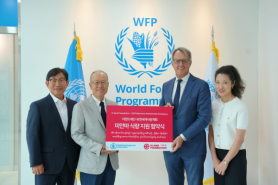 E-Land Foundation Provides 281 Tons of Food Aid to HIV and Tuberculosis Patients in Myanmar
E-Land Foundation representatives, including CEO Jeong Young-il (left), Chairman Jang Kwang-kyu, WFP Myanmar Director Michael Dunford, and WFP Korea Director Lee Hyun-ji, pose for a commemorative photo after the fund delivery ceremony on June 19. The E-Land Foundation has partnered with the United Nations World Food Programme (WFP) to provide food and nutritional support to vulnerable patients in the Yangon region of Myanmar.On June 19, the E-Land Foundation announced that it signed an agreement with WFP in Seoul and held a fund delivery ceremony. Attendees included E-Land Foundation Chairman Jang Kwang-kyu, CEO Jeong Young-il, WFP Korea Director Lee Hyun-ji, and WFP Myanmar Director Michael Dunford.The initiative will involve a total investment of $231,488 (approximately 320 million won). Over the next year, the E-Land Foundation and WFP will implement a food support program targeting vulnerable patients at seven partner clinics in Yangon.The program aims to assist approximately 1,700 patients suffering from immunodeficiency diseases, including HIV and tuberculosis. A total of 281 tons of food, including rice and legumes, will be provided. Nutritional assessments, counseling, and health education will also be offered to support the patients' recovery and nutritional needs during their treatment.E-Land Myanmar has previously engaged in community support activities, including providing clean water and sanitation, improving living conditions, and supporting orphanages. This initiative is part of a broader plan to expand community cooperation. An E-Land Foundation representative stated, "We will continue to work with WFP to ensure that practical support reaches those in need."In addition, the E-Land Foundation is expanding its support for vulnerable groups both domestically and internationally. On June 18, it held a fund delivery ceremony with BonIF and announced that 10 million won raised through the 'Good Menu, Delicious Donation' campaign will be used to support marginalized future generations. The funds will be distributed as dining vouchers to 500 individuals, including homeless youth, young people preparing for independence, children from vulnerable multicultural families, and isolated youth.* This article has been translated by AI.
-
Africa’s Biggest International HIV And AIDS Conference Opens In Zimbabwe
The largest gathering on HIV and AIDS and Sexually transmitted infections, in Africa has officially commenced in Harare, Zimbabwe. where countries took stock of the achievements and challenges they have encountered in response to HIV and AIDS over the past decades. The six-day conference, under the theme of "AIDS in Post 2015 Era: Linking Leadership, Science and Human Rights", brings together more than 5,000 delegates from around the world including the world's leading scientists, policy makers, activists, people living with HIV and government leaders to showcase new research findings, and strategies towards achieving the global target of ending the AIDS epidemic by the year 2030. The conference being organised from 29th November – 4th December 2015, by the Society for AIDS in Africa (SAA). Zimbabwean Health Minister David Parirenyatwa said about ICASA as “a tremendous platform for researchers from all around the globe to share latest scientific advances in the field, learn from others experiences and develop strategies for facets of a collective effort to prevent and treat HIV.” Importantly, it is to strengthen the interaction between the public health, science and human right approaches in the control and elimination of the HIV/AIDS and associated diseases. ICASA 2015 is co-chaired by Dr Ihab Abdel Rhaman Ahmed, President of the Society for AIDS in Africa (SAA), and Dr. Pagwesese David Parirenyatwa, Zimbabwe's Health and Childcare Minister. Present at the opening ceremony of the week-long conference were; Mr Michel Sidibé the Executive Director of UNAIDS, and Dr Matshidiso Rebecca Moeti, WHO Regional Director for Africa. UNAIDS estimates there were 1.4 million new HIV infections in 2014, in sub-Saharan Africa, a drop of 41% since 2000. Currently, there are about 11 million people in Africa receiving HIV treatment, a massive rise from the about 11, 000 persons who were on HIV treatment 15 years ago. By Ruchi Singh