
In an op-ed carried by the state-run Korean Central News Agency (KCNA), it said Lee insulted North Korea by describing it as a "poor but fierce neighbor" while talking about the North's denuclearization, which it claimed "showed his true colors as a hypocrite to the whole world."
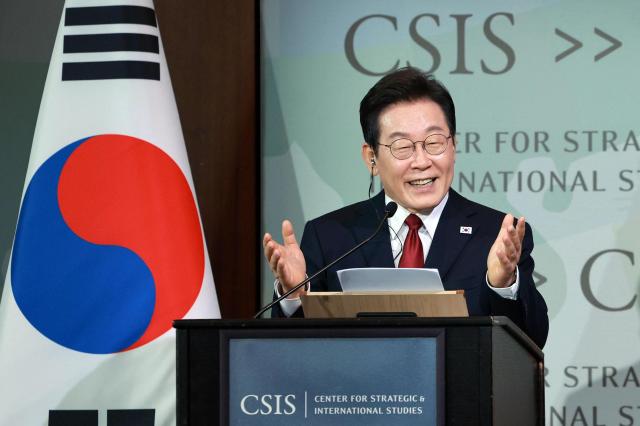
Lee said the previous day that South Korea will "modernize" its bilateral alliance with the U.S. to "counter" any provocation while working closely with the U.S. to engage in talks with North Korea for the denuclearization of the Korean Peninsula, during a speech at the Center for Strategic and International Studies after wrapping up his first summit with U.S. President Donald Trump at the White House.
Calling his remarks about denuclearization a "sheer sophism," it further criticized Lee, saying he "did not hide his real intention and revealed his true colors as a confrontation maniac," just 80 days after taking office.
"It is a daydream for the [South], the one and only political poor in the world who has offered all its sovereignty to the U.S., to cherish an absurd hope for 'denuclearization' unaware of the nature of the nuclear issue of the [North]," it blasted.
Stressing its strong resolve not to give up its nuclear arsenal, it added, "We once again remind him of the fact that our position as a nuclear weapons state is an inevitable option that correctly reflects the hostile threat from outside and the change of the structure of the world security dynamics."
The state media also criticized Lee's recent "three-stage denuclearization" proposal, calling it a "naive dream." Just days ahead of his trip to the U.S., Lee proposed the idea that would freeze North Korea's nuclear and missile programs as a first step, eventually leading to permanent denuclearization through a phased reduction.
Lee has shown a series of conciliatory gestures toward North Korea despite the North's snub of his overtures.
Copyright ⓒ Aju Press All rights reserved.
Related News
-
 Editorial: Beyond the toast of Korea's $1 trillion export milestone
A citizen looking over Seoul from Namsan Tower in central Seoul. AJP Yoo Na-hyun South Korea has finally entered the era of $1 trillion in annual exports, becoming only the fourth country in the world to reach the milestone after the United States, Germany and China. Even Japan has yet to cross that threshold. A nation once short of natural resources and capital has risen into a global manufacturing powerhouse. It is a historic achievement built on the entrepreneurial spirit of business leaders, the sweat of workers, the determination of engineers and decades of industrial policy. Yet as the nation raises a toast, it must confront two questions. How much of this export success is translating into better lives for ordinary Koreans? And how long can the boom last? Semiconductors have powered this year's export record, accounting for 42.7 percent of total shipments in the January-October period. The explosive growth of artificial intelligence (AI) and worldwide investment in data centers have presented the Korean economy with an extraordinary opportunity. But the more dependent an economy becomes on a single industry, the more vulnerable it becomes when that industry falters. The U.S. Federal Reserve recently warned in its Financial Stability Report of a surge in debt issuance tied to advanced computing infrastructure, including AI data centers. Such issuance exceeded $680 billion through October this year, roughly five times the amount recorded in all of 2023. If these enormous investments fail to generate sufficient returns, both corporations and financial markets could face serious strains. The parallels with the dot-com bubble around the turn of the millennium are difficult to ignore. The internet did not disappear when the bubble burst. On the contrary, it went on to transform the global economy. But countless companies built on inflated expectations collapsed along the way. A technological revolution does not necessarily guarantee investment success. The same holds true for AI. What Korea must guard against is not AI itself, but indiscriminate investment and excessive confidence in the semiconductor boom. If chip prices fall and global AI spending undergoes a correction, exports, corporate earnings, capital investment and tax revenues could all suffer at once. When the tide of prosperity recedes, the underlying strength of the Korean economy will be laid bare. How, then, should Korea prepare for its future? The answer lies partly in its own history of industrialization. Korea's manufacturing success was built on its ability to adapt to shifts in the global order. During the Cold War, it capitalized on the international political environment to lay the foundations for industrialization. After China joined the World Trade Organization (WTO), Korea expanded exports of intermediate goods, including semiconductors, steel and petrochemicals. In shipbuilding, automobiles and electronics, it accumulated technological expertise and established a commanding presence in global markets. But yesterday's formula for success offers no guarantee of tomorrow's prosperity. China is no longer merely the world's factory, assembling products from components imported from Korea. It has become a formidable competitor in electric vehicles, batteries, solar power and advanced manufacturing. The United States, meanwhile, is reinforcing protectionism and industrial policies centered on domestic production. The rules of global trade are being rewritten. An era in which price and production capacity largely determined competitiveness is giving way to one in which technology, supply chains, economic security and trust matter just as much. Korea International Trade Association (KITA) staff in photo session to mark Korea's $1 trillion export milestone on Nov. 19, 2026. (Courtesy of KITA) For Korea, this transformation presents both a threat and an opportunity. Few countries possess Korea's breadth of manufacturing capabilities across semiconductors, automobiles, shipbuilding, steel, batteries and electronics. That industrial diversity is a powerful strategic asset in the emerging international order. Korea must now evolve beyond exporting finished products to exporting technology, production systems and entire industrial ecosystems. It should expand networks of industrial cooperation linking Europe, the Association of Southeast Asian Nations (ASEAN), India, the Middle East and Latin America. Economic diplomacy must also be reoriented toward joint investment, technological partnerships and resilient supply chains. Domestic industrial policy must change as well. Investment in AI and semiconductors must continue. But Korea should move beyond competing simply on the scale of investment. Commercial viability, profitability, technological differentiation and employment benefits must be rigorously assessed. Physical AI, which brings artificial intelligence into machines and real-world industrial operations, offers a particularly important strategic path for a country with world-class manufacturing capabilities. Integrating AI into robotics, automobiles, shipbuilding, logistics, agriculture and health care could strengthen existing industries while creating entirely new ones. Biotechnology, aerospace, advanced materials and energy industries also deserve sustained support. Concentrating investment in strategic sectors is necessary, but the entire national economy must not become hostage to the fortunes of a single industry. Korea must also overhaul its institutions for entrepreneurship, investment, research and development, and talent cultivation so that a new generation of globally competitive companies can emerge. Above all, the success of exports must be translated into improvements in people's lives. Strong earnings at semiconductor giants do not automatically create jobs for young Koreans. A rising stock market does not necessarily mean higher sales for small businesses and the self-employed. AI can raise productivity, but it can also displace workers. If the gains from technological innovation accrue mainly to a handful of companies and investors, the gulf between the achievements of an export powerhouse and the everyday realities of its people will only widen. The government must stop treating industrial policy and public welfare as separate agendas. It must foster an economic structure in which large corporations and smaller businesses grow together, productivity gains translate into better wages and higher-quality jobs, and the benefits of innovation spread to regional economies and households across the country. What, ultimately, is the purpose of an economy? The classics of Eastern philosophy have long sought the answer in the well-being of human beings. In the Tao Te Ching, Laozi cautioned that the hunger of the people could be traced to excessive demands imposed by their rulers. In the Analects, Confucius emphasized the importance of enriching the people before educating them. The concept of junghwa (中和), or harmonious balance, in the Doctrine of the Mean embodies the pursuit of an orderly society free from destructive extremes. These teachings can be understood as affirmations of a common principle: National prosperity cannot be separated from the welfare of the people. Korea has its own enduring ideal in Hongik Ingan (弘益人間), the principle of broadly benefiting humanity. The Cheonbugyeong, an ancient Korean philosophical text, contains the phrase Injungcheonjiil (人中天地一), which may be interpreted as heaven and earth coming together as one within the human being. It expresses a vision in which humanity, nature and the universe are not separate but fundamentally interconnected. That understanding also resonates with the spirit of Hongik Ingan. Korea's national philosophy for the AI age should be rooted in these principles. Technology must serve humanity, and industry must advance for the sake of people's lives. The fruits of growth should be shared, while human beings, culture and nature should flourish in harmony. Translating that vision into economic policy would give contemporary meaning to the spirit of Injungcheonjiil and bring the ideal of Hongik Ingan into practice. Korea became prosperous through manufacturing. It must now move toward a future in which technology, industry and human well-being advance together. The $1 trillion export milestone is not a destination but a new point of departure. Export records are measured in numbers. A nation's success is measured by the lives of its people.
-
 The Irresponsible Conduct of the Education Minister Amidst Exam Cheating Chaos Demands Serious Consideration of Resignation
The response to cheating incidents involving advanced electronic devices, including artificial intelligence (AI), surrounding the 2027 College Scholastic Ability Test has revealed significant disarray in educational administration. Critics argue that the head of the Ministry of Education, responsible for ensuring fairness in this national examination, has exacerbated confusion through a complacent attitude and inappropriate conduct. Given the duty to alleviate the anxieties of students and parents while leading the situation, the calls for the resignation of Minister Choi Kyo-jin from both political and educational circles should not be taken lightly.The essence of the issue lies not in the technical limitations of responses but in the complacent attitude of the head of the relevant ministry and the absence of crisis management. On November 16, just three days before the exam, during a full meeting of the National Assembly's Education Committee, Minister Choi faced criticism for stating, "Due to my age, I cannot guarantee 100% prevention of AI cheating," when asked about measures to block new electronic devices such as smart glasses and miniature cameras. This response implied that the person responsible for overseeing an exam that represents a year of effort for students was using age as an excuse to acknowledge limitations in response. After deferring the answer to his staff, he was criticized by National Assembly Education Committee Chair Kim Hee-jung, and later that afternoon, while inspecting the exam site at Yeongdeungpo Girls' High School in Seoul, he was seen smiling while mentioning instances of cheating and the criticism from the National Assembly. Although the Ministry of Education explained that this was meant to empathize with the difficulties faced by on-site supervisors, it was insufficient to cover the erosion of trust caused by the leader's lighthearted remarks.The evasive actions displayed during this crisis have raised serious questions about the minister's qualifications and sense of responsibility. Following the controversy, on November 17, Minister Choi did not attend the public address by Prime Minister Han Seung-soo, nor did he appear at the briefing on the status of cheating detection on the morning and afternoon of the exam day, November 19. He even canceled his scheduled visits to exam sites, delegating the responsibility to Deputy Minister Choi Eun-ok, which led to accusations of shifting responsibility to subordinates. This prompted the opposition to immediately call for his resignation, stating, 'The minister hid during a crisis in college admissions.'The leadership vacuum left by the minister directly contributed to confusion in the educational field. The Ministry of Education announced on November 20 that it had detected 111 cases of cheating related to electronic devices, but the 'Student Coalition,' composed of third-year high school students, pointed out that the implementation of button sticker attachments and glasses inspections varied across exam sites. The issuance of emergency disaster text messages during the exam, along with excessive shoe searches at some venues, only added to the confusion among students. Nevertheless, on November 21, five days after the incident, when asked about his intention to resign in a public setting, Minister Choi responded, "If those who appointed me ask me to resign, I should do so," further fueling criticism that he is more concerned about retaining his position than reflecting on his mistakes and the policy confusion.The foundation of educational administration is fairness and predictable trust. Equally important to establishing advanced systems to prevent cheating is the leadership of a head who does not evade responsibility and takes charge during a crisis. Educational authorities must thoroughly reassess the gaps in supervisory manuals and instances of student harm revealed during this exam and present effective measures to prevent recurrence. Above all, Minister Choi must make the decision to step down and take appropriate responsibility to prevent further erosion of trust in educational administration.* This article has been translated by AI.
-
Shin Beom-cheol: 'Beware of North Korea's Combat Experience... Innovation Requires Discarding Yesterday's Successes'
Shin Beom-cheol, former Deputy Minister of National Defense, emphasized on November 20 the importance of utilizing artificial intelligence (AI) experts in the military, stating, "We need to reflect on whether we are training people, integrating technology, and creating systems to support technology with a sense of urgency."During his keynote speech at the '2026 Defense Industry Forum' held at the Ntree Premier Hotel in Yongsan, Seoul, Shin stressed that to innovate military capabilities using AI, the foundation of human resources and personnel systems must be restructured.This forum, co-hosted by Aju Economy, the Korea Defense Industry Association, and Jeonbuk National University, was themed 'The Future Battlefield Transformed by AI: A New Leap for K-Defense.'Shin shared his experience from when he took office as Deputy Minister of National Defense in May 2022, pointing out the shortage of AI experts in the defense sector. He recalled asking if there were any AI majors among the senior officials at the Ministry of National Defense, but no one responded, saying, "That is our reality."He then cited the case of an officer with a Ph.D. in AI from KAIST, whom he had placed in the Ministry of National Defense. Although the officer wanted to continue working in AI after being promoted to lieutenant colonel, he was pressured to take on a battalion commander position and eventually left the military for a university position.Shin noted, "The loss of specialized personnel is a disadvantage for our military," pointing out the conflict between the need for continuous development of expertise in technology fields and the existing military personnel system. He argued that it is essential to improve systems so that experts can build their capabilities in their respective fields, rather than merely paying lip service to the introduction of advanced technologies.He highlighted the core aspects of future battlefields transformed by AI, referencing Napoleon's statement on 'time, space, and combat power.' He explained that AI would support commanders' awareness, judgment, and coordination while also directly participating in combat through unmanned combat systems, thereby changing the way wars are conducted.Shin described the role of AI as enabling operations "faster, longer, and simultaneously." He predicted that the ability to shorten decision-making time, enhance the continuity of surveillance and tracking, and operate multiple unmanned systems would determine the advantage in future battlefields.In terms of space, he explained that manned and unmanned combined combat systems would expand the operational range of units and allow for the concentration of firepower at necessary points by connecting dispersed forces through a network.He also warned against underestimating North Korea's accumulation of combat experience. Shin stated that North Korea is gaining real combat experience through the Russia-Ukraine war, particularly in drone warfare, asserting that "the difference between having war experience and not having it is like night and day."He emphasized that North Korea's capabilities should not be evaluated based on past standards, urging a sense of crisis that they could fall behind in terms of time, space, and combat power. He particularly noted that "innovation begins with discarding yesterday's successes," a mindset that should also apply to the field of AI.Additionally, he stated that despite the export achievements of K-defense, the competitiveness in the AI and drone sectors should be assessed realistically. He explained that low-cost drones may offer less profit incentive for companies compared to large weapon systems, necessitating government investment and encouragement, as well as technology development by universities and small businesses.Shin identified defense data management as a key issue. He stated that the data produced during the activities of the Ministry of National Defense, the Defense Acquisition Program Administration, and frontline units forms the basis for AI development, and that it is essential to check whether this data is being properly managed.He also proposed improving the cooperative structure that connects civilian technology with the military. He pointed out that concerns about defense industry corruption can inhibit necessary communication between the government and businesses, and emphasized the need for the military to actively visit companies and universities to find technologies that can be utilized.Shin concluded that developing defense AI cannot be achieved solely by specific agencies, stating, "We must utilize all available data through a national mobilization effort, integrating contributions from small and large enterprises, academic societies, and more."* This article has been translated by AI.