
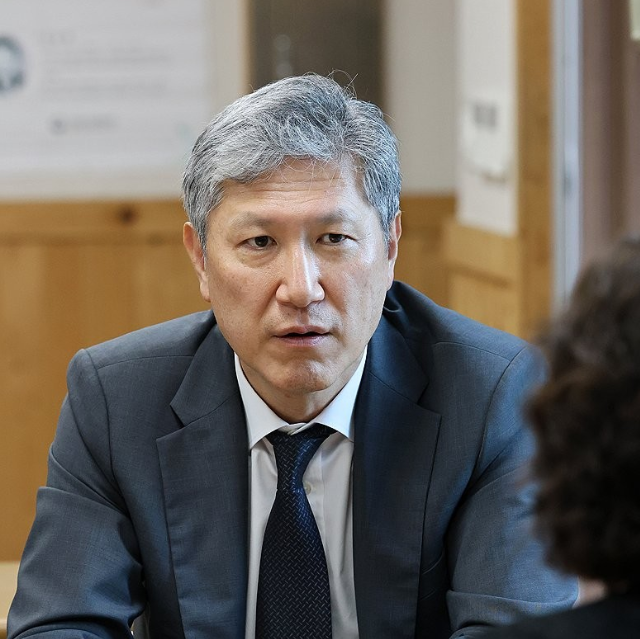
Despite not being a career diplomat or a key political figure, Roh, 60, has engaged in various activities related to China including serving as an adviser to an international council of the Chinese city of Chengdu in 2016 and participating in exchange programs to foster ties with Beijing through his role as director of the East Asia Culture Center in Seoul.
His surprise appointment comes after he traveled to Beijing last month as part of an entourage delivering a letter from South Korean President Lee Jae Myung to Chinese President Xi Jinping. During the visit, he met senior officials, including Vice President Han Zheng.
If confirmed, he will become the first envoy to China under the Lee administration.
He is expected to assume the post as soon as agrément procedures from China are finalized.

Copyright ⓒ Aju Press All rights reserved.
Related News
-
 NH Nonghyup Bank President Meets Indian Ambassador to Discuss Cooperation
NH Nonghyup Bank President Kang Tae-young met with Indian Ambassador to South Korea Gauranglal Das to discuss ways to expand business in the Indian financial market.The meeting took place on November 12 at the bank's headquarters in Jung-gu, Seoul, as announced by NH Nonghyup Bank on November 13.NH Nonghyup Bank opened a branch in Noida, India, in May 2023 and plans to relocate it to New Delhi in February 2027.During the meeting, they focused on enhancing corporate finance for local businesses and exploring collaboration with local financial institutions. They also sought to identify and support financial needs in agriculture-related industries, including food processing, distribution of agricultural and marine products, and cold chain logistics, leveraging the bank's expertise in agricultural finance.Kang Tae-young stated, "We will expand our financial support beyond Korean companies to include local businesses and various sectors such as agriculture and infrastructure, and discover new growth opportunities through collaboration with local financial institutions."* This article has been translated by AI.
-
South Korea's Foreign Minister to Meet China's Wang Yi Ahead of APEC
South Korea's Foreign Minister Park Jin is set to meet with Wang Yi, head of the Chinese Communist Party's Central Foreign Affairs Commission and Foreign Minister, in Beijing on November 13. This meeting comes ahead of President Lee Jae-myung's attendance at the Asia-Pacific Economic Cooperation (APEC) summit in Shenzhen next week. Analysts suggest the discussions will focus on coordinating diplomatic agendas while exploring China's role in reviving stalled inter-Korean and North Korea-U.S. dialogues. Before departing from Gimpo International Airport, Minister Park stated that he plans to discuss a range of topics, including overall South Korea-China relations, coordination ahead of the APEC meeting, issues concerning North Korea, and the potential for North Korea-U.S. talks. Regarding China's potential mediation in North Korea-U.S. talks, Park acknowledged the possibility but expressed uncertainty about the extent of China's active involvement in inviting North Korea to APEC, saying, "I don't think the chances are very high, but I can't say for sure yet." His comments seem to temper expectations for a surprise meeting between North Korean leader Kim Jong-un and U.S. President Donald Trump during APEC, while still leaving open the possibility for diplomatic engagement. The South Korean government is expected to outline its policy for peaceful coexistence on the Korean Peninsula during this meeting and request China's constructive role in resuming inter-Korean and North Korea-U.S. dialogues. Given that North Korea is not an APEC member, there are concerns that a major diplomatic event between the U.S. and North Korea could overshadow the multilateral agenda set by China. This raises the likelihood that China may prefer to facilitate communication between the two sides behind the scenes rather than publicly orchestrating a meeting. Preliminary coordination for the South Korea-China summit is also a key focus of this meeting. President Lee is scheduled to visit Manila, Philippines, and Shenzhen, China, from November 16 to 19. He will arrive in Shenzhen on the 18th to attend the APEC CEO Summit and a welcome dinner hosted by Chinese President Xi Jinping, followed by the main APEC summit on the 19th. The government is also coordinating separate meetings with leaders of major countries during this trip, raising interest in the potential for a South Korea-China summit. If the South Korea-China summit takes place, stabilizing bilateral relations and expanding practical cooperation are expected to be major topics. Ahead of this, Park and Wang are likely to review differences in their positions on sensitive practical issues, such as China's construction activities in the Yellow Sea, maritime boundary delineation, and the THAAD deployment restrictions. In practical terms, the core task of this visit to China is to outline the agenda for South Korea-China diplomatic relations while engaging China as a partner in restoring dialogue on the Korean Peninsula. Meanwhile, this meeting marks the first South Korea-China foreign ministers' meeting in about three months since Wang's visit to South Korea in August. Park's visit is also seen as a reciprocal gesture following Wang's invitation. He will spend two days in China, meeting with Wang before sharing a dinner together. * This article has been translated by AI.
-
China's Electric Vehicle Push Leaves South Korea's Auto Industry Seeking Solutions
As electric vehicles (EVs) become mainstream, with one in four new cars sold in South Korea being electric, the domestic auto industry faces increasing pressure from low-cost Chinese competitors. Experts agree that South Korean automakers must enhance price competitiveness while the government provides time for necessary industrial transitions. Improving charging and maintenance infrastructure, along with consumer protection systems, is also seen as an urgent task.Kim Kyung-yu, a senior researcher at the Korea Institute for Industrial Economics and Trade, stated during the 'EV Media Insight Talk' hosted by the Korea Automobile Journalists Association in Seoul on November 13, "When the share of new electric vehicle sales exceeds 15%, it indicates a shift from the initial market to a growth phase. Currently, this figure is approaching 25%. In the past, consumers purchased electric vehicles for environmental reasons, but now more are choosing them for economic reasons such as fuel savings and subsidies."However, the growth of the market does not directly translate to enhanced competitiveness for the domestic auto industry. Chinese companies are expanding their influence in the global market by leveraging price competitiveness, forcing South Korean automakers to protect both profitability and market share. Kim emphasized, "To compete with Chinese electric vehicles, we must also be able to produce at lower costs, enhance production efficiency and flexibility, and utilize artificial intelligence in manufacturing to find practical solutions."Choi Young-seok, a professor at Hanla University’s Department of Future Automotive Engineering, noted, "Chinese companies are entering the South Korean market due to restrictions in Europe and the United States. The government must provide time for the domestic industry to adapt to rapid changes, and companies must accelerate their internal transitions."As the electric vehicle market moves into the mainstream, there is a growing call for policies that prioritize consumer benefits over those focused solely on subsidies, including maintenance networks and parts supply systems. Choi stated, "If parts supply is inadequate when a vehicle has an accident or issue, we need to establish systems that allow for practical consumer protection measures, such as vehicle refunds. Since individual responses from various government departments have limitations, we need fundamental solutions from the consumer perspective."He also called for consistency in government policies and support that considers the entire industry. Choi remarked, "Clarity in government policy is crucial. Each department must respond comprehensively, considering domestic production, exports, parts suppliers, and even job creation."Ryu Jong-eun, president of the Korea Automobile Journalists Association, stated, "In the face of intensifying competition with Chinese companies, domestic automakers need to focus not just on short-term profitability but also on strategies to maintain market share. Alongside government support, manufacturers must enhance their price competitiveness."The 'EV Media Insight Talk' was held as part of the 'Omnipotent Battery - Exhibition to Promote Electric Vehicle Adoption' organized by the Ministry of Climate, Energy, and Environment. The main event runs from November 13 to 15 at Space S50 in Seoul.Major automotive brands, including Hyundai and Kia, as well as Mercedes-Benz, Volvo, BMW, KGM, and Volkswagen, are participating in the event to showcase electric vehicles. The exhibition will also provide various information related to electric vehicles, including charging, economic viability, carbon reduction, and artificial intelligence, along with programs for attendees to experience electric vehicles firsthand.* This article has been translated by AI.