
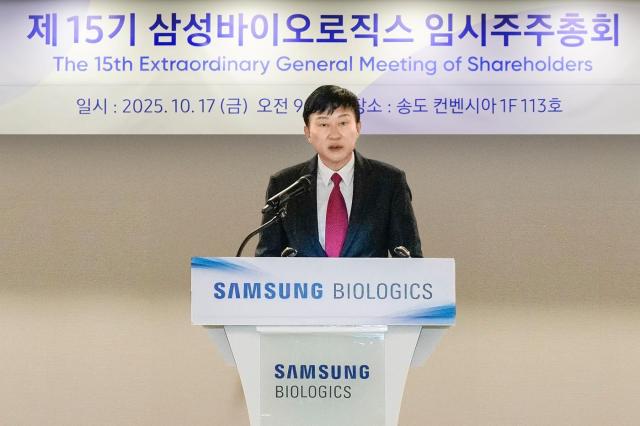
The approval paves the way for the creation of Samsung Epis Holdings, a pure holding company that will take over the parent's entire stake in biosimilar developer Samsung Bioepis, while Samsung Biologics will remain as the surviving entity focused on its contract development and manufacturing operations.
Shares in Samsung Biologics fell 1.06 percent to 1,121,000 won as of 10:02 a.m. local time.
Kim Dong-young
Kim Dong-young is a bilingual journalist at AJU Press (AJP), covering Korean tech, energy, and bio/pharma.
He reports from the field at events like CES and APEC, runs AJP's YouTube channels,
and is pursuing a master's at Sogang's MOT program.
Copyright ⓒ Aju Press All rights reserved.
Related News
-
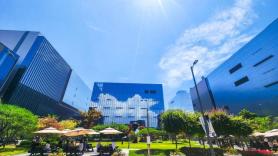 Samsung Biologics surges ahead as Trump targets pharma imports
Samsung Biologics' headquarters in Incheon is seen, in this undated photo. Courtesy of Samsung Biologics Editor's Note: This article is the 31st installment in our series on Asia's top 100 companies, exploring the strategies, challenges, and innovations driving the region's most influential corporations. SEOUL, August 14 (AJP) - South Korea's largest contract development and manufacturing organization (CDMO) Samsung Biologics is charging ahead in global markets, even as U.S. President Donald Trump reshapes the biopharmaceutical landscape with sweeping protectionist measures. Trump has repeatedly signaled his intention to impose tariffs on pharmaceutical imports, finally announcing on Aug. 5 plans to levy a "small tariff" before escalating rates dramatically. "In one year, one and a half years maximum, it's going to go to 150 percent and then it's going to go to 250 percent because we want pharmaceuticals made in our country," Trump told CNBC in an interview. While global drugmakers scramble to assess potential damage, industry experts say Samsung Biologics is unlikely to face significant headwinds. The firm focuses primarily on CDMO contracts, its biosimilars unit Samsung Bioepis now spun off from the firm. "South Korea has relatively few drug substance or finished drug exporters at present, aside from major pharmaceutical companies," said Hwang Ju-rie, director of public and international relations at the Korea Biotechnology Industry Organization. Researchers are seen at Samsung Biologics' laboratory, in this undated photo. Courtesy of Samsung Biologics "For tariffs to significantly impact the industry, we would need at least another decade, as most biotech firms remain in the research and development phase." Meanwhile, Samsung Biologics has been actively participating in global healthcare events such as the J.P. Morgan Healthcare Conference and Interphex Week Tokyo 2025, attracting international drugmakers as CDMO customers. A relative latecomer to the market, Samsung Biologics sprang to life after Samsung Electronics' late chairman Lee Kun-hee issued stern warnings that the group's cash-cow smartphone and LCD businesses could soon be overtaken by competitors. Needing fresh avenues for innovation, the group's future strategy office identified pharmaceuticals as a key growth sector. The biologics arm of Samsung began operations in early 2011, with the groundbreaking ceremony for Plant 1 held in May. Drug production and drug substance good manufacturing practices were established by 2013, followed by FDA approvals in 2015, positioning the firm for global expansion. Samsung Biologics went public in November 2016, fueling continuous growth. By 2020, it had opened an R&D center in San Francisco, and by 2025, the firm's fifth plant became fully operational, bolstered by robust CDMO operations. In a regulatory filing released on July 23, Samsung Biologics posted 324.4 billion won (approximately $233.5 million) in second-quarter net profit — a 2-percent increase year-over-year. Samsung Biologics' plant is seen, in this undated photo. Courtesy of Samsung Biologics Operating profit rose 9.5 percent during the same period to 475.6 billion won, while sales increased 11.5 percent to 1.28 trillion won. For the first half of the year, Samsung Biologics' sales totaled 2.59 trillion won with operating profit reaching 962.3 billion won — historic gains for the bio giant. The company attributed its second-quarter performance to steady operations at Plants 1 through 3 and accelerated operations at Plant 4. Samsung Biologics noted it has signed a series of large-scale CDMO deals with global pharmaceutical companies this year, surpassing 60 percent of its full-year order total from 2024. Despite current tailwinds, the firm faced scrutiny over legal conflicts concerning an alleged merger case dating back to 2015. Accusations claimed Samsung Electronics Chairman Lee Jae-yong committed unfair trading, stock price manipulation, and accounting fraud related to Samsung Group succession, with Samsung Biologics implicated in the fraud charges. On July 17, the Supreme Court finalized Lee's acquittal in the controversial merger case, clearing Samsung Biologics of all accounting fraud allegations. Samsung Biologics continues expanding its portfolio beyond major CDMO contracting, now venturing into contract research organization services as well. On June 16, the firm announced the launch of Samsung Organoids — advanced drug screening services designed to support clients in drug discovery and development. These three-dimensional cell culture systems are engineered to closely mimic human organs, providing better predictions for patient responses. Samsung Biologics CEO John Rim speaks during a press conference held on the sidelines of this year's Bio USA in Boston. Courtesy of Samsung Biologics "With Plant 5 now fully operational, we are leveraging our manufacturing expertise and expanded capacity to deliver seamless, end-to-end CDMO services at scale," said John Rim, CEO and President of Samsung Biologics, in a press release on July 23. Further announcing the firm's advancements in antibody-drug conjugates (ADCs) and the launch of Samsung Organoids, Rim said Samsung Biologics is redefining digitalization in biomanufacturing, its strategic initiatives to "strengthen our ability to accelerate client pipelines, while fostering enduring partnerships grounded in quality and operational excellence." As the global biopharmaceutical landscape undergoes rapid transformation amid trade tensions and technological advances, Samsung Biologics is well-prepared to capitalize on growing demand for both manufacturing expertise and cutting-edge research capabilities, cementing its status as a formidable player in the evolving life sciences arena.
-
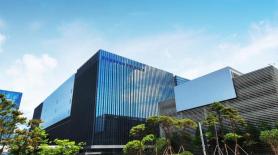 Korean pharma firms post record earnings despite US trade uncertainty
Samsung Biologics' Plant 4/ Courtesy of Samsung Biologics SEOUL, August 4 (AJP) - South Korea’s leading pharmaceutical companies reported their strongest second-quarter results on record, brushing aside investor concerns over potential U.S. trade restrictions under President Donald Trump. Biosimilar manufacturer Celltrion led the charge, posting revenue of 961.5 billion won, or approximately $692.4 million, for the April-to-June period — a 9.9 percent increase from the same quarter last year. The company’s operating profit soared 234.5 percent to 242.5 billion won, fueled by strong global demand for its high-margin biosimilar therapies, including its flagship subcutaneous treatment for autoimmune diseases, Remsima SC. Samsung Biologics also posted historic gains, breaching the 2 trillion won ($1.44 billion) sales mark for the first time over the first half of the year. The company reported second-quarter revenue of 1.289 trillion won, up 11.5 percent year-on-year, with operating profit rising 9.5 percent to 475.6 billion won. Executives attributed the gains to increased output at its state-of-the-art Plant 4 facility and a broader biosimilar pipeline developed by its subsidiary, Samsung Bioepis. The robust earnings come despite growing geopolitical headwinds. U.S. President Trump has repeatedly signaled an intent to impose tariffs on foreign biotechnology and pharmaceutical imports, including from South Korea, as part of his broader “America First” economic platform. While no formal measures have been enacted, the warnings have cast a shadow over the sector’s longer-term outlook. Still, for now, South Korean pharmaceutical firms are showing resilience. Yuhan Corporation, known for its lung cancer treatment pipeline, reported a 9.6 percent rise in revenue alongside a 168.9 percent leap in operating profits. GC Biopharma, formerly Green Cross, posted sales of 500.3 billion won — up 19.9 percent year-on-year — while Daewoong Pharmaceutical reported an 11.8 percent increase in revenue over the same period. “Despite the policy uncertainty coming from Washington, Korean biopharma continues to outperform thanks to its manufacturing efficiency, global partnerships, and increasing presence in high-value therapeutic areas,” said Kim Hyun-soo, a healthcare analyst at Shinhan Investment Corp. Industry observers say the sector’s performance underscores not only the growing maturity of South Korea’s biotech ecosystem but also its ability to adapt to shifting global regulatory and political environments. “South Korean pharmaceutical firms are no longer simply following global trends — they’re setting them,” said Park Eun-jung, director at the Korea Pharmaceutical and Bio-Pharma Manufacturers Association. “And that makes them increasingly difficult to ignore.”
-
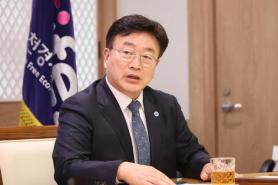 S. Korea must race to grab US-bound talents for leap in AI race: IFEZ czar
IFEZ Commissioner Yun Won-sok speaks during an interview at his office in Songdo International City, Incheon. Sep. 25, 2025. AJP Han Jun-gu SEOUL, October 01 (AJP) - Brain power defines the AI era, and the possibility of a brain drain in Silicon Valley from the U.S. imposition of hefty fees on skilled-worker visas offers an "enormous" opportunity for South Korea, said the nation’s foreign direct investment (FDI) czar. "This is a windfall, and we must move fast in hosting roadshows to draw global brains here," said Incheon Free Economic Zone (IFEZ) Commissioner Yun Won-sok in an exclusive interview with AJP at the landmark 31st-floor headquarters in Songdo. Since its establishment in 2003, IFEZ — spanning Songdo, Cheongna, and Yeongjong districts near Incheon International Airport — has been tasked with attracting FDI. Over two decades, it has secured more than $10 billion in investment, anchored by biotech, logistics, and finance. But with nearly all available space filled, growth has slowed. That reality, Yun argued, demands a paradigm shift. Instead of focusing solely on hard capital, IFEZ must pivot toward drawing high-value people — scientists, engineers, and creators — who can turn Incheon into a magnet for ideas and innovation. "Bringing here those who worked with CEO Mark Zuckerberg can now be more valuable in the long run than hosting Meta outposts," he said. The timing is favorable. Washington recently announced a $100,000 fee for new H-1B visas, a major pathway for foreign professionals. Nearly two-thirds of such visas go to computer-related occupations, mostly in California, with Indians making up 71 percent of approvals and Chinese 12 percent last year. Photos of Songdo's historical development are displayed at the Incheon Free Economic Zone Promotion Center (left). Visitors view a digital media art wall at the Incheon Free Economic Zone Promotion Center (right), Sep. 24. Photographed by AJP Han Jun-gu, edited by Song Ji-yoon IFEZ, Yun stressed, is well-positioned as a Silicon Valley alternative. "Who can better pose as the brain hub in Asia-Pacific?" he asked, pointing to five key strengths: a robust bioengineering ecosystem, a global-standard education system, strong R&D commercialization between universities and companies, world-class logistics and transport infrastructure, and globally popular content and lifestyle offerings. What IFEZ seeks, he explained, is not a simple investment but a virtuous cycle powered by human capital. "If seasoned and budding scientists and IT talents come here, continue their research, and launch businesses, their activities will naturally feed investment and hiring." Graphic image designed by Song Ji-yoon Korea, he noted, can no longer rely on foreign direct — let alone greenfield — investment because of land and labor constraints. "If our land resources are limited, then our advantage must come from the people and technologies we can attract. High-value jobs, advanced R&D centers, startups that commercialize ideas — that is where Incheon will stand out." Biotech has been the anchor of this pivot. Songdo now hosts one of the world’s largest biomanufacturing clusters, with Samsung Biologics producing more than 600,000 liters of biologic drugs annually. "From those anchors, suppliers and partners have clustered in Songdo. Now we must move further up the value chain into new drug development, AI-based healthcare, and quantum-assisted research. That requires bringing in the best minds from overseas," Yun said. Education is central. "Foreign executives and researchers will not relocate if their families cannot," he said. "That is why we built Incheon Global Campus with five overseas universities, and why we are expanding K-12 international schools in Songdo, Cheongna, and Yeongjong. Parents need to know their children will receive the same standard of education they had back home." The campus hosts institutions such as Stony Brook University, George Mason University, and SUNY Korea, offering English-language degree programs in South Korea. IFEZ is also negotiating with leading institutions abroad. "We are discussing joint R&D hubs with Georgia Tech, MIT, Johns Hopkins, and Fraunhofer in Germany," Yun said. "The goal is to place companies, labs, and universities side by side. That is how you accelerate innovation — by bringing people, capital, and ideas under one roof." Graphic image designed by Song Ji-yoon Lifestyle, he added, is another pillar. "Cheongna can become a media and content hub, an Asian Hollywood. We are preparing legal amendments so that major studios can invest and film here. Incheon has the airport, the logistics, and the consumer base. Content, tourism, and high-end services will be the next growth axis." Cheongna has already been earmarked for tourism and leisure development, including a large K-pop arena and entertainment complexes. The ultimate test, Yun said, will be whether people choose to come. "Our goal is to make IFEZ a place where global researchers, entrepreneurs, and creators want to live and work." And for Korea, he added, the stakes could not be higher: "In the AI era, countries that win the talent race will win the future. Incheon must be at the front of that race."