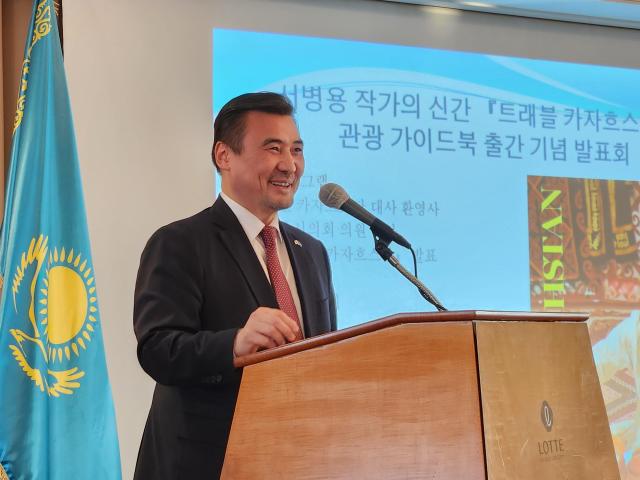
Kazakhstan's ambassador in Seoul said tourism is emerging as a new bridge between his country and South Korea, speaking at a book launch held at Lotte Hotel Seoul on December 3 for the travel guide "Travel Kazakhstan" by author Seo Byung-yong.
"It's a delight for me to be in front of such a wonderful audience, the true friends of Kazakhstan and the wonderful partners who are always here to support us," Ambassador Nurgali Arystanov told guests at the Garnet Suite on the hotel's 37th floor. The audience included diplomats, officials from the travel industry and business leaders, according to event organizers.
Holding up the newly published guide, Arystanov said the book arrived at a moment of deepening ties. "This book is not just yet another book. It's yet another built bridge between our two countries," he said. He noted that more than 1,800 South Korean companies now operate in Kazakhstan and pointed to roughly 20 weekly direct flights connecting the two countries. (The flight frequency figure was stated by the ambassador at the event.)
He also referred to Kazakhstan as "the country in the heart of Central Asia," highlighting next year's planned C5+K summit that will bring the presidents of Kazakhstan, Kyrgyzstan, Uzbekistan, Tajikistan and Turkmenistan together with the South Korean president. "Central Asia is a beautiful region, beautiful food, beautiful cultures," he said, encouraging South Koreans to explore the wider region as well.
Arystanov ended his speech by reciting the Korean proverb "seeing once is better than hearing a hundred times," adding that books can "open many doors, spark many dreams and bring our two nations even closer."
Seo, who has written guidebooks for a decade, traced how his latest project took shape. His earlier titles on Moscow, Saint Petersburg, the Trans-Siberian Railway and Georgia had all focused on places that lacked detailed Korean-language guides at the time. He said the same gap existed for Kazakhstan.
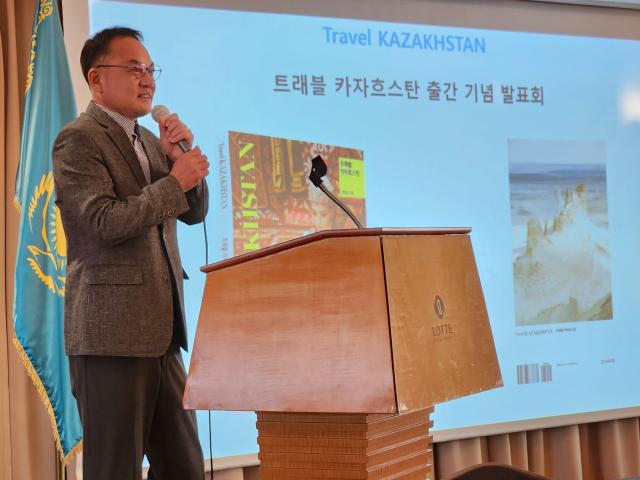
The author walked the audience through the structure of the new book, which covers Almaty, Astana, Shymkent, Aktau and Ush-Tobe, along with sample itineraries that combine Kazakhstan with Kyrgyzstan or Uzbekistan. He also pointed to the cover design, which uses yellow typography inspired by the Kazakh flag. "The blue represents the sky and water, the sun stands for abundance and the golden eagle symbolizes future flight," Seo said, adding that the cover image was provided by the Kazakhstan Embassy.
A large portion of his talk focused on why he believes Kazakhstan will appeal to South Korean travelers. He listed seven points he said make the country "a blue ocean" for the travel market.
The first was flight access. "There are so many direct flights now, with Air Astana, Asiana Airlines, Eastar and SCAT operating around 20 flights a week," Seo said. "This is a huge advantage when you design products or decide where to go."
Second, he highlighted visa-free entry. "You do not need a visa for 30 days. If you have a passport, you can fly tomorrow," he said.
Third, he argued that the perceived distance is misleading. "The flight to Almaty is about six and a half hours. Bangkok is around six hours, so it is not far at all," he said.
His next points focused on scenery and food. Seo described Kazakhstan as "an Asian country that still feels exotic," pointing to places such as the rock formations and coastal desert around Aktau. At the same time, he said travelers rarely struggle with meals. "There are rice dishes, noodle dishes and plenty of meat," he said. "I don't think many people suffer because of the food."
His sixth point centered on history, especially the legacy of ethnic Koreans who were deported to Central Asia in the 1930s. "For people interested in the history of Koreans abroad, Ush-Tobe and other sites linked to Koryoin history are very meaningful places," he said.
Finally, he mentioned local attitudes and Kazakhstan's policy focus on tourism. "There is almost no discrimination, and the level of friendliness toward Koreans is something you have to experience yourself," he said, noting that Korean convenience store chains and food brands have been expanding in Almaty. (Expansion of Korean brands was mentioned by Seo at the event.)
Seo said he hoped the book would be useful for independent travelers, pointing to sections covering local transport, currency, ride-hailing apps, SIM cards and practical travel tips. "We live in an era when more than 30 million South Koreans travel abroad each year," he said. "If this book can help turn curiosity about Kazakhstan into actual journeys, then I think it has done its job."
Copyright ⓒ Aju Press All rights reserved.