

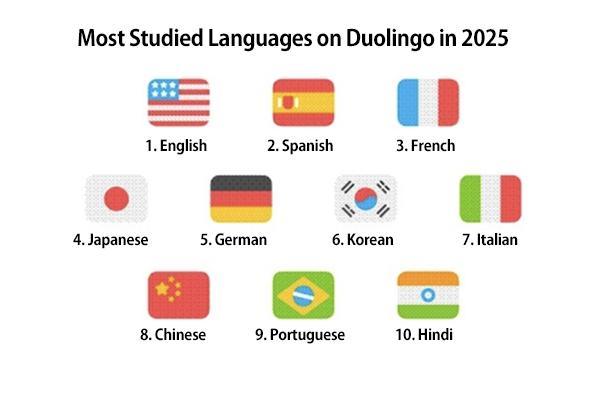
SEOUL, December 04 (AJP) - In another sign of Korean pop culture's global reach, Korean has become the sixth most-studied language on Duolingo, one of the world's largest language-learning platforms, increasingly replacing Chinese as a preferred foreign language.
According to the 2025 Language Report released Thursday, Korean trailed only English, Spanish, French, Japanese and German in global popularity. It also ranked as the second-fastest-growing language in Western countries including Argentina, Colombia, France, Germany, Mexico, Spain and Poland. Duolingo now counts 5.5 million Korean learners worldwide, a trend the company attributes to the international success of "Squid Game," K-dramas and K-pop.
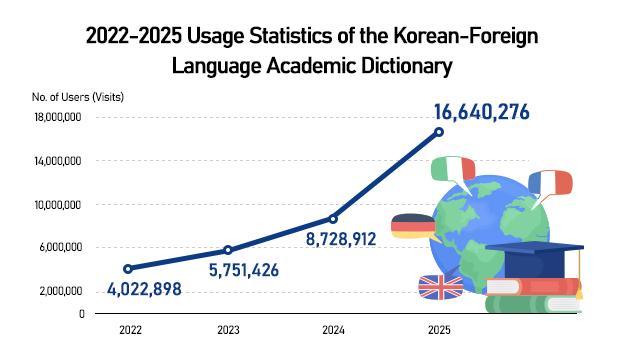
Official dictionary traffic tells a similar story. The National Institute of the Korean Language, the government body overseeing Korean language policy, said Tuesday that its two major online dictionaries — the Basic Korean Dictionary and the Korean–Foreign Language Learners' Dictionary — surpassed 20 million cumulative visits this year. From January through October, the Basic Korean Dictionary recorded 3.5 million visits, while the learners' dictionary logged 16.64 million, led by its Korean–English edition.
High usage was also reported in the Korean–Arabic and Korean–Indonesian versions, particularly in regions where Korean pop culture enjoys strong followings and alternative reference tools are scarce. Users searched not only nouns but also verbs, adverbs and suffixes, suggesting that learners across proficiency levels depend on the dictionaries. The Basic Korean Dictionary, launched in 2012 with about 52,000 headwords, will add roughly 1,300 new entries in March 2026.
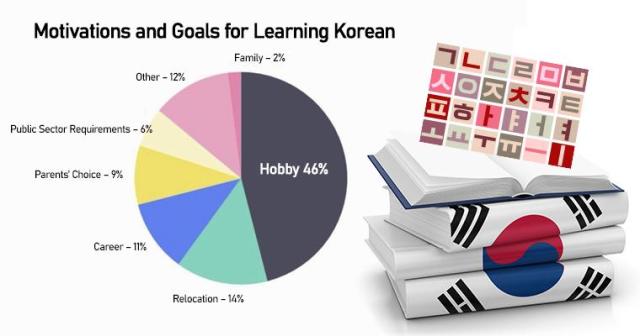
Motivation data shows why Korean stands apart from other foreign languages. A survey last year by Preply found that most Korean learners cited "hobby or personal interest" as their main reason for studying the language. By contrast, 28 percent of general language learners worldwide study for job-related or career or self-development purposes — highlighting how Korean's appeal is tied directly to entertainment consumption and cultural affinity.
Demand is also rising in higher education. A 2024 report by the Modern Language Association found that U.S. university enrollment in Korean courses grew more than 60 percent between 2013 and 2024, while enrollment in Chinese courses fell about 30 percent. Similar patterns have emerged in the United Kingdom, according to data from the Higher Education Statistics Agency.
The South China Morning Post noted that China's slowing economy and deteriorating global image have dampened interest in Chinese language study, while Korean continues to gain momentum on the back of K-pop and Korean media.
The King Sejong Institute, South Korea's government-run global Korean-language network, has also expanded rapidly. It now operates 256 branches in 88 countries — up from just 13 in 2007 — with roughly 700,000 cumulative learners. The government aims to increase the network to 350 branches by 2027 and is rolling out AI-based learning tools, including the "i-Sejong Institute," alongside localized curricula and dispatched teaching staff.
"The Basic Korean Dictionary and the Korean–Foreign Language Learners' Dictionary have become essential tools for both learners and instructors," an official at the National Institute of the Korean Language said. "As global interest in Korean continues to rise, we will work to provide reliable and accessible online dictionary services."
Copyright ⓒ Aju Press All rights reserved.
