SEOUL, December 07 (AJP) - The presidential office in Seoul will return to the Blue House by Christmas while readying a stronger national data-protection measures and a renewed push for dialogue with North Korea as the Lee Jae Myung administration moves beyond the phase of "a stabilization of diplomacy, security and governance" in the first six months after a snap election and presidential impeachment.
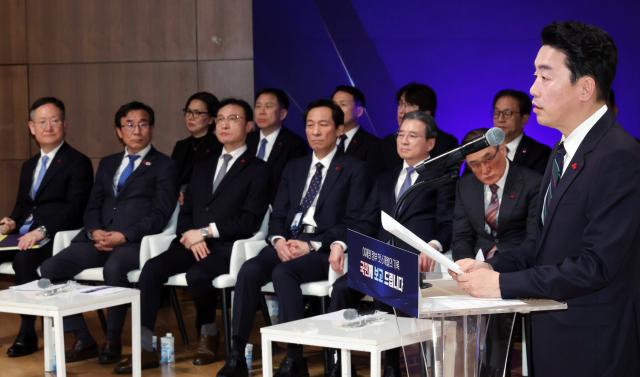
The move out from Yongsan premise will be "essentially finished around Christmas," said presidential chief of staff Kang Hoon-sik in a press briefing on Sunday, looking back the first six months under Lee presidency.
The return to the presidency’s “rightful home” will become a symbolic reset for the administration as it enters its second phase, he said.
The government will reinforce its data-security framework before year-end following the massive personal-information leak at Coupang, building on what officials described as an “initial comprehensive response” already in place.
National Security Adviser Wi Sung-lac used the six-month briefing to emphasize that while inter-Korean relations have seen little movement, the administration has rebuilt the diplomatic environment needed to attempt genuine engagement next year.
He rejected speculation that Seoul might adjust its joint military drills with the United States as a goodwill gesture toward Pyongyang, saying the idea is “not under direct consideration” and stressing that exercises remain a function of “evolving security circumstances.” '
Pyongyang has not responded to Seoul’s recent offer of military talks to clarify parts of the Military Demarcation Line and prevent accidental clashes, but President Lee has reiterated that dialogue remains open and necessary.
Wi said the administration had worked “without pause” to normalize foreign and security policy that he argued had deteriorated in previous years.
He pointed to the stabilization of the Korea-U.S. alliance, “unexpectedly forward-looking” progress with Japan, and the shift of Korea-China ties from their “worst point” toward a recovery track as groundwork for a relaunch of inter-Korean diplomacy.
He added that the presidential office plans to execute a “Korean Peninsula Peace Coexistence Process” beginning next year, now that broader regional alignments have been reset.
The administration also outlined follow-up steps to last month’s security and tariff negotiations with Washington, including task forces on enriched uranium consultations, nuclear-powered submarine cooperation, and expanded defense-budget coordination.
Working-level talks will begin this month, with tangible results expected in the first half of next year. Wi said these efforts reflect Seoul’s intention “to assert a more proactive defense posture” while reaffirming U.S. security guarantees and moving toward the eventual restoration of wartime operational control.
On the economic front, Kang and Policy Chief Kim Yong-beom highlighted the successful conclusion of the Korea-U.S. tariff negotiations as a signature achievement of the administration’s first half-year.
Kim said public trust and “the competitiveness of Korean manufacturing” were the foundation of the breakthrough and signaled that Seoul will use the agreement to upgrade the alliance into a 21st-century technology-security-economic partnership.
The presidential office said it evaluates its six-month performance under three themes: restoring the public’s everyday economic conditions, normalizing foreign and security policy, and governing with a citizen-first framework.
As for the ruling party’s proposal to establish a special court division to handle insurrection-related cases, the presidential office said it would proceed only within “the narrowest constitutionally permissible boundaries.”
* This article, published by Aju Business Daily, was translated by AI and edited by AJP.
Copyright ⓒ Aju Press All rights reserved.