

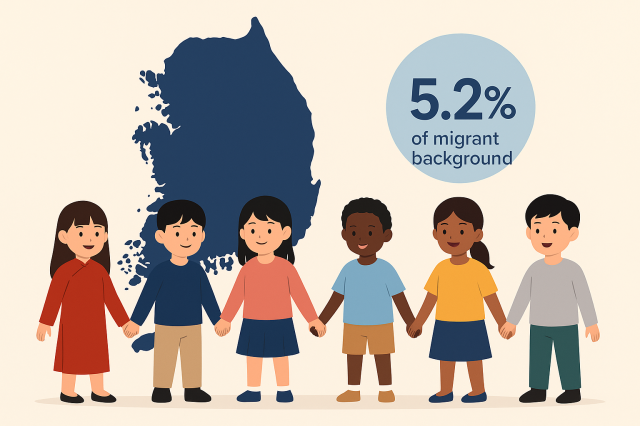
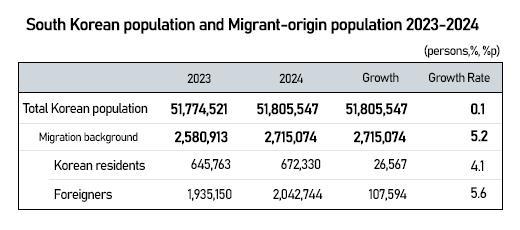
SEOUL, December 08 (AJP) - Migration backgrounds spanning naturalized Koreans, foreigners, second-generation immigrants, and North Korean defectors – counted for the first time - made up 5.2 percent of South Korean population as of November 2024, according to the first comprehensive dataset tracking the rise of multicultural diversity in the traditionally homogenous society.
According to the 2024 Migration Background Population Statistics published by the Ministry of Data and Statistics, 2.715 million people living in Korea as of last November last year were either not originally from South Korea or had at least one parent of a migration background.
The figure represents 5.2 percent of the total population and marks a 0.3 percentage-point increase from a year earlier. About a quarter are Korean citizen and the rest registered as foreign nationals who have stayed in the country for more than three months.
The demographic profile skews distinctly young. Youth and working-age individuals dominate the group, with 2.223 million (81.9%) in the 15–64 age bracket, 344,000 (12.7%) aged 14 or under, and only 148,000 (5.5%) aged 65 or older. Men outnumber women at 52.5 percent, producing a sex ratio of 110.7 men for every 100 women.
The 20s and 30s make up the largest cohorts, at 21 percent and 24.3 percent respectively. Compared with the overall Korean population, this group is markedly younger with a much smaller share of elderly,” said Kim Seo-young, head of the Population Census Division.
Migration-background residents are heavily concentrated in the greater capital area, with Gyeonggi Province alone accounting for 32.7 percent, followed by Seoul (17.5%) and Incheon (6.6%).
The cities with the largest absolute populations are Ansan, Hwaseong and Siheung, while Yeongam County in South Jeolla Province and Eumseong County in North Chungcheong Province record the highest ratios relative to their total populations.
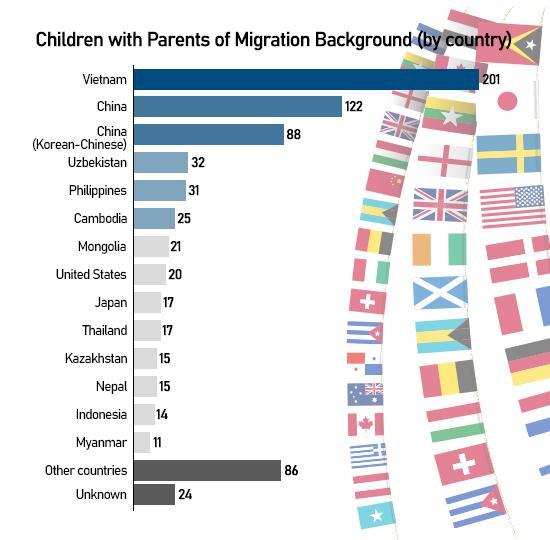
Children and adolescents under 24 account for 738,000 people — 27.2 percent of the migration-background population — reflecting Korea’s accelerating demographic diversification. Among this group, domestic nationals grew 3.4 percent from last year to make up 49.7 percent, while foreign residents increased 12.8 percent to 50.3 percent.
The nationality of parents shows Vietnam as the most common origin at 27.2 percent, followed by China (16.5%) and Korean-Chinese (12.0%). Among naturalized citizens, 34.5 percent trace their origin to China, while 33.3 percent of second-generation immigrants come from Vietnam.
Kim noted that the agency included North Korean defectors in the data set for the first time to ensure “no group is overlooked in policy planning,” adding that the rise in foreign workers, international students, and marriage immigrants continues to expand Korea’s migration-background population.
Copyright ⓒ Aju Press All rights reserved.
