
According to Britain's Ofcom, 99 percent of children now spend time online, and nine in ten own a mobile phone by age 11. The regulator warns of "a blurred boundary between the lives children lead online and the 'real world,'" describing how deeply digital habits shape childhood. Ofcom also found that three-quarters of children aged 8 to 17 who use social media have at least one account, even though most platforms set a minimum age of 13. Among 8- to 12-year-olds, six in ten maintain their own profiles.
The United States shows a similar pattern. A Pew Research Center report released Tuesday found that most American teenagers use YouTube and TikTok daily, and about one in five are on one of the two platforms "almost constantly."
Experts warn of risks ranging from diminished attention spans to delayed cognitive development, but few governments have enacted hard rules. Australia stands out for enforcing a complete ban on social media accounts for anyone under 16, prohibiting minors from creating or maintaining profiles on designated platforms. The measure has sparked intense debate. The Australian Human Rights Commission has warned that VPNs and fake age declarations could undermine the law and argues that an account ban "does not address the root causes of online risks or make platforms safer for everyone."
For Seoul, such a prohibition would be politically and socially untenable. Korea's last attempt at sweeping digital regulation — the so-called shutdown law, which barred anyone under 16 from online gaming between midnight and 6 a.m. — was repealed in 2021 after a decade of resistance and ridicule. It had little impact on gaming habits, even as Korean gamers became world-class e-sports competitors.
"I don't think parents would tolerate it," said Song Ki-chang, professor of education at Sookmyung Women's University. "Parents and children communicate through these apps these days. They check things or send messages whenever needed. I'm not sure a ban on SNS accounts is even feasible."
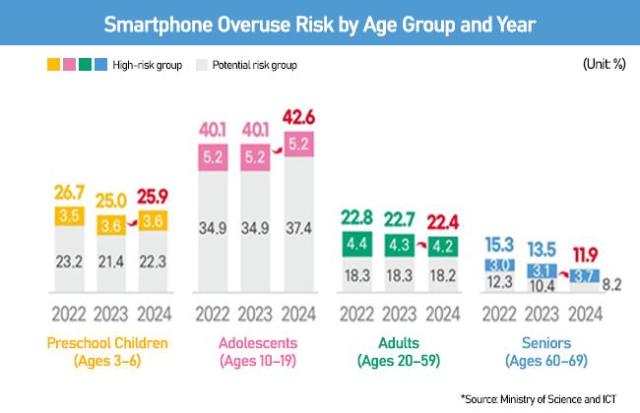
The OECD notes that governments have a critical role in shaping safer digital environments, yet reliable global data on youth digital behavior remains limited, hampering evidence-based policymaking.
For educators, the answer lies less in prohibition and more in resilience-building. "It's not going after the companies that can really do something, which are Apple, Google, and Microsoft," said Douglas Weir, 33, a principal at an international school in Seoul. Larger schools face greater challenges in monitoring usage, he said, but the underlying problem is universal. "When we were kids, we had to learn how to use search engines and computers for the first time. The same conversations were happening then about whether it was appropriate or dangerous. I don't think we're going to solve this overnight — but the approach needs to be about educating kids, not banning."

Copyright ⓒ Aju Press All rights reserved.