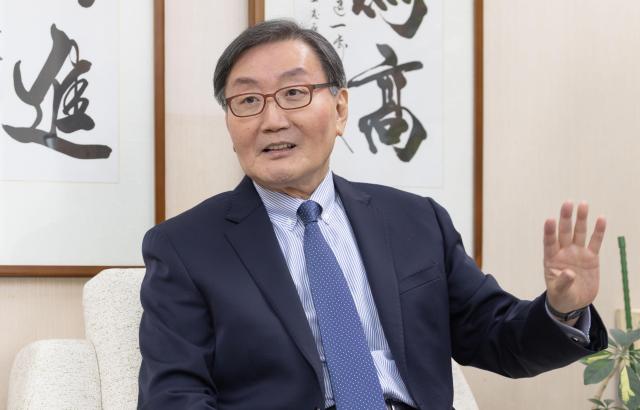
South Korea’s won has weakened past 1,470 per dollar, a level that evokes memories of past currency crises. But strong external fundamentals suggest the current situation differs sharply from previous episodes of financial turmoil, according to Jeon Kwang-woo, chairman of the World Economic Research Institute and a former head of the Financial Services Commission (FSC) and the National Pension Service (NPS).
Despite record current account surpluses and a stock market rally that has pushed the KOSPI above 4,000 points, the won has remained under pressure for months. Foreign exchange authorities have stepped in through verbal intervention and coordination with the NPS on currency hedging, but the exchange rate has shown little sustained improvement.
“The won's weakness is unlikely to reverse quickly,” Jeon said in an interview, attributing the situation primarily to a structural imbalance in dollar supply and demand rather than financial instability.
Jeon said demand for dollars has surged as individuals, corporations, and institutional investors increase overseas investments, particularly in the United States following bilateral economic agreements.
Bank of Korea data underscore the imbalance. In October, South Korea recorded a current account surplus of $6.81 billion, while overseas investment by South Koreans jumped $17.27 billion — more than two-and-a-half times the surplus. In contrast, foreign investment inflows into South Korea totaled $5.2 billion, less than one-third of the outflow.
As a result, the won has weakened steadily for seven months, rising 7.6 percent against the dollar since June to reach around 1,470 in December.
Jeon stressed that the current environment bears little resemblance to the 1997 Asian financial crisis or the 2008 global financial crisis.
“Back then, instability was systemic,” he said. “Today, the pressure is concentrated in the foreign exchange market. Without resolving the underlying supply-demand structure, policy measures alone cannot change the trend.”
Authorities recently extended a $65 billion currency swap arrangement with the National Pension Service as part of stabilization efforts. Still, the won opened at 1,469 per dollar and later weakened to as much as 1,477, highlighting the limits of intervention.
While acknowledging the government’s efforts, Jeon said policymakers have limited control over the growing scale of overseas investment, which continues to fuel dollar demand.
A “four-party consultative body” comprising the Ministry of Economy and Finance, the Ministry of Health and Welfare, the National Pension Service, and the Bank of Korea has been discussing measures to stabilize the exchange rate. The central bank has suggested strengthening the domestic stock market and encouraging pension funds to allocate more assets at home to curb capital outflows.
Jeon, who was the longest-serving chairman in NPS history, strongly criticized efforts to enlist the pension fund as a policy tool.
“The National Pension is the people’s asset,” he said. “It should not be mobilized for political or short-term policy objectives.”
He argued that while exchange rate stability and a buoyant stock market are legitimate government goals, the overriding mandate of the pension fund must remain maximizing long-term returns for beneficiaries — citing Canada’s pension system as a model of institutional independence.
Jeon did not entirely rule out a limited role for the NPS, noting that given the size and strong performance of its overseas portfolio, some dollar inflows could occur naturally as profits are realized. However, he emphasized that any such moves must be based on autonomous investment decisions, not government pressure.
For longer-term solutions, Jeon called for structural reforms to raise South Korea’s potential growth rate. In the short term, he suggested temporary tax incentives, expanded currency swap lines by the Bank of Korea, and independently issued foreign-currency bonds by the NPS.
He cautioned that short-term measures carry inherent risks.
“Every quick fix has two sides,” Jeon said. “If policymakers move too fast, they risk unsettling the market. Preserving trust is ultimately the most important factor.”
* This article, published by Aju Business Daily, was translated by AI and edited by AJP.
Copyright ⓒ Aju Press All rights reserved.