

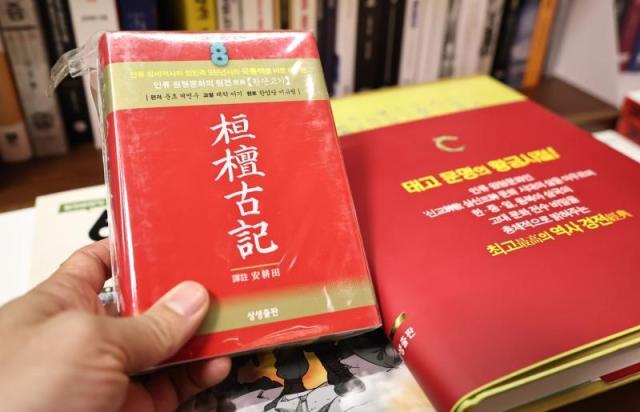
The claims originate from Hwandan Gogi, a book published in 1979 by Yi Yu-rip, founder of the religious group Taebaekgyo. The text asserts that Hwan-guk had a population of 180 million around 1600 B.C., exceeding the populations of present-day Bangladesh or Russia.
Long regarded by scholars as pseudohistory, the obscure book drew renewed attention after President Lee Jae Myung raised the issue during a televised government briefing last Friday.
During a round of briefings with state-run agencies, Lee asked Park Ji-hyang, chair of the Northeast Asian History Foundation, whether the government-funded think tank had examined the validity of Hwandan Gogi. The president’s public reference to what mainstream historians consider a forgery triggered immediate backlash from the academic community.

“There is no academic debate between historians and pseudo-historians,” the statement said. “What exists are only one-sided defamation and absurd claims from pseudo-history directed at academia.”
The scholars noted that no verified 1911 edition of the text — as claimed by its proponents — has ever been found, and that the book contains numerous modern terms that could not have existed in pre-modern Korea.
Many of those terms were coined in Japan during the late 19th century following the Meiji Restoration, when Japanese intellectuals created new Sino-Japanese vocabulary to translate Western political and philosophical concepts such as “civilization” and “enlightenment.” Their presence in Hwandan Gogi is widely cited as evidence of modern fabrication.
Although the book purports to be a compilation of texts from the late Goryeo and early Joseon periods, historians overwhelmingly agree that it was written by Yi himself and published in 1979.
Yoo Hong-jun, director of the National Museum of Korea, described Hwandan Gogi as “a fantasy born from a sense of national inferiority and a form of self-consolation,” during a lecture Tuesday at the Korean Cultural Center in Washington, D.C.
Yoo said the president’s remarks should not be interpreted as an endorsement. “The reference was not to validate its historical claims,” he said, “but to question how the Foundation is dealing with blind followers of such views.”
Opposition politicians nevertheless seized on the controversy. Lee Jun-seok, leader of the Reform Party and former head of the People Power Party, wrote on Facebook: “If Hwandan Gogi is history, then The Lord of the Rings is history too.” He added that calling it a matter of interpretation was “like saying flat-earth theory is just another scientific opinion.”
The presidential office moved quickly to contain the fallout. Spokesperson Lee Kyu-yeon said the president was merely encouraging public interest in ancient history research and “was not offering any positive evaluation of Hwandan Gogi or lending it legitimacy.”
Lee Jeong-bin, a history professor at Kyung Hee University, bluntly summed up: “Discussing the text itself is a waste of time,” he said. “It only reconfirms that Hwandan Gogi is a complete fantasy — not history.”
Copyright ⓒ Aju Press All rights reserved.
