

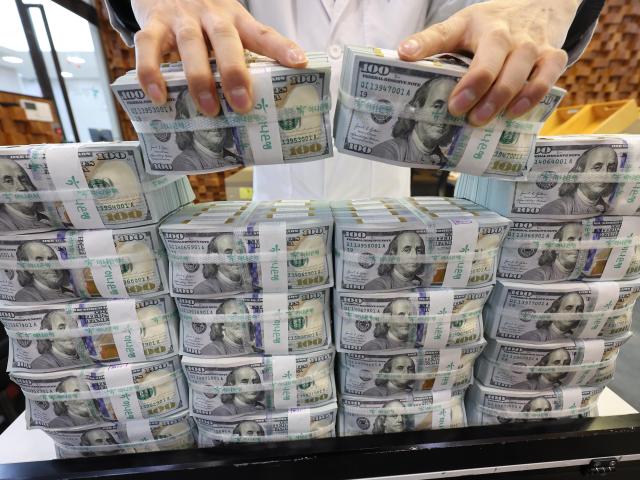
An employee sorts U.S. dollar bills at Hana Bank’s counterfeit-response center in Seoul. [Photo=Yonhap]
SEOUL, December 27 (AJP) -The dollar-won exchange rate has retreated sharply following strong verbal warnings by authorities against excessive volatility, combined with year-end dollar-selling demand and a broader weakening of the U.S. currency.
Still, growing belief that the exchange rate may settle into a new “mid-1,400 won” range has renewed interest in foreign-currency–linked financial products, including dollar-denominated insurance.
Sales of dollar insurance at South Korea’s five major lenders — KB Kookmin, Shinhan, Hana, Woori and NH NongHyup — totaled 1.5526 trillion won from January through November this year, according to industry data. That compares with 225.4 billion won in 2022, 568.5 billion won in 2023, and 964.1 billion won last year, underscoring a rapid expansion in demand.
The increase is widely seen as reflecting expectations of further dollar strength, as well as a desire among corporations to diversify portfolios amid prolonged weakness in the won. Because premiums and benefits under these products are denominated in U.S. dollars, exchange-rate movements directly affect their cost and payout value. A higher exchange rate raises the won cost of paying premiums, while a lower rate at the time of payout can reduce the won value of benefits.
Some analysts note that if the exchange rate is expected to decline, delaying enrollment could help lower premium burdens. Conversely, if the dollar is expected to strengthen further, policyholders may benefit from locking in exposure earlier.
Others caution, however, that foreign-currency insurance products are typically long-term contracts — often spanning five to 10 years — making short-term exchange-rate fluctuations less decisive. Over time, currency movements may average out, reducing the impact of near-term volatility. During periods of elevated exchange rates, consumers may also consider products that include mechanisms designed to mitigate exchange-rate risk.
“Foreign-currency insurance is not designed as a vehicle for currency speculation,” an industry official said. “If exchange rates or overseas bond yields move unfavorably, premiums can rise or benefits may fall, and additional costs such as foreign-exchange fees can apply. Careful consideration is essential.”
Still, growing belief that the exchange rate may settle into a new “mid-1,400 won” range has renewed interest in foreign-currency–linked financial products, including dollar-denominated insurance.
Sales of dollar insurance at South Korea’s five major lenders — KB Kookmin, Shinhan, Hana, Woori and NH NongHyup — totaled 1.5526 trillion won from January through November this year, according to industry data. That compares with 225.4 billion won in 2022, 568.5 billion won in 2023, and 964.1 billion won last year, underscoring a rapid expansion in demand.
The increase is widely seen as reflecting expectations of further dollar strength, as well as a desire among corporations to diversify portfolios amid prolonged weakness in the won. Because premiums and benefits under these products are denominated in U.S. dollars, exchange-rate movements directly affect their cost and payout value. A higher exchange rate raises the won cost of paying premiums, while a lower rate at the time of payout can reduce the won value of benefits.
Some analysts note that if the exchange rate is expected to decline, delaying enrollment could help lower premium burdens. Conversely, if the dollar is expected to strengthen further, policyholders may benefit from locking in exposure earlier.
Others caution, however, that foreign-currency insurance products are typically long-term contracts — often spanning five to 10 years — making short-term exchange-rate fluctuations less decisive. Over time, currency movements may average out, reducing the impact of near-term volatility. During periods of elevated exchange rates, consumers may also consider products that include mechanisms designed to mitigate exchange-rate risk.
“Foreign-currency insurance is not designed as a vehicle for currency speculation,” an industry official said. “If exchange rates or overseas bond yields move unfavorably, premiums can rise or benefits may fall, and additional costs such as foreign-exchange fees can apply. Careful consideration is essential.”
Copyright ⓒ Aju Press All rights reserved.
