

Rather than signaling a collapse of work itself, the trend reflects a breakdown in how education systems, labor markets and public policy align skills with demand in the AI era.
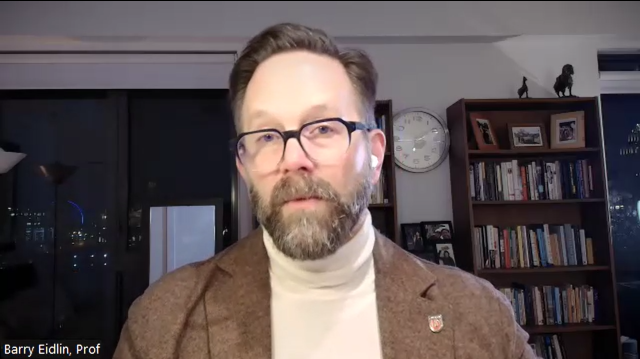
“The old system where companies hired young people and trained them for long careers has largely disappeared,” the professor Quebec-based McGill University told AJP in a recent Zoom interview.
“Today, graduates are expected to arrive with experience — but you need a job to get experience, and experience to get a job.”
Collapse of the school-to-work bridge
For much of the postwar period, large firms in advanced economies operated internal labor markets, recruiting young workers and investing in their long-term development.
That model has steadily eroded over the past four decades, leaving graduates to navigate fragmented, experience-driven labor markets on their own.
As a result, Eidlin said, youth unemployment should not be framed as a failure of individual effort or ambition.
“I try to get through to my students that it’s not about them,” he said. “It’s about broader macroeconomic and social trends that are largely beyond their control.”
AI accelerates polarization
Artificial intelligence has intensified these pressures, particularly for degree holders seeking entry-level or mid-skill office jobs — roles increasingly exposed to automation and outsourcing.
According to the U.S. Bureau of Labor Statistics (BLS), as of Sept. 2025, individuals with a four-year college degree accounted for 25 percent of all unemployed people in the United States, marking an all-time high. This is the first time since the related data began to be compiled in 1992.
The phenomenon is graver in Korea. According to the Ministry of Data and Statistics (MODS), the proportion of unemployed persons with a university degree or higher rose from 37.7 percent in 2010 to 47.8 percent in 2024, and further climbed to 49.6 percent in the first through third quarters of 2025.

While skepticism toward higher education has grown in the United States and Canada as graduate unemployment rises, Eidlin cautioned against interpreting the trend as evidence that college no longer pays off.
“In terms of lifetime earnings, people with college degrees on average are still making quite a bit more,” he said. “But unemployment rates have to do with shifts within the structure of the labor market.”
Job growth, he noted, is increasingly concentrated at the lower end of the wage and education spectrum.
“You look at where the growth is in the job market and it is toward the bottom of the wage and education distribution,” Eidlin said. “Growth is in things like home-health aides and service work of various types, because a lot of this work cannot get automated.”
By contrast, many mid-level jobs traditionally associated with higher education are precisely those most vulnerable to technological substitution.
“A lot of jobs that require some degree of education are easier to automate or outsource,” he said.
Jobs disappearing — and jobs not yet imagined
Eidlin rejected alarmist narratives predicting a jobless future driven by artificial intelligence, arguing that history shows technological change reshapes work rather than eliminates it.

Those new roles, he added, are difficult to foresee precisely because they do not yet exist.
“They’re hard to imagine,” he said. “That’s always been the case with major technological shifts.”
Care work as the blind spot
One area where labor demand is already overwhelming supply — and unlikely to be solved by machines — is social and care work, particularly as populations age across industrialized societies.
“There are all kinds of socially necessary work that doesn’t get done because it’s not profitable,” Eidlin said. “Care work requires a lot of human labor, and it’s not something that can be automated.”
Korea, facing one of the world’s fastest demographic declines, exemplifies the challenge.
According to the 2025 Senior Statistics released by the Ministry of Data and Statistics on Sept. 29, 2025, the population aged 65 and older in South Korea reached 10.514 million, surpassing the 20 percent threshold for the first time and falling under UN-classified superaged society.

Demand for elder care and childcare continues to rise, yet supply remains constrained, and costs remain prohibitive for many families.
“There’s a crying need for more care workers and more childcare for young families,” Eidlin said. “That need is going unmet because when these services exist, they are incredibly expensive.”
Eidlin argued that this gap presents a rare opportunity for governments to address both unemployment and welfare challenges simultaneously.
“It creates a really perfect opportunity to address the unemployment problem while fulfilling socially important tasks and taking care of the broader population,” he said.
Public investment in care work and job programs, he added, could absorb displaced workers while meeting urgent social needs that markets fail to provide.
Political risks of stalled opportunity
Beyond the labor market, Eidlin warned that prolonged insecurity among young people carries political risks. Degrading job quality, stagnant wages and weak representation have fueled labor unrest across regions, including Korea, North America, Europe and Latin America.
“We’ve seen some of the biggest strike waves in decades,” he said.
Yet economic frustration has not consistently translated into progressive political outcomes.
According to Eidlin, the erosion of traditional labor-based political movements has left space for other forces to shape the narrative.
“When there isn’t a strong left alternative, the political field opens up for narratives that shift blame,” he said. “It becomes ‘not the bosses, but immigrants,’ or ‘women entering the labor force,’ or ‘competition from other countries.’”
Such dynamics, he said, have helped fuel the rise of far-right movements in many societies.
For students and recent graduates navigating an increasingly uncertain labor market, Eidlin cautioned against advice that focuses solely on individual adaptation.
“I think our expectations are actually too low,” he said. “Political and business elites have told people not to expect much and to be grateful for what they get.”
The challenges young people face, he emphasized, are collective rather than personal.
“The problems you are trying to solve are not individual problems,” Eidlin said. “They are social problems, and they can only be addressed collectively.”
Copyright ⓒ Aju Press All rights reserved.
