

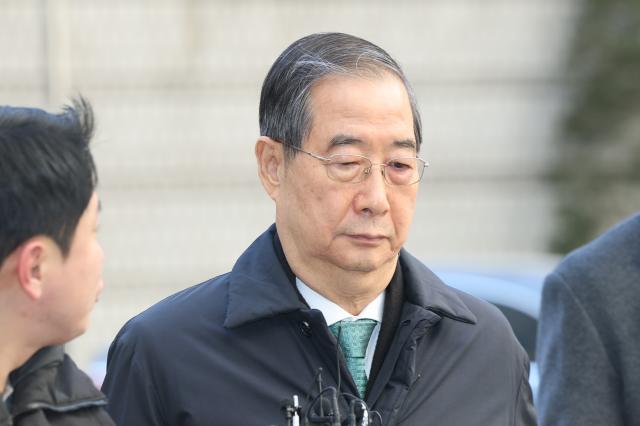
The sentencing of former South Korean Prime Minister Han Duck-soo to 23 years in prison marks more than the end of an individual career. It represents a moment of moral reckoning for a democracy confident enough to judge its own power at its peak.
The court’s ruling did not merely describe the December 3 emergency decree as unconstitutional. It called it what it was: a “coup from above,” a form of insurrection carried out not by rebels on the margins but by those entrusted with the state itself.
The phrase matters. History teaches us that democracies rarely fall from outside pressure alone; they are more often weakened when those in power convince themselves that necessity excuses lawlessness.
What made this case exceptional was not the duration of the emergency rule—it lasted only hours—nor the absence of casualties. Rather, it was the context.
South Korea today is not the fragile republic of the late 20th century. It is a consolidated democracy, a member of the global economic elite, and a nation whose citizens have repeatedly demonstrated civic courage. In such a country, the court argued, an abuse of constitutional authority carries greater, not lesser, weight.
This reasoning reflects a principle often misunderstood outside democratic societies: the stronger the system, the heavier the responsibility borne by those who lead it.
In authoritarian states, power is expected to override law. In democracies, power exists precisely because law restrains it. To violate that restraint is to strike at the foundation itself.
The ruling also delivered a quieter, more unsettling message. Han Duck-soo was not a demagogue or a political firebrand. He was widely regarded as a stabilizer—a career technocrat shaped by nearly five decades of public service. That is precisely why his fall resonates. Experience, the court made clear, is not a shield. Longevity in office does not dilute accountability; it intensifies it.
There is an undeniable tragedy here. According to testimony, senior officials urged restraint, warning that decades of public service should not end in disgrace. Those warnings went unheeded. What followed was not merely a legal violation but a moral failure: the choice to obey political momentum rather than constitutional duty.
Yet the broader significance of the verdict lies beyond personal regret. By rejecting arguments of “symbolic,” “preventive,” or “warning” emergency powers—terms with no grounding in constitutional law—the court reaffirmed a central democratic truth: extraordinary authority cannot be improvised. In a democracy, there are no informal shortcuts around the constitution, no rhetorical devices that transform illegality into prudence.
Equally important was the court’s recognition of the public. The absence of violence, it noted, was not evidence of restraint by those who ordered the emergency measures. It was the result of citizens who resisted peacefully, lawmakers who acted decisively, and soldiers and police officers who quietly refused unlawful commands. Democracy, in this telling, was preserved not by power, but by conscience.
For South Korea, the sentence will reverberate far beyond this case. It establishes a precedent that future leaders cannot ignore: that even failed attempts to subvert constitutional order will be judged by their intent, not their outcome.
This is how democracies protect themselves—not by assuming virtue in leadership, but by institutionalizing skepticism toward it.
The lesson is neither vengeful nor triumphalist. It is sober. Democracies do not mature by avoiding crisis, but by confronting it within the rule of law. Painful accountability is not a sign of weakness; it is evidence of strength.
In the end, the court’s message was unmistakable. In an advanced democracy, betrayal of constitutional order is not a historical echo—it is an immediate danger. And the price of that betrayal must be high enough to ensure it is never mistaken for an option again.
South Korea has chosen to remember that lesson. Other democracies would do well to take note.
Copyright ⓒ Aju Press All rights reserved.
