

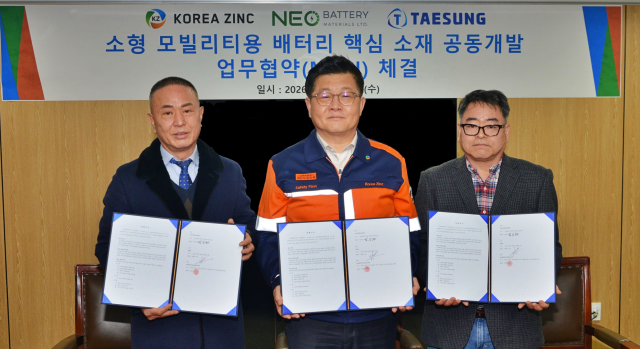
The company said Tuesday it signed a memorandum of understanding with the two firms on Jan. 28 at its Onsan smelter to develop high-performance battery technology using composite copper foil for drones and robots.
Attendees included Korea Zinc Onsan smelter chief Kim Seung Hyun and R&D center chief Choi Heon Sik, Taesung CEO Kim Jong Hak, and Neo Battery Materials Korea Vice President Jeong Jun Sik.
Compared with conventional copper foil made only of copper, composite copper foil uses less copper and has a polymer core, which the companies said improves price competitiveness. They also said it is lighter while maintaining high density and offers safety advantages.
Korea Zinc said commercialization still requires stable yields and a mass-production system. Under the MOU, the three companies will work across the full process, from materials development and manufacturing to feasibility checks and demonstrations.
Planned steps include optimizing and verifying material performance; evaluating and improving processes for battery cells and stacks using the foil; making small battery prototypes; and producing and testing prototypes of small mobility devices such as drones and robots.
The companies aim to build capabilities to compete in the composite copper foil market. Wise Guy Reports forecasts the global market will grow about 1.5 times, to US$10.18 billion in 2032 from US$6.88 billion in 2023.
A Korea Zinc official said that if the partners successfully demonstrate prototypes of small mobility devices such as drones using composite copper foil by the end of this year, it would be the first such case among South Korean companies. The official said the effort would help diversify the company’s battery materials portfolio and secure technology to respond to market changes.
* This article has been translated by AI.
Copyright ⓒ Aju Press All rights reserved.