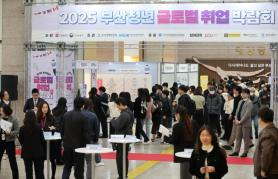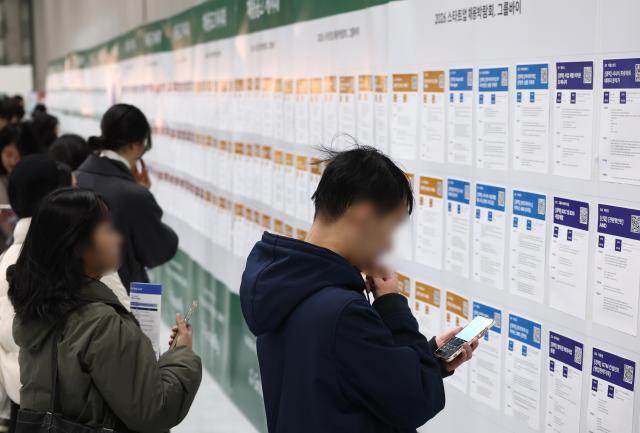
SEOUL, Feb. 11 (AJP) – South Korea’s youth employment remains in the doldrums for a second straight year, and fresh losses in science, technology, law and accounting services suggest the country’s rapid embrace of artificial intelligence is steadily worsening job prospects for college graduates.
January job data indicate that hiring is slowing just as companies accelerate automation, raising concerns that AI is quietly narrowing access to stable, long-term employment for young workers.
According to January job data released Wednesday by the Ministry of Data and Statistics, net payroll growth slowed to 108,000 jobs, the smallest increase in 13 months.
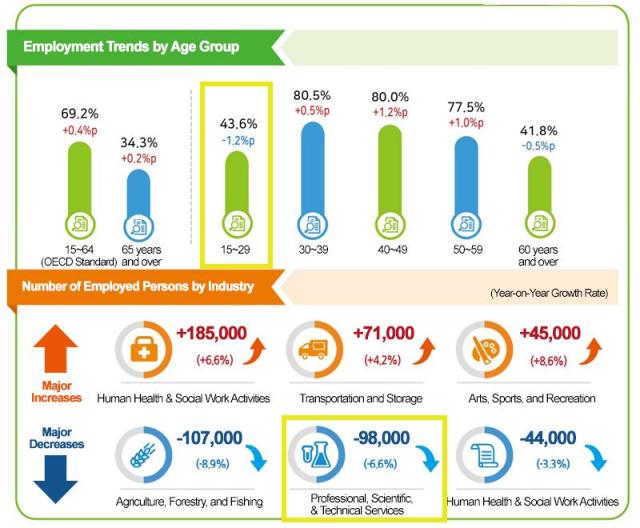
The youth employment rate for those aged 15 to 29 fell 1.2 percentage points to 43.6 percent, marking its 21st consecutive month of decline.
Weak job creation is hardly new. What stands out is where new losses stemmed from.
Employment in professional, scientific and technical services fell by 98,000 in January, a 6.6 percent year-on-year plunge – the steepest decline since the category was created in 2013.
The sector includes legal affairs, accounting, consulting, marketing, research and development, and quality control, fields that typically require undergraduate or higher degrees and regarded as resilient to economic downturns and technological disruption.
Even in April 2020, when the COVID-19 pandemic wiped out more than 470,000 jobs nationwide, employment in this category rose by 19,000.
That buffer is shaken.
After rebounding in 2022, growth in the professional sector slowed sharply in 2023 and weakened further in 2024 and 2025. Over the same period, youth employment fell by more than 210,000, reversing the brief post-pandemic recovery.
AI hits juniors first
Economists increasingly point to AI as the main driver behind the shift.
A report by the Bank of Korea released last October found that 208,000 of the 211,000 youth jobs lost over the past three years were in occupations with high exposure to automation.
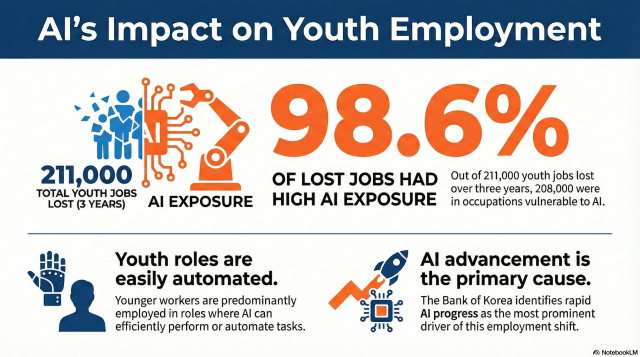
Younger workers are heavily concentrated in routine-intensive tasks such as document review, data processing, basic research, internal reporting and customer support – areas where AI systems are rapidly replacing human labor.
“These are precisely the functions companies are automating first,” said a Seoul-based labor economist.
“It is the junior layer of professional work that is being hollowed out.”
A study by the Thomson Reuters Institute shows that many practitioners in law and accounting expect AI to reduce long-term staffing needs.
A November survey by the Organization for Economic Cooperation and Development found that 14 percent of small and medium-sized firms in seven countries, including Korea, now handle marketing, research and public relations internally using AI tools.
Global shift reaches Korea
Major global firms have already begun adjusting their workforces.
International law firm Baker McKenzie has restructured about 10 percent of its back-office staff in parts of Europe, while U.S. software company Salesforce laid off roughly 4,000 customer-support workers last year.
In South Korea, strict labor protections have limited large-scale layoffs. Instead, companies are responding by freezing recruitment and trimming entry-level hiring.
“We have not hired anyone since early last year,” said an executive at a Seoul-based IT services startup, speaking on condition of anonymity. “Basic work is now handled by AI systems. There is simply less need for junior staff.”
Industry insiders say this quiet pullback in hiring is having a bigger long-term impact than visible job cuts, especially for new graduates trying to enter competitive fields.
‘AI-washing’ or structural change?
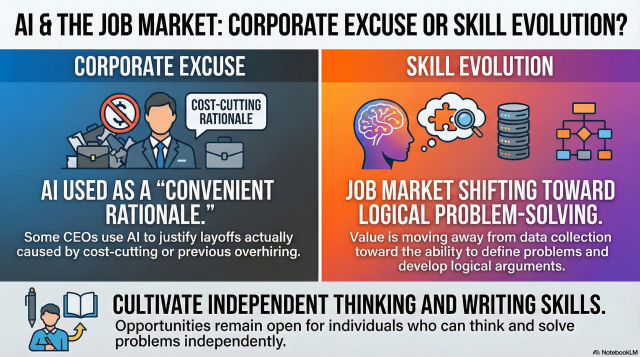
Some analysts caution that AI is sometimes used as a convenient justification for cost-cutting.
“Some executives cite AI as a rationale for downsizing that is actually driven by overhiring or margin pressure,” said Fabian Stephany, a researcher affiliated with the Oxford Internet Institute.
In such cases, “AI” becomes a branding tool for traditional restructuring, rather than the real cause of job losses.
Others argue that a deeper transformation is under way.
“This is not simply about fewer jobs,” said Yoon Seok-bin, a professor at Sogang University’s Graduate School of AI and Software.
“It is about different jobs. Demand is shifting toward people who can define problems, structure arguments and create value, rather than those who only process information,” he said.

Copyright ⓒ Aju Press All rights reserved.