


South Korea won its first Olympic gold medal in a snow event, but many viewers in the country could not watch the decisive run because JTBC aired it on a cable sports channel rather than its main network.
Choi Ga-on won the women’s halfpipe at the 2026 Milan-Cortina Winter Olympics at Livigno Snow Park, scoring 90.25 on her third run to take gold. The result drew added attention because she beat Chloe Kim, her idol, who scored 88.00 while seeking a third straight Olympic gold.
The gold-medal moment was shown on JTBC Golf & Sports, not JTBC’s main channel. JTBC carried Choi’s first final run live, then switched to short track speedskating airing at the same time.
Choi had crashed hard on her first run, catching the lip of the slope on her landing after the second jump, raising fears of a serious injury and making her medal chances appear slim. Short track is one of South Korea’s strongest Olympic sports, and that day Lim Jong-eon won bronze in the men’s 1,000 meters. It was also the day Choi Min-jeong, described as a “queen,” competed in the women’s 500 meters. With JTBC having paid heavily for broadcast rights, the network appeared to prioritize events with expected medal chances.
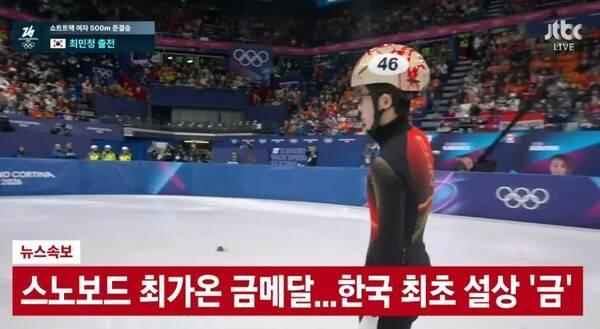
Online, viewers voiced disappointment that the main broadcast carried only a “breaking news” caption about Choi’s gold. Many who stayed with the main channel focused on short track and were left wondering how Choi recovered from her first-run fall to win.
Some critics called it a downside of exclusive broadcast deals. JTBC holds exclusive rights to the 2026-2032 Summer and Winter Olympics and the 2026-2030 World Cup. Viewers without paid cable TV or internet TV subscriptions may have limited access to events.
The debate is expected to continue, with arguments over viewers’ access versus the winner-take-all nature of major rights deals. Critics say exclusive broadcasts have reduced public interest in mega sports events, while supporters say exclusivity is the point of paying for the rights.
The government is also weighing a response. Kim Jong-cheol, chair of the Korea Communications Commission, told a National Assembly briefing on Feb. 10 that under current law there is very limited legal basis to force negotiations over broadcast rights between networks, and that the government is preparing legal revisions to address the issue. Attention is now on what measures may follow and how JTBC will respond.
* This article has been translated by AI.
Copyright ⓒ Aju Press All rights reserved.