

AI-powered robots are expected to reshape manufacturing and boost efficiency across industrial processes, and analysts say the auto industry is especially well positioned to scale the technology.
The report said advanced control and driving technologies already used in vehicles could be combined with robotics, expanding business opportunities across many areas of human mobility and helping build a next-generation mobility ecosystem.
But it said commercialization will require progress on cutting costs, improving productivity, building data sets and addressing ethical concerns.
On Feb. 18, the Export-Import Bank of Korea’s Overseas Economic Research Institute released a report titled “The auto industry’s entry into AI robotics and risk factors.”
It forecast the global AI robotics market will grow 46% annually through 2034 to $375.9 billion (544 trillion won).
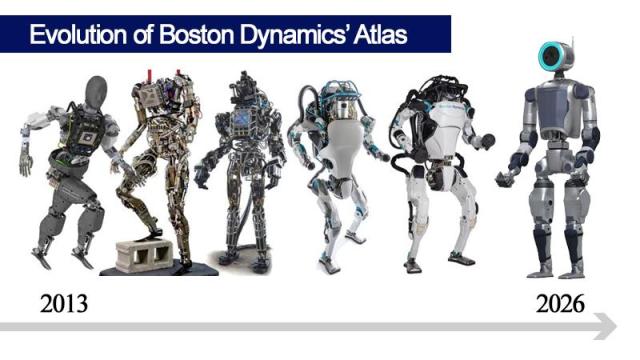
The institute said automakers including Hyundai Motor and Tesla are currently driving the market. It said Hyundai’s Atlas is being advanced for use in industrial sites, focusing on manufacturing processes, while Tesla’s Optimus aims to secure leadership through development of general-purpose AI robotics.
Tesla plans to integrate its own algorithms into robot systems and gradually deploy intelligent control systems in factories so robots can perceive and make decisions, the report said. It said Tesla is training Optimus on real-time driving data and pursuing a strategy to capture labor-replacement markets through mass production. Optimus units deployed at Tesla plants are being used in practical tasks such as moving battery cells to improve autonomous decision-making, it said.
The report said Hyundai’s open-API strategy is designed as a platform that allows broad participation by partners. It said an end-to-end value chain could help Hyundai secure real-world data based on its own demand and build a vertically integrated data structure, giving it strong potential to lead its own intelligent mobility market. The report defined an end-to-end value chain as a supply chain that integrates and manages the entire process of delivering products and services to customers.
Hyundai plans to invest 50.5 trillion won in AI robotics by 2030, exceeding Tesla’s AI investment of 13.5 trillion won, the report said. It added Hyundai is building a robot-dedicated plant in the United States with annual capacity of 30,000 units.
The institute estimated the price of Hyundai’s Atlas at $130,000 and projected the investment could be recovered within two years after adoption. It said deploying Atlas in production sites could raise productivity by up to threefold by improving assembly efficiency.
“Hyundai is internalizing AI robotics control technology through its acquisition of Atlas (Boston Dynamics) technology, and is pushing a practical strategy that applies its capabilities on site to move beyond simple mechanical movement and shift manufacturing toward unmanned operations,” the report said. “High-performance AI robotics will play a key role in that process.”
The report also cited hurdles. It said Hyundai has gained flexibility through its open-API strategy to adopt a vision-language-action (VLA) model with language-based reasoning, but the total volume of real-time data being accumulated is not sufficient, limiting the speed of AI self-learning.
Other challenges include malfunction risks in complex situations, building data for unexpected events, delays in generating profits due to technical constraints, and defining the operating scope of AI robots that can collaborate with humans, it said.
“AI robotics has limited ability to respond to situations outside specific scenarios, and high upfront investment costs are a major burden on short-term profitability,” the report said. “In addition, because responsibility for AI robotics working with humans is not clearly established, legal disputes between manufacturers and operators and difficulties in compensation systems are also expected in the event of accidents.”
* This article has been translated by AI.
Copyright ⓒ Aju Press All rights reserved.