

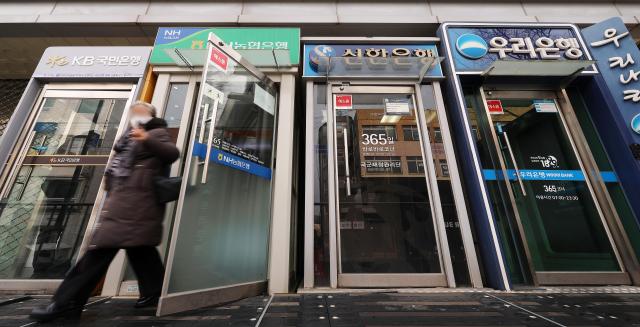
Minimum interest rates on credit loans at major South Korean commercial banks have climbed back above 4% for the first time in 14 months, adding pressure on borrowers who have relied on debt to invest or buy homes.
According to the financial sector on Tuesday, credit-loan rates at the four biggest commercial banks — KB Kookmin, Shinhan, Hana and Woori — stood at 4.010% to 5.380% as of Feb. 13 for top-tier borrowers with one-year maturities.
The lower end of the range, which had stayed in the 3% range since December 2024, returned to the 4% range after 14 months. Compared with Jan. 16, the lower end rose 0.260 percentage points and the upper end gained 0.150 points.
The move was attributed to faster increases in short-term bank bond yields, which are used as benchmarks for credit loans. As of Feb. 13, the five-year bank bond yield — a key reference for fixed-rate mortgages — rose 0.107 percentage points from the previous month, while the one-year bank bond yield, a major benchmark for credit loans, climbed 0.158 points.
With mortgage rates already elevated, the rise in credit-loan rates could further increase repayment burdens, the report warned. Even if tighter rules cool mortgage lending, a pickup in unsecured credit could become a new trigger for household debt growth.
Minimum mortgage rates moved into the 4% range late last year and have continued to rise. As of Feb. 13, mixed-rate mortgages at the four banks were 4.360% to 6.437%, with the lower and upper ends up 0.230 and 0.140 percentage points, respectively. Adjustable-rate mortgages that reset annually were 3.830% to 5.731%, with both ends up about 0.1 point.
Borrowers using overdraft-style credit lines, known as “minus accounts,” are expected to feel the impact more sharply. These products have a much higher share of floating rates than standard credit loans, and customers repeatedly borrow and repay within their limits. With rate cuts seen as unlikely in the near term, borrowers’ interest costs are expected to rise further.
Credit lending has also been increasing recently amid demand for investment funds, including for stocks. As of Feb. 12, outstanding credit loans at the five major banks — KB, Shinhan, Hana, Woori and NH NongHyup — totaled 104.8405 trillion won, up 95 billion won from the previous month. Overdraft balances hit a roughly three-year high of 40.0837 trillion won at the end of November, eased to the 39.7 trillion won range at the end of December and in January, then rebounded to the 39.8 trillion won range this month.
A financial industry official said credit loans typically decline early in the year as bonuses are paid, but this year some demand appears tied to investment amid a strong stock market, including the KOSPI’s move above 5,000. “If credit lending rises while rates are increasing, borrowers’ interest burdens could grow if the market corrects or rates climb further,” the official said.
* This article has been translated by AI.
Copyright ⓒ Aju Press All rights reserved.