

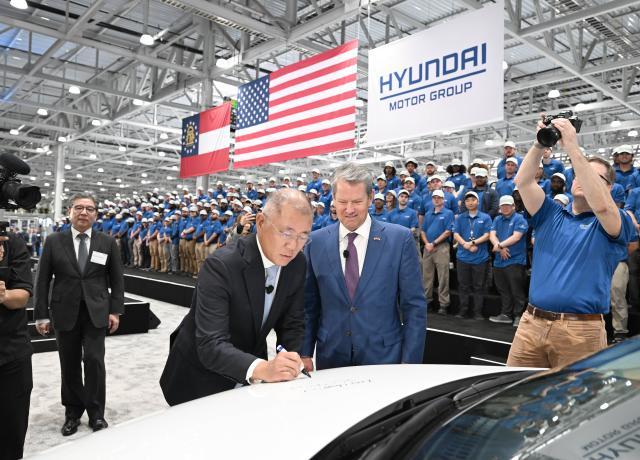
Industry officials said Feb. 19 that Hyundai is developing autonomous driving on two tracks rather than merging everything into a single architecture. It is pursuing a certification-friendly modular approach through Motional, prioritizing safety validation and regulatory approvals, while also developing a more general end-to-end (E2E) approach through 42dot.
Motional, which is building the modular system, aims to commercialize a Level 4 driverless robotaxi service in Las Vegas later this year, signaling commercial operations for the general public in a real urban environment. Motional is currently running test operations based on Hyundai’s Ioniq 5 robotaxi.
At a media briefing in Las Vegas last month, Motional CEO Laura Major said, “Given that the market is still in its early stages, I don’t think there is any company that has a cost-efficient Level 4 autonomous driving system yet,” adding, “Motional wants to focus not only on a safe driving experience but also on developing a profitable business model.”
Hyundai’s robotaxi push is the other pillar of its physical AI strategy alongside humanoid robots. The group sees Atlas’ data from physical work environments and robotaxi driving data from city roads as inputs that can help AI understand and adapt to the real world. Hyundai plans to use its hardware-software integration capabilities to expand practical uses of physical AI more quickly.
Hyundai also plans to build a domestic physical AI ecosystem, including AI data centers, to strengthen future technologies such as in-vehicle AI, autonomous driving, manufacturing efficiency and robotics.
To that end, it is stepping up collaboration with global AI companies. Hyundai has been pursuing cooperation with Waymo, Alphabet’s autonomous driving unit, to adopt the Ioniq 5 as an autonomous vehicle platform. Boston Dynamics has also signed a strategic partnership with Google’s AI research organization DeepMind to accelerate development of future humanoid technologies.
At CES 2026 in Las Vegas last month, Hyundai Motor Group Executive Chairman Chung Euisun drew attention when he met again with Nvidia CEO Jensen Huang, a reunion that became a talking point in the industry. Some in the industry have speculated Hyundai could adopt Nvidia’s autonomous vehicle platform, “Alpamayo.”
Hyundai also plans to expand cooperation among its Advanced Vehicle Platform (AVP) division, 42dot and Motional to speed development. It is reviewing ways to combine Level 4 operational know-how and safety validation systems accumulated through the Las Vegas robotaxi rollout with 42dot’s roadmap to advance software-defined vehicles (SDVs).
An industry official said Park Min-woo, a president recruited from Nvidia who runs both AVP and 42dot, is expected to move quickly on upgrading 42dot’s autonomous driving technology, Atria AI, and deciding whether to use Nvidia’s Alpamayo.
Separately, Chung visited 42dot’s Pangyo headquarters late last year to review Atria AI, a Level 2+ E2E autonomous driving system based on the Ioniq 6, and stressed that “safety and completeness must come first to secure global competitiveness.”
* This article has been translated by AI.
Copyright ⓒ Aju Press All rights reserved.